
You just checked your credit score, and something looks off. Maybe your bank app shows one number, but a card issuer’s decision letter shows another. You spot the words “FICO Bankcard Score” next to a figure like 742 or 810, and you have no idea if that’s good, bad, or even the same thing as the score you’ve been tracking for years. The confusion gets worse when the range doesn’t match what you thought you knew.
A FICO Bankcard Score is a unique credit score. It shows how likely you are to be 90 days late on a credit card. This score ranges from 250 to 900, unlike the usual 300 to 850.
Below, you’ll get a full breakdown of every version, how it stacks up against your regular score, which cards pull which version, and how to check yours for free.
Key Takeaways
This guide explains what a FICO Bankcard Score is, including its 250 to 900 range, how it differs from a regular FICO Score, which version card issuers use most, and how to check it for free.
Core Facts:
- A FICO Bankcard Score ranges from 250 to 900, compared to the standard FICO Score range of 300 to 850, a 50-point wider span on each end.
- The score predicts the likelihood that a borrower will be 90 or more days late on a credit card payment within the next 24 months.
- FICO Bankcard Score 8 is the version most card issuers currently use, while older versions 2, 3, 4, and 5 are tied to specific credit bureaus and legacy underwriting systems.
- FICO Bankcard Score 9 changes how paid collections and medical debt are weighted and can factor in positive rent payment history.
- Card issuers use the score to decide credit card approval, credit limit amount, and the interest rate (APR) offered to the applicant.
- The same Bankcard Score version can produce different numbers across Experian, Equifax, and TransUnion because each bureau holds different account data.
Best for:
- Readers who see a FICO Bankcard Score for the first time and want to understand why it differs from their regular FICO Score.
- People preparing to apply for a new credit card who want to know which score version the issuer is likely to check.
- Anyone comparing FICO Bankcard Score versions (such as 2, 8, or 9) to understand which one applies to their situation.
What Is a FICO Bankcard Score?
A FICO Bankcard Score is a credit score built by FICO for one job only: to help credit card companies decide how risky it is to lend you money on a card. The industry calls it an industry-specific score. That means it’s not the same all-purpose score a mortgage lender or auto lender might pull. It’s tuned just for revolving credit behavior.
The regular FICO Score looks at your total credit picture. It weighs your mortgage, car loan, student loans, and credit cards all together. The Bankcard Score does something different. It zooms in on how you handle credit cards specifically. It puts extra weight on your card payment history, your card balances, and how close you get to your card limits.
The score’s job is to answer one question for the card issuer. How likely are you to be 90 or more days late on a credit card in the next 24 months? A higher number means you’re less risky. A lower number means the issuer might charge you a higher rate, give you a smaller limit, or turn down your application.
Fair Isaac Corporation, better known as FICO, first built these industry scores to give lenders sharper tools. A person who pays their mortgage on time but juggles maxed-out credit cards may look fine on a regular score. But that same person looks riskier on a Bankcard Score, because the model is trained to spot card-specific trouble.
FICO Bankcard Score Range Explained
Here’s where most people get thrown off. The regular FICO Score runs from 300 to 850. But the FICO Bankcard Score runs from 250 to 900. That’s a 50-point wider range on both ends.
So if you see a Bankcard Score of 780, don’t panic. That’s not the same as an 850 ceiling. On a 900 scale, 780 sits lower in the range than it would on an 850 scale. But 780 is still a strong score.
Here’s a simple way to think about the range shift:
| Score Type | Minimum | Maximum | Total Range |
|---|---|---|---|
| Regular FICO Score | 300 | 850 | 550 points |
| FICO Bankcard Score | 250 | 900 | 650 points |
The wider range gives card issuers more room to sort people. Two people with the same 800 on the regular scale might score 30 to 40 points apart on the Bankcard scale. This happens because the model detects smaller differences in card behavior.
To translate your number, use this quick anchor. If your regular FICO is in the “very good” band (740 to 799), your Bankcard Score will often land somewhere between 760 and 830. It’s not a straight conversion, but it gives you a rough map.
📌 Did You Know: Only the industry-specific FICO scores (Bankcard and Auto) use the 250 to 900 range. Every other consumer FICO Score, including the base FICO 8 and FICO 10, uses the standard 300 to 850 scale.
FICO Bankcard Score vs. Regular FICO Score
The main difference is focus. A regular FICO Score is a general-purpose score. It’s built to predict how likely you are to miss a payment on any type of credit account. A Bankcard Score is a card-specific score. It only cares about how you’ll handle credit cards.
That focus changes how the model weighs your data. On a regular score, a late car payment and a late credit card payment hurt you in similar ways. On a Bankcard Score, that late credit card payment hits harder. The model reads it as a direct warning sign for card default.
The same rule applies to positive behavior. Paying down a credit card balance can boost your Bankcard Score more than paying down a personal loan by the same amount. The score is watching your revolving accounts closely.
This is why the two numbers rarely match. It’s normal for your Bankcard Score to be 20, 40, or even 60 points different from your regular FICO. Neither is wrong. They’re just answering different questions.
Card issuers pull the Bankcard version because it’s a sharper tool for their job. Mortgage lenders stick with older base FICO versions (like FICO 2, 4, and 5) because those are the versions Fannie Mae and Freddie Mac still require.
Why There Are Multiple FICO Bankcard Score Versions
FICO doesn’t just release one Bankcard Score and call it done. They release new versions every few years, the same way software companies release updates. Each new version tweaks the formula based on fresh data about how borrowers actually behave.
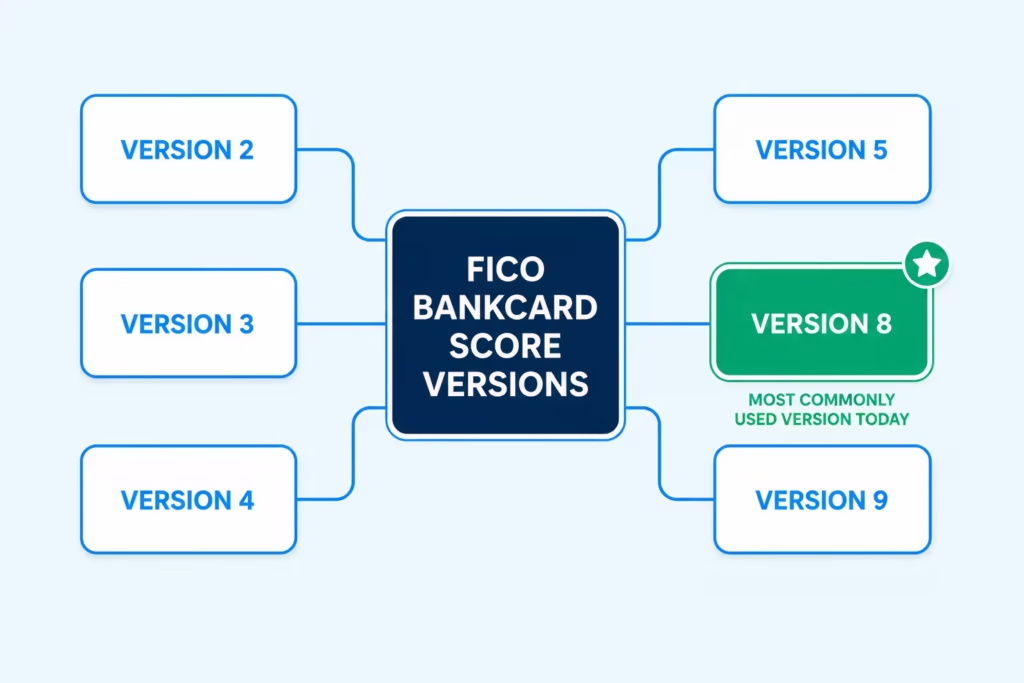
But here’s the twist. Lenders don’t all upgrade at the same time. Some card issuers still use older versions. Their systems are built around them. They’ve tested these versions with their own default data and trust them.
So on any given day, your credit report could show six or more different Bankcard Score numbers, all valid, all pulled from the same file. Here’s what each generation does.
FICO Bankcard Score 2
This version is tied to Experian data. It’s an older model, first released in the mid-1990s and updated over time. Some card issuers, especially those with legacy underwriting systems, still pull this version. It focuses a lot on classic factors, such as payment history and utilization. However, it struggles with newer credit patterns, like authorized user accounts, compared to newer versions.
FICO Bankcard Score 3
FICO Bankcard Score 3 is used less often now, and mostly by lenders whose systems date back to the same era as Score 2. It shares much of the same core logic but was tuned with a slightly different data set. If you see this version on a report, it’s usually from a smaller or regional card issuer.
FICO Bankcard Score 4
This version runs on TransUnion data. It’s the TransUnion counterpart to Score 2 in terms of age and design. Some card issuers pull this version when they order a TransUnion credit file for their approval decision.
FICO Bankcard Score 5
Score 5 uses Equifax data. It’s the third leg of the older-generation trio, sitting alongside Score 2 (Experian) and Score 4 (TransUnion). Together, these three older versions still get pulled by many major card issuers today, even though newer versions exist.
FICO Bankcard Score 8
This is the version most card issuers use today. It’s more forgiving of a single isolated late payment, especially if the rest of your file looks strong. It’s also stricter on high utilization, so carrying a big balance on one card can hurt your score more here than on older versions. Score 8 is available across all three credit bureaus (Experian, Equifax, and TransUnion), and each bureau’s version uses its own data.
FICO Bankcard Score 9
The newest widely used version. It changes how medical collections are handled. Paid collections are ignored, and unpaid medical collections carry less weight than other types of collections. It also gives some credit to positive rent payment history, if that data is on your file. Adoption is growing but slower than Score 8.
FICO Bankcard Score 8 vs. FICO Score 8
Both numbers share the “8” label, but they’re not the same score. FICO Score 8 is the general-purpose base score. FICO Bankcard Score 8 is the card-focused industry version.
Here’s how they compare in plain terms.
| Feature | FICO Score 8 | FICO Bankcard Score 8 |
|---|---|---|
| Range | 300 to 850 | 250 to 900 |
| Focus | All credit types | Credit cards only |
| Used by | Many lenders across products | Mostly credit card issuers |
| Weight on card behavior | Standard | Heavier |
| Late payment impact | General penalty | Stronger penalty on card lates |
If Sarah, a marketing coordinator at a mid-sized tech firm, has one 60-day late payment on a store card from two years ago, her FICO Score 8 might sit at 745. Her Bankcard Score 8 could land at 720 or lower, because the card-focused model reads that missed card payment as a bigger red flag.
The reverse is also true. David, a project manager, keeps his credit card balances low each month. He also has a moderate auto loan. Because of his good card habits, his Bankcard Score 8 could be higher than his FICO Score 8. The Bankcard model values his clean credit use more.
FICO Bankcard Score 2 vs. FICO Bankcard Score 8
Score 2 is the old guard. Score 8 is the current standard for most card approvals. The two versions use different formulas, so the same credit file can produce two different numbers.
Score 8 handles utilization more harshly. If one card is nearly maxed out but the rest of your cards are low, Score 8 flags that single high card more strongly. Score 2 tends to smooth that out across your total card utilization.
Score 8 also treats isolated late payments more gently. If you have one 30-day late payment from three years ago and nothing else negative, Score 8 may forgive it faster than Score 2 would.
For most people applying for a card today, Score 8 is the version the issuer is likely pulling. But some banks still run both, and a few still use Score 2 as their main decision tool. That’s why it pays to know both exist.
What Is a FICO Bankcard Score Used For?
Card issuers use the Bankcard Score to make three main decisions.
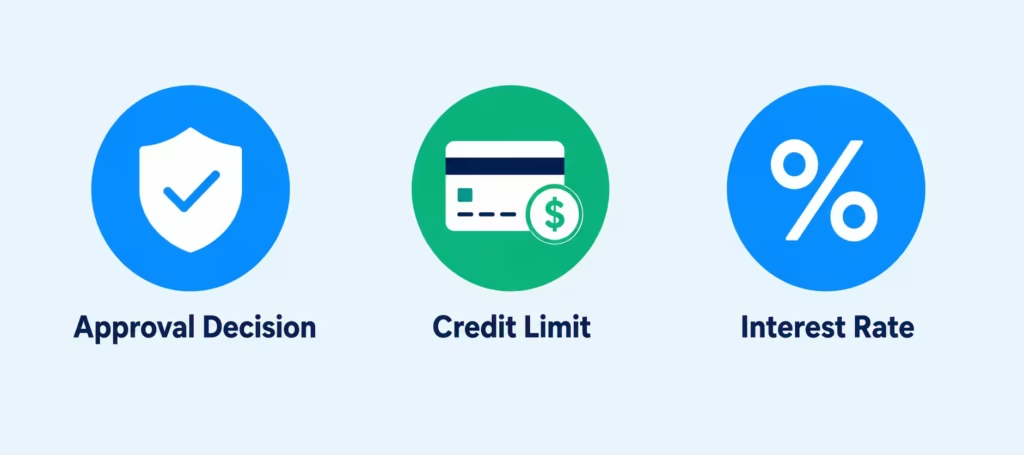
The first is approval. When you apply for a new credit card, the issuer pulls your Bankcard Score to see if you clear their risk cutoff. Each issuer sets its own threshold. A premium travel card might need 750 or higher. A starter card might approve at 620.
The second decision is your credit limit. Two people can both get approved for the same card, but the one with the higher Bankcard Score often walks away with a much bigger limit. Someone at 820 might get a $25,000 limit on a rewards card, while someone at 680 gets $2,500 on the same card.
The third decision is your interest rate, also called the APR. Cards usually list a range, like “18.99% to 28.99% variable.” Where you land in that range depends heavily on your Bankcard Score. A stronger score can save you thousands of dollars in interest over the life of a balance.
Issuers also use the score after you’re already a customer. They may re-check your Bankcard Score to decide whether to raise your limit, lower it, or offer you a balance transfer deal. This is called account management, and it happens quietly in the background.
💡 Pro Tip: Before applying for a big card, request a credit limit increase on a card you already have. A higher total credit line lowers your utilization ratio. This can boost your Bankcard Score even before the new application appears on your file.
Which Credit Cards Use FICO Bankcard Score 8
Most large U.S. card issuers use FICO Bankcard Score 8, though they don’t publish exactly which score they pull. Based on how the industry works, the following issuers rely heavily on Bankcard Score 8 for underwriting.
Chase pulls Bankcard Score 8, most often from Experian or TransUnion depending on your home state. Capital One tends to pull all three bureaus and uses the Bankcard Score across them. American Express uses Bankcard Score 8, usually from Experian.
Citi mixes Bankcard Score 8 with its own internal scoring layer. Discover leans on Bankcard Score 8 from Experian for many of its consumer cards. Bank of America and Wells Fargo both use Bankcard Score 8 in their standard approval process.
Store cards and co-branded retail cards, like those from Synchrony or Comenity, use Bankcard Score 8. They often pair this with a second score model made for retail credit.
You can’t pick which score an issuer uses. But knowing that Bankcard Score 8 is the most common gives you a clear target when you’re trying to improve your approval odds.
Why Your FICO Bankcard Score Can Differ by Credit Bureau
Even if two issuers pull the same version (Bankcard Score 8), they may get different numbers. The reason is the data source. FICO doesn’t hold your credit history. The three credit bureaus (Experian, Equifax, and TransUnion) each hold their own copy of your file.
Not every lender reports to all three bureaus. Some report to just one or two. So your Experian file might show a credit card that your Equifax file doesn’t. Your TransUnion file might list a collection account that the other two missed.
When FICO runs its Bankcard Score 8 formula on each bureau’s file, it produces three different numbers, one per bureau. The scoring math is the same. The raw data is different.
This is why checking one bureau isn’t enough. If a card issuer pulls TransUnion and your TransUnion file has an old error, you could get denied even if your Experian file is perfect.
FICO Bankcard Score 8 Based on Equifax Data
When a lender requests your FICO Bankcard Score 8 from Equifax, it uses your accounts, balances, and payment history that Equifax has. If your bank reports your credit card only to Experian and TransUnion, then Equifax won’t see it. This can change your Equifax Bankcard Score 8. It may be higher or lower.
Some large issuers, like American Express, historically favor Experian. Others, including certain regional banks in the South and Midwest, lean toward Equifax. Knowing which bureau your target issuer uses (even roughly) helps you focus on cleaning up that specific file first.
What Factors Affect Your FICO Bankcard Score
The Bankcard Score uses the same five core factors as the regular FICO Score, but it re-weights them for card behavior.
Payment history is still the single biggest factor. Missing a credit card payment hurts more here than on the general FICO. Even one 30-day late payment can knock 60 to 100 points off if your file was otherwise clean.
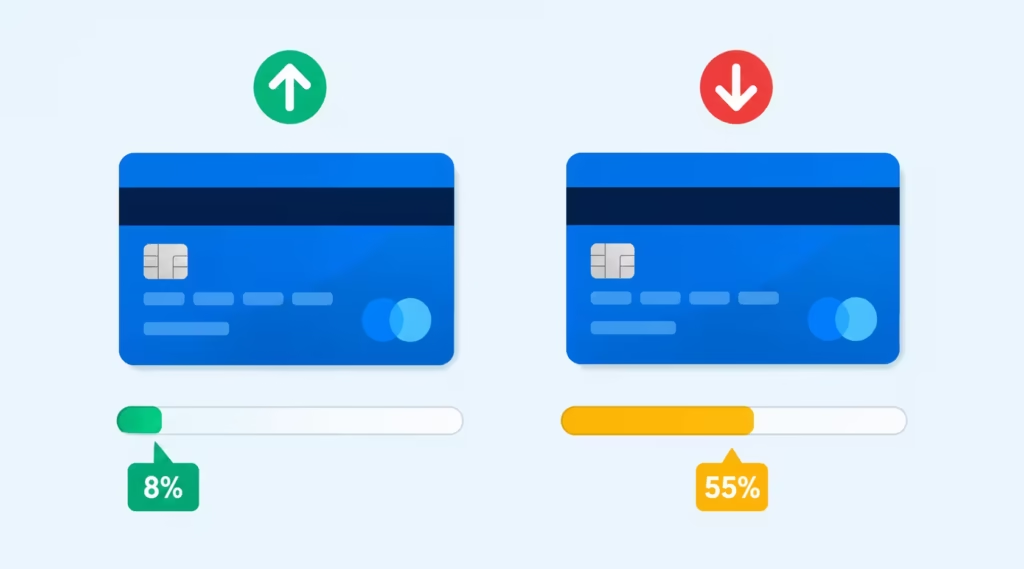
Credit utilization carries extra weight. This is the percentage of your card limits you’re using. If your total card limits add up to $20,000 and you’re carrying $6,000 in balances, your utilization is 30%. On the Bankcard Score, keeping this under 10% gives the strongest lift. Under 30% is still healthy. Above 50% starts to drag your score down fast.
Length of credit history matters, but slightly less on the Bankcard Score than on the general FICO. What the Bankcard model cares about more is the age and depth of your card accounts specifically. A 10-year-old car loan doesn’t help your Bankcard Score as much as a 5-year-old credit card would.
New credit is watched closely. Opening several new cards in a short window is a red flag on the Bankcard Score, because it can signal financial stress or an upcoming default.
Credit mix carries the least weight. The Bankcard model considers your mix of card types, like major credit cards and store cards. However, this factor usually only changes your score by a few points.
⚠️ Mistake to Avoid: Don’t close an old credit card just because you don’t use it. Closing it lowers your total credit. This spikes your utilization ratio and can drop your Bankcard Score by 20 to 40 points overnight.
How to Check Your FICO Bankcard Score for Free
Getting your Bankcard Score used to require paying for a myFICO subscription. That’s no longer true. Several free options now exist, thanks to the FICO Score Open Access program.
Many card issuers give free FICO scores to their cardholders as a monthly benefit. Discover shows a FICO Score 8 to any consumer, even non-cardholders, through the Discover Credit Scorecard. Bank of America, Citi, American Express, and Wells Fargo all display a FICO score inside their card apps for existing customers. Some of these are based on FICO 8, while others are Bankcard Score 8, depending on the issuer.
To find out which version your issuer shows, look for the small print next to the score. It usually says something like “FICO Bankcard Score 8 based on Equifax data” or “FICO Score 8 based on TransUnion data.” That small line tells you exactly which score and which bureau.
If your issuer only shows the base FICO Score, you can still estimate your Bankcard Score. Take your base score and adjust it based on your card behavior. Strong card habits (low utilization, no late card payments) mean your Bankcard Score will likely be higher. Weaker card habits (high balances, recent late card payments) mean it will likely be lower.
For a direct Bankcard Score read, myFICO offers a paid subscription that shows all versions, including Bankcard Score 2, 5, 8, and 9. It’s worth the cost only if you’re preparing for a major card application and want the exact number the issuer will see.
What Counts as a Good FICO Bankcard Score
Because the range runs to 900 instead of 850, the score bands shift a bit. Here’s a clean breakdown of what each band means for a card application.
| Bankcard Score Range | Rating | What It Means for Card Approval |
|---|---|---|
| 800 to 900 | Exceptional | Top-tier cards, best APRs, highest limits |
| 740 to 799 | Very Good | Strong approval odds on most cards |
| 670 to 739 | Good | Approval likely, mid-tier limits and rates |
| 580 to 669 | Fair | Limited card options, higher APRs |
| 250 to 579 | Poor | Secured cards or credit-builder cards only |
A score of 740 or higher is where most people should aim if they want access to premium rewards cards and the lowest APRs. Anything above 800 puts you in the strongest position for approval and top credit limits.
If your Bankcard Score is in the “good” range (670 to 739), you can still get good cards. However, you might not qualify for the best travel or cashback deals. Focus on lowering your utilization and building a longer clean payment record to move up.
Someone like Jennifer, a nurse who paid off $12,000 in card debt over 18 months, saw her Bankcard Score climb from 682 to 764 during that stretch. That single jump moved her from “good” to “very good,” and she got approved for a premium travel card that had denied her the year before.
Frequently Asked Questions (FAQs)
What is FICO Bankcard Score 9?
FICO Bankcard Score 9 is the newest widely used version, and it ignores paid collection accounts entirely. It also reduces the impact of unpaid medical debt and can factor in positive rent payment history if that data appears on your credit file.
What is FICO Bankcard Score 2?
FICO Bankcard Score 2 is an older scoring model built on Experian data, first released in the mid-1990s. It’s still used by some card issuers with legacy underwriting systems, though it handles newer credit patterns like authorized user accounts less accurately than newer versions.
How do I find out my FICO Bankcard Score 2, 4, and 5?
A myFICO paid subscription shows all Bankcard Score versions, including 2, 4, 5, 8, and 9. Some card issuer apps also display a Bankcard Score, so check the fine print next to your score for the version and bureau used.
Is FICO Bankcard Score 2 or FICO Bankcard Score 8 better?
Neither version is objectively better, but Score 8 is more commonly used today. Score 8 penalizes a single maxed-out card more heavily and forgives isolated late payments faster than Score 2, which spreads utilization impact more evenly across all cards.
How can I raise my FICO Bankcard Score?
Keep your credit card utilization under 10% for the strongest boost, and avoid missing card payments, since even one 30-day late payment can drop your score 60 to 100 points. Avoid opening several new cards in a short window.
Is a FICO score 850 or 900?
It depends on which score you’re looking at. The general-purpose base FICO Score maxes out at 850, while the industry-specific FICO Bankcard Score has a wider range that maxes out at 900.
Is a 700 FICO Bankcard Score good or bad?
A 700 FICO Bankcard Score falls in the “Good” range on the 250 to 900 scale. It typically means likely approval with mid-tier credit limits and interest rates, though it may not qualify for premium rewards cards.
Which credit cards use FICO Bankcard Score 8?
Most large U.S. issuers rely on FICO Bankcard Score 8, including Chase, Capital One, American Express, Citi, Discover, Bank of America, and Wells Fargo. Store and co-branded retail cards from issuers like Synchrony also commonly use this version.
Can I improve my FICO Bankcard Score without paying off all my debt?
Yes, lowering your utilization ratio below 10% can boost your score even with existing balances remaining. Requesting a credit limit increase on a current card also lowers your utilization ratio without requiring any debt payoff.
Wrapping Up
The FICO Bankcard Score is a tool for credit cards. It ranges from 250 to 900. This score focuses on your credit card use. There are different versions, with Bankcard Score 8 being the most common now. Different bureaus and different issuers can produce different numbers, and that’s normal.
To boost your score, keep your card utilization under 10%. Also, always make your payments on time. For most readers, using the free version from your card issuer gives you the best and cheapest view of your real status.
If you know someone who’s about to apply for a new credit card, share this guide with them. Knowing what score the issuer checks can mean instant approval or an expensive denial.