
I’ve spent years reading credit reports, and one thing still trips people up: seeing a number labeled “FICO Score 9” that doesn’t match the score they’ve been tracking for months. It’s frustrating, especially when you’re about to apply for a card, a car loan, or a new apartment. You just want to know which number actually counts.
Here’s the short answer:
FICO Score 9 is a newer, more forgiving version of your credit score, and it treats collections, medical debt, and rent very differently than older versions do.
Below, we’ll walk through exactly how it works, why your numbers may not match, and where to check your real FICO 9.
Key Takeaways
This guide explains what FICO Score 9 is, including how it differs from FICO 8, how it treats paid collections, medical debt, and rent history, and where to check your actual FICO 9 score.
Core Facts:
- FICO Score 9 launched to lenders in fall 2014 and reached consumers through myFICO in 2016, using the same 300-850 range as FICO 8.
- Paid third-party collections have zero impact on FICO 9, while the same paid collection can still lower a FICO 8 score, creating a typical swing of 30 to 60 points.
- Unpaid medical collections are weighted less heavily under FICO 9 than under FICO 8, typically producing a 10 to 40 point difference depending on the debt’s size and age.
- FICO 9 was the first FICO model to factor rent payment history into the score, but only if a landlord or rent-reporting service actually reports payments to the credit bureaus.
- FICO 8 remains the most widely used base credit model among lenders in 2026, while FICO 9 adoption has grown mainly among credit card issuers.
- Mortgage lenders typically use older Classic FICO scores (FICO 2, 4, and 5) rather than FICO 9 when a loan will be sold to Fannie Mae or Freddie Mac.
Best for:
- Readers confused about why their FICO 9 score doesn’t match a FICO 8 score pulled from the same credit file.
- People with a paid collection or medical debt on their credit report who want to understand how it’s being scored differently.
- Renters trying to determine whether their on-time rent payments are actually counting toward their credit score.
What Is FICO Score 9?
FICO Score 9 is a base credit scoring model built by the Fair Isaac Corporation, the company behind every score labeled “FICO.” Like other base FICO scores, it uses a score range of 300–850, with higher numbers signaling lower credit risk to lenders.
Think of FICO 9 as one member of a family. There isn’t just one “FICO score.” Many versions are in use today: FICO 8, FICO 9, FICO 10, and FICO 10 T. FICO 9 is in the middle of this lineup. It is more forgiving than earlier versions, especially for those with paid collections or old medical bills.
That “more forgiving” reputation is the reason so many readers land on this topic in the first place. If your score jumped when you saw FICO 9, this section explains why that can happen.
When FICO Score 9 Was Released and Why It Was Created
FICO 9 launched to lenders in the fall of 2014, then reached consumers through myFICO in 2016, according to FICO’s own announcement. It was built to be a more accurate predictor of credit risk, based on newer credit data patterns.
One big reason for its release: research showed that medical debt was a weaker signal of future credit risk than other kinds of debt. Later findings from the Consumer Financial Protection Bureau supported that same idea. FICO 9 tried to fix that with softer treatment of medical collections and paid collections.
How FICO 9 Calculates Your Score
FICO 9 uses the same five core scoring factors you may already know from other FICO models:
- Payment history (whether you pay on time)
- Amounts owed (how much of your available credit you use)
- Length of credit history (how long your accounts have been open)
- Credit mix (variety of credit types, like cards and loans)
- New credit (recent applications and new accounts)
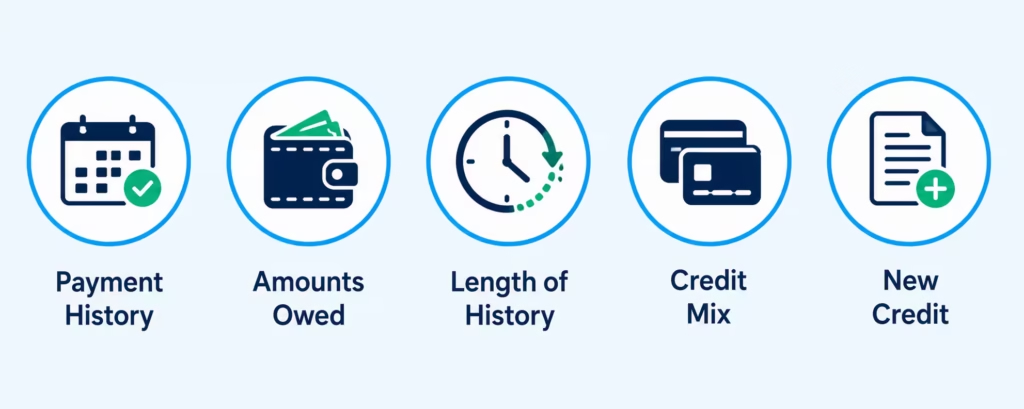
The category weights and buckets stay the same. So if you’ve studied credit before, nothing here is new at the top level.
What’s different is what happens inside those categories. FICO 9 changes how certain kinds of data get scored, especially collections, medical debt, and rent. That’s why two people with almost the same file can see very different results between FICO 8 and FICO 9. The rest of this article shows exactly where those differences come from.
FICO 9 vs. FICO 8: Key Differences
Both scores share the 300–850 scale and the same five weighted categories. Yet the numbers don’t always match.
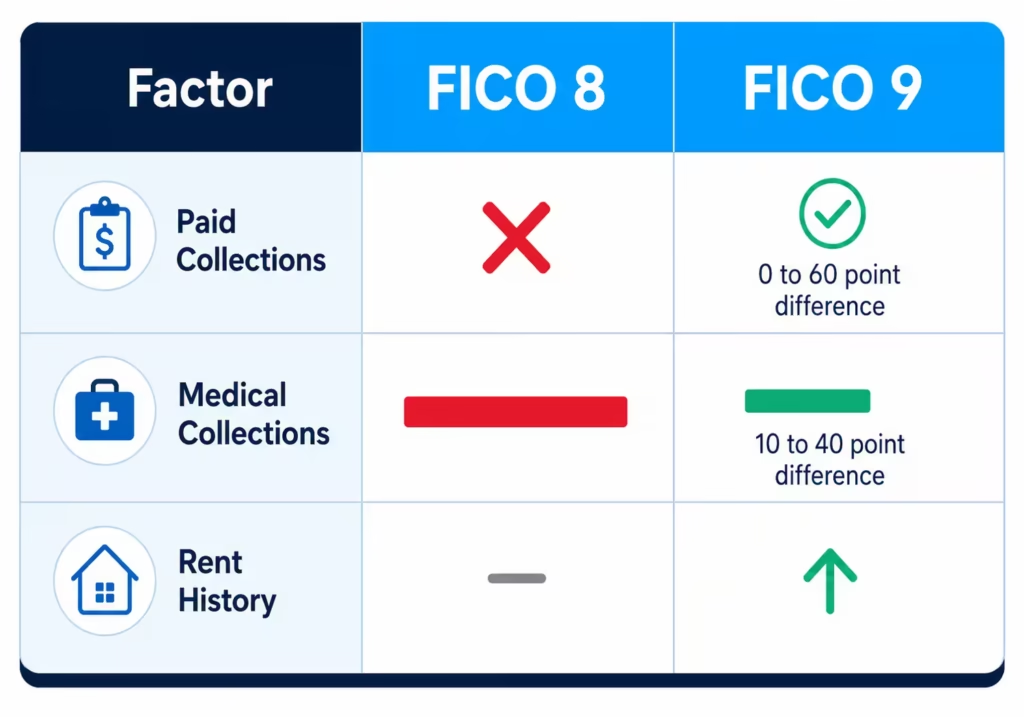
The gap comes from three specific changes in how FICO 9 handles certain accounts:
- Paid collection accounts
- Unpaid medical collections
- Rent payment history (covered later)
These changes are why some readers see a 20-, 40-, or even 60-point jump when switching from FICO 8 to FICO 9. Others may see very little change. It depends on what’s actually on your credit report.
The next three subsections break each one down.
How FICO 9 Treats Paid Collection Accounts
This is the single biggest difference between the two scores.
Paid third-party collections have zero impact on FICO Score 9, no matter the original amount. Once a collection account is marked paid, FICO 9 acts as if it isn’t there. myFICO confirms this directly, stating that “collections reported as paid in full are disregarded by FICO Score 9.”
FICO 8 does not do this. Under FICO 8, a paid collection still drags on your score, sometimes for years, even after you’ve cleared the balance.
For a real-world sense of scale, a person with one paid collection might notice a 30 to 60 point difference between their FICO 8 and FICO 9 scores. This difference comes from just this one rule. That’s often the biggest single reason two versions of your score don’t match.
💡 Pro Tip: If you have a paid collection sitting on your report, don’t panic when a lender pulls a score older than FICO 9. The account may still be dragging your FICO 8 down even though your FICO 9 has already moved past it.
How FICO 9 Treats Unpaid Medical Collections
Medical bills are the pain point most readers care about. Good news: FICO 9 goes easier on them.
Unpaid medical collections are weighted less heavily under FICO 9 than under FICO 8. In practice, a $600 medical bill in collections will hurt your FICO 9 less than a $600 credit card debt in collections would. The reasoning comes from research by FICO and the CFPB showing medical debt is a weaker predictor of future credit risk than other types of debt.
FICO 8 doesn’t make this distinction. Under FICO 8, medical and non-medical collections are treated the same. So a $600 medical debt and a $600 store card debt in collections both hit you the same way.
If your credit file has medical collections, FICO 9 is very likely showing you a higher number than FICO 8.
How FICO 9 Treats Unpaid Non-Medical Collections
FICO 9 is not universally softer. It only forgives paid collections and softens medical collections. Unpaid non-medical collections can still damage your FICO 9 score. Some sources say they may weigh more heavily than in FICO 8. This change helps balance out the impact of medical debt.
So if you have an unpaid store card in collections or an unpaid personal loan sitting with a debt collector, don’t expect FICO 9 to save you. Paying off that collection is still the smart move, and under FICO 9, it can move your score up meaningfully once it flips to “paid.”
How FICO 9 Includes Rent Payment History
FICO 9 was the first FICO model to factor rent into your credit score. VantageScore and FICO 10 do this too, but FICO 9 was the one that started it.
Here’s how it works:
- On-time rent payments can help your score, especially if you have a thin credit file
- Late or missed rent payments reported to the credit bureaus can hurt your score
But there’s a big catch, and this is where many renters get confused: rent only counts if it’s actually reported to the credit bureaus. If your landlord doesn’t report your payments, or if you don’t use a rent-reporting service, your on-time rent is invisible to FICO 9. It’s not automatic. You have to make it happen.
That matters most for newer credit users. If you’re 26, have one credit card, and pay $1,800 in rent on time every month, that history could be doing nothing for your score right now. Reporting it can change that.
How to Get Your Rent Payments Reported
You have two realistic paths to get your rent onto your credit report:
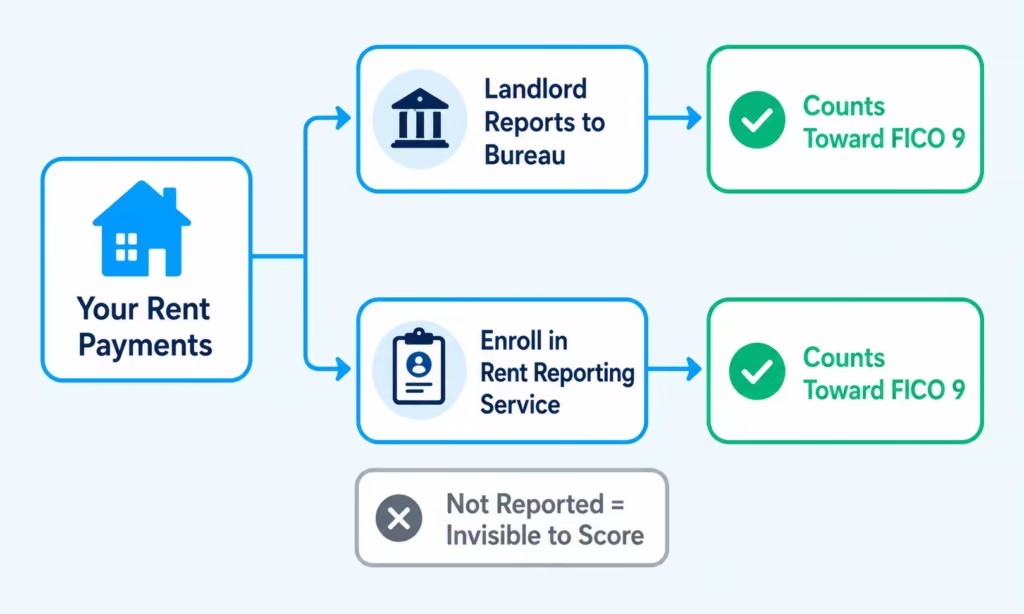
- Ask your landlord or property manager if they already report tenant payments to a credit bureau. Larger property management companies sometimes do this through built-in payment portals.
- Enroll in a third-party rent-reporting service if your landlord doesn’t report. Common options are services from banks, credit-building apps, and standalone rent reporters. Many charge a small monthly fee.
Two things to keep in mind before you sign up:
- Not every service reports to all three bureaus (Experian, Equifax, and TransUnion). If it only reports to one, only scores pulled from that bureau’s data will see the benefit.
- Not every scoring model a lender uses will count rent. Older FICO models won’t. FICO 9, FICO 10, and VantageScore 3.0/4.0 will.
FICO Score 9 Range and What Counts as a Good Score
FICO 9 uses the same 300–850 range as FICO 8 and other base FICO scores. The tier breakdown is also the same. Here’s the quick lookup:
| FICO 9 Score | Rating | What It Means |
|---|---|---|
| 800–850 | Exceptional | Top-tier approvals and rates |
| 740–799 | Very Good | Above-average rates for most credit |
| 670–739 | Good | Approved for most credit products |
| 580–669 | Fair | Subprime rates, higher deposits |
| 300–579 | Poor | Very limited approval options |
One important note: your FICO 9 number can differ from your FICO 8 number. This can happen even on the same day and from the same credit file, even though the scale is the same. That’s normal. The scale is the same, but the math inside is not. A 720 FICO 8 and a 745 FICO 9 for the same person is a completely reasonable pairing.
Industry-Specific Versions: FICO Bankcard Score 9 and FICO Auto Score 9
Beyond the base score, FICO also builds industry-specific versions tuned for particular lending decisions. You may run into these two under the “9” family:
- FICO Bankcard Score 9 is used by some credit card issuers. It weights revolving-credit behavior more heavily. So how you use your credit cards, meaning your utilization, payment habits, and balances, matters more here than in the base version.
- FICO Auto Score 9 is used by some auto lenders. It weights auto-loan history more heavily to predict risk on car loans specifically.
Both industry versions can use a different range on some pulls: 250–900, not 300–850. So if you ever see a credit card issuer show you an 810 out of 900, that’s likely a Bankcard 9, not your base FICO 9.
You don’t need to memorize how each one works. Just know they exist so you don’t get confused when a number labeled “FICO Auto Score 9” doesn’t match the base FICO 9 you saw yesterday.
Which Lenders Actually Use FICO Score 9
Here’s the honest reality most articles skip: FICO 8 is still the most widely used base model in 2026, and FICO 9 adoption has grown slowly.
A realistic breakdown by lender type:
- Credit card issuers are the most likely to use FICO 9 or FICO Bankcard Score 9. Card companies tend to adopt newer models faster because they update their approval systems more often.
- Auto lenders may use FICO Auto Score 9, but many still use older versions.
- Mortgage lenders almost always use much older FICO models. When a loan is sold to Fannie Mae or Freddie Mac, the lender typically pulls Classic FICO (FICO 2, 4, and 5, one from each bureau), based on Fannie Mae’s Selling Guide. VantageScore 4.0 is now also approved for use on Fannie Mae and Freddie Mac mortgages, but FICO 9 is not part of that mortgage system.
The takeaway: there’s no way to know for certain which score a specific lender will pull before you apply. What you can do is match your expectations to the type of credit you’re seeking. For a credit card, FICO 9 or Bankcard 9 is a reasonable proxy. For a mortgage, your FICO 9 is not the number that will decide your rate.
Why Your FICO 9 Score Differs From Your FICO 8 Score
Now the earlier pieces click together. Your FICO 9 and FICO 8 come from the same credit file, on the same day, using the same five categories. Yet they can look quite different. Here’s why:
- Paid collections? They’re erased in FICO 9 but still counted in FICO 8. Point swing: often 30 to 60 points.
- Medical collections? Softer under FICO 9. Point swing: usually 10 to 40 points, depending on how large and how recent.
- Positive rent history reported? Adds nothing to FICO 8, but can lift FICO 9 modestly.
Stack those together, and it’s easy to see why one file can produce a 705 FICO 8 and a 745 FICO 9. Neither score is “wrong.” They’re built to answer slightly different questions using slightly different rules.
If your FICO 9 is higher, it usually means your file has one of those forgiveness triggers (a paid collection, a medical debt, or reported rent). If they’re nearly identical, your file just doesn’t have those specific items to score differently.
Where and How to Check Your FICO Score 9
This is one of the biggest frustrations readers hit: most free credit score tools don’t show FICO 9.
Here’s what shows up where in 2026:
- Most free credit score apps (like Credit Karma or free bureau apps) show VantageScore 3.0 or FICO 8, not FICO 9. Helpful for tracking trends, not for confirming FICO 9.
- FICO Score Open Access is a program where participating banks, credit card issuers, and credit unions give you your FICO score for free. Some issuers under this program share FICO 9 or FICO Bankcard 9 specifically. Check the list at FICO’s Where to Get FICO Scores page.
- myFICO.com is the most direct way to guarantee access. A paid myFICO subscription displays several FICO versions side by side. This includes FICO 9 and industry versions, using data from all three bureaus.
The most practical move: check your current credit card statement or online account first. Many issuers now print the FICO score they use right on your monthly statement. If it says “FICO Score 9” there, you already have it, no subscription needed.
⚠️ Mistake to Avoid: Don’t assume the score in your free app is the one your lender will pull. It’s often a different version entirely, and the number gap can be big enough to change an approval decision.
Should You Focus on Improving Your FICO 9 Score?
Short answer: no. Focus on the habits, not the model.
Good credit habits improve every FICO version and VantageScore at the same time. There’s no separate lever you pull for FICO 9 alone. The moves that work are:
- Pay every bill on time, every month
- Keep credit card balances low, ideally under 30% of the limit, and under 10% is even better
- Pay off collection accounts (this helps most under FICO 9, but doesn’t hurt any other model)
- Avoid opening several new accounts in a short window
- Keep older accounts open so your average account age keeps growing
The one place where FICO 9 rewards you specifically is when you clear a collection or when medical debt sits on your file. But even then, those same actions won’t cost you anywhere else.
The most effective approach is to stop chasing a single score version and focus on the underlying credit behaviors. Every model, from FICO 2 to FICO 10 T to VantageScore 4.0, rewards the same core habits. Get those right and every score you have moves in the same direction.
Frequently Asked Questions (FAQs)
Is FICO score 9 better than 8?
FICO 9 is more forgiving than FICO 8 because it ignores paid collections completely and weighs medical debt more lightly. Neither score is wrong; they just calculate risk differently, so “better” depends on which one your lender actually pulls.
Is FICO score 9 used for car loans?
Some auto lenders use FICO Auto Score 9, a version tuned specifically for auto-loan risk, but many still rely on older FICO models. There’s no way to know in advance which score a specific auto lender will pull.
How do I get FICO score 9?
Check your credit card statement first, since many issuers now print the FICO version they use right on it. If it’s not listed there, a paid myFICO.com subscription shows your FICO 9 alongside other versions using data from all three bureaus.
Which lenders use FICO 9?
Credit card issuers are the most likely to use FICO 9 or FICO Bankcard Score 9. Mortgage lenders almost always pull older Classic FICO scores instead, and FICO 9 isn’t part of that system.
Is there a FICO Score 10?
Yes, FICO 10 and FICO 10 T exist as newer models in the FICO lineup, released after FICO 9. FICO 8 remains the most widely used base model among lenders as of 2026.
How do I raise my FICO 9 score?
Pay every bill on time and keep credit card balances under 30% of your limit, ideally under 10%. Paying off collection accounts helps the most under FICO 9 specifically, since a paid collection is disregarded entirely once it’s marked paid.
Does FICO 9 ignore medical debt?
Not fully. Unpaid medical collections still count, but they’re weighted less heavily than non-medical collections. Paid medical collections (and any paid collections) are ignored entirely.
Do banks use FICO score 8 or 9?
Card issuers lean toward FICO 9 or Bankcard 9, but FICO 8 is still the most widely used base model overall in 2026. Which one a bank uses depends on the type of credit and how recently that lender updated its systems.
What is the lowest possible FICO score?
The lowest possible FICO 9 score is 300, with the full range running from 300 to 850. A score in the 300-579 range falls into the “Poor” tier with very limited approval options.
Does unpaid rent hurt my FICO 9 score?
Late or missed rent payments can hurt your FICO 9 score, but only if your landlord or a rent-reporting service actually reports that history to the credit bureaus. If your rent payments aren’t reported, they do not affect your score either way.
The Bottom Line
FICO Score 9 is a kinder version of your credit score. It softens the effects of paid collections and medical debt. Also, it includes your rent payment history. It uses the same 300–850 scale as FICO 8, but it usually gives a different score from the same credit file. Many lenders still prefer FICO 8 over it.
The best approach is to focus on good habits instead of chasing one model. Pay your bills on time, keep your credit utilization low, and clear any collections when you can.
If you know a friend who just spotted a “FICO 9” on their statement and felt confused, share this guide with them. It could save them a needless panic before their next credit application.