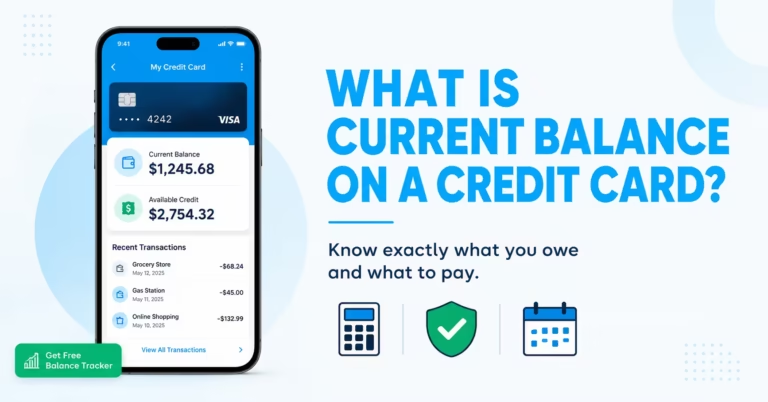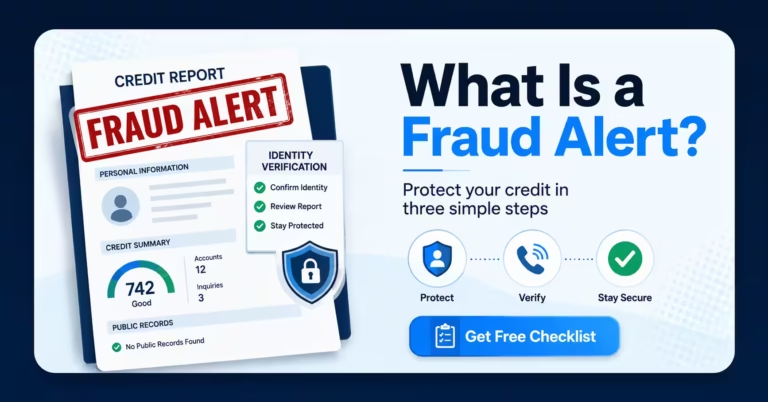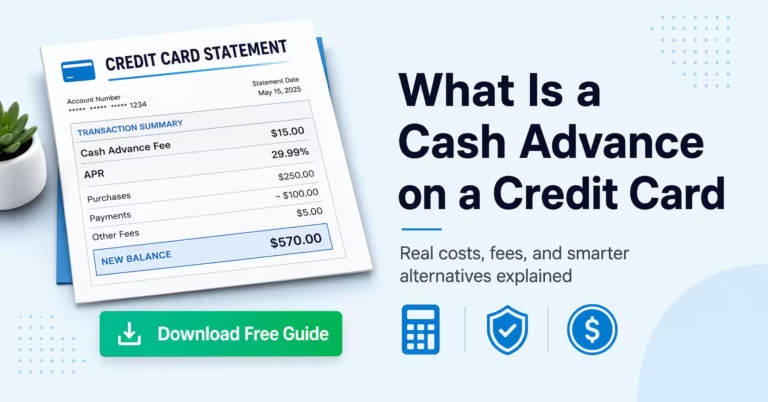

You just spotted a small charge on your credit card bill labeled something like “Payment Protection Plan” or “Credit Shield.” Or maybe a rep called and pushed you to sign up “before something bad happens.” You’re not sure what it is, whether you need it, or whether it’s even real. That confusion is fair, because credit card payment protection is one of the most misunderstood add-ons on a credit card statement, and issuers rarely explain it in plain words.
Credit protection is an optional, paid add-on that pauses, covers, or cancels part of your credit card balance if you lose your job, get hurt, or die.
Here’s a quick guide on how it works, the costs, what triggers a payout, how to cancel, and how to spot a real offer versus a scam. This way, you can make your decision confidently.
Key Takeaways
This guide explains what credit protection is on a credit card, including how it differs from free fraud liability, its typical monthly cost, qualifying hardship events, and how to cancel or file a claim.
Core Facts:
- Credit protection is a paid, opt-in add-on that pauses, covers, or cancels part of a credit card balance if the cardholder loses their job, becomes disabled, is hospitalized, or dies.
- Monthly fees typically range from $0.85 to $1.35 per $100 of statement balance, so a $3,000 balance can cost roughly $30 a month, or about $360 a year.
- Credit protection is separate from $0 fraud liability, which is free and automatic on major credit cards and covers unauthorized charges, not personal inability to pay.
- Most contracts include a 30 to 90 day waiting period after enrollment before a claim becomes eligible, and claims must usually be filed within 60 to 90 days of the qualifying event.
- Common exclusions include voluntary resignation, pre-existing conditions diagnosed before enrollment, and part-time or self-employed status that doesn’t meet full-time employment requirements.
- Enrolling in or canceling credit protection does not directly affect a credit score, since credit bureaus do not track add-on products.
Best for:
- Cardholders with unstable income, less than one month of emergency savings, and no employer disability or life insurance.
- Sole income earners with dependents who lack other safety nets in case of job loss or disability.
- Readers who received a mailer, phone pitch, or spotted an unexplained fee and want to verify what the product actually covers before enrolling or canceling.
What “Credit Protection” Actually Means
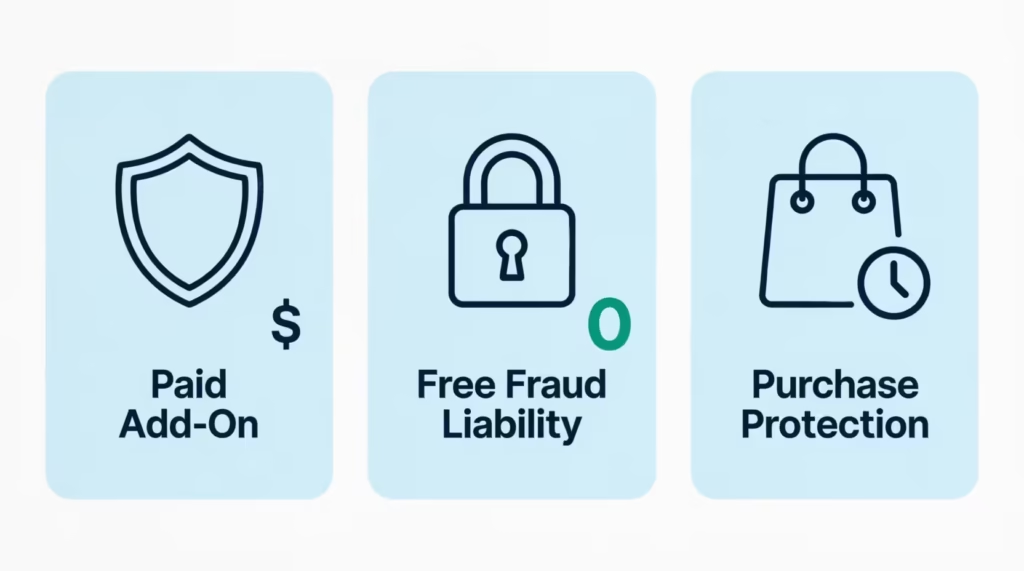
The phrase “credit protection” gets slapped on three very different things, which is why so many cardholders end up confused when they see it on a statement. Sorting these out first will save you from paying for something you already have for free.
The first meaning is a paid, opt-in add-on you enroll in through your card issuer. This is what people usually mean when they ask about credit card payment protection. You pay a small monthly fee, and in return, the issuer promises to cover, pause, or cancel part of your balance if a specific hardship hits. This is the product you can actually enroll in, cancel, or file a claim on.
The second meaning is built-in $0 fraud liability. This is free. It kicks in automatically the moment your card is issued. If someone steals your card number and buys a TV with it, you don’t pay for the TV. No enrollment, no fee.
The third meaning is purchase protection or extended warranty coverage. This covers stuff you buy with the card (theft, damage, breakage) for a short window. It’s a card perk, not a monthly product.
Issuers use lots of brand names for the paid add-on: Credit Shield, Payment Protection Plan, Account Assure, Credit Protector, and more. The names change, but the product underneath is usually the same.
Legally, these are called debt cancellation contracts or debt suspension agreements, and they must follow Truth in Lending Act disclosure rules. National bank issuers also fall under 12 CFR Part 37, the federal rule that sets standards for how these products are sold and disclosed.
So if you saw a fee on your bill, that’s meaning #1. If you’re worried about a stolen card, that’s meaning #2, and it’s free. If you dropped your new phone, that’s meaning #3. Read on to see which one your situation actually needs.
How Credit Card Payment Protection Actually Works
The basic idea is simple. You pay a monthly fee based on your balance. If a covered event happens, the issuer either pauses your payments, pays your minimum for you, or cancels part of the balance outright. That’s it.
There are three general outcomes you’ll see spelled out in the contract:
- Payment deferral (debt suspension). Your due date gets pushed out. You still owe the balance, but you don’t have to pay it right now, and late fees are usually waived during the covered period.
- Issuer-paid minimum payments. The issuer makes your minimum payment for you each month while the hardship lasts, so your account stays current.
- Balance cancellation (debt cancellation). In severe events like death, the full outstanding balance (up to a cap) is wiped clean.
The flow from sign-up to benefit is straightforward. You can enroll through your online account, by phone, or by mailer. The fee will appear on your next statement. If a qualifying event happens later, you file a claim with paperwork proving what happened.

Once approved, the benefit kicks in on your account. You keep making payments (or the minimum, depending on the plan) until the claim is officially approved, so don’t stop paying just because you filed.
One important note: exact terms vary by issuer. The fee rate, the cap, the waiting period, and even the list of qualifying events differ between banks. Always read your specific contract before assuming a benefit applies.
What Counts as a Qualifying Hardship
This is the part that decides whether the product is actually useful to you. A benefit only pays out if the event fits the contract’s definition. Most plans cover a short list of specific events:
- Involuntary job loss (being laid off, not quitting)
- Total disability that stops you from working
- Hospitalization for a set minimum number of days
- Death of the primary cardholder
- Sometimes military deployment, unpaid family leave, or divorce, depending on the issuer
The word “involuntary” carries most of the weight here. If you quit, retire, or take a voluntary buyout, you’re usually not covered. The event has to be forced on you.
You’ll also need paperwork. For job loss, that means state unemployment approval letters. For disability, a doctor’s certification. For death, a certified death certificate. No paperwork, no payout.
What’s Typically Excluded or Causes Denied Claims
Coverage sounds broad in the sales pitch, but the fine print narrows it fast. These are the most common reasons a claim gets denied:
- Voluntary resignation or quitting. Even if you had good reasons, quitting almost always disqualifies you.
- Pre-existing conditions. If a disability or illness was diagnosed before you enrolled, the related claim usually gets rejected.
- Part-time, seasonal, or self-employed status. Many plans require full-time W-2 employment for a set number of hours per week.
- Waiting periods. Most contracts have a 30 to 90 day waiting period after enrollment. A claim filed inside that window won’t pay out.
- Minimum enrollment length. Some issuers require you to have been enrolled for several billing cycles before your first claim is eligible.
⚠️ Mistake to Avoid: Enrolling right after you’ve heard rumors of layoffs at work. Waiting periods exist for exactly this reason, and a claim filed too soon after sign-up is almost always denied.
How Much Credit Card Protection Actually Costs
The fee is not a flat number. It’s a balance-based premium, meaning it scales with what you owe. Most issuers charge somewhere between $0.85 and $1.35 per $100 of your statement balance, applied every month.
That sounds small until you run the numbers on a real balance.
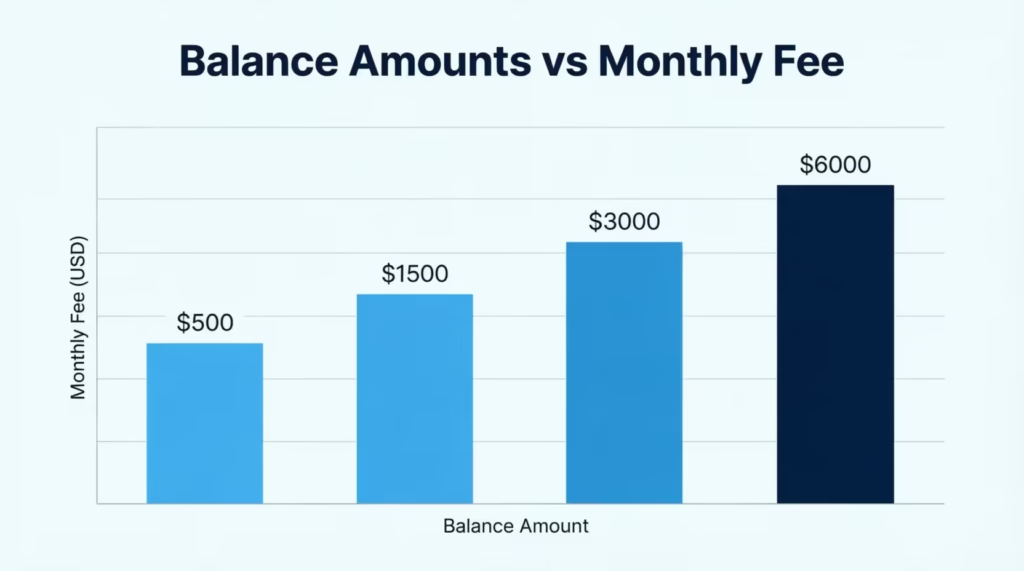
Here’s a worked example. Say your rate is $1.00 per $100 of balance.
| Statement balance | Monthly fee | Annual cost |
|---|---|---|
| $500 | $5.00 | $60.00 |
| $1,500 | $15.00 | $180.00 |
| $3,000 | $30.00 | $360.00 |
| $6,000 | $60.00 | $720.00 |
Notice the pattern. The bigger the debt, the bigger the fee. Someone carrying a $6,000 revolving balance pays $720 a year just for the protection, on top of the interest they’re already paying on that balance.
The fee is charged against last cycle’s statement balance, not today’s balance, so it can jump month to month as your spending changes. It’s also treated as a purchase on your account, which means if you don’t pay your statement in full, the fee itself starts collecting interest.
📌 Did You Know: Because the premium scales with debt, the people who technically need the coverage most (those with high balances and thin savings) also pay the most for it. That’s the built-in cost paradox of these plans.
Before you enroll, take the fee you’d pay this month and multiply it by 12. That’s your annual cost. Ask yourself whether that same money in a savings account would cover more than the plan actually would if you lost your job for a few months. Often, it does.
Is Credit Protection the Same as $0 Fraud Liability?
No. And this is the single most important thing to understand before paying for anything.
$0 fraud liability is free. Every major credit card in the U.S. comes with it automatically. If a thief runs up charges on your stolen card, you don’t owe those charges. Federal law under the Fair Credit Billing Act caps your liability for unauthorized charges at $50, and Visa, Mastercard, American Express, and Discover all voluntarily waive even that $50 as a network policy. So real-world liability is zero.
Payment protection is different. It doesn’t cover fraud. It doesn’t help if your card gets stolen. It only pays out if you personally can’t pay because of job loss, disability, hospitalization, or death. And you have to pay a monthly fee for it.
Here’s the clean side-by-side:
| Feature | $0 Fraud Liability | Payment Protection |
|---|---|---|
| Cost | Free | Monthly fee based on balance |
| Enrollment | Automatic | You must opt in |
| Covers | Unauthorized charges by someone else | Your inability to pay due to hardship |
| Backed by | Federal law + network policy | Contract with your issuer |
If a caller ever tells you that you need to pay extra to get “fraud protection,” they’re either confused or running a scam. The federal cap on unauthorized charges applies to every U.S. cardholder for free.
Is Credit Protection the Same as Purchase Protection?
Also no, and this one trips people up because both sound like safety nets.
Purchase protection is a built-in card benefit, not a paid add-on. It covers the item you bought with your credit card. If your new laptop gets stolen from a coffee shop within a certain window (usually 90 to 120 days) or breaks from an accident, purchase protection can reimburse you.
Payment protection covers you, not your stuff. It only helps if you personally can’t make payments because of a life event.
Extended warranty works the same way as purchase protection. It’s a card benefit that stretches the manufacturer’s warranty on eligible items by a year or two, at no extra cost.
You don’t enroll in these. They activate automatically when you pay with the card, though some issuers ask you to register the purchase within a certain window. Check the “Benefits Guide” for your specific card to see the coverage limits, since perks vary widely between cards.
How to Enroll in Credit Card Payment Protection
If you’ve decided the coverage is worth it for your situation, enrollment usually takes just a few minutes. Issuers offer three main channels:
- Online account portal. Log into your issuer’s website or mobile app, look under “Services,” “Benefits,” or “Add-On Products,” and follow the enrollment prompts.
- Phone with your issuer. Call the number on the back of your card and ask a rep to enroll you. They’ll read the disclosures out loud and email or mail a copy.
- Response to a mailer or statement insert. Some issuers send preprinted enrollment cards. Sign, return, and enrollment activates on the next cycle.
Whichever channel you use, expect the issuer to disclose the rate per $100 of balance, the list of covered events, the waiting period, the maximum benefit amount, and the cancellation terms. Federal disclosure rules require this. If a rep skips over any of it, ask for it in writing.
Before you say yes, run through this quick checklist:
- Confirm the exact fee formula, including whether the rate applies to your average daily balance or your statement balance.
- Get the full list of qualifying events and their documentation requirements in writing.
- Ask about the waiting period before benefits can be triggered.
- Verify the maximum monthly benefit and the total lifetime cap.
- Ask directly how to cancel and whether cancellation is immediate.
- Make sure the plan doesn’t duplicate coverage you already have, like employer-provided short-term disability or a life insurance policy.
💡 Pro Tip: Ask the rep to email you the full contract before you enroll, not after. Reading the exclusions often changes minds. About one in three people who read them decide differently than those who just hear a smooth pitch over the phone.
How to File a Credit Protection Claim
If a qualifying event happens, the clock starts. Most contracts require you to file a claim within a set window, often 60 to 90 days from the date of the event. Missing the window can void your right to the benefit.
Here’s what you’ll typically need to gather:
- For involuntary job loss: A copy of your termination or layoff letter from your employer, plus proof you filed for state unemployment benefits (or an unemployment approval letter).
- For disability: A signed statement from your treating physician confirming the diagnosis, the start date of the disability, and that you can’t perform your normal job duties.
- For hospitalization: Admission and discharge records showing dates.
- For death: A certified copy of the death certificate.
Contact the issuer’s claims department once you have the paperwork. Use the number on the back of your card or the claims line in your welcome packet. Fill out the claim form completely, attach the documents, and keep copies of everything.
Processing usually takes 10 to 30 business days. During that time, your account is still active, which means:
- Payments are still due until the claim is officially approved. Missing them can hurt your credit score even if the claim is later approved.
- Interest usually keeps accruing on your balance, even during a payment suspension, unless the contract specifically says otherwise.
- Once approved, the benefit is usually applied retroactively to the event date, so any late fees you paid may get refunded.
If a claim is denied, you have the right to appeal in writing. Ask the issuer for the specific reason for denial, then respond with any missing documentation. Denials are often reversed at the appeal stage when documentation is complete.
How to Cancel Credit Card Protection
If you decide the plan isn’t worth it, canceling is usually simple. Federal rules require issuers to make cancellation as easy as enrollment.
You have three main options:
- Phone call. Call the number on the back of your card. Tell the rep you want to cancel the payment protection add-on. Ask for a confirmation number and a written confirmation by email or mail. This is the fastest method.
- Online account settings. Log in and look under “Services,” “Add-Ons,” or “Benefits.” Some issuers let you toggle the plan off with one click. Others require a phone call for cancellation, even if enrollment was online.
- Written request. Send a signed letter to the customer service address on your statement. This creates a clear paper trail, which is useful if you’re worried about a dispute later.
Cancellation timing varies. Some issuers stop the fee immediately and prorate the current month’s charge. Others let the current cycle finish and stop billing on the next statement. Ask directly which one applies to your plan, and check the next two statements to make sure the fee actually stops.
Partial refunds of the current month’s fee are typical but not guaranteed. If you canceled mid-cycle, ask whether the unused portion will be credited back.
Does Canceling (or Having) Credit Protection Affect Your Credit Score?
No. And this is where a lot of people get stuck.
The act of enrolling in payment protection doesn’t help your credit score, and the act of canceling doesn’t hurt it. Credit bureaus don’t track add-on products. Your score reacts to things like on-time payment history, credit utilization, length of credit history, and hard inquiries. Payment protection isn’t any of those.
The only indirect connection is this: if you were about to miss a payment during a real hardship and the protection product covered the minimum payment for you, then your on-time payment record stays intact. That’s an indirect score benefit. But it comes from the payment being made, not from having the plan.
So if you’ve been avoiding cancellation because you worried it would ding your credit, you can let go of that fear. Canceling the plan will not lower your score by a single point.
How to Spot a Credit Protection Scam
Scammers love credit protection because the product is confusing enough that a smooth pitch works. The FTC has taken enforcement action against fake “credit card loss protection” telemarketers for years, and the same playbook still shows up today.
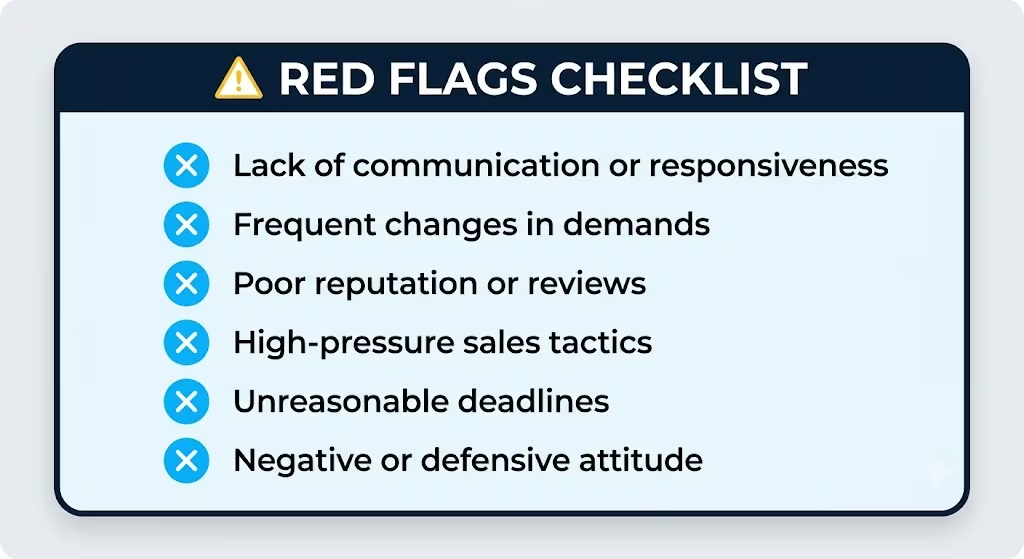
Watch for these red flags on any incoming call, text, or email:
- Unsolicited call claiming your card is “already compromised.” Real issuers don’t cold-call to sell add-ons using scare tactics.
- Pressure to enroll immediately or “before the fraud team closes your case.” Urgency is the oldest trick in the book.
- Requests for your full 16-digit card number, PIN, CVV, or online banking password. Your real issuer already has your card number. They never need you to read it back to them.
- Claims that you need to pay for fraud protection. Federal law already caps your liability. Anyone selling this is lying.
- Wire transfers, gift cards, or cryptocurrency as the payment method. No legitimate issuer will ever ask for these.
- Offers that don’t match the product name on your statement. If your issuer is Chase, and someone calls selling “Capital Credit Shield Ultra,” that’s not your issuer.
If a caller sounds even slightly off, hang up and call back using the number printed on the back of your card. Never use a number the caller provides, even if they say to “verify” with it. That number leads back to them.
If you already gave out information, act fast:
- Call your issuer immediately using the number on your card and ask them to freeze your account and issue a new card number.
- Change your online banking password and enable two-factor authentication.
- Place a fraud alert with one of the three major credit bureaus (Equifax, Experian, or TransUnion). One alert covers all three.
- Report the scam to the FTC at ReportFraud.ftc.gov and to your state attorney general.
Is Credit Card Payment Protection Worth It?
The honest answer depends on three things: how stable your income is, how much you already have saved, and what coverage you already have elsewhere.
When it may make sense:
- Your job feels shaky, or your industry has been going through layoffs.
- You have less than one month of expenses saved in an emergency fund.
- You’re the sole income earner, and dependents rely on you.
- You don’t have short-term disability or life insurance through work.
- Your card balance is small (say, under $1,000), so the monthly fee stays modest.
When it usually isn’t worth it:
- Your job is stable, and your industry is steady.
- You already have three or more months of expenses in emergency savings.
- You have short-term disability insurance through your employer.
- You carry life insurance that would cover your card balance if the worst happened.
- Your balance is high (say, over $3,000), which makes the fee expensive without proportionally more coverage.
Run this quick math before deciding. Take the monthly fee, multiply by 12, and compare it to what the maximum monthly benefit would actually pay you. Most plans cap the benefit at your minimum payment, not your full balance.
So a $30 monthly fee on a $3,000 balance might buy you a benefit of only about $75 a month during hardship. That’s $360 a year for a promise of about $900 in benefit over a full year of unemployment.
For most cardholders with stable jobs and any meaningful savings, that math doesn’t work. For someone in a genuinely unstable situation with no other safety net, it can. The decision should come from your specific numbers, not from a phone pitch.
Frequently Asked Questions (FAQs)
What is credit protection on a credit card?
Credit protection is an optional, paid add-on that pauses, covers, or cancels part of your balance if you lose your job, become disabled, are hospitalized, or die. You enroll and pay a monthly fee based on your balance, and issuers use brand names like Credit Shield or Payment Protection Plan for the same product.
Is credit card payment protection worth it?
It’s usually worth it only if you have unstable income, less than a month of emergency savings, and no employer disability or life insurance. For most people with steady jobs and 3+ months saved, putting the same fee into savings outperforms the plan.
How much does credit card protection cost?
Most issuers charge $0.85 to $1.35 per $100 of your statement balance each month. On a $3,000 balance, that comes out to roughly $30 a month, or about $360 a year.
How does credit card protection work?
You pay a monthly fee, and if a covered hardship hits, the issuer either defers your payments, pays your minimum for you, or cancels the balance outright in cases like death. You file a claim with supporting paperwork once the qualifying event happens.
How do I cancel a credit card protection plan?
Call the number on the back of your card and ask a rep to cancel, or check your online account under “Services” or “Add-Ons.” Federal rules require cancellation to be as easy as enrollment, so ask for written confirmation and check your next two statements to confirm the fee stopped.
Does using credit protection affect your credit score?
No, enrolling or canceling doesn’t directly affect your score, since credit bureaus don’t track add-on products. The only indirect link is that if the plan covers a missed payment during hardship, your on-time payment history stays intact.
How long does credit card protection last?
Coverage continues as long as you’re enrolled and paying the monthly fee, but most contracts have a 30 to 90 day waiting period before a new enrollee can file a claim. Individual benefit payouts are also capped, often to your minimum payment for a limited number of months.
Is credit protection the same as $0 fraud liability?
No, $0 fraud liability is free and automatic on every major U.S. credit card, covering unauthorized charges from theft. Credit protection is a separate paid product that only covers your inability to pay due to job loss, disability, hospitalization, or death.
What documents do I need to file a credit protection claim?
You typically need a termination or layoff letter plus unemployment approval for job loss, a physician’s signed statement for disability, hospital admission and discharge records for hospitalization, or a certified death certificate for death claims. Claims are usually due within 60 to 90 days of the event.
How can I spot a credit protection scam?
Hang up on unsolicited calls that pressure you to enroll immediately or ask for your full card number, PIN, or CVV, since real issuers already have that information. Always verify any offer by calling the number printed on the back of your card, never a number given by the caller.
Wrapping Up
Credit card payment protection is a paid add-on. It pauses, covers, or cancels part of your balance if you lose your job, become disabled, are hospitalized, or die. It’s not the same as free $0 fraud liability, and it’s not the same as purchase protection. It costs about $0.85 to $1.35 for every $100 of your balance each month. There are also waiting periods, exclusions, and documentation rules. These can surprise many first-time claimants.
For most readers with steady income and even a small emergency fund, the same money saved directly will outperform this coverage. The plan works best only for cardholders with unstable income, low savings, and no employer disability or life insurance.
If this breakdown helped clear up your statement or saved you from a pushy phone offer, share it with a friend or family member who’s been staring at a mystery fee on their bill. It could save them real money before their next cycle closes.