
If you’ve been sitting on a growing pile of Membership Rewards points and wondering how to actually book a flight with them, you’re in good company. Most Amex cardholders understand that points have travel value, but the process of actually redeeming them for flights feels confusing. There are two booking paths, more than 20 transfer partners, and no obvious sign pointing you to the best deal.
The good news is that using Amex points for flights is simple. Just know the right path for your trip. Also, check for a seat before transferring any points.
This guide covers every step, from choosing your booking method to completing the reservation.
Key Takeaways
This guide explains how to use Amex Membership Rewards points for flights, covering the two booking methods (Amex Travel portal and airline transfer partners), how to calculate whether a redemption is worth it using the cents-per-point formula, and how to find and confirm award seat availability before transferring any points.
Core Facts:
- Two booking paths exist: the Amex Travel portal (book directly at AmexTravel.com using points at roughly 1 cent per point) and airline transfer partners (convert points to miles at a 1:1 ratio for most partners and redeem through the airline’s own award booking tool).
- Redemption value is calculated with this formula: cash price of flight divided by points required, multiplied by 100, equals cents per point (CPP). A $900 flight booked for 60,000 miles yields 1.5 CPP; a $280 flight booked for 35,000 portal points yields only 0.8 CPP.
- Transfer partner redemptions typically deliver 1.5 to 2.5 cents per point, while the portal delivers around 1 cent per point; the difference on a 60,000-point redemption can be $600 versus $1,200 in travel value.
- Award seat availability must be confirmed on the airline’s website before initiating any transfer. Transfers are irreversible and cannot be recalled or redirected once processed.
- Transfer timing varies by partner: some post within minutes, others take up to several days. Booking an award flight before miles appear in the airline account is one of the most common and costly mistakes.
- Amex periodically runs transfer bonus promotions offering 15 to 35 percent additional miles on select partner transfers; a bonus improves a strong redemption but does not rescue a poor one.
Best for:
- Amex cardholders sitting on unused Membership Rewards points who want to understand which booking method produces the most value before redeeming for an upcoming flight.
- Travelers planning long-haul international or premium cabin bookings, where transfer partner redemptions consistently outperform the portal by a significant margin.
- Anyone who has transferred points before and lost value by moving miles without confirming award availability first, and wants a clear process to avoid repeating that mistake.
Two Ways to Use Amex Points for Flights
When you want to fly using Membership Rewards points, two paths are available to you. They work very differently, and which one you pick will have a big impact on how much value you get from your points.
The first option is the Amex Travel portal. This is American Express’s own booking website, available at AmexTravel.com. You log in with your Amex account, search for flights from hundreds of airlines, and pay using points instead of cash. It works like any other travel booking site, just with points as the currency. When you choose this route, you’re using the “Pay with Points” feature to cover the base fare directly at checkout.
The second option is transferring points to an airline’s loyalty program. This transfers your Membership Rewards points from your Amex account to an airline’s miles program. For example, you could choose Delta SkyMiles or Air Canada Aeroplan. When your miles arrive in your airline account, you can use them to book a flight with that airline. This is just like redeeming frequent flyer miles you earned from flying.
These two paths are not interchangeable. They use different pricing, give you access to different award seats, and produce very different value per point. A $600 round-trip flight to London could cost 60,000 points through the portal.
But if you transfer to the right partner and find a saver award seat, it might only need 30,000 miles. The reverse can also be true for shorter domestic trips. The key is knowing which method fits your specific situation, and the next section gives you a clear way to decide.
Amex Travel Portal vs. Transfer Partners: Which Should You Use
Most cardholders default to whichever option looks simpler. That usually means the portal, which feels familiar and takes about five minutes.
But the portal is often the lower-value choice, especially for long-haul trips and premium cabins. Knowing when each method is the right call saves you thousands of points on every booking.
Use the Amex Travel portal when:
- You’re booking on an airline that isn’t one of Amex’s transfer partners (such as Southwest or Spirit).
- You need to book quickly and don’t have time to set up an airline loyalty account or wait for a transfer to post.
- The flight you want has no available award seats on the airline’s own site, but you can still book it as a paid fare through the portal using points.
- The cash price of the ticket is low, and the portal’s points pricing is competitive (roughly 1 cent per point).
Transfer to an airline partner when:
- You’re booking a premium cabin seat, such as business or first class, where transfer partner award pricing can yield 2 to 4 cents per point of value.
- You’ve already found confirmed award space on the airline’s website at a saver rate.
- You’re booking a long-haul international flight where transfer sweet spots exist.
- The cash price of the ticket is high, which makes the per-point value of a transfer redemption much stronger.
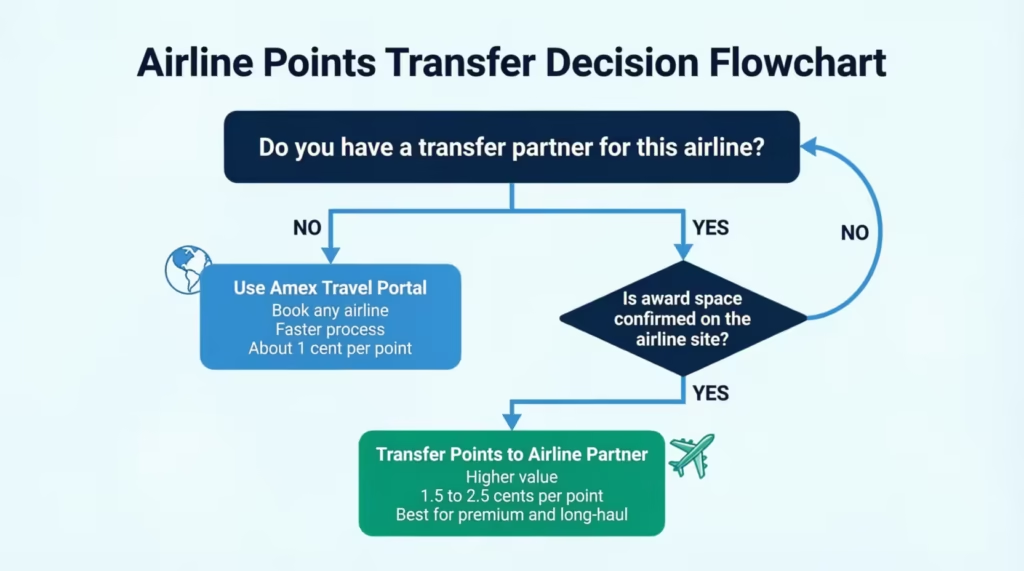
The fundamental trade-off is this: the portal is faster, more flexible, and works for any airline, but it typically delivers around 1 cent per point.
Strong transfer redemptions often yield 1.5 to 2.5 cents per point, and exceptional ones on premium international routes can go even higher.
For a 60,000-point redemption, the difference between 1 cent and 2 cents per point is $600 in travel value versus $1,200. That gap makes the transfer process worth learning.
Amex Airline Transfer Partners Worth Knowing
American Express has over 20 airline transfer partners. This sounds great, but it can be a bit much. The truth is that most U.S.-based travelers will get the most use out of five or six of them. The rest serve niche routes or have programs that require more complex redemption strategies than most people need.
The shortlist below focuses on programs with the clearest value for common travel goals:
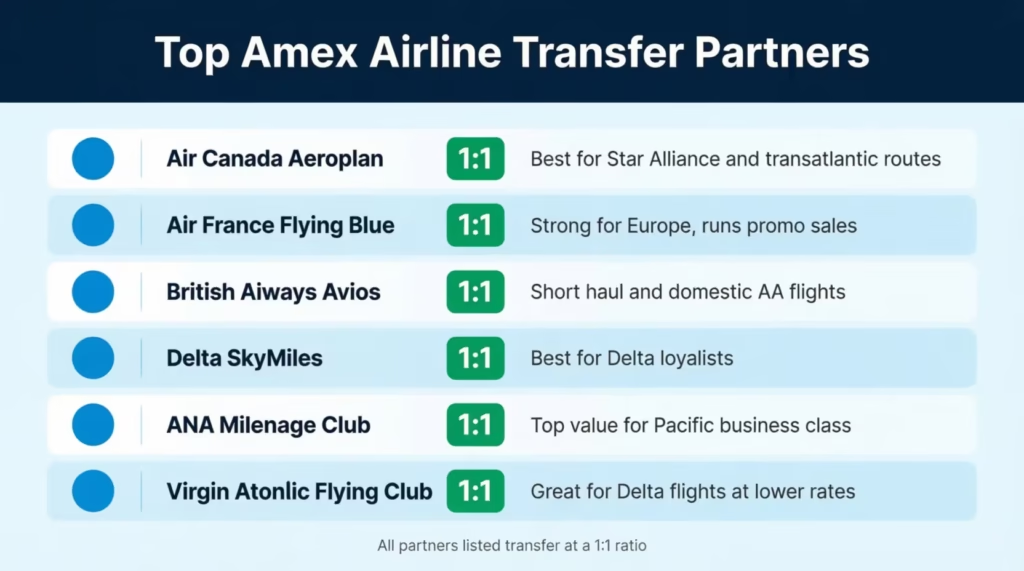
Air Canada Aeroplan is one of the most versatile transfer partners for U.S. travelers. Aeroplan covers the Star Alliance network, which includes United, Lufthansa, ANA, and many others. It’s usually the top choice for non-stop flights to Europe. Plus, it doesn’t charge fuel surcharges on many partner redemptions. The transfer ratio is 1:1.
Air France/KLM Flying Blue is a solid pick for transatlantic travel to France, the Netherlands, and dozens of other destinations across Europe and Africa. Flying Blue runs monthly “Promo Rewards” sales that cut award prices by 25 to 50 percent on select routes. Transfer ratio: 1:1.
British Airways Executive Club (Avios) is particularly useful for short-haul flights on American Airlines within the U.S. and for shorter transatlantic routes. A flight from New York to London on British Airways, for example, can be priced at a low Avios rate for off-peak travel. Transfer ratio: 1:1.
Delta SkyMiles is the most obvious choice for Delta loyalists. It’s the only big U.S. airline that lets you transfer Amex points directly. This can help with domestic routes if SkyMiles prices are good. That said, Delta’s award pricing is dynamic and can be high, so always calculate value before transferring. Transfer ratio: 1:1.
ANA Mileage Club offers some of the best pricing for business and first-class flights across the Pacific on Star Alliance carriers. A round-trip business class ticket from the U.S. to Japan often costs fewer miles with ANA than with most other Star Alliance programs. Transfer ratio: 1:1.
Virgin Atlantic Flying Club offers great deals on Delta flights in the U.S. You can often book these flights using fewer miles. This is less than what Delta SkyMiles requires for the same seat. This works because Flying Club uses a distance-based award chart, not Delta’s variable pricing. Transfer ratio: 1:1.
Complete List of Amex Airline Transfer Partners and Ratios
The full Amex transfer partner list currently includes the following airlines. Most transfer at a 1:1 ratio, meaning 1,000 Membership Rewards points convert to 1,000 miles. JetBlue is the main exception.
| Airline | Loyalty Program | Transfer Ratio (MR to Miles) |
|---|---|---|
| Aeromexico | Club Premier | 1:1 |
| Air Canada | Aeroplan | 1:1 |
| Air France / KLM | Flying Blue | 1:1 |
| ANA | Mileage Club | 1:1 |
| Avianca | LifeMiles | 1:1 |
| British Airways | Executive Club (Avios) | 1:1 |
| Cathay Pacific | Asia Miles | 1:1 |
| Delta Air Lines | SkyMiles | 1:1 |
| Emirates | Skywards | 1:1 |
| Etihad | Etihad Guest | 1:1 |
| Hawaiian Airlines | HawaiianMiles | 1:1 |
| Iberia | Iberia Plus (Avios) | 1:1 |
| JetBlue | TrueBlue | 1:0.8 |
| Korean Air | SKYPASS | 1:1 |
| Qantas | Frequent Flyer | 1:1 |
| Qatar Airways | Privilege Club (Avios) | 1:1 |
| Singapore Airlines | KrisFlyer | 1:1 |
| Virgin Atlantic | Flying Club | 1:1 |
Note that JetBlue’s 1:0.8 ratio means 1,000 Membership Rewards points only become 800 TrueBlue points. Factor this into your value calculation before choosing JetBlue as a transfer destination.
How to Calculate Whether a Flight Redemption Is Worth It
One of the most common mistakes cardholders make is redeeming points without knowing whether the deal is actually good. Skipping this calculation can cost you hundreds of dollars in value on a single booking. The math takes about 30 seconds.
The formula is:
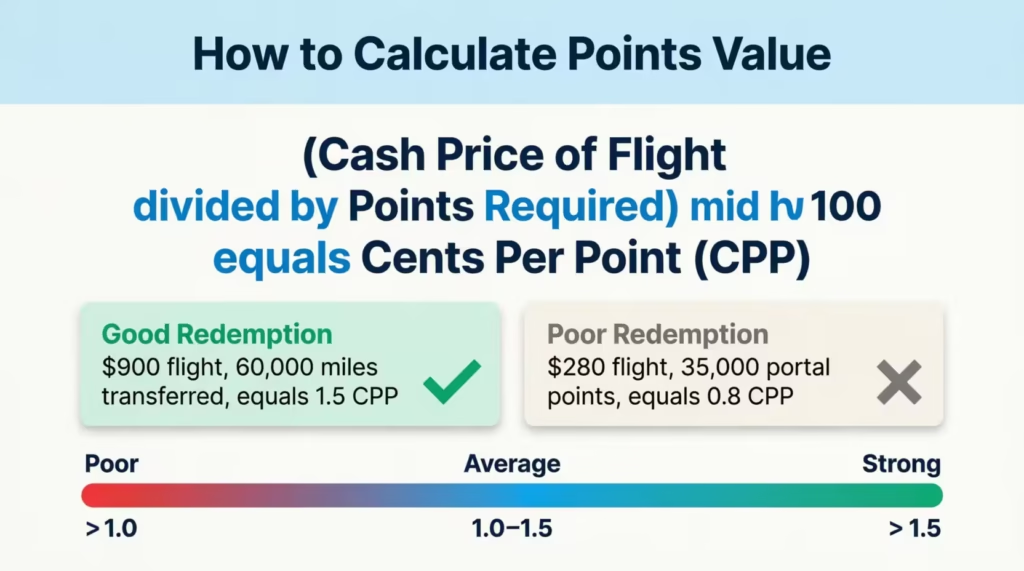
(Cash price of flight ÷ Points required) x 100 = Cents per point (CPP)
Here’s how it works with real numbers. Suppose you find a round-trip flight from Atlanta to Paris priced at $900 in cash. You can book the same seat for 60,000 Flying Blue miles. You can get these miles by transferring 60,000 Membership Rewards points at a 1:1 ratio.
900 ÷ 60,000 = 0.015. Multiply by 100, and you get 1.5 cents per point. That’s a solid redemption.
Now take a different example. A $280 domestic round-trip appears in the portal for 35,000 points.
280 ÷ 35,000 = 0.008. Multiply by 100, and you get 0.8 cents per point. That’s a poor redemption. You’d be better off paying cash and saving your points for a trip with better value.
One important note: always use the base fare (before points are applied) as your cash price reference. Do not include taxes and carrier fees in the numerator. These costs are usually paid separately in cash, even for award bookings.
What Counts as a Good Redemption Value for Amex Points
Use these benchmarks to evaluate any redemption before you commit:
Amex Membership Rewards points are widely considered to have a baseline value of around 1 cent per point when used through the portal. Transferring redemptions to partner airlines greatly increases value, especially for premium international travel.
How to Find Award Availability Before You Transfer
Award availability is the step most new redeemers skip, and it’s the one that causes the most frustration. You find a flight you want. You transfer your points. Then, when you go to book it, you see that no award seats are available at the expected rate. Since transfers are one-way and non-reversible, that’s a very expensive mistake.
The process works in this order: find the available seat first, then transfer the points. Never reverse this.
To search for award space, go directly to the airline’s website and use their award booking tool. Look for a search option labeled “Miles,” “Points,” or “Award Travel” rather than the standard paid fare search.
Enter your route and travel dates. Look for what most programs call a “Saver” or “Standard” award. Avoid “Flex” or “Anytime” awards. Saver awards use far fewer miles and represent the sweet spot you’re calculating value against.
If award space isn’t available on your first-choice dates, try these adjustments:
- Shift your travel dates by one or two days in either direction. Award seats can change daily.
- Check nearby airports. A route from Philadelphia instead of New York can open up different seat inventory.
- Check whether a different partner airline flies the same route. For example, If Air Canada’s Aeroplan shows no availability, check Lufthansa’s Miles and More program. You might find the same Star Alliance flight there.
- Consider a one-stop itinerary instead of a direct. Connecting flights often have more award seats available.
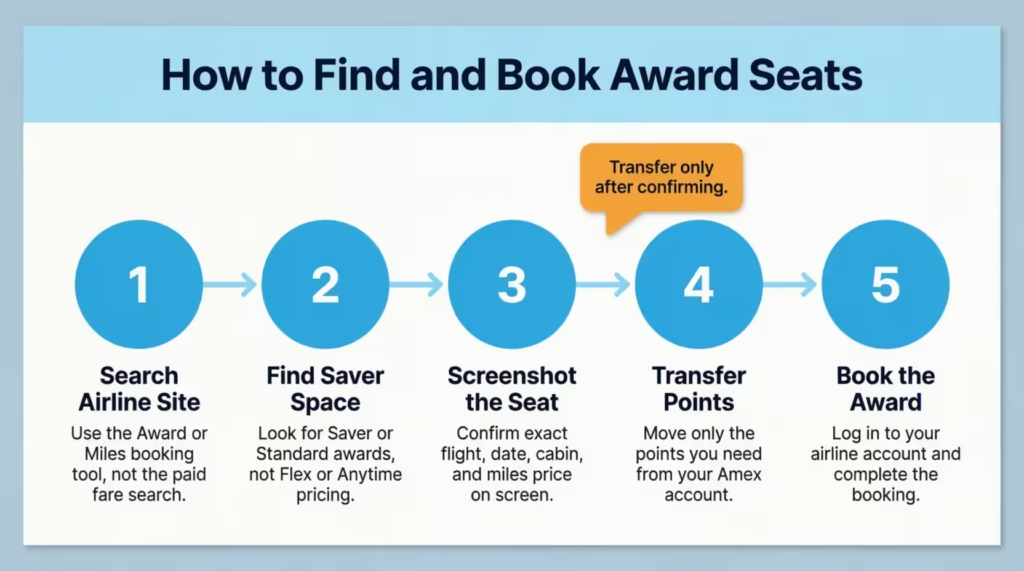
⚠️ Mistake to Avoid: Don’t transfer Membership Rewards points to an airline until you’ve confirmed award space for that flight. Transfers post quickly and cannot be reversed, recalled, or redirected once processed. Confirm the seat is there first, then initiate the transfer.
Best Times to Search for Award Seats
Award availability isn’t random. There are windows when seats are much easier to find.
For long-haul international flights and premium cabin seats, search as early as possible. Most airlines release their award inventory 330 to 355 days before departure.
This is when the most seats at saver pricing are available. Business and first-class award seats at low rates can vanish within days on popular routes. This is especially true for flights like New York to Tokyo or Los Angeles to London.
A second window opens close to departure. Airlines usually release unsold award seats in the last one to three weeks before a flight. This helps them fill empty spots. Last-minute availability is great for flexible travelers. But premium cabins rarely show up on popular routes.
For domestic flights, availability is steady throughout the year. However, it gets tight around major holidays. July 4th, Thanksgiving, and Christmas weeks see the least award space across nearly all programs. If your travel dates are fixed around a holiday, search especially early and have a backup plan ready.
Mid-week departures, such as Tuesday, Wednesday, and Thursday, often have more award seats available. In contrast, weekend trips typically have fewer. This pattern applies to both domestic and international flights.
What to Confirm Before You Transfer Points
Before you initiate any point transfer, run through this checklist. Each item protects you from an irreversible outcome.
- The award seat exists. You’ve seen it on the airline’s website with the exact flight number, date, cabin, and miles price confirmed on screen.
- The miles price matches your value calculation. You’ve found that your cents per point is above 1.5 cpp for most transfers.
- You have a loyalty account with that airline. Transfers can only go to an account you already own. You cannot open an account and transfer simultaneously. If you don’t have an account with the airline yet, create one first and allow a few hours for it to fully activate before initiating a transfer.
- The account number is correct. Double-check your loyalty account number before submitting. Transfers sent to the wrong account number cannot be retrieved.
- You understand the miles will not appear instantly. Some transfers post in minutes; others take days. Don’t attempt to book the award flight until the miles appear in your airline account.
How to Transfer Amex Membership Rewards Points to an Airline
Once you’ve confirmed award availability, you’re ready to move your points. The transfer process takes about five minutes through your Amex account.
- Log in to your American Express account. Go to AmericanExpress.com and sign in with your username and password.
- Navigate to Membership Rewards. From your account dashboard, select the “Membership Rewards” section. You’ll see your current points balance and account options.
- Select “Transfer Points.” Look for the option to transfer points to travel partners. This brings up the full list of available airline and hotel partners.
- Choose your airline partner. Scroll through the list and select the airline program you’ve already confirmed availability with. The current transfer ratio is shown next to each partner.
- Enter your loyalty account number. Type your airline frequent flyer account number carefully. This is the account where your miles will land. There’s no undo option once you confirm.
- Enter the number of points you want to transfer. Transfers are usually processed in increments of 1,000 points. Enter only what you need for the specific award booking. You don’t need to transfer excess points.
- Review the transfer summary and confirm. Amex will show you the transfer details: the partner, your account number, the points being transferred, and the miles you’ll receive. Read this screen carefully before clicking confirm.
- Submit the transfer. Once confirmed, the transfer is initiated. You’ll receive a confirmation email from American Express. Save this for your records.
After submitting, check your airline loyalty account periodically. Many transfers post within minutes to a few hours. Others take longer, depending on the airline. Don’t attempt to book the award flight until the miles show up in your airline account balance.
💡 Pro Tip: Transfer the minimum number of miles you need for the specific booking, not your entire points balance. Miles in an airline account usually offer less flexibility than Membership Rewards points. Those points can be redirected to various partners.
How Long Do Amex Point Transfers Take
Transfer timing varies by airline partner. Most transfers fall into one of two windows:
| Transfer Speed | Partners (examples) | Typical Posting Time |
|---|---|---|
| Fast | Delta SkyMiles, Air France Flying Blue, British Airways Avios | Minutes to a few hours |
| Standard | Air Canada Aeroplan, ANA Mileage Club, Singapore KrisFlyer | 1 to 5 business days |
Timing can also change during weekends and bank holidays. Some airlines’ processing systems don’t work at full speed outside business hours. If a transfer doesn’t show up in five business days, call American Express customer service. Provide your confirmation email from the transfer as a reference.
Do not book the award flight before the miles show in your account. Award space can disappear while you wait, which is one reason why searching early and acting quickly matters.
Transfer Bonuses and How to Use Them
American Express periodically runs transfer bonus promotions with specific airline partners. These bonuses typically offer an extra 15 to 35 percent on top of your normal transfer ratio for a limited time.
A 30 percent bonus on an Air France Flying Blue transfer turns 50,000 Membership Rewards points into 65,000 Flying Blue miles, not just 50,000.
Stay updated on active bonuses. Sign up for American Express Membership Rewards emails. Also, subscribe to the loyalty newsletters of the airline programs you use. Bonuses usually run for four to six weeks and are not always widely advertised.
One important principle applies here: a transfer bonus only makes a good redemption better. It doesn’t rescue a poor one.
If the base redemption value is already under 1 cent per point, adding a 20 percent bonus still leaves you with a below-average outcome. Always run your cents-per-point calculation on the base redemption first. If it passes your threshold, then factor in the bonus as extra upside.
How to Book a Flight Through the Amex Travel Portal
If you’ve decided the portal is the right path for your trip, the booking process is straightforward. You’re essentially shopping for a flight the same way you would on any travel site, with points replacing your payment method.
- Go to AmexTravel.com. Open AmexTravel.com in your browser and sign in with your American Express account credentials. Make sure the card linked to your session earns Membership Rewards.
- Search for your flight. Use the flight search tool to enter your origin, destination, travel dates, and number of passengers. The results show both cash prices and points prices side by side for eligible fares.
- Check your points balance. Before selecting a flight, confirm your available Membership Rewards balance at the top of the page. You’ll need enough points to cover the base fare you’re targeting.
- Select your flight and choose “Pay with Points.” When you find the flight you want, click through to the fare details. You’ll see an option to pay with points. Select this to apply your Membership Rewards balance to the booking. The portal shows you the points required and any remaining cash balance due for taxes and fees.
- Review the cost breakdown. The base airfare is covered by points. Taxes, government fees, and any carrier surcharges are typically charged to your Amex card separately. This cash portion is unavoidable on most bookings.
- Complete passenger information and confirm booking. Enter traveler details as prompted and review the full itinerary before submitting. After confirmation, you’ll get an email with your itinerary number from the airline.
One thing to know: the Amex Travel portal books on your behalf, but the reservation is held with the airline.
Your itinerary will show the operating carrier’s name. If you need to make changes or check in, you’ll do so directly with the airline using your confirmation number, just as you would with any other booking.
How to Book a Flight With an Airline After Transferring Points
Once your transferred miles appear in your airline loyalty account, you’re ready to complete the booking. This step happens entirely on the airline’s website, not on Amex’s.
- Log in to your airline loyalty account. Go to the airline’s website and sign in using your frequent flyer account credentials.
- Use the award booking search. Find the flight search section and select the “Award Travel” or “Miles” booking option. This opens the award-specific search interface rather than the paid fare search.
- Search for your pre-confirmed route and date. Enter the exact flight details you confirmed during your availability search. If the seat is still available, it will appear with the miles price shown.
- Select your award seat and confirm pricing. Choose the specific flight and cabin class you want. Confirm the miles required match what you saw during your pre-transfer availability check.
- Pay any taxes and carrier fees. Award tickets still carry government taxes and, on some airlines, carrier-imposed fees. These are charged to a credit card at checkout. Using an Amex card that earns Membership Rewards here means you’re earning points on the fee portion.
- Complete the booking and save your confirmation. After submitting, you’ll receive a booking confirmation from the airline with your record locator. Screenshot the award pricing details as well, since these don’t always appear on the confirmation email.
If the seat you picked is gone when you try to book, contact the airline’s award booking line directly. A phone agent can sometimes see different inventory or help you rebook on a comparable flight.
Common Mistakes That Cost You Points in the Booking
Most redemption problems come down to a small number of avoidable errors. The mistakes below appear regularly, and each has a straightforward fix.
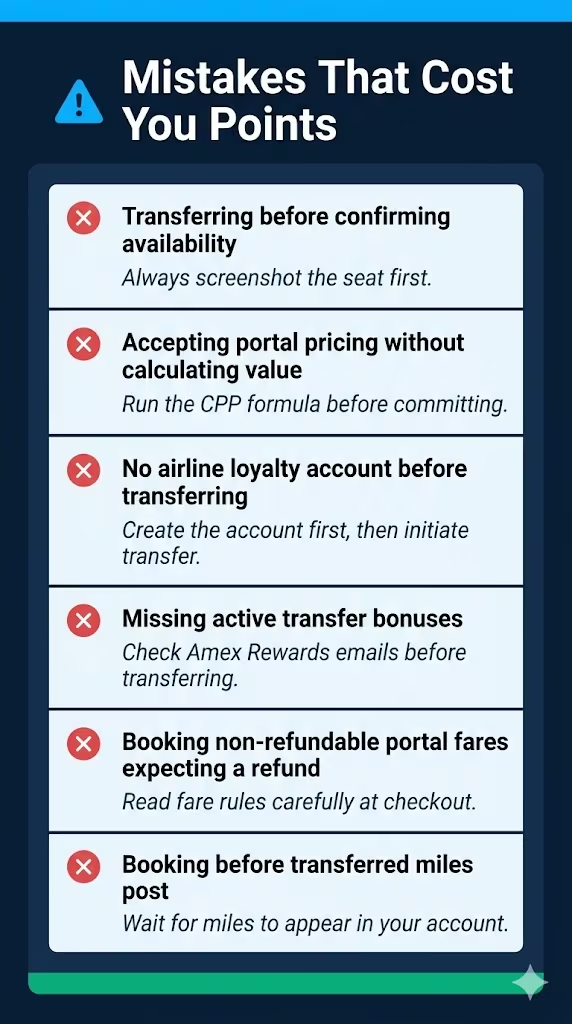
Transferring before confirming award availability.
This is the most costly mistake in points travel. Marcus, a frequent traveler, had 80,000 Membership Rewards points. He saw a flight he liked on Google Flights and decided to transfer his points to an airline.
When he went to book the award, no saver seats were available for that route or any nearby dates. His points were stranded in a SkyMiles account for months. The fix: always search for and screenshot award availability on the airline’s own site before transferring a single point.
Accepting portal pricing without calculating the value.
The Amex Travel portal is convenient, but it defaults to a redemption rate of around 1 cent per point for most flight bookings. Many cardholders accept this without realizing a transfer could get them 1.8 or 2 cents per point on the same flight. Run the cents-per-point formula before committing to any booking method.
Transferring to an airline program you haven’t created an account with yet.
Membership Rewards transfers go directly into an existing loyalty account. To transfer, first sign up for the airline’s program. Then, create an account. Wait for activation and confirm your account number. You can create a frequent flyer account for free on most airline websites in minutes.
Forgetting to check for an active transfer bonus.
Jennifer, a Platinum cardholder, transferred 50,000 points to Air France Flying Blue on a regular Tuesday. Three days later, she learned that a 30 percent transfer bonus to Flying Blue had been active for two weeks. She missed it and lost 15,000 bonus miles. Checking for active bonuses takes two minutes and can meaningfully increase what you get from a transfer.
Booking through the portal on a refundable fare and expecting a full points refund.
Some portal bookings allow changes or cancellations, but the refund policy varies by fare class and airline. Read the fare rules carefully during checkout. If you book non-refundable fares with points through the portal, you might get a travel credit. You won’t get your points back in your account.
Booking the award flight before transferring miles post.
Some cardholders rush to book their award seat after a transfer is confirmed. But they find the miles aren’t in their airline account yet. Award seats can vanish while you wait. This is especially true on busy routes with few options. Wait until the miles appear in your balance before completing the booking.
Frequently Asked Questions (FAQs)
How much are 50,000 Amex Membership Rewards points worth for flights?
At the portal’s standard rate of 1 cent per point, 50,000 points are worth $500 toward flights. Using a transfer partner with saver award pricing, those same points can be worth $750 to $1,000 or even more, based on the route.
How much are 100,000 Amex points worth for flights?
Through the Amex Travel portal, 100,000 points are worth roughly $1,000 in flight bookings. When you transfer points to an airline partner for a premium international route, those points can be worth $1,500 to $2,500. That’s about 1.5 to 2.5 cents per point.
How many Amex points do you need for a $500 flight?
Through the Amex Travel portal at 1 cent per point, a $500 flight costs around 50,000 points. A transfer partner redemption on the same flight could cost as few as 25,000 to 30,000 miles if saver award space is available.
What will 30,000 Amex points get me for flights?
At the portal rate of 1 cent per point, 30,000 points cover about $300 in airfare. Transferred to an airline partner at 1.5 cents per point, the same points deliver roughly $450 in travel value, making a short domestic or regional route realistic.
How much are 70,000 Amex points worth?
At 1 cent per point through the portal, 70,000 points are worth $700 in flights. You can redeem points at 1.5 cents each. This gives you about $1,050. That amount can pay for a transatlantic economy ticket on a partner airline.
Is it worth it to use Amex points for flights?
Yes, especially for international and premium cabin bookings. Transfer partner redemptions can give you 1.5 to 2.5 cents per point. For domestic flights under $300, paying cash often makes more sense. You can save your points for a better trip later.
What is the best thing to spend Amex Membership Rewards points on?
Long-haul international flights and business or first-class cabin bookings through airline transfer partners typically produce the highest value, often 2 cents per point or more. Domestic economy flights through the portal generally return the lowest value at around 1 cent per point.
Does Amex charge a fee to transfer Membership Rewards points to airlines?
No, American Express does not charge a fee to transfer Membership Rewards points to airline loyalty programs. You enter your frequent flyer account number, choose how many points to transfer, and the miles are delivered to your airline account at the standard ratio with no cost beyond the points themselves.
Can you transfer Amex points to more than one airline for the same trip?
Yes, you can split transfers across multiple airline programs as long as each transfer goes to a loyalty account you already own. Each transfer is processed separately and is irreversible, so confirm award availability with each airline before initiating any transfer.
Is it smart to use Amex points for flights rather than paying cash?
Aim for a redemption value above 1.5 cents per point, which is realistic for international or premium transfer partner bookings. For domestic flights yielding only 0.8 to 1 cent per point, pay cash and save your points for better value.
Wrapping Up
To use Amex Membership Rewards points for flights, you have two choices. First, decide which booking method works for your trip. Second, check if the points are worth the value. The Amex Travel portal works well for last-minute bookings and airlines without a transfer partner.
Transferring redemptions, especially for long-haul and premium routes, offers better value. Just know where to look and check availability before moving your points.
Aim for 1.5 cents per point or more for flight redemptions. This is a realistic goal based on the benchmarks in this guide.
If this helped you plan your next redemption, share it! Tell someone with unused Amex points.