
I’ve been there too. You’ve been swiping your Discover it Miles card for months, watched the balance grow, and now you’re staring at a flight you want to book. The catch? You can’t quite figure out how Discover miles actually become a flight discount. There’s no booking portal, no obvious “use miles for travel” button at checkout, and the rules around the 180-day window feel confusing.
Here’s the short answer: you pay for the flight first with your card, then redeem your miles as a statement credit to wipe out the cost.
Read on for the full walk-through, the math, and the timing rules that make this work.
Key Takeaways
This guide explains how to redeem Discover miles for flights, including the reimbursement booking process, the flat mile-to-dollar conversion rate, the 180-day redemption window, and how leftover miles apply to other travel costs.
Core Facts:
- Discover uses a reimbursement model: you book and pay for the flight first, then apply miles as a statement credit against that specific charge, with no booking portal or award seat search involved.
- Every 100 Discover miles equals $1 in statement credit, a flat 1 cent per mile rate that applies regardless of airline, fare class, or travel dates.
- There is no minimum redemption amount, so miles can be applied starting from 1 mile, and any unused portion of a flight cost can be paid normally.
- Miles must be applied to a specific flight charge within 180 days of the purchase date, though the flight itself does not need to occur within that window.
- Discover miles themselves never expire as long as the account stays open and in good standing, separate from the 180-day rule on individual charges.
- Eligible travel categories beyond flights include hotels, car rentals, cruises, trains, buses, rideshares, gas stations, tolls, parking, and campgrounds, all coded by merchant category.
Best for:
- Discover it Miles cardholders who have an accumulated balance and want to apply it toward an already booked or upcoming flight.
- Cardholders confused about the 180-day redemption window who need clarity on the difference between charge eligibility and mile expiration.
- Anyone deciding between redeeming miles for travel statement credit versus cash back, direct deposit, or retail checkout options like Amazon and PayPal.
How Discover Miles Redemption for Flights Actually Works
Most people expect to log in, click “book a flight,” and see prices listed in miles. Discover doesn’t work that way. There is no travel booking portal, no partner airline transfer chart, and no award seat search. The system uses a reimbursement model, which is a fancy way of saying you pay first and get paid back.
Here’s the order of operations you need to follow:
- Book your flight directly with the airline (or any travel site you like). Pay with your Discover it Miles card.
- Wait for the charge to post to your account. This usually takes 1 to 3 days.
- Log in to Discover, go to Rewards, and apply your miles as a statement credit against that specific travel charge.
The credit shows up on your statement and reduces your balance owed. Your miles drop by the amount you used. That’s the whole process. This makes Discover it Miles flight redemption refreshingly simple compared to airline programs with blackout dates and dynamic award pricing. It’s a flat, non-transferable rewards program, but the trade-off is total flexibility on which flight, which airline, and which fare or class you book.
The 100 Miles = $1 Conversion Rate
The math is dead simple. Every 100 miles equals $1 in statement credit. That works out to 1 cent per mile, every single time. There are no tiered redemption rates, no “peak season” penalties, and no bonus value for booking through a specific airline. A $250 ticket on Delta is worth the same in miles as a $250 ticket on Spirit: 25,000 miles flat.
This penny-per-mile value applies across every redemption method Discover offers, which we’ll get to later. Once you understand this fixed rate, planning becomes easy. Multiply the flight price by 100, and you have the exact miles you need.
Minimum Redemption Amounts
You can redeem any amount, starting from 1 mile. Discover removed the old $20 minimum years ago. That means even a balance of 500 miles ($5) can knock $5 off a travel charge. There’s no need to save up for a big redemption.
💡 Pro Tip: Since miles never expire and there’s no minimum, treat your balance like cash sitting in a savings account. Use whatever you have whenever a travel charge posts, even small amounts.
What Travel Purchases Qualify for Mile Redemption
A lot of cardholders think “travel” means only flights. Discover’s definition is much broader, and knowing the full scope helps you use up leftover miles after your main booking.
Eligible travel purchase categories include:
- Airlines and airfare (any carrier, any route)
- Hotels, motels, and resorts
- Car rental agencies
- Cruise lines
- Travel agencies and online booking sites
- Trains and passenger rail
- Buses and shuttles
- Taxis and rideshares like Uber and Lyft
- Gas stations
- Tolls and parking
- Timeshares
- Campgrounds
The charge has to be coded by the merchant as one of these travel-related categories. That’s an industry standard set by the merchant category code system, so a coffee shop at the airport won’t count, but the Uber to the airport will.
This wider net is why rideshares and gas stations are useful for soaking up leftover miles after the flight is paid off. The statement credit vs cash back choice doesn’t matter for value, but using miles against a travel charge keeps the redemption clearly tied to your trip.
Step-by-Step: Redeeming Discover Miles for Your Flight
Once your flight charge posts to your account, the redemption itself takes about two minutes. Follow these steps in the Discover mobile app or on the website.
- Log in to your Discover account.
- Tap or click Rewards from the main menu.
- Select Ways to Redeem.
- Choose Travel or Reimburse Travel (the exact wording shifts slightly between the app and the desktop site).
- You’ll see a list of recent eligible travel charges. Pick the flight purchase.
- Enter the mile amount you want to apply. You can cover the full charge or just part of it.
- Confirm. The statement credit posts within 1 to 2 billing cycles, but usually appears within a few days.
That’s it. No phone calls, no forms, no waiting on hold. The Miles Available to Redeem figure updates instantly, so you can see your new balance.
Checking Your Mile Balance Before You Redeem
Before you book, confirm how many miles you actually have. From the Discover home screen, your Cashback Bonus and Miles balance show near the top. You can also tap Rewards to see a full history of earnings and redemptions. Knowing your exact balance helps you decide whether to cover the full flight or just part of it.
Redeeming by Phone Instead of Online
Prefer to talk to a person? Call 1-800-DISCOVER (1-800-347-2683). The automated system can handle simple redemptions, or you can ask for an agent. This route is helpful if your charge isn’t showing up online yet, or if you want to confirm a charge qualifies as travel before you apply miles. The phone option uses the same conversion rate and the same rules, so there’s no difference in value.
How Many Miles Do You Need to Cover Your Flight
The formula is one line:
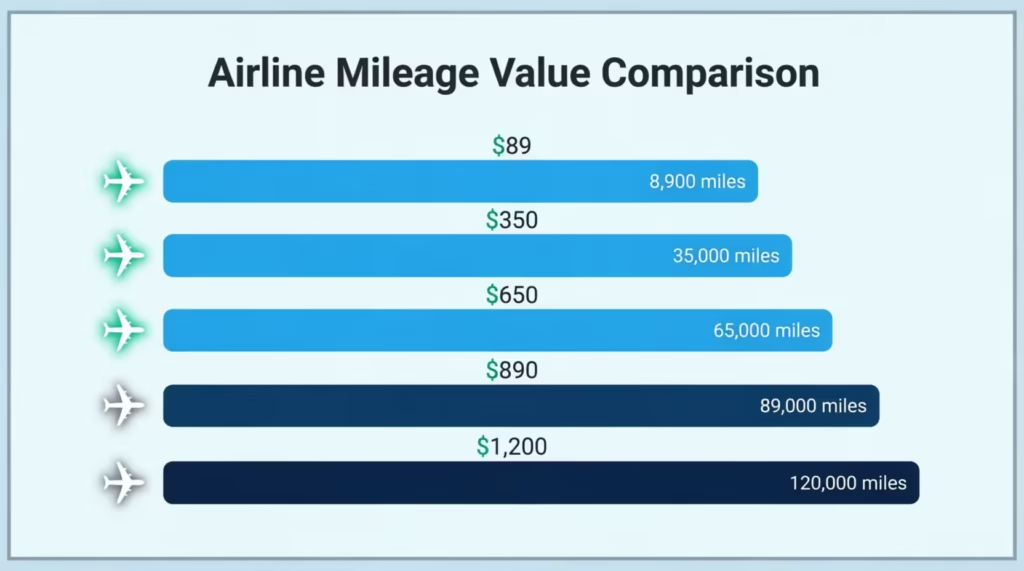
Flight cost in dollars × 100 = Miles needed
Let’s walk through some real numbers so you know what your balance covers.
| Flight Cost | Miles Needed |
|---|---|
| $89 (budget one-way) | 8,900 miles |
| $250 (domestic round-trip) | 25,000 miles |
| $400 (cross-country round-trip) | 40,000 miles |
| $750 (Hawaii or premium domestic) | 75,000 miles |
| $1,200 (international economy) | 120,000 miles |
If you’ve been spending around $1,500 a month on the card at the standard 1.5x miles rate, you’re earning roughly 27,000 miles per year.
That’s enough for a typical domestic round-trip every 12 to 14 months. New cardholders also get a Mile-for-Mile match at the end of year one, which can double your first-year balance and bring a free flight much closer.
Redeeming Miles for Part of a Flight Cost
You don’t have to wipe out the entire charge. Partial redemption works the same way as full redemption. Here’s the worked math:
Sarah, a marketing coordinator at a Boston-based consulting firm, books a $420 flight to Denver. She has 22,000 miles. She applies all of them, which equals a $220 statement credit.
Her remaining balance owed on the flight drops to $200, which she pays normally. Her mile balance is now zero, but she covered more than half the ticket cost.
Partial redemption is the right move when you don’t have enough to cover the full price, or when you want to save some miles for later travel charges like hotels or rideshares.
What Happens If You Don’t Have Enough Miles
Nothing bad. You just apply whatever you have and pay the rest. There’s no penalty, no fee, and no requirement to cover a minimum portion of the charge.
If you only have 5,000 miles and your flight costs $300, you can still knock $50 off. The remaining $250 sits on your card balance like any other purchase.
⚠️ Mistake to Avoid: Don’t wait to “save up enough” for a full redemption. Miles applied today reduce your interest-bearing balance now. Holding out for a full coverage redemption can cost you more in interest than the redemption is worth.
The 180-Day Window for Redeeming Miles Against a Flight Purchase
This is the single rule that catches most cardholders off guard. You have 180 days from the date the flight charge posts to your account to apply miles against it. After day 180, that specific charge is no longer eligible for travel redemption.
Note the important detail: the clock starts on the purchase date, not the travel date. So if you book a flight in January for an October trip, you need to redeem miles against that charge by roughly late July. The flight itself doesn’t have to happen within 180 days. Only the redemption needs to.
In practice, the 180-day redemption window is plenty of time for almost everyone. The cardholders who run into trouble are people who book flights very far in advance and forget to log in. Set a calendar reminder for 60 days after the booking date, and you’ll never miss it.
Miles themselves never expire
Here’s the reassuring part. Your miles balance never expires. As long as your Discover account stays open and in good standing, the miles sit there indefinitely. Discover also guarantees that if your account closes, any unredeemed miles are paid out as a check or statement credit.
So two different rules are running at the same time:
- Miles in your account: Never expire.
- A specific travel charge: Eligible for mile redemption for 180 days from the purchase date.
Once you understand this, the timing rule stops feeling stressful. You’re not racing a deadline on your miles. You’re just making sure you apply them to a specific charge within six months of buying it.
Using Leftover Miles on Other Travel Costs From Your Trip
After your flight is paid off, any extra miles can do more work on the same trip. This is where the “maximize the trip” angle pays off.
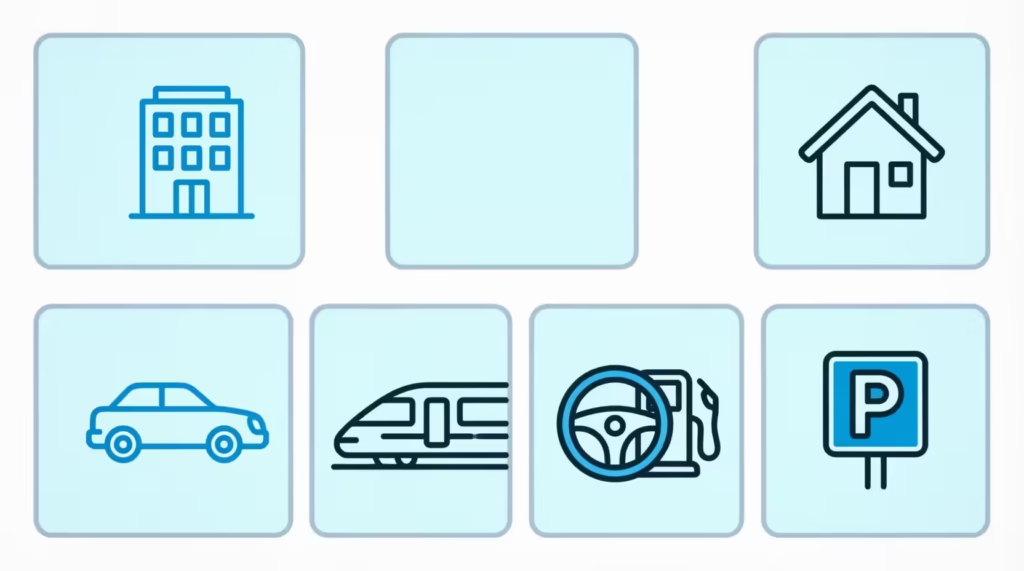
Eligible travel purchases during your trip include:
- Hotel nights
- Airbnb bookings (these usually code as travel)
- Rental cars and gas for the rental
- Rideshares and gas stations on the way to the airport
- Train tickets, bus fare, and ferry rides
- Parking at the airport
- Tolls during the drive
Each of these charges has its own 180-day window starting from when it posts. So a trip with multiple travel charges gives you multiple separate redemption opportunities, all at the same penny-per-mile value.
Michael, a software engineer at a Chicago tech startup, booked a $310 flight to Austin and used 31,000 miles to cover it. After the trip, he had 14,000 miles left.
He applied 8,500 against the $85 Uber rides during the trip and 5,500 against his $55 airport parking charge. Total trip cost reduction: $450 for 45,000 miles, all at the same flat rate.
Travel Redemption vs. Cash Back vs. Amazon and PayPal: Which Is Best for Your Flight
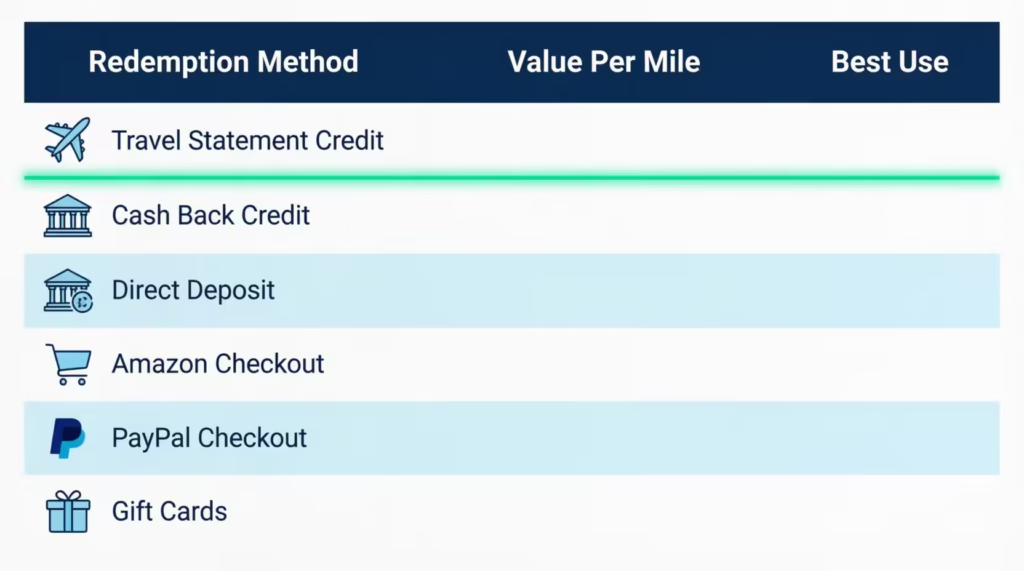
A lot of cardholders worry they’re “wasting” miles if they don’t use them on travel. Discover removes that worry by paying the same penny-per-mile value across every redemption method. Here’s the side-by-side.
| Redemption Method | Value Per Mile | Best Use |
|---|---|---|
| Statement credit against a travel charge | 1 cent | Direct flight cost reduction |
| Cash back as a statement credit (any purchase) | 1 cent | Pay down your card balance |
| Direct deposit to a bank account | 1 cent | Pull miles out as actual cash |
| Pay with Discover Cashback Bonus at Amazon | 1 cent | Quick Amazon checkout |
| PayPal redemption at checkout | 1 cent | Online shopping anywhere PayPal works |
| Gift cards from partner brands | 1 cent (sometimes more during promos) | Gifts or pre-planned spending |
Notice that no method beats the others on raw value. The choice comes down to what you want the money for. If your goal is a flight, applying miles directly to the flight charge keeps the link clean and tracked.
If you’d rather get cash and book through a third-party travel site for points or rewards from another program, direct deposit redemption gives you the same dollar amount with more flexibility.
📌 Did You Know: Unlike most airline miles programs that lose value during peak travel times, Discover’s 1 cent per mile rate never changes. A holiday flight and a Tuesday morning flight cost the same in miles, dollar for dollar.
For most flight-focused readers, the travel statement credit is the simplest path. It clears the charge from the same bill, keeps your records clean for budgeting, and uses the miles for their intended purpose. But the value is identical no matter which option you pick, so there’s no “wrong” choice.
Frequently Asked Questions (FAQs)
How many Discover miles do I need for a flight?
Multiply your flight cost in dollars by 100 to get the miles needed. A $250 round-trip costs 25,000 miles, while a $750 flight costs 75,000 miles.
How do I use my Discover miles for flights?
Book and pay for your flight with your Discover it Miles card first, then log in to Rewards and apply your miles as a statement credit against that charge. The credit typically posts within a few days.
How much are 50,000 Discover miles worth?
50,000 Discover miles is worth exactly $500 in statement credit. Discover pays a flat 1 cent per mile with no tiers or bonus categories.
How much is 20,000 miles worth on a credit card?
20,000 Discover miles equals $200 in statement credit. This flat penny-per-mile rate applies whether you use the miles for travel, cash back, or Amazon purchases.
Do Discover miles ever expire?
No, Discover miles never expire as long as your account stays open and in good standing. The only time limit is on individual travel charges, which must have miles applied within 180 days of the purchase date.
Can I transfer Discover points to airlines?
No, Discover miles cannot be transferred to any airline program. Discover uses a reimbursement model instead, where you pay for the flight first and then redeem miles as a statement credit against that purchase.
What airlines accept Discover miles?
Discover miles work with any airline since they’re not tied to a specific carrier or transfer partner. You can book with Delta, Spirit, or any other airline and redeem miles at the same flat rate of 1 cent each.
How do I convert my Discover miles to cash?
You can redeem miles as a direct deposit to your bank account at 1 cent per mile. This gives you actual cash instead of a statement credit, at the same value as every other redemption method.
Is there a minimum amount of Discover miles needed to redeem?
No, Discover removed its old $20 minimum, so you can redeem starting from just 1 mile. Even a small balance of 500 miles can knock $5 off a travel charge.
What happens if I don’t have enough miles to cover my flight?
You simply apply whatever miles you have and pay the remaining balance normally. There’s no penalty or fee for partial redemption, so a 5,000-mile balance can still cover $50 of a $300 flight.
Bottom Line
Discover Miles flight redemption works on a reimbursement model: book the flight, let the charge post, then apply miles as a statement credit at a flat 1 cent per mile. The 180-day window applies only to specific charges, while your mile balance itself never expires.
Based on the flat-rate structure, the most effective approach for most readers is applying miles directly to the travel charge within the 180-day window, then sweeping leftover miles onto hotels, rideshares, and parking from the same trip.
If a friend or family member is sitting on a growing Discover miles balance and hasn’t booked travel yet, share this guide so they can turn those miles into a real flight before the next vacation.