
You were about to check out, and then a button appeared: “Pay in 4.” Now you’re wondering: what is buy now pay later, and what are you actually agreeing to if you tap it? That hesitation is smart, because the answer is not the same for every plan.
Buy now pay later is a type of point-of-sale financing that splits a purchase into scheduled payments, and the short “pay in 4” version is usually interest-free.
Below is what you’ll learn:
- How these plans work.
- The differences between the two main types.
- Changes in credit reporting for 2025 and 2026.
- What happens if you miss a payment.
- Tips to decide if BNPL is right for your next purchase.
At a Glance
This guide explains what buy now pay later (BNPL) is, how pay-in-4 and installment plans work, how 2025-2026 credit bureau reporting changes affect your score, and how to decide if BNPL fits a purchase.
Core Facts:
- BNPL splits a purchase into scheduled payments through a separate point-of-sale lender, not the retailer, with a common pay-in-4 structure requiring 25% down at checkout and three more payments over six weeks.
- Pay-in-4 plans are typically 0% interest, while longer installment loans running 6 to 36 months can carry an APR, with Affirm’s example range disclosed as 0% to 36% based on credit.
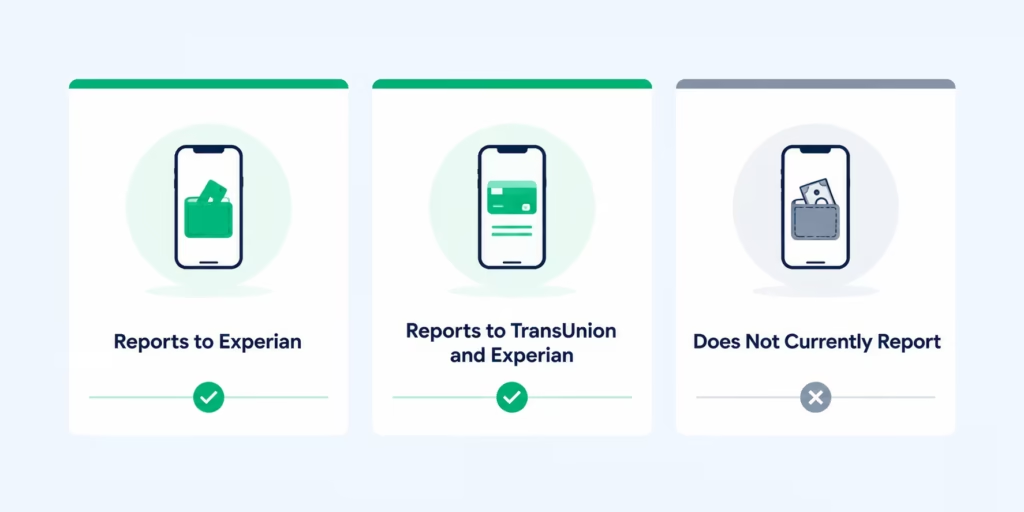
- Affirm reports payment plans issued on or after April 1, 2025 to Experian, Klarna reports to TransUnion and Experian, and Afterpay does not currently report to US credit bureaus.
- FICO has released two scoring models, FICO Score 10 BNPL and FICO Score 10 T BNPL, built to factor BNPL account data into a credit score, though not all lenders use them yet.
- Missing a payment can trigger a late fee, a temporary freeze on new purchases with that provider, and a report to credit bureaus for providers that furnish this data.
- The CFPB withdrew its 2024 interpretive rule treating some BNPL products like credit cards in May 2025, leaving dispute and refund protections less standardized than traditional credit cards.
Best for:
- Shoppers deciding whether to use a “Pay in 4” button at checkout for a planned, budgeted purchase.
- Readers with limited credit history who want to understand how BNPL payment activity may now appear on their credit report.
- Anyone currently juggling more than one BNPL plan who wants to understand the combined cost and risk.
What Buy Now Pay Later Actually Is
Buy now pay later, often shortened to BNPL, is a deferred payment option offered at checkout. Instead of paying the full price today, you split the cost into a small number of scheduled payments over a set period.
One detail matters more than any other: the store is not the one giving you credit. A separate company, called a point-of-sale lender, pays the merchant in full right away. You then owe your payments to that lender, not to the retailer. This is why refunds, disputes, and late payments are handled by the BNPL provider, a topic covered in detail later in this article.
Most plans also start with a down payment at checkout. On the common pay-in-4 structure, that’s typically 25% of the price due on the spot.
One more thing to clear up early: “interest-free” is real, but it applies mainly to short-term pay-in-4 plans. Longer installment plans are a different product, and they can carry a real APR. The next major section breaks down that difference.
How a Pay-in-4 Plan Works, Step by Step
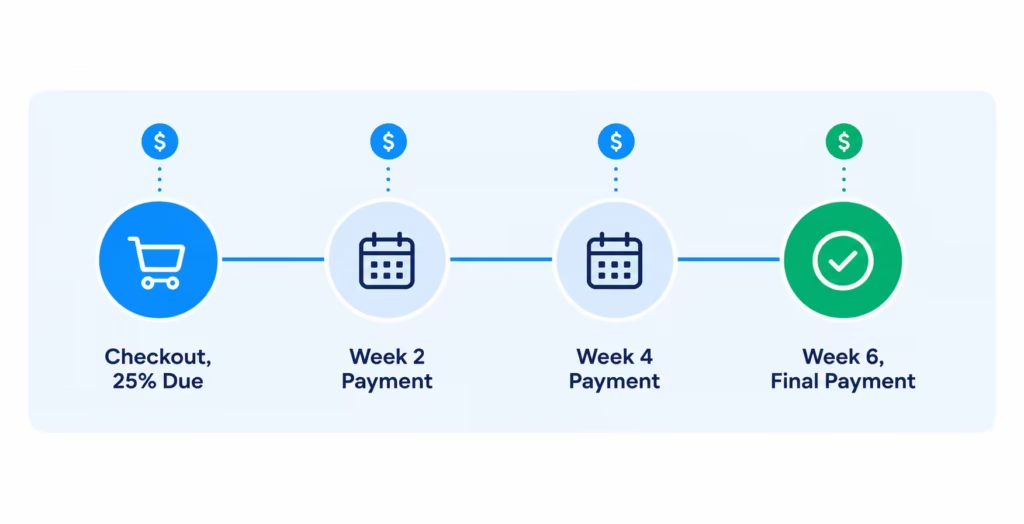
A pay-in-4 plan follows a simple pattern. Say you buy a $200 jacket:
- At checkout: You pay 25% up front. That’s $50.
- Two weeks later: The second $50 payment is charged.
- Week four: The third $50 payment is charged.
- Week six: The final $50 payment closes the plan.
The whole purchase is paid off in about six weeks. Payments usually come out automatically through autopay from a linked debit card or bank account. So, the money is deducted unless you change the settings.
Not every pay-in-4 plan follows this exact structure. Some use different timing or payment counts, so read the schedule shown before you confirm.
Where and How You Can Use BNPL
You’ll see BNPL in three main places. First, many online stores show it as a button right at checkout. Second, provider apps, browser extensions, and one-time virtual cards let you use a plan at stores that don’t offer it directly. Third, in-store checkout is growing, often through a virtual card in the provider’s app.
It’s not accepted everywhere. Availability depends on both the retailer and the provider.
Who Offers Buy Now Pay Later
The names you’ll see most often at checkout are Klarna, Afterpay, Affirm, PayPal Pay in 4, and Sezzle. Each one sets its own plan lengths, fees, and credit policies, and those differences are big enough to deserve their own comparison page, so this article stays at the overview level.
Usage is now mainstream. The Federal Reserve’s household survey found that the top reasons people use BNPL are wanting to spread out payments (87% of users) and convenience (82%).
Who Tends to Use BNPL and Why
Federal Reserve survey data shows BNPL use is most common among younger adults and people with thinner credit files. The reasons are clear: avoid credit card interest, manage cash flow between paychecks, and spread a big purchase over several weeks without getting a new credit card. None of these reasons are wrong on their own. The risk comes from how the product is used, a theme this article returns to several times.
Types of Buy Now Pay Later: Pay-in-4 vs. Installment Loans
This is the single most important distinction in the whole article, because “BNPL” is really two different products wearing one name.
Pay-in-4 plans are short-term. They usually last about six weeks, cover smaller purchases, and charge 0% interest. Affirm’s pay-in-4 option, for example, is always 0% APR per Affirm’s published terms.
Longer-term installment loans run from about 6 to 36 months and cover bigger purchases. These can carry interest. Affirm’s longer loans range from 0% to 36% APR based on your credit, which is disclosed before you accept.
Here’s how to tell which one you’re being offered:
| Clue at checkout | Pay-in-4 | Installment loan |
|---|---|---|
| Number of payments | 4 | 6 to 36 monthly payments |
| Timeline | About 6 weeks | Months to years |
| Interest | Usually 0% | Often an APR is shown |
| Typical purchase size | Smaller | Larger |
The cost difference is not trivial. A $1,000 purchase on a 12-month plan at 30% APR costs roughly $170 in interest. The same purchase on a 0% pay-in-4 plan costs nothing extra. Two buttons can say “buy now, pay later,” but the totals can differ. So, check the payment count and look for an APR disclosure before you tap confirm.
How BNPL Approval Works
Approval is fast by design, and the process is lighter than a credit card application.
For most pay-in-4 plans, providers use a soft credit inquiry or no traditional credit check at all, so applying doesn’t hurt your score. Afterpay, for instance, states that it does not run credit checks that affect your credit score. Affirm notes that checking your eligibility won’t affect your credit either.
Longer installment loans can involve a deeper review, especially for larger amounts. Terms vary by provider and by loan size, so the safe habit is to read the eligibility language on the screen before accepting.
A few things to keep in mind about the process:
- Decisions are usually instant, based on limited underwriting rather than a full credit review.
- Approved amounts tend to be smaller and tied to a specific purchase, not a revolving credit line.
- “No hard credit check” means applying is low-risk for your score. It does not mean the loan has no consequences, as the next two sections explain.
Does Buy Now Pay Later Affect Your Credit Score?
For years, the honest answer was “mostly no.” That answer is now out of date, and it’s the biggest recent change in how BNPL works.
Historically, BNPL activity was not reported to the major credit bureaus. That’s changing fast. Affirm now reports payment plans issued on or after April 1, 2025, to Experian, per its official credit reporting policy. Klarna confirms that it shares loan and repayment information with TransUnion and Experian. Afterpay, by contrast, says it does not currently report to credit bureaus in the United States.
What this means for you, in plain terms:
- On-time payments can help. For people with limited credit history, reported BNPL payments can start building a file.
- Missed payments can now hurt. A late payment may show up on your credit report, just like a late payment on any other credit account.
- The rules differ by provider and are still expanding. “Not reported today” is not a promise of “never reported.”
📌 Did You Know: A missed payment on a $30 BNPL installment now has the same impact on your credit report as a missed credit card payment. This wasn’t the case just a few years ago.
FICO’s New BNPL-Inclusive Scoring Models
The reason this shift has real teeth is a change at the scoring level, not just the reporting level. FICO announced two new models, FICO Score 10 BNPL and FICO Score 10 T BNPL, built specifically to factor BNPL account data into a credit score.
The models were developed using large-scale data from BNPL lending, including research done with Affirm. Lenders using them can see a BNPL-inclusive score alongside a traditional score and compare the two.
Rollout has been gradual, and not every lender uses the new models yet. But the direction is clear: BNPL is being pulled into the mainstream credit system, so treating it as invisible debt is no longer a safe assumption.
What Happens If You Miss a BNPL Payment
This is the question that matters most before you commit, so here’s the direct answer.
In the short term, expect a late fee and a possible freeze on new purchases with that provider until you’re current again. Many providers will pause your account in their ecosystem after a missed payment.
In the longer term, the missed payment may be reported to the credit bureaus, now that several major providers furnish data. That can lower your score and affect future credit applications.
If you do miss a payment, act in this order:
- Pay the overdue amount as soon as you can. Fees and reporting risk grow with time.
- Contact the provider. Some will work with you if you reach out early.
- Turn on autopay or set a reminder for every remaining due date.
Outcomes vary by provider and by how long the payment stays overdue, so quick action genuinely matters here.
Late Fees and Other Costs to Watch For
“Interest-free” does not mean “cost-free if things go wrong.” The fee structure to know:
- Flat late fees. Klarna’s longer pay-over-time terms list a late fee of up to $7 per missed payment, with total late fees capped at 25% of the order value. Other providers use similar flat-fee structures with their own caps.
- Fees compound per missed payment. Each missed installment can trigger its own fee, so two or three slips multiply the cost.
- Lost promotional terms. On some longer installment loans, a missed payment can affect promotional 0% terms or trigger interest, depending on the contract.
For context, credit card late fees are typically several times larger than a $7 BNPL fee. The real danger with BNPL isn’t one big fee. It’s multiple small plans that create several small fees at the same time. This links directly to the phantom debt problem explained below.
Is Buy Now Pay Later a Loan? Your Legal Protections
Functionally, yes. BNPL is a form of short-term consumer credit, even when it’s marketed as just a payment method. A lender gives you money’s worth of goods now, and you repay on a schedule. That’s a loan.
Your legal protections, though, are less settled than the product itself. In 2024, the Consumer Financial Protection Bureau released a rule. This rule treated some BNPL products like credit cards under Regulation Z. It aimed to standardise dispute and refund rights. In May 2025, the CFPB withdrew that interpretive rule, leaving the federal picture unsettled.
The practical consequences:
- Dispute rights and refund processes are not standardized the way they are for credit cards under the Truth in Lending Act.
- Protections can differ meaningfully from one provider to the next.
- Some states are developing their own rules, so coverage may also depend on where you live.
The takeaway is simple: don’t assume credit-card-level protection. Check the specific provider’s dispute and refund terms before a large purchase.
Returns, Refunds, and Disputes With BNPL Purchases
Returns usually start the normal way: you send the item back to the retailer under the store’s return policy. The complication happens on the payment-plan side.
Refund timing varies by provider, and your remaining scheduled payments may not pause automatically while the return is processed. In some cases, you need to keep paying until the refund is confirmed, then wait for the provider to settle the plan.
Disputes can also work differently. A credit card chargeback follows a legally defined process. A BNPL dispute follows the provider’s own policy, which may be narrower.
⚠️ Mistake to Avoid: Don’t put a costly item, like furniture or electronics from a new seller, on BNPL before checking the provider’s refund and dispute policy. If the item never arrives, the fix may be slower and less predictable than a credit card chargeback.
The Risk of Using Multiple BNPL Apps at Once
Each pay-in-4 plan looks small on its own. The problem is that no single screen shows you all of them. Your plans live in separate apps, from separate lenders, and nothing consolidates them.
Researchers at the Federal Reserve Bank of Richmond call this “phantom debt”: obligations that are real but easy to lose sight of, partly because BNPL borrowing has historically been underreported.
Here’s how fast it adds up. Imagine four active plans:
- Plan A: $75 every two weeks
- Plan B: $100 every two weeks
- Plan C: $100 every two weeks
- Plan D: $125 every two weeks
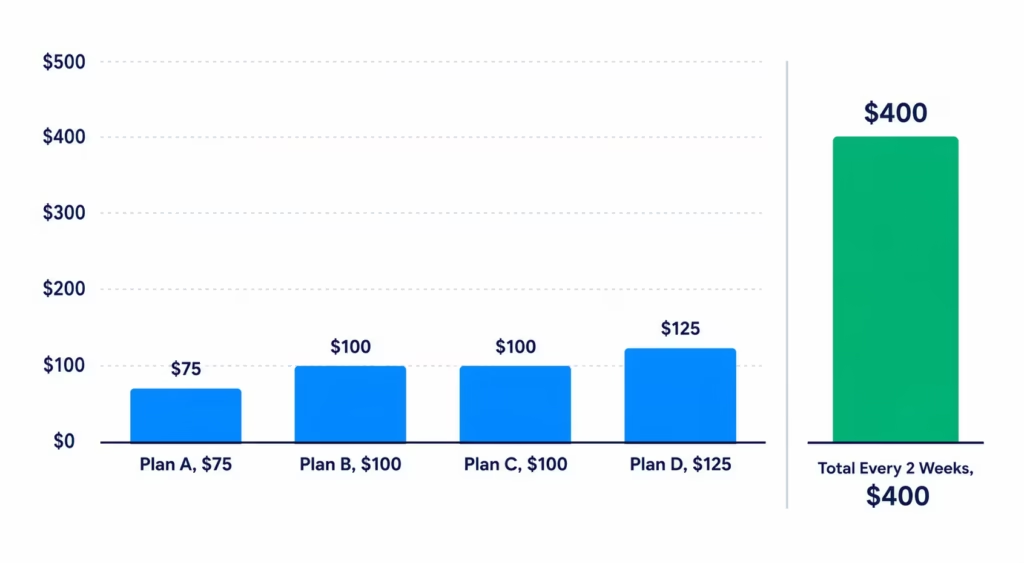
Each plan felt manageable at checkout. Together, they demand $400 every two weeks, roughly $800 a month, on top of rent, utilities, and everything else. The cash-flow squeeze arrives even though no single purchase seemed like a stretch.
How to Track Your Total BNPL Obligations
The fix is boring but effective:
- List every active plan in one place: provider, remaining balance, and each due date. A notes app or a simple spreadsheet works.
- Add the payments to your budget as recurring bills, next to rent and utilities, so you see the true monthly total.
- Set a reminder or autopay for each plan. Autopay is usually the default, but confirm it’s linked to an account that will actually have the funds.
- Check your credit reports periodically at AnnualCreditReport.com, the federally authorized free report site. As more providers report, your reports are one of the few places where several BNPL accounts appear together.
💡 Pro Tip: Before opening a new plan, look at your combined biweekly total across all active plans. If adding the new payment would strain the next two paychecks, that’s your answer.
BNPL vs. Credit Cards: Key Differences
Both let you buy now and pay over time, but they are structurally different products:
| BNPL pay-in-4 | Credit card | |
|---|---|---|
| Cost | Usually 0% interest, small late fees possible | Interest if you carry a balance; APRs are often well above 20% |
| Credit impact | Growing; several major providers now report, practices vary | Fully reported, always, to all three bureaus |
| Dispute protections | Set by provider policy; federal picture unsettled | Legally defined chargeback and billing-error rights |
| Approval | Instant, light underwriting, purchase-specific | Fuller underwriting, but you get an ongoing credit line |
| Rewards | Generally none | Cash back or points are common |
A few honest conclusions fall out of this table. For a planned purchase you can comfortably pay off in six weeks, a 0% pay-in-4 plan avoids the interest a carried credit card balance would charge.
For big purchases or those likely to be returned, a credit card is often better. It offers dispute rights and rewards, as long as you pay your bill in full. And since BNPL now touches your credit report in many cases, the old “it doesn’t count” advantage has largely faded.
When Buy Now Pay Later Makes Sense (and When It Doesn’t)
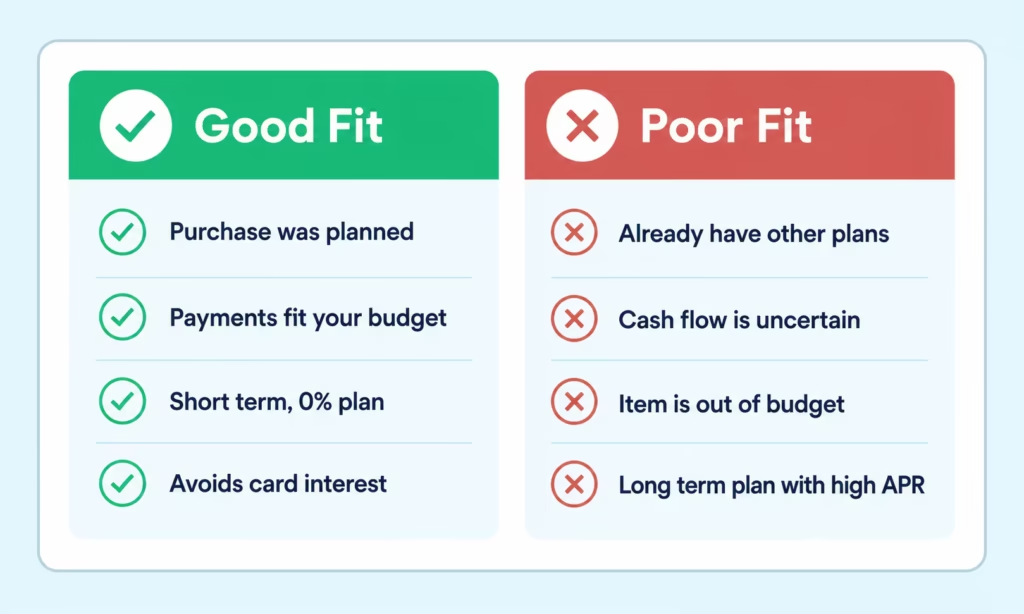
Everything above comes down to one decision at checkout. A plan tends to be a good fit when:
- The purchase was already planned and budgeted.
- You’re confident you can make every payment on schedule, even if something small goes wrong.
- It’s a short-term 0% plan, not a longer loan carrying a meaningful APR.
- You’d otherwise carry a credit card balance and pay interest.
It tends to be a poor fit when:
- You already have several active plans running at once.
- Your cash flow over the next six weeks is uncertain.
- The plan is the only way to afford the item, which usually means the item is out of budget right now.
- The offer is a longer installment loan at a high APR.
Before tapping “Pay in 4,” run three quick questions: Was this purchase planned? What’s my total biweekly BNPL obligation after adding this plan? Have I read this plan’s fees and terms? Three good answers mean BNPL is working as a tool. A weak answer on any of them is a reason to pay another way or wait.
Tips for Using Buy Now Pay Later Responsibly
Durable habits matter more than any single decision:
- Use BNPL only for planned, budgeted purchases. Checkout buttons are designed to trigger impulse buys. A plan that starts as an impulse is the one most likely to go wrong.
- Limit how many plans run at once. One or two active plans are trackable. Five are a second rent payment you can’t see in one place.
- Turn on autopay and back it with a reminder. Autopay prevents forgetfulness; the reminder makes sure the money is actually in the account.
- Read the specific plan’s terms before confirming. Payment count, APR if any, late fee amount, and the provider’s refund policy take under two minutes to check.
- Check your credit reports a few times a year. With reporting expanding, your reports are now part of how you monitor BNPL, not just cards and loans.
Keep these habits consistent for every transaction. If you find yourself relying on these services just to make ends meet, stop immediately. BNPL should never bridge a gap in your regular monthly income. When in doubt, it is always safer to save up and pay in full later. Treating these services with caution keeps your financial health secure.
Frequently Asked Questions (FAQs)
What is buy now pay later (BNPL)?
BNPL is a point-of-sale financing option that splits a purchase into scheduled payments instead of one lump sum. The most common version, pay-in-4, charges 25% upfront and splits the rest into three payments over about six weeks, usually at 0% interest.
Who uses BNPL most?
Younger adults and people with thinner credit histories use BNPL most often. Common reasons include avoiding credit card interest and spreading a purchase across paychecks without opening a new credit card.
Is buy now, pay later a trap?
BNPL itself isn’t a trap, but it can become one if you run several plans at once or use it for purchases you can’t otherwise afford. Treating it as a planned bill rather than free money keeps the risk low.
What are the downsides of buy now, pay later?
Missed payments can trigger late fees and may now appear on your credit report, since providers like Affirm and Klarna report to bureaus. Multiple small plans across different apps can also add up to a large biweekly total without you realizing it.
Is it hard to get approved for buy now, pay later?
No, most pay-in-4 approvals are instant and use a soft credit check or no traditional check at all. Longer installment loans for bigger purchases may involve more review, especially for larger amounts.
Can you have more than one BNPL plan at a time?
Yes, most providers allow multiple active plans, and there’s no single screen showing your total across different apps. Four plans of $75 to $125 each can quietly add up to around $400 due every two weeks.
Is buy now, pay later the same as a payday loan?
No, pay-in-4 BNPL is usually 0% interest with a fixed six-week schedule, while payday loans charge very high fees for short-term cash advances. Longer BNPL installment loans can carry an APR, but it’s disclosed upfront, unlike typical payday loan terms.
Does using BNPL affect your ability to get a credit card later?
It can. Affirm, Klarna, and similar services now report payment history to credit bureaus. So, making on-time BNPL payments can help build your credit file. But missed payments can lower your score and hurt future approvals.
What’s the biggest mistake people make with BNPL?
The most common mistake is treating each small plan as separate rather than adding up the combined total. Keeping all active plan amounts and due dates in one place, along with rent and other bills, helps avoid unexpected cash-flow issues.
The Bottom Line
Buy now pay later is short-term financing that splits a purchase into scheduled payments. The 0% interest applies mainly to pay-in-4 plans, while longer installment loans can charge a real APR.
Approval is easy, but the obligations are serious. You might deal with late fees, provider limits, and effects on your credit report. This is because of expanded bureau reporting and FICO scores that include BNPL.
A practical approach is to treat every plan like a bill: keep them few, track the combined total, and read the terms first. If this guide cleared things up for you, share it with a friend who taps “Pay in 4” without reading the fine print.