
You have probably seen a number like “50,000 points” sitting in your credit card account and wondered what it actually means. Is that real money? Why is the bank giving it away? And why do the same points buy a $200 gift card in one place and a $700 flight in another? This confusion around credit card points is common, and it costs people real value.
The short answer: credit card points are a loyalty currency that your card issuer creates and controls. You earn them by spending, and their dollar value depends entirely on how you redeem them.
This guide explains where points come from, how you earn them, what they are really worth, and how to redeem them without losing value to bad redemption choices, devaluation, or expiration.
At a Glance
This guide explains what credit card points are, how they are earned and funded, how to calculate their real cash value, and how to avoid losing value to devaluation, expiration, or poor redemption choices.
Core Facts:
- Credit card points are a rewards currency controlled by the issuer, funded by interchange fees that merchants pay on card transactions.
- Point values typically range from about half a cent to more than 2 cents each, depending on the program and redemption method.
- Point value can be calculated with a simple formula: dollar value received divided by points used, multiplied by 100 for cents per point.
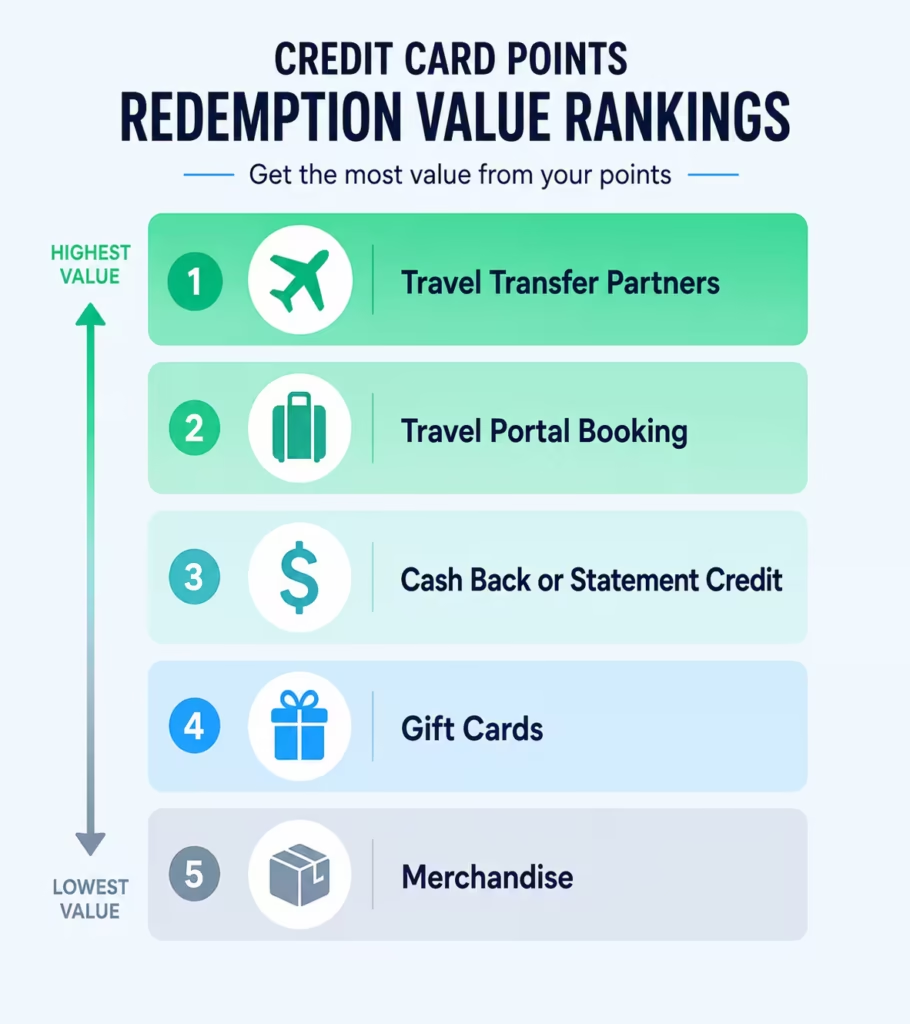
- Redemption value generally ranks from highest to lowest as travel transfers, travel portal bookings, cash back or statement credit, then gift cards or merchandise.
- Points are typically forfeited when an account closes unless redeemed or transferred first, and some programs expire points after a set period of inactivity.
- Carrying a balance can erase reward value, since typical credit card interest rates far exceed typical rewards rates of 1 percent to 3 percent.
Best for:
- Readers deciding between a new rewards credit card and unsure how points, cash back, and miles compare.
- Cardholders with an existing points balance who want to redeem it without losing value to a poor redemption choice.
- Anyone concerned about point devaluation, expiration, or losing points after closing an account.
What Credit Card Points Actually Are
Credit card points are a rewards currency issued by your card company. They are not cash. They are not backed by the government, and no bank guarantees their value. The issuer sets the rules for how you earn them, what they are worth, and when they can be taken away.
The basic loop is simple. You spend money on the card. The issuer gives you points based on that spending. You redeem those points for travel, cash back, gift cards, or other options. What trips people up is that the value of a point is not fixed. It changes based on the program and the redemption method you pick.
Issuers also prefer points over plain cash for a reason. Points give them control over redemption value. A dollar of cash back always costs the issuer a dollar. A point can cost them less or more depending on how you use it. That is why points come with more rules, more options, and more fine print than cash back.
Why Credit Card Points Exist (How They’re Funded)
Points are not free money the bank invents. They are funded by interchange fees, which are the processing fees merchants pay every time you swipe or tap a card.
Part of that fee revenue flows back into rewards programs. Research from the Federal Reserve documents this mechanism and finds that rewards are partly funded by higher merchant costs that get spread across all shoppers, including those who pay with cash or debit.
This funding model matters to you for one practical reason. Because rewards are an expense the issuer manages, the terms can change. Earning rates, redemption values, and transfer ratios can all shift when the underlying economics shift. Points are real value, but they are value the issuer controls.
How You Earn Credit Card Points
Most earning confusion comes from one place: not understanding the difference between the default rate and bonus categories. Once you see how the pieces fit, reading your own card’s terms gets much easier.
Base Earning Rates vs. Bonus Category Multipliers
Every rewards card has a base earning rate. On many cards, this is 1 point per $1 spent, often written as “1x.” That rate applies to every purchase that does not fall into a special category.
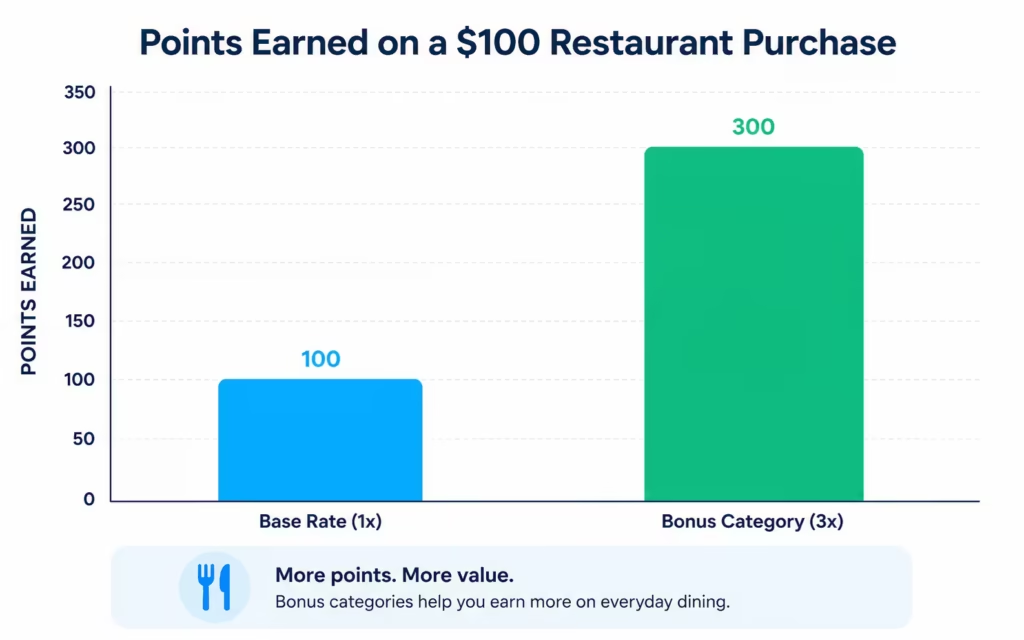
On top of the base rate, many cards offer bonus categories with an earning multiplier. A card that advertises “3x on dining” pays 3 points per $1 at restaurants instead of 1. Common bonus categories include dining, travel, groceries, and gas. This is why the same $100 dinner can earn 100 points on one card and 300 on another.
Two details catch people off guard:
- Rotating vs. fixed categories. Some cards keep the same bonus categories all year. Others rotate them each quarter, and you may need to activate the new categories to earn the higher rate.
- Category caps. Many multipliers stop applying after you spend a set amount in a period. Once you hit the cap, earning drops back to the base rate.
The practical move: pull up your card’s rewards terms and note which categories earn more than 1x and whether a cap applies. That tells you which purchases belong on that card.
Sign-Up Bonuses and Minimum Spend Requirements
A sign-up bonus (also called a welcome offer) is usually the single largest earning event a card offers. The typical structure is simple: spend a set amount within a set number of months, and the issuer awards a large lump of points. A typical bonus can be worth several hundred dollars in travel, depending on the program and how you redeem.
Two cautions apply. First, do not manufacture spending just to hit a minimum spend requirement. Buying things you did not need turns a bonus into a net loss. Time a new card around purchases you were already planning.
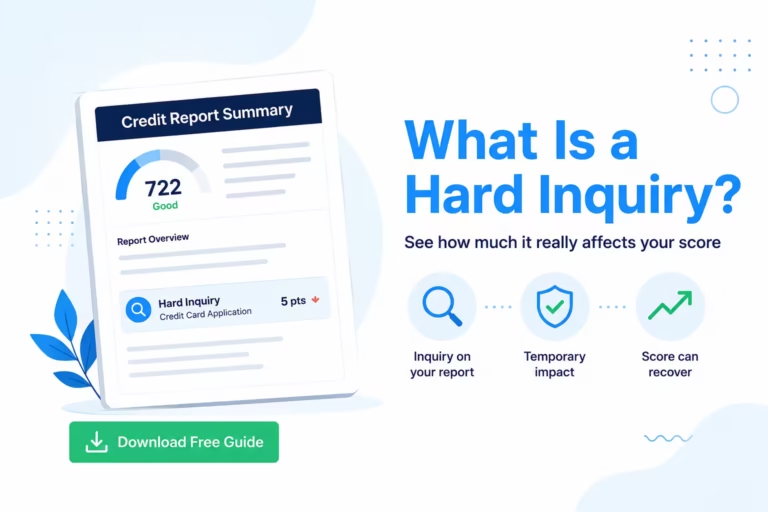
Second, opening a new card involves a hard inquiry and a new account on your credit report, which can affect your credit scores in the short term. The impact varies by person and credit profile.
How Point Values Differ by Issuer and Program
There is no universal exchange rate for points. Each issuer runs its own program and sets its own values, so 40,000 points on one card can be worth a very different dollar amount than 40,000 points on another.
As a rough range, a point can be worth anywhere from about half a cent to more than 2 cents, depending on the program and the redemption path. The same points can even produce different values inside one account.
For example, Chase’s own Ultimate Rewards page states that points used at checkout with certain retail partners are worth $0.008 each, or 80 cents per 100 points, while the same points can be worth more when redeemed for travel through the program’s other options.
Big transferable points programs, like Chase Ultimate Rewards and American Express Membership Rewards, usually offer better value. This is because you can transfer points to airline and hotel partners.
Fixed-value or store-card points usually sit at the lower, more predictable end. Neither is automatically better. The right question is what value you can realistically capture, which the next section shows you how to measure.
How to Calculate What Your Points Are Actually Worth
You do not need to guess whether a redemption is good. There is a simple formula you can run before every redemption:
Dollar value of what you get ÷ number of points used = value per point
Multiply by 100 to express it in cents per point.
A worked example with a 40,000-point balance:
| Redemption option | What you get | Math | Value per point |
|---|---|---|---|
| Gift card | $200 gift card | $200 ÷ 40,000 | 0.5 cents |
| Statement credit | $400 credit | $400 ÷ 40,000 | 1.0 cent |
| Travel booking | $700 flight | $700 ÷ 40,000 | 1.75 cents |
Same points. Three very different outcomes. The gift card option throws away more than 70% of the value the flight option delivers.
As a benchmark, 1 cent per point is the common floor for major programs. Anything below that is usually poor. Anything at or above about 1.5 cents is generally strong, though achievable values vary by program. For travel redemptions, use the actual cash price of the flight or hotel stay in the formula, not a fare class you would never buy.
Run this check every time, not just once. Programs change their redemption options, and the best choice today may not be the best choice next year.
💡 Pro Tip: Before redeeming for travel, open two tabs: the issuer’s travel portal and the cash price of the same flight or room on the provider’s site. The two numbers give you everything the formula needs.
Redemption Options Overview
Most programs offer a similar menu of redemption options. You will usually find them in your issuer’s online account or mobile app, under a rewards or redemption portal. Some issuers also handle redemptions by phone.
Common options include:
- Travel, booked through the issuer’s portal or by transferring points to partners
- Cash back or statement credit
- Gift cards
- Merchandise
- Event access or experiences
- Charitable donations
As a general ranking, travel redemptions tend to deliver the best value, cash back and statement credits sit near the 1-cent baseline, and gift cards and merchandise usually fall below it. The three options you will use most are worth a closer look.
Redeeming for Travel (Portal Bookings vs. Transfer Partners)
Travel is where the biggest value differences live, and there are two main paths.
Portal bookings are the simple option. You book flights or hotels through the issuer’s own travel site, and each point has a fixed value there, often 1 cent or a bit more on premium cards. You see the price, you pay with points, done.
Transfer partners take more work but can pay more. Many programs let you move points to airline miles partners or hotel loyalty programs at a set ratio, often 1:1. If the partner program prices an award flight cheaply in points compared with its cash price, your value per point can climb well past 2 cents.
Two rules protect you here. First, transfers are usually irreversible, so confirm award availability with the partner before moving any points. Second, transfer ratios and partner award pricing can and do change. Programs periodically raise the points needed for the same award, which is part of the devaluation risk covered later in this article.
Redeeming for Cash Back or Statement Credit
This is the simplest path. You convert points into a statement credit against your balance or a deposit to a linked account. The value is predictable, and for many programs this redemption defines the floor value of a point, typically around 1 cent each.
Cash redemption works well when you value simplicity over maximum value. It’s a good choice if you don’t travel or want to avoid risks like expiration and devaluation from holding a big balance. You give up upside, but you lock in a known value.
Redeeming for Gift Cards and Merchandise
Gift cards and merchandise usually deliver below-baseline value. Merchandise is often the weakest option on the menu, because the catalog price in points frequently implies well under 1 cent per point.
The fix is the formula from earlier. Before redeeming, divide the item’s retail price by the points required. If the result comes in under 1 cent, a statement credit would put more real dollars in your pocket for the same points.
One exception: if you have a small orphaned balance with no better use and no cash-out option at that size, a gift card beats letting the points expire.
⚠️ Mistake to Avoid: Redeeming straight from a checkout prompt or catalog page without checking the math. These paths are designed to be easy, not generous, and often price points below 1 cent each.
Transferable Points vs. Fixed-Value (Card-Specific) Points
This distinction explains most of the value gap between programs.
Transferable points are a bank-run currency you can move to multiple airline and hotel partners. Chase Ultimate Rewards, American Express Membership Rewards, and Citi ThankYou Points work this way. The upside is flexibility and the chance at high-value redemptions. The cost is effort: you need to research partners, compare award prices, and manage the risk that transfer ratios change.
Fixed-value points redeem at a set rate, usually only through the issuer’s own portal or as cash back. Capital One Miles, despite the name, are often used this way at about 1 cent each toward travel purchases. The value is predictable, and the process is simple, but there is little upside beyond the fixed rate.
Which fits you comes down to effort tolerance. If you enjoy comparing options and travel at least occasionally, transferable points offer more potential. If you want rewards that behave like a rebate with zero homework, fixed-value points or plain cash back will serve you better.
Points vs. Cash Back vs. Miles: Which Is Right for You
These three currencies get marketed as if they compete, but they suit different people.
Cash back is a percentage of spending returned as dollars. It requires no research, no transfer partners, and no redemption strategy. A 2% flat-rate rewards card returns 2 cents per dollar, every time, with no fine print about award charts.
Points are the flexible middle ground. Value depends on how you redeem, which means both more upside and more ways to leave value on the table.
Miles are typically tied to an airline program, either earned on a co-branded airline card or transferred in from a bank program. Value swings the most here, and miles make sense mainly for people who fly that airline or its partners regularly.
A simple decision framework:
- Rarely travel, want zero hassle: a flat-rate cash-back card.
- Spend heavily in a few categories (dining, groceries, gas): a tiered rewards card whose bonus categories match your spending.
- Travel at least once or twice a year and willing to do some research: transferable points.
The worst outcome is paying an annual fee for a travel card whose benefits you never use. Match the currency to your actual habits, not to the marketing.
Point Devaluation Risk (Why Your Points Can Lose Value Overnight)
Devaluation means the issuer or a partner program changes what your points can buy. The points needed for a flight go up. A transfer ratio gets cut. A redemption option disappears. Your balance stays the same, but its purchasing power drops.
This is not a theoretical risk. The Consumer Financial Protection Bureau’s research on credit card rewards found that consumers repeatedly report losing value to devaluation, redemption barriers, and hidden terms. The CFPB has also warned that devaluing rewards consumers have already earned can violate the law in some circumstances.
Even so, programs across the industry have continued adjusting award pricing and transfer terms, and recent waves of partner program changes have hit hotel and airline transfers alike. Because airline and hotel programs increasingly use dynamic award pricing instead of fixed charts, the points needed for a given trip can rise at any time.
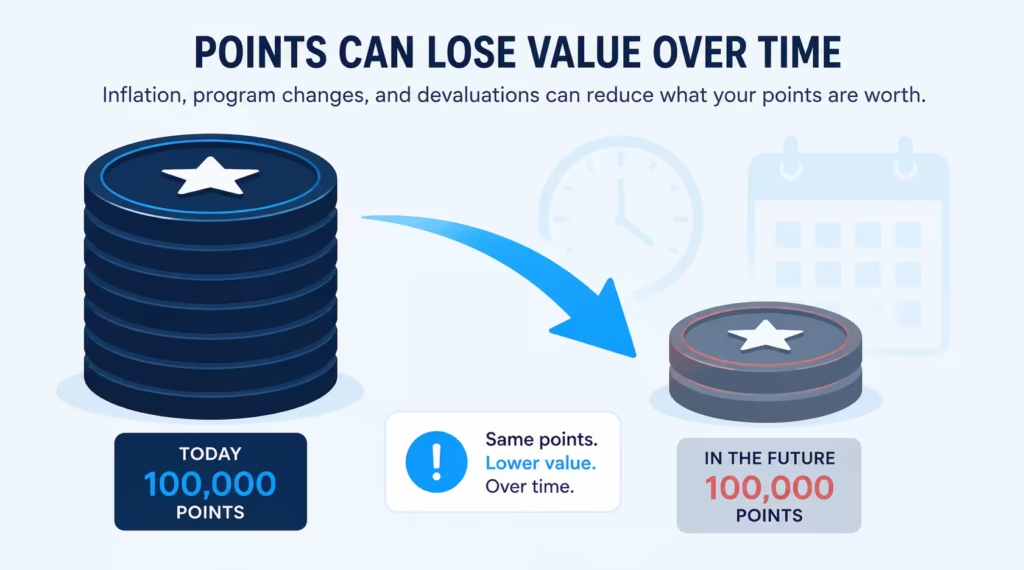
The bigger your balance and the longer you hold it, the more exposed you are. “Saving up” points for a dream trip years away means betting that the redemption chart will still be friendly when you get there.
Practical mitigation:
- Redeem within a reasonable timeframe rather than stockpiling.
- Never transfer points speculatively. Move them only when you have a specific, confirmed award ready to book.
- Treat a large points balance like perishable value, not a savings account.
Point Expiration and Forfeiture Rules
Devaluation shrinks value. Expiration and forfeiture erase it entirely.
Expiration policies vary by program. Many major bank programs keep points alive as long as your account stays open and in good standing. Others expire points after a set period of account inactivity. Where inactivity rules apply, “activity” that resets the clock typically means earning or redeeming any amount, but the exact definition is set by each program.
The safe habit: Check your card’s rewards terms for the expiration policy. If there’s an inactivity clock, ensure you make a post to the account before the deadline. The CFPB’s complaint analysis found consumers lost rewards to expiration dates imposed without adequate warning, so do not assume you will get a reminder.
What Happens to Points When You Close an Account or Miss a Payment
Closing a card is the most common way people lose points without realizing it. With most programs, points are forfeited when the account closes, unless you redeem or transfer them first. Some issuers provide a short grace period. They may allow you to keep points if you have another card in the same program. However, policies vary and are not always clear.
Missed payments can also put rewards at risk. Depending on the program’s terms, a late payment or account default can trigger forfeiture or suspension of points. The specific triggers vary by issuer, so check your cardmember agreement.
The key point is this: before you close any rewards card, redeem your balance. You can also move points to a partner or another card in the same program if that’s an option. Confirm the transfer has posted before you cancel.
⚠️ Mistake to Avoid: Canceling an old card to tidy up your wallet while a five-figure points balance is still attached to it. Redeem first, close second.
How Carrying a Balance Can Erase Your Reward Value
Rewards only pay off if you pay your statement balance in full. The math is not close.
Federal Reserve data puts the average interest rate on credit card accounts at about 21% as of mid-2026, with accounts that actually carry a balance paying more. Compare that with typical rewards rates of 1% to 3% on spending.
Carry a $3,000 balance for a year at roughly 21% APR, and you pay around $600 or more in interest. Earning 2% back on $3,000 of spending returns $60. Interest outweighs rewards by about ten to one in this example.
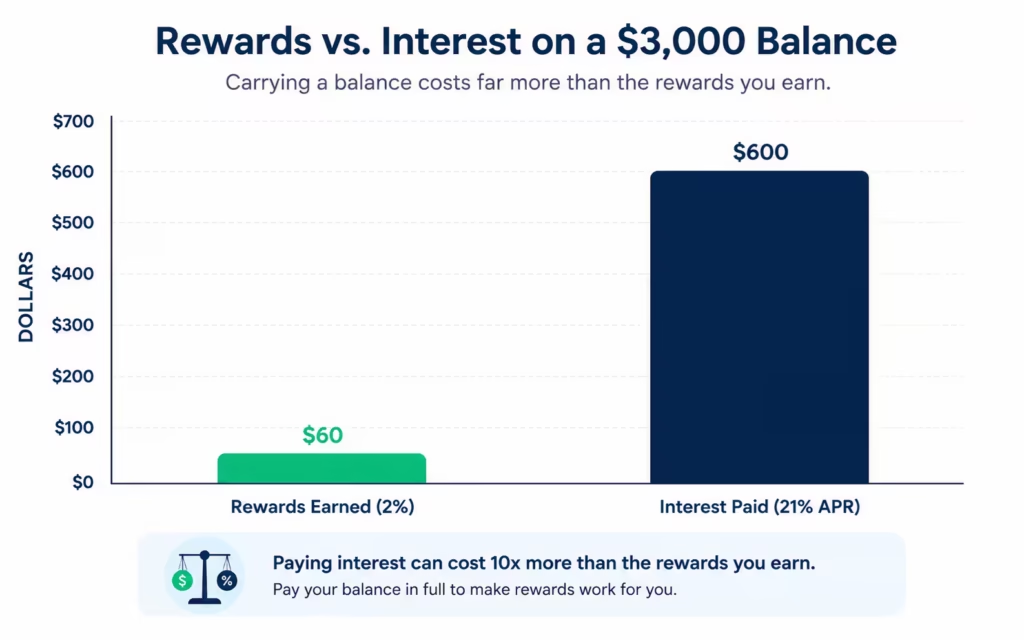
That is why a card marketed as “rewarding” can net you negative money. If you are carrying a balance, the right move is to focus on paying it down and minimizing interest, not chasing points. Once you pay in full each month, rewards become genuinely additive.
How to Choose a Rewards Card That Matches Your Spending
Choosing well is a process, not a guess. Four steps get you there.
- Audit your spending. Pull two or three months of statements and total your spending by category: dining, groceries, gas, travel, everything else. Your real pattern, not your intended one, is the input that matters.
- Match the card type to the pattern. Spending concentrated in a few categories points toward a tiered rewards card with strong multipliers there. Spending spread points toward a flat-rate card evenly. Regular travelers can consider transferable-points cards.
- Weigh the annual fee honestly. Estimate the rewards and benefits you would realistically capture in a year, based on your audit and your redemption habits. If that number does not clearly exceed the fee, a no-fee card likely serves you better. Many people pay for premium travel perks they never use.
- Check approval fit at a high level. Rewards cards, especially premium ones, generally require good to excellent credit. Approval is never guaranteed and depends on the issuer’s criteria and your credit profile.
Common Mistakes That Waste Point Value
Each of these errors is avoidable, and each maps back to a section above. Run through this list before your next redemption:
- Redeeming for gift cards or merchandise without checking the math. Always compute cents per point first. Below 1 cent usually means a statement credit is the better deal.
- Hoarding points for years. Large idle balances carry the most devaluation risk. Redeem on a reasonable timeline.
- Transferring points speculatively. Transfers are typically irreversible. Confirm award space, then transfer.
- Letting points expire through inactivity. Know your program’s expiration policy and keep the account active.
- Carrying a balance while chasing rewards. Interest at typical APRs wipes out rewards many times over. Pay in full or prioritize the balance.
- Closing a card with points still on it. Redeem or transfer the balance before you cancel.
Frequently Asked Questions (FAQs)
What are credit card points?
Credit card points are a rewards currency your card issuer creates and controls, not real cash. You earn them by spending, then redeem them for travel, statement credit, gift cards, or other options, with value that changes based on how you redeem.
Do credit card points expire?
It depends entirely on the program. Many major bank programs keep points active as long as the account stays open and in good standing, while others expire points after a set period of account inactivity.
How much money is 10,000 points worth?
At the common 1-cent floor value, 10,000 points equal about $100. Strong travel redemptions can push that closer to $150 or more, while gift cards or merchandise often fall below $100 for the same points.
How much is 50,000 points worth?
Using the typical 1-cent baseline, 50,000 points equal roughly $500. A well-chosen travel redemption at 1.5 to 2 cents per point could stretch that to $750 or even $1,000.
How much money is 100,000 points worth?
At the 1-cent floor, 100,000 points equal about $1,000. Redeeming through a strong transfer-partner travel deal at 2 cents per point could double that value to around $2,000.
What is the biggest mistake I can make with credit card points?
Redeeming for gift cards or merchandise without first checking the value per point. These options frequently price points below 1 cent each, while a statement credit or travel booking on the same balance often delivers 1 to 2 cents per point.
Is it worth it to use points to pay off a credit card?
Using points for a statement credit typically locks in about 1 cent per point, which is the common floor value for most programs. It’s simple and predictable, but usually delivers less value than a well-chosen travel redemption.
What is the smartest way to use credit card points?
Divide the dollar value of your redemption by the number of points used to get your cents-per-point figure before redeeming. Aim for at least 1 cent per point, and look toward travel bookings or transfer partners, which often land between 1.5 and 2 cents per point.
What happens to my points if I close my credit card account?
Most programs forfeit your points immediately when the account closes unless you redeem or transfer them first. Some issuers offer a short grace period, so always cash out your balance before canceling any rewards card.
Wrapping Up
Credit card points are a type of currency controlled by issuers. They come from interchange fees and can be earned through base rates, bonus categories, and welcome offers. Their value ranges from half a cent to over 2 cents, depending on how you redeem them.
Protecting value is easy:
- Do the cents-per-point math before redeeming.
- Choose travel or cash back instead of merchandise.
- Redeem rewards instead of saving them.
- Empty your account before closing a card.
- Never carry a balance just for rewards.
For many readers, a good way to start is by checking the points in your account. See what they’re worth for each redemption option today. If this guide helped you make sense of your balance, share it with a friend or family member who has points sitting unused. It could save them real money.