
Seeing the term “FICO 10” pop up in a news article, a lender conversation, or a Reddit thread can feel unsettling. You already track your credit score. You roughly know where you stand. And now there’s a new model with letters and numbers attached to it, and nobody has told you whether it changes your odds of getting approved or the rate you’ll pay. The confusion is real, and it’s made worse by the fact that “FICO 10” is actually a family of four different models, not one.
FICO Score 10 is the latest version of the FICO credit scoring model from Fair Isaac Corporation. It still uses the familiar 300 to 850 scale, but it views some behaviors differently.
Here’s what changed:
- Which lenders will use it in 2026.
- What it means for your mortgage plans this year.
- The habits that score well under it.
Let’s break it all down, step by step.
Key Takeaways
This guide explains what FICO Score 10 is, how its four-model suite differs from FICO 8 and FICO 9, which behaviors it scores differently, and what the 2026 mortgage rollout means for borrowers.
Core Facts:
- FICO Score 10 keeps the same 300 to 850 score range and score bands as FICO 8 and FICO 9, changing only the underlying scoring math.
- The FICO Score 10 Suite includes four models: FICO Score 10, FICO Score 10T (adds 24 months of trended data), FICO Score 10 BNPL, and FICO Score 10T BNPL.
- FICO Score 10T tracks whether balances are rising or falling over roughly 24 months, rewarding consistent debt paydown more than older snapshot-based models.
- On April 22, 2026, FHFA and HUD approved VantageScore 4.0 and FICO Score 10T for use in Fannie Mae, Freddie Mac, and FHA-insured mortgage underwriting, alongside Classic FICO.
- On July 1, 2026, Fannie Mae and Freddie Mac released historical credit score data covering loan performance from about 2013 to 2025 to help lenders test the new models.
- A pattern of consolidating credit card debt with a personal loan and then running the cards back up is treated as a stronger risk signal under FICO 10 than under older models.
Best for:
- Readers who want to understand why their credit score might change without any change in their habits.
- Homebuyers planning a 2026 mortgage application who want to know which scoring model their lender might use.
- Anyone using a personal loan to consolidate credit card debt who wants to avoid the specific pattern that FICO 10 flags as risky.
What Is FICO Score 10?
FICO Score 10 is a credit scoring model created by the Fair Isaac Corporation, the same company behind every FICO score you have ever had. Lenders use it to predict credit risk, which simply means the chance that a borrower will fall behind on payments in the near future.
The FICO Score 10 meaning is simpler than most people expect. It is not a new type of score. It is an update to the math. Think of it like a new version of the same phone operating system. The screen looks the same, but the code underneath runs a bit differently. The FICO Score 10 Suite changes the way older models, like FICO 8 and FICO 9, weigh and analyze data. It uses newer information on borrower behavior.
Here is what did not change:
- The score range. FICO 10 still uses the score range of 300 to 850, exactly like FICO 8 and FICO 9.
- The score bands. The familiar categories are unchanged. A score below 580 is poor, 580 to 669 is fair, 670 to 739 is good, 740 to 799 is very good, and 800 or higher is excellent.
- The core factors. Paying on time, keeping balances low, and not applying for lots of new credit still drive your score more than anything else.
So if your score is 720 under FICO 8, it is not suddenly measured on a different scale. It is still a 720-style number. What can change is whether the new math pushes that number up or down, and that depends on your specific habits, which we will cover shortly.
The FICO Score 10 Suite: Four Models Explained
One of the biggest sources of confusion is that “FICO 10” is not one model. The FICO Score 10 Suite is a family of four models. Each one is built for a slightly different data set, but they all share the same underlying credit scoring model at their core.
Here is the quick map:
| Model | What makes it different | Most likely use |
|---|---|---|
| FICO Score 10 | Base model using traditional credit report data | Credit cards, personal loans |
| FICO Score 10T | Adds 24 months of trended data | Mortgages |
| FICO Score 10 BNPL | Includes Buy Now Pay Later loan data | Future consumer lending |
| FICO Score 10T BNPL | Combines trended data and BNPL data | Future consumer lending |
The base score underneath all four is consistent. A lender does not get a wildly different number just by switching from one variant to another. The difference is in how much extra information each version considers. The next two sections explain the two variants you are most likely to hear about.
FICO Score 10T and Trended Data
The “T” in FICO Score 10T stands for trended data, and this is the single biggest change in the whole suite.
Older models, like FICO 8, look at a snapshot. They see your credit card balance on one day and score you based on that moment. FICO Score 10T looks at a moving picture instead. It reviews roughly 24 months of history and tracks whether your balances are rising, falling, or holding steady over time.
Why does this matter? Because two people can have the exact same balance today and look completely different over time. Someone who owed $9,000 a year ago and has paid it down to $3,000 looks far less risky than someone who owed nothing a year ago and has climbed to $3,000. The snapshot treats them the same. The trend does not.
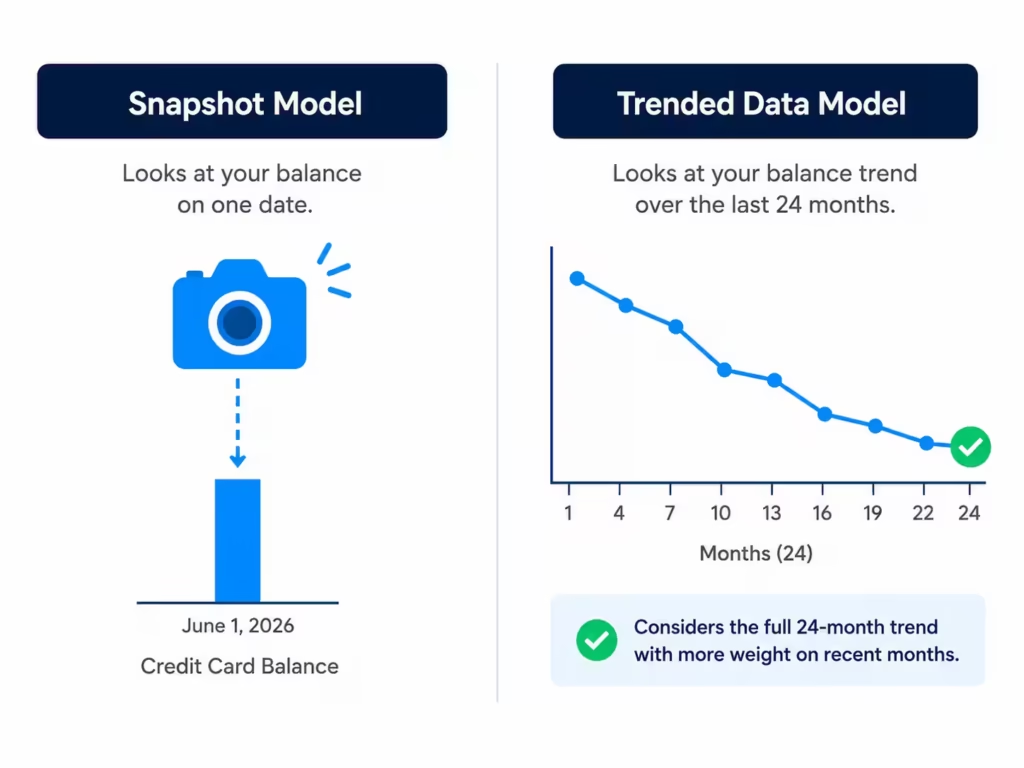
This version rewards consistent debt paydown more than older models ever did, which is exactly why the mortgage industry chose it.
FICO Score 10 BNPL and FICO Score 10T BNPL
These are the newest members of the family, announced by FICO in June 2025 and rolling out starting in fall 2025. They are designed to incorporate Buy Now, Pay Later loan data from services like Klarna, Affirm, and Afterpay.
The key design choice is aggregation. A typical BNPL user might have several small, short plans open at once. Older scoring logic could treat each one as a separate new account, making the user look artificially risky. The BNPL variants group these plans together so the pattern reads more accurately.
One key point: these models only work when BNPL data is reported to credit bureaus widely. That reporting is still growing. So these scores are real but not yet standard.
How FICO Score 10 Differs From FICO 8 and FICO 9
Now for the comparison most readers actually want: FICO 10 vs FICO 8, in plain terms.
Late payments may carry more weight. Under this scoring algorithm update, recent missed payments can cost more points than they did under FICO 8. The model’s delinquency prediction is sharper, meaning it separates likely payers from likely late payers more aggressively. FICO has reported that Score 10T is meaningfully more predictive in mortgage lending, a finding backed by independent research from Milliman.
Utilization is scored with more nuance. Under FICO 8, a high balance on statement day hurts you, even if you pay it off the next week. Under FICO Score 10T, the credit utilization trend matters. A balance that is falling month after month reads better than the same balance that has been climbing.
The fundamentals stayed put. This is not a radical departure. The model uses the same reason codes (the explanations lenders see for why a score is what it is) and a similar odds-to-score relationship. If you had good habits under FICO 8, those same habits still work.
📌 Did You Know: Millions of consumers might see a double-digit point change under FICO 10. This can happen without altering any habits. The new math just interprets their existing history differently.
How Personal Loans and Debt Consolidation Are Scored Differently
This is the change that surprises people the most, and it is best explained with a concrete story.
Meet David, a project manager at a manufacturing company. He had $12,000 spread across four credit cards and was paying painful interest. Smart move: he took out a $12,000 personal loan at a much lower rate, paid off every card, and kept making steady loan payments. Under FICO 8, his score rose nicely.
But here is where the personal loan consolidation risk shows up. Six months later, David’s cards were empty and tempting. He ran them back up to $7,500. Now he carries both the personal loan and new card debt.
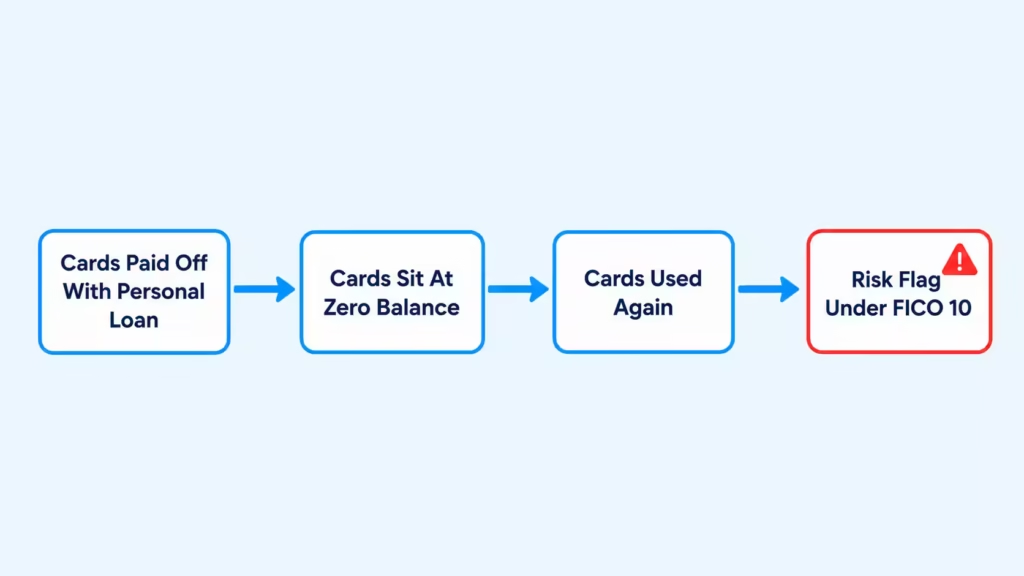
Under FICO 10, that specific pattern, consolidate then reload, is a red flag. The model treats a recent personal loan combined with rising card balances as a stronger risk signal than older models did. It is a sharper form of credit risk assessment, because the data shows this exact pattern often ends in delinquency.
What is not penalized: using a personal loan responsibly without reloading your cards. If you consolidate and keep your card balances near zero, FICO 10 does not punish you for the loan itself. The problem is the pattern, not the product.
How BNPL Loans Affect Your FICO Score 10
If you use Klarna, Affirm, or Afterpay, here is the current state of play.
First, your BNPL activity is not factored into base FICO 10 or 10T at all. Only the dedicated BNPL variants (10 BNPL and 10T BNPL) are built to read it. Those models are new, and they only produce a score when BNPL data is actually present on your credit report.
Second, when BNPL credit reporting does flow in, the models aggregate your plans. Five small active plans get grouped rather than counted as five separate risky accounts. That is friendlier treatment than older scoring logic would have given.
Third, the real-world status is still limited. BNPL providers are only beginning to report to Equifax, Experian, and TransUnion at scale. Right now, Buy Now Pay Later (BNPL) has little effect on your score. But that’s changing. Making on-time BNPL payments could help your score, while missed payments might hurt it.
Who Uses FICO Score 10 Right Now
Here is the honest answer: adoption is gradual, and each lender chooses its own model. There is no master switch.
Many credit card issuers still use FICO Score 8 because it works, their systems are built around it, and switching models is expensive. Personal loan lenders are in a similar spot. FICO 10 and 10T are available to lenders in both categories, and some have adopted them, but there is no public master list, and adoption varies widely.
Mortgages are the biggest exception, and they get their own section below. For decades, the mortgage industry has used Classic FICO, a set of much older model versions required for loans sold to Fannie Mae and Freddie Mac.
The practical takeaway: the score you see in your banking app (almost always FICO 8 or a VantageScore) may not be the score a lender pulls. That gap matters most for big loans.
FICO Score 10T and the 2026 Mortgage Industry Changes
This is the most time-sensitive part of the story, so here is exactly where things stand as of August 2026.
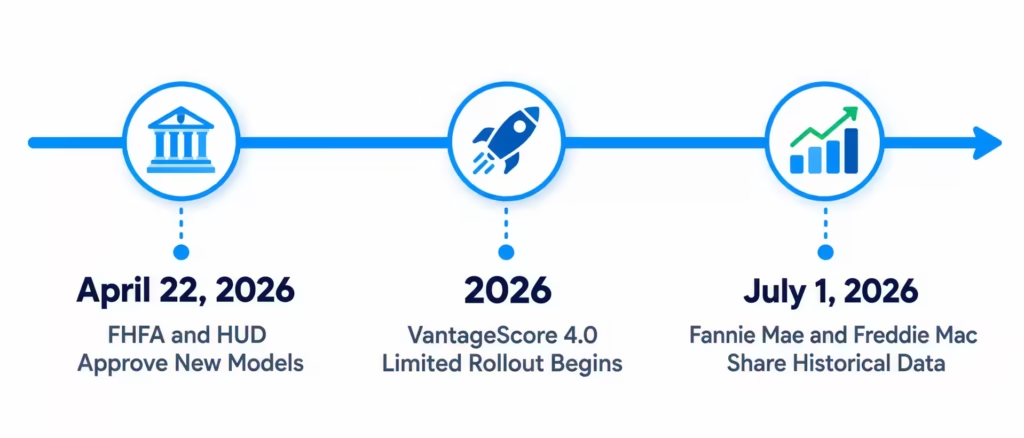
April 22, 2026. The FHFA (Federal Housing Finance Agency) said that Fannie Mae and Freddie Mac will change their selling policies. They will now accept VantageScore 4.0 and later FICO Score 10T, along with Classic FICO. On the same day, HUD announced that FHA will permit VantageScore 4.0 and FICO 10T as eligible models for FHA-insured mortgage underwriting, per the FHFA announcement. VantageScore 4.0 launched for approved lenders right away in a limited rollout. FICO Score 10T will come later.
July 1, 2026. Fannie Mae and Freddie Mac shared historical credit score data. This includes FICO Score 10T and expanded details for VantageScore 4.0. The data covers loan performance from about 2013 to 2025. This gives lenders the testing ground they need before adopting the model, as detailed on Freddie Mac’s credit score initiative page.
What has not happened: there is no fixed date for when FICO Score 10T becomes mandatory or the default. Classic FICO is not going away. Lenders can still choose it. FHA and VA timelines run separately from the GSE timeline. If you are buying a home in 2026, nothing about your approval process has to change today, but the transition is officially underway.
💡 Pro Tip: Because this rollout is still in motion, re-check the FHFA and GSE pages a few weeks before you apply for a mortgage. The model your lender uses could shift between now and your closing date.
FICO Score 10T vs. VantageScore 4.0
Since the FHFA approved these two models side by side, a quick comparison belongs here.
Both use trended data instead of just one snapshot. They can also consider alternative data, like rent and utility payments, if those are reported. Both were validated and approved by the FHFA back in October 2022 for GSE use, years before the 2026 policy update went live.
The key difference for you: the lender chooses which one to pull, and you may not know which one applies to your file. The good news is that the behaviors both models reward, paying on time and keeping balances low and falling, are the same.
Will Your Credit Score Go Up or Down Under FICO 10?
This is the question everyone asks, and the honest answer has two parts: the direction is often knowable, but the exact points are not.
Likely to score higher: consumers whose utilization trend points the right way. If your balances have been shrinking month after month for the past year or two, 10T sees that pattern and rewards it. People who consistently pay more than the minimum fall into this group.
Likely to score lower: consumers with recent missed payments, volatile or rising balances, or the consolidate-then-reload pattern described earlier. The model’s sharper delinquency prediction cuts both ways.
Not predictable: the exact point change. FICO does not publish a conversion table, and no calculator can tell you “minus 12 points.” The direction depends on your individual credit behavior patterns.
Here is the reassuring part: the core fundamentals still matter most across every model ever made. On-time payments, low utilization, and limited new credit applications carry the day under FICO 8, FICO 10, and whatever comes next.
How to Find Out Which FICO Version a Lender Uses
You do not have to guess. Three practical steps:
- Ask the lender directly. Before you apply, ask: “Which credit scoring model and version do you pull for this product?” Loan officers hear this question more often than you would think, especially for mortgages.
- Know what your free apps actually show. Bank apps and Credit Karma typically show FICO 8 or VantageScore 3.0. Those are useful for tracking your health, but they are not necessarily the number a lender will see.
- Use a paid service for version details. A myFICO subscription shows various FICO versions, like FICO 10 and 10T. This is the best way to see what a lender might check.
Where to Check Your FICO Score 10
Set your expectations first: most free apps show FICO 8, not FICO Score 10. If you want to see this specific version, here are your real options:
- myFICO. Fair Isaac Corporation’s consumer service provides access to many FICO versions. This includes FICO 10 and FICO Score 10T, available through paid plans. You can see the available versions at the myFICO credit education page.
- Your lender, upon request. Some lenders will share the exact score they used for your application. If you are denied or given worse terms, you usually have the right to know that score.
- Your free score as a proxy. Your FICO 8 from a bank app will not match your FICO 10 exactly, but it moves in the same direction for the same reasons. Watching it still tells you plenty.
How to Score Well Under FICO Score 10
Everything above boils down to a short list of behaviors. None of them are exotic. All of them matter a bit more now than they used to.
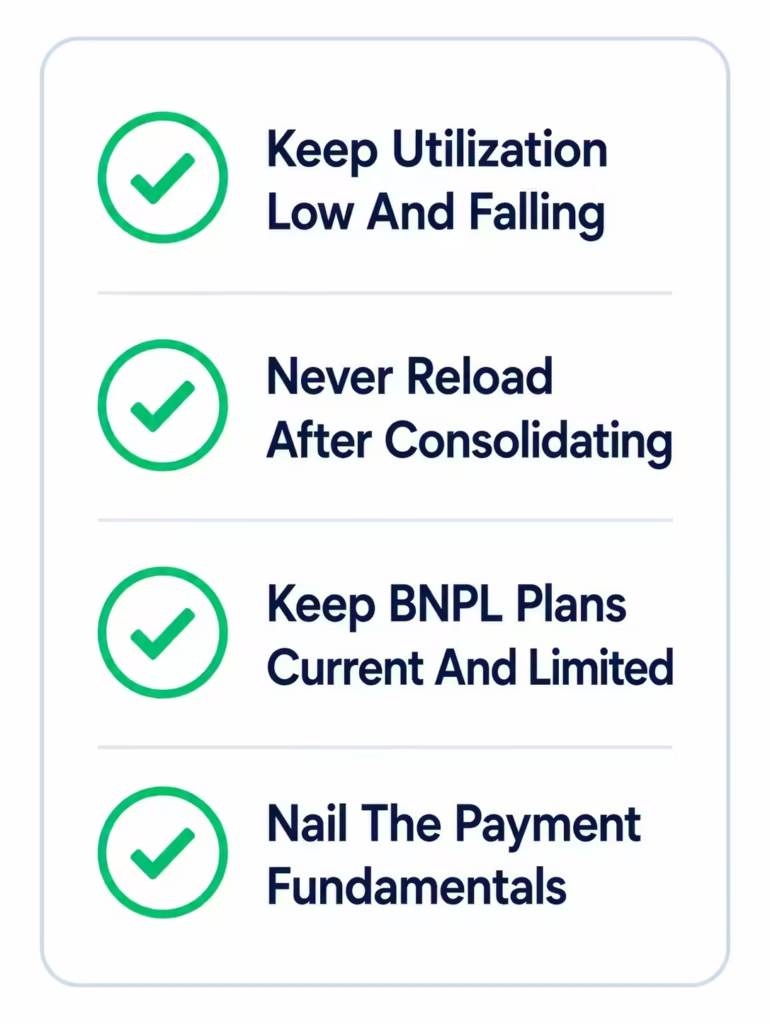
- Keep utilization low and falling: The credit utilization trend is the new star. Aim to have each month’s total balance lower than the one before, even by a small amount. Consistency beats one heroic payoff.
- Never reload after consolidating: If you use a personal loan to pay off cards, treat those cards as off-limits until the loan is gone. Consider lowering their limits or removing them from your digital wallet to remove the temptation.
- Keep BNPL plans current and limited: Please pay each installment on time, and avoid stacking many concurrent plans. Today’s invisible plans may be tomorrow’s reported tradelines.
- Nail the fundamentals: on-time payments, every time, no exceptions. Keep new credit applications rare and purposeful. These habits have survived every scoring algorithm update ever released, and they will survive the next one too.
⚠️ Mistake to Avoid: Do not freeze your finances out of fear of the new model. Avoiding all credit activity to “wait out” FICO 10 backfires, because a quiet, aging file gives the trended data nothing positive to work with.
Frequently Asked Questions (FAQs)
What is a FICO score of 10?
“FICO score of 10” usually means FICO Score 10, the newest version of FICO’s credit scoring model, not a literal score of 10 points. It still uses the standard 300 to 850 scale, just with updated math for weighing your credit behavior.
What’s the difference between FICO 8 and FICO 10?
FICO 10 weighs recent missed payments more heavily and reads utilization as a trend rather than a single snapshot. A balance that’s been falling for months scores better under FICO 10 than under FICO 8, even if the current balance is identical.
Do any mortgage lenders use FICO 10?
As of August 2026, mortgage lenders are moving to FICO Score 10T. This change follows the FHFA’s approval of FICO Score 10T and VantageScore 4.0 for Fannie Mae and Freddie Mac loans in April 2026. Classic FICO is still allowed too, so lenders can choose either during this rollout.
Why is my FICO 10 score lower than expected?
A lower FICO 10 score often shows missed payments or higher balances. This model detects delinquencies better than older versions. Consolidating debt with a personal loan and then running your credit cards back up is a specific pattern FICO 10 penalizes.
What’s the lowest FICO score to buy a house?
Minimum scores vary by loan type and lender, so this isn’t something FICO 10 changes on its own.
Is FICO score 8 a real credit score?
Yes, FICO Score 8 is a real, widely used version of the FICO model, and it’s the version most bank apps and Credit Karma display for free. It’s still commonly used by credit card and personal loan lenders even as FICO 10 becomes available.
How do I raise my FICO 10 score?
Keep your total balance lower each month than the month before, since falling utilization is what FICO 10 rewards most. Avoid running up credit cards again after paying them off with a personal loan, and always pay on time.
Is a FICO score the same as a credit score?
FICO is one type of credit score, but not the only one. VantageScore is the other major model, and both are calculated from the same credit report data using different formulas.
Is there a FICO Score 9?
Yes, FICO Score 9 exists and came before FICO Score 10 in the model’s history. The article focuses on FICO 8 and FICO 10 as the more commonly referenced comparison points.
Which FICO score matters most for a mortgage in 2026?
It depends on the lender, since Classic FICO is still allowed while FICO Score 10T is being phased in for Fannie Mae and Freddie Mac loans. Ask your loan officer directly which version they pull, since there’s no single mandatory model yet.
The Bottom Line
FICO Score 10 updates the math but keeps the basics. It still uses the 300 to 850 scale, the same score bands, and core rules. Now, it focuses more on balance trends, personal loan behavior, and BNPL activity.
For most readers, the best way is simple: pay on time, lower balances, and don’t reload cards after consolidation. These habits look good to lenders, no matter what version they check. If a mortgage is in your near future, ask your lender which model they use before you apply.
If you know someone house-hunting in 2026 or paying down card debt, share this with them. It could spare them a very confusing surprise at the lender’s desk.