
Carrying a balance on your American Express card can feel like running on a treadmill. You pay every month, but the balance barely moves. That is because a big chunk of each payment goes to interest, not your actual debt. If you are wondering how to get Amex to lower your interest rate, you are not alone, and you are not stuck.
The direct answer: yes, you can call American Express and ask for a lower APR, and many cardholders with solid payment histories do get one.
This guide walks you through the whole process. You will learn who to call, what to have ready, exactly what to say, and what to do if the first answer is no.
Key Takeaways
This guide explains how to get American Express to lower your interest rate, including who to call, what to have ready, a sample negotiation script, and backup options like Plan It, balance transfers, and the Financial Relief Program.
Core Facts:
- Amex’s main customer service line is 1-800-528-4800, available 24 hours a day, 7 days a week, and phone calls work better than in-app or online chat for rate negotiation requests.
- A standard APR reduction request only involves a soft credit pull, which does not affect your credit score, unlike a credit limit increase request that can trigger a hard inquiry.
- The Federal Reserve’s G.19 data shows the average rate on credit card accounts that pay interest sits above 22%, and dropping from 24% to 19% on a $6,000 balance saves roughly $300 a year.
- Approval odds depend mainly on account tenure, payment history over the last 12 months, overall credit standing, and any competing offers from other issuers.
- If Amex declines a rate reduction, alternatives include the Plan It program for splitting new purchases into fixed payments, a balance transfer card, or calling back later with an improved account record.
- The Amex Financial Relief Program, reached at 1-866-703-4169, can lower rates and reduce payments for genuine hardship, but it typically suspends charging privileges and may freeze or forfeit Membership Rewards points.
Best for:
- Cardholders who have paid on time for six or more months and want to reduce interest costs on an existing balance.
- People who can afford their payments but want better terms, rather than those facing genuine financial hardship.
- Anyone who received a rate increase notice or a competing balance transfer offer and wants leverage before calling Amex.
Does American Express Actually Lower Interest Rates?
Many people assume credit card rates are fixed, like a mortgage rate. That is not quite true. American Express does consider requests to lower Amex interest rate charges on existing accounts, especially when the request reaches its retention team.
A few things to keep in mind:
- It is not guaranteed. Amex reviews your account before agreeing to any change.
- It is not automatic. You have to ask. Amex rarely lowers a rate on its own.
- Success is more common than most people think. Cardholders who have paid on time for a year or more often have real room to negotiate Amex APR terms.
The Federal Reserve’s G.19 consumer credit data shows the average rate on credit card accounts that actually pay interest sits above 22%. Even a cut of a few points saves real money. On a $6,000 balance, dropping from 24% to 19% saves roughly $300 a year in interest.

So the request is worth making. The worst outcome is a polite no, and you are no worse off than before you called.
How to Contact American Express About a Lower APR
Calling the wrong line is the fastest way to waste an afternoon. You dial, sit through a phone menu, and land with someone who cannot help. Skip that frustration and go straight to the right channel.
The main American Express customer service number is 1-800-528-4800. Lines are open 24 hours a day, 7 days a week. You can also find every current contact option on the American Express contact page. When the automated system answers, say “representative” or press 0 to reach a live person faster.
You have three main ways to make an Amex APR reduction request:
- Phone. This tends to work best. Retention offers are easier to discuss in a real conversation, and reps can check your account on the spot.
- In-app chat. Log in to the Amex app and tap the chat icon. This works, but chat agents sometimes have less authority to approve rate changes.
- Online account chat. Same idea, through the website instead of the app.
Phone is the stronger option for this specific ask. When you ask Amex for lower interest by phone, you can respond in real time, ask for a supervisor, or request a transfer to the retention department.
What to Have Ready Before You Call
Walking in prepared is the difference between a flat no and a real conversation. Reps respond to specifics, not vague pleas. Spend ten minutes gathering these items first:
- Your current APR. Find it on your latest billing statement, usually in the “Interest Charge Calculation” section, or in your online account under card details.
- Your card or account number. Have the physical card in hand for verification questions.
- Your account tenure. Know how long you have been a cardholder. Two years of history sounds a lot better than “a while.”
- Your recent payment history. Know whether you have missed any payments in the last 12 months, and when.
- Your reason. Decide how you will frame it. Common reasons include planning to pay down the balance faster, receiving better offers from other issuers, or tighter finances.
That last point matters more than people expect. Jennifer, a marketing manager in Chicago, called with her statement open and mentioned a 0% balance transfer offer she had received in the mail. The rep put her on hold for two minutes and came back with a rate 4 points lower. Preparation gave her leverage.
💡 Pro Tip: Pull up your online account before you dial. If the rep quotes a number that does not match your statement, you can correct it on the spot instead of calling back later.
What to Say When You Call: A Sample Script
Most failed requests fail in the first thirty seconds. The caller mumbles something like “can you lower my rate?” and gets a scripted no. A clear, polite, prepared opening changes the tone of the whole call.
Start with a direct opening:
“Hi, I’ve been an American Express cardholder for three years, and I’ve paid on time every month. I’m calling to ask about a lower interest rate on my account. Can you check if there are any rate reduction or retention offers available for me?”
If the rep hesitates or says no, stay calm and try this:
“I understand. Would it be possible to speak with the retention or loyalty team? I’d like to check whether they have any options before I consider moving my balance to another card.”
That second line does two things. It signals you know the retention department exists, and it gently hints you have other options. When you negotiate Amex APR terms, mentioning a competing offer is fair and normal. Banks would rather cut your rate than lose your balance to a rival.
Tone rules for the whole call:
- Be polite. The rep did not set your rate, and kindness gets you further than pressure.
- Be direct. State what you want in the first sentence.
- Stay calm after a no. A no from one rep is not a final answer.
Write your version of this script down before you call. Reading your own words beats freezing mid-sentence.
What Affects Whether Amex Approves Your Request
Not every account gets the same answer. Amex weighs a handful of factors, and knowing them helps you judge your own odds before you dial.
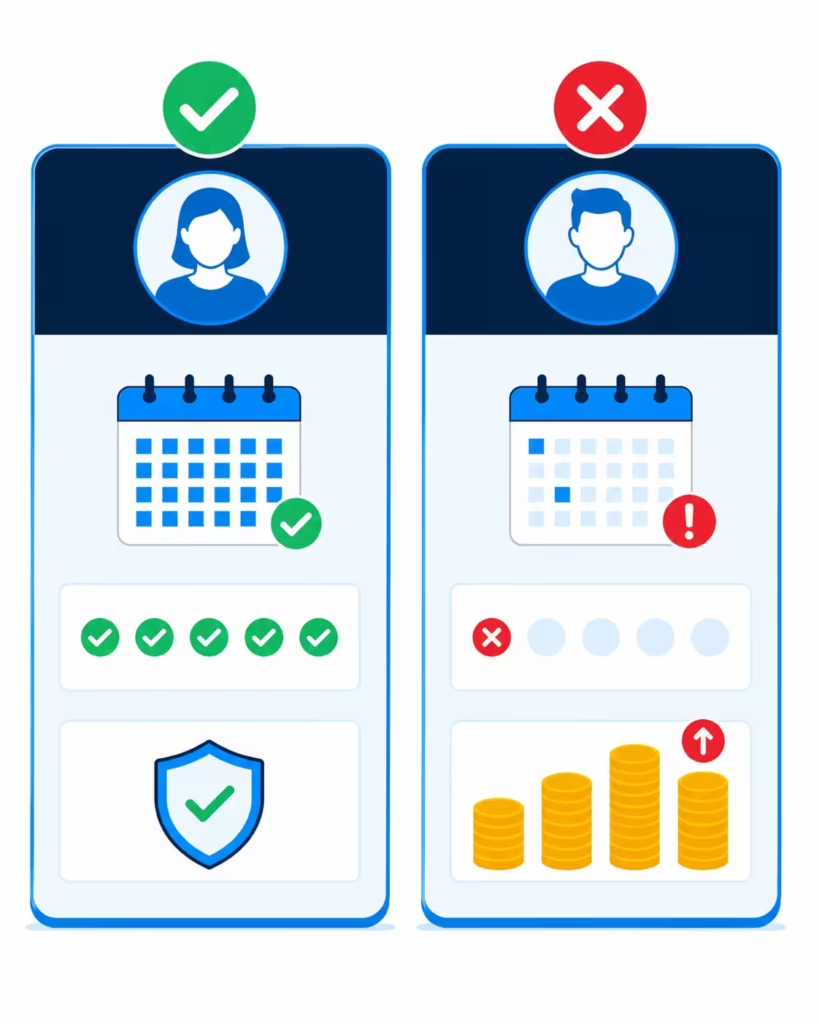
Account tenure is the big one. A card you have held for two or more years, with steady use, gives Amex a track record to trust. A card opened four months ago rarely qualifies, because there is not enough history to reward.
Payment history comes next. On-time payments for the past 12 months or longer put you in strong shape. A recent late payment hurts your case, and a payment missed in the last 90 days usually ends the conversation before it starts.
Overall credit standing matters too. Amex periodically reviews your credit through soft pulls. A strong FICO score and low credit utilization across all your cards suggest you could take your balance elsewhere, which is exactly the kind of customer retention teams want to keep. Utilization above 50% on the card in question can work against you, since it signals financial stress rather than strength.
Competing offers can tip a borderline case. If another issuer has sent you a promotional APR offer in the mail, mention it. It is proof the market values you as a customer.
David, an operations manager at a logistics firm, had held his card for five years with zero late payments and a FICO score of 780. His request took under ten minutes and cut his APR by 3 points. A coworker with the same card, but two late payments that spring, was declined. Same card, different file, different result.
Will Asking for a Lower APR Hurt Your Credit Score?
This worry stops a lot of people from ever picking up the phone. Here is the direct answer: a standard request to lower your rate does not require a hard inquiry. Asking is free, in credit terms.
There is no application involved. You are not opening a new account or asking for new credit. You are asking for better terms on an account you already have. Amex can review your file using soft pulls, and soft pulls never affect your score.
Two exceptions are worth knowing:
- Credit limit increases are different. Asking Amex for a higher limit can trigger a hard pull. Do not confuse the two requests, and do not ask for both on the same call unless you are comfortable with a possible inquiry.
- Hardship programs can be reported. Enrolling in a formal relief plan may add a notation to your credit report at Experian, Equifax, and TransUnion. That is covered in detail in the hardship section below.
⚠️ Mistake to Avoid: Some cardholders about to apply for a mortgage skip the call out of fear. A simple rate request leaves no mark on your credit report, so there is no reason to wait.
What to Do If Amex Says No
A no is a starting point, not an ending. Plenty of cardholders get a yes on their second or third try. Work through these fallbacks in order.
First, call back. Retention offers vary by rep, by day, and by what promotions are running that month. A different agent on a different day can give a different answer. Wait a week or two, then try again.
Second, improve your file, then re-ask. Pay down the balance to lower your credit utilization, keep every payment on time for six months, and call again with a stronger record behind you.
Third, use the tools below. Two options can cut your interest costs even when the standing APR stays put.
Try Amex’s Plan It® Program
Plan It is a built-in Amex feature, not a separate product. It lets you split eligible purchases of $100 or more into fixed monthly payments. You pay a set monthly plan fee instead of standard interest, and the fee is often cheaper than letting the charge revolve at your normal variable APR.
There is no enrollment and no application. Open the Amex app, look for the Plan It icon next to eligible purchases, and check your offer there.
One limit matters: Plan It works on new or recent eligible purchases. It does nothing for an existing revolving balance already sitting on your card. Think of it as a way to stop future interest from piling up while you attack the old balance.
Consider a Balance Transfer
If Amex will not budge, another issuer might. A 0% intro APR balance transfer card lets you move your Amex balance and pay no interest for a set period, often 12 to 21 months.
Run the math before you jump. Most balance transfer cards charge a fee of 3% to 5% of the amount moved. On a $5,000 balance, that is $150 to $250 upfront. Compare that fee to the interest you would pay Amex over the same period.
If your balance would otherwise revolve for a year at 24%, the transfer usually wins by a wide margin. If you could pay it off in two or three months anyway, the fee may cost more than it saves.
When Amex Has a Financial Hardship Program Instead
Sometimes a point or two off the APR is not enough. A job loss, a medical event, or a divorce can make even the minimum payment hard to reach. That situation calls for a different path: the Amex Financial Relief Program.
This is Amex’s formal hardship program. Per the American Express Financial Relief Program page, it can temporarily lower your interest rate, reduce your monthly payment, and waive certain fees. It comes in two forms:
- A short-term plan, which provides relief benefits for up to 12 months after enrollment.
- A long-term plan, which can stretch relief across 48 months, with a deeper rate cut and a fixed payoff schedule.
To ask about hardship relief specifically, call 1-866-703-4169, Monday through Friday. That line reaches the team that handles payment difficulty, not general account questions.
Hardship Program vs. Standard APR Negotiation
These two paths are easy to confuse, and picking the wrong one costs you. Here is how they differ:
| Standard Negotiation | Financial Relief Program | |
|---|---|---|
| Best for | Managing costs, staying ahead | Genuine financial distress |
| Rate cut | Usually a few points | Often much larger |
| Card use | Unaffected | Typically frozen or restricted |
| Rewards | Keep earning and redeeming | Points may be frozen or lost |
| Proof of hardship | None needed | Situation reviewed |
| Credit report | No notation | May be noted |
The simple rule: if you can afford your payments and just want a better deal, negotiate. If you cannot afford your payments, call the hardship line. Do not enroll in a relief plan just to chase a lower rate you might have gotten through a normal retention offer.
Risks to Know Before Enrolling in Hardship Relief

The relief is real, but so are the tradeoffs. Three consequences catch cardholders off guard:
- Charging privileges are usually suspended. Your card may stop working for new purchases while you are on the plan. Do not enroll if you rely on the card for monthly spending.
- Long-term plans can close the account. Some 48-month arrangements end with the account closed once the balance is paid. That closure can affect your credit history length and available credit.
- Membership Rewards points may be frozen or forfeited. This is the most painful surprise. If you are sitting on a large points balance, redeem your points before you enroll.
📌 Did You Know: Cardholders have reported losing five-figure Membership Rewards balances after enrolling in relief plans without redeeming first. Cash out your points before you make the call.
When’s the Best Time to Ask for a Lower Rate
Timing will not rescue a weak account, but it can help a decent one. A few windows work in your favor.
After a streak of on-time payments. Six to twelve clean months is the strongest setup for an Amex interest rate negotiation. Your recent history is the evidence the rep needs.
Around your account anniversary. Renewal season is when issuers think hardest about keeping you. Retention offers tend to flow more freely when Amex knows you are deciding whether the annual fee is worth another year.
Right after a rate increase notice. Most Amex cards carry a variable APR tied to the Prime Rate, so your rate can drift up over time. A rate increase letter is a perfectly natural reason to call and push back.
Not right after a missed payment. A late payment in the last 60 to 90 days makes a yes very unlikely. Get current, stay current for a few months, and then ask.
How Often You Can Reasonably Ask Again
There is no official limit, but there is a practical one. Asking every few weeks accomplishes nothing, because nothing on your account has changed.
A sensible rhythm is one request every six to twelve months. Re-ask sooner only if something important has changed: a higher credit score, a lower balance, a clean payment history, or a new competing offer. Each call works best when you can point to something new that strengthens your case.
Frequently Asked Questions (FAQs)
Will American Express lower my interest rate?
Yes, American Express does consider APR reduction requests, especially through its retention team. Success is more common for cardholders with a year or more of on-time payments, though it isn’t automatic or guaranteed.
Can I negotiate my interest rate with American Express?
Yes, you can call 1-800-528-4800 and ask to speak with the retention or loyalty team about lowering your rate. Phone calls work better than in-app chat since reps have more authority to approve changes on the spot.
How can I avoid paying Amex interest?
Amex’s Plan It program lets you split eligible purchases of $100 or more into fixed monthly payments with a set fee instead of standard interest. It only works on new purchases, though, not on an existing revolving balance.
What is the Amex Financial Relief Program?
This is Amex’s formal hardship program for cardholders facing genuine financial distress, reachable at 1-866-703-4169. It can temporarily lower your rate and reduce payments, but charging privileges are usually suspended, and Membership Rewards points may be frozen.
Will asking Amex for a lower rate hurt my credit score?
No, a standard request to lower your APR only involves a soft credit pull, which never affects your score. This differs from asking for a credit limit increase, which can trigger a hard inquiry.
How can I lower my credit card APR if Amex says no?
Try calling back on a different day since offers vary by rep, or improve your payment history and credit utilization for six months before re-asking. You can also use Amex’s Plan It program or transfer the balance to a 0% intro APR card.
How often can I ask Amex to lower my interest rate?
There’s no official limit, but a request every six to twelve months is reasonable. Re-ask sooner only if something has changed, like a higher credit score, lower balance, or a new competing offer from another issuer.
When is the best time to ask Amex for a lower rate?
The strongest window is after six to twelve months of on-time payments, or right after a rate increase notice. Avoid asking within 60 to 90 days of a missed payment, since that makes approval very unlikely.
What’s the difference between standard APR negotiation and the hardship program?
Standard negotiation is for cardholders who can afford payments but want a better deal, with no proof of hardship needed and no credit report notation. The hardship program is for genuine financial distress and can freeze card use and rewards points, sometimes with a credit report notation.
Wrapping Up
To get Amex to lower your interest rate, follow these three steps:
- Prepare your account details.
- Call the right number and have a clear script ready.
- If they say no, follow up with Plan It, a balance transfer, or the Financial Relief Program.
For most cardholders, the best way to keep their account is a polite, well-prepared phone call. This should be done after six or more months of on-time payments, considering how retention teams view tenure and payment history. It costs nothing and can save hundreds a year.
If you know someone watching interest eat their payment every month, share this guide with them. One phone call could change their whole payoff timeline.