
I’ve been there myself. One missed Capital One payment shows up on your credit report, your FICO score drops 60 to 100 points, and suddenly a mortgage or car loan feels out of reach. You’ve probably read a few generic templates already, but you need the exact goodwill letter to Capital One approach that actually reaches someone with authority to remove it.
The fastest way to get a Capital One late payment removed is to send a short, honest goodwill request straight to the Executive Office, not general customer service.
Below, you’ll get the verified contact path, a plug-and-play template, the timing details, and what to do if the first answer is no.
Key Takeaways
This guide explains how to write and send a goodwill letter to Capital One, including the Executive Office contact channel, letter structure, a fill-in template, and what to expect after sending it.
Core Facts:
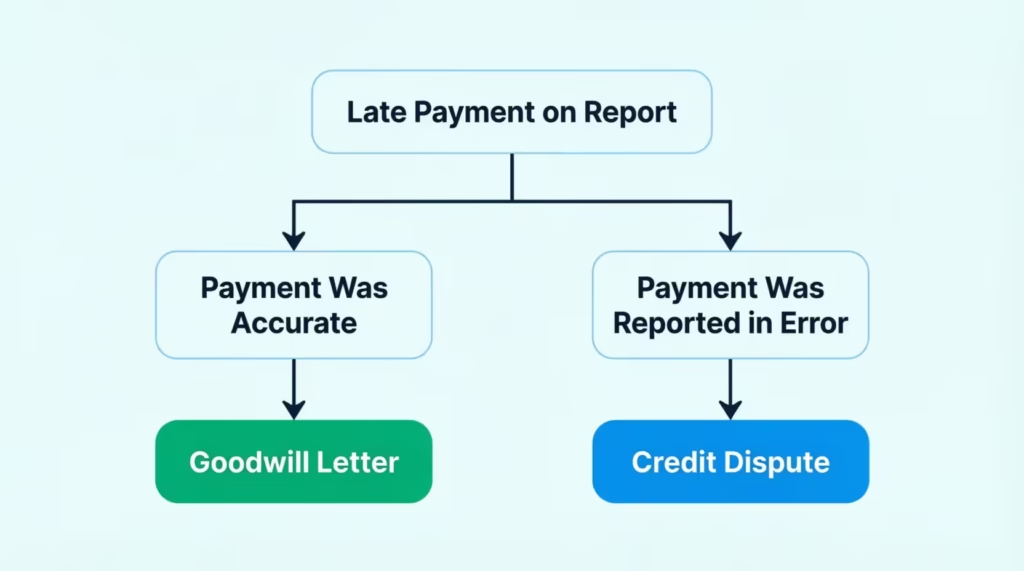
- A goodwill letter asks Capital One to remove an accurate late payment as a courtesy, while a credit dispute challenges a late payment that was reported incorrectly.
- Goodwill requests should go to the Executive Office at richard.fairbank@capitalone.com or by certified mail to 1680 Capital One Drive, McLean, VA 22102, not the billing statement address.
- Capital One has no published goodwill policy and reviews requests case by case, so outcomes may be approval, partial adjustment, or denial.
- Most responses arrive within 10 to 30 business days, with an automated email acknowledgment often appearing within 48 hours.
- If approved, credit bureaus typically update the tradeline within 30 to 45 days of the decision.
- If denied, the article recommends waiting 60 to 90 days before sending a second letter with new context, and reserving CFPB or OCC complaints for genuine reporting errors rather than accurate late payments.
Best for:
- Cardholders or auto loan borrowers with one isolated late payment and a history of on-time payments since.
- Readers who confirmed their late payment was reported accurately and are not disputing an error.
- Anyone preparing to apply for a mortgage, auto loan, or refinance who wants a late payment removed before applying.
Goodwill Letter vs. Credit Dispute: Which One You Need
Before you write anything, pick the right tool. A goodwill letter and a credit dispute solve two very different problems, and using the wrong one wastes your best shot.
A goodwill letter is a polite request. You’re admitting the late payment happened, and you’re asking Capital One to remove it as a one-time courtesy. Use this when the late payment is accurate. Maybe you paid 32 days late during a rough month, and Capital One correctly reported it to Equifax, Experian, and TransUnion. The record is true. You’re just asking for grace.
A credit dispute is a formal challenge. You use it when the late payment is wrong. Maybe the payment posted on time, but the account still shows a 30-day late. Or the date is off. Or the account isn’t yours. Under the Fair Credit Reporting Act, both the credit bureau and Capital One must investigate and correct real errors within 30 days, per the Consumer Financial Protection Bureau.
Here’s a quick self-check before you draft anything:
| Question | If YES → | If NO → |
|---|---|---|
| Did the payment post more than 30 days after the due date? | Goodwill letter | Dispute (inaccurate reporting) |
| Is the account, date, and amount on your report correct? | Goodwill letter | Dispute |
| Do you have proof it was paid on time? | Dispute | Goodwill letter |
If it’s a dispute, skip this article and file directly through Capital One’s dispute intake by signing in at capitalone.com or by mailing the credit bureau. If it’s truly a goodwill situation, keep reading.
⚠️ Mistake to Avoid: Don’t file a dispute on an accurate late payment hoping it will “just fall off.” Capital One can flag the account, and repeated frivolous disputes may be ignored under the FCRA.
Does Capital One Actually Grant Goodwill Adjustments?
Short answer: yes, but not always, and not by policy.
Capital One has no published goodwill policy. Unlike some issuers that flatly refuse in writing, Capital One reviews these requests case by case, and the decisions are made by the Executive Office team, not the front-line agents on the 1-800 line.
That’s why calling customer service usually leads to a polite “we can’t adjust accurate reporting” response. Those reps genuinely can’t. Only the Executive Office can.
Success is real but uneven. Members on the myFICO forums regularly report removals for isolated 30-day lates, with score bumps of 20 to 30 points afterward. Others get denied on the first try, especially when the account had multiple lates or the delinquency is recent.
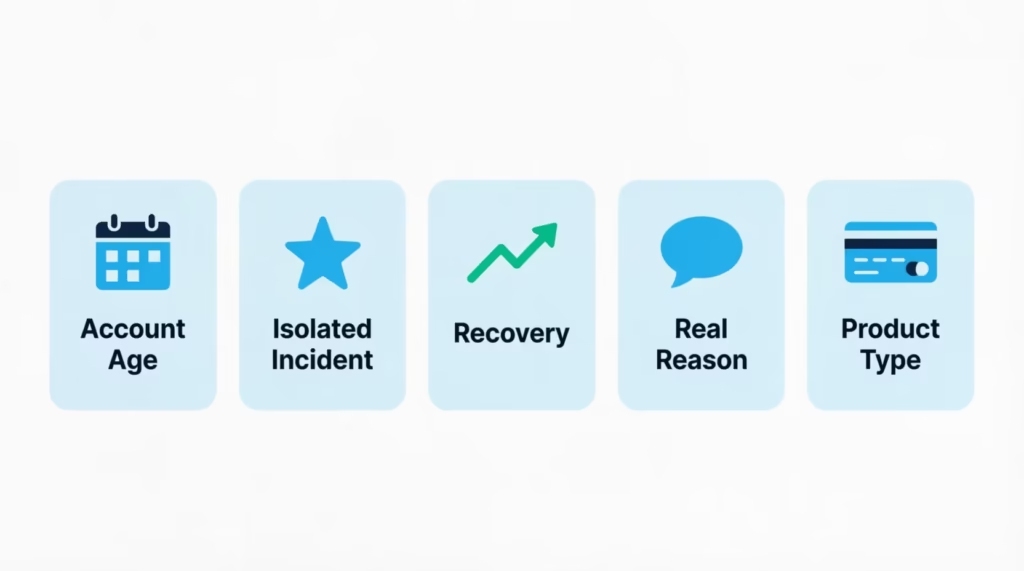
From the patterns in approved letters, a few things move the needle with Capital One:
- Account age. A cardholder of 4+ years gets more grace than a 6-month customer.
- Isolated incident. One 30-day late in five years of clean history is very different from three lates in a row.
- Recovery. Every on-time payment after the slip strengthens your case.
- A real reason. Job loss, hospitalization, a family death, a move. Not “I forgot.”
- Product type. Credit card requests move faster than Capital One Auto Finance requests, but auto loan lates can also be adjusted.
Set your expectations honestly. You may get a removal, a partial adjustment, or a denial. All three are possible, and none of them will hurt your account standing.
Who and Where to Contact at Capital One
This is the part most guides get wrong. Sending your letter to the address on your billing statement drops it into a queue where no one has authority to help. You need the Executive Office.
Executive Office Mail and Email
The most widely reported successful channel is emailing the CEO’s office. Yes, the CEO himself. Emails sent there get routed to the Executive Response team, which does have the authority to grant goodwill adjustments.
Email: richard.fairbank@capitalone.com
Richard Fairbank is the founder and CEO of Capital One. He doesn’t personally read every message, but his office staff triages them and forwards goodwill requests to the correct team. This is the channel users on r/CRedit most often credit with success.
Mailing Address (Executive Office):
Capital One Attn: Executive Office 1680 Capital One Drive McLean, VA 22102
Send by USPS certified mail with return receipt requested. It costs about $5, and you get proof of delivery, which matters if you later need to escalate.
Do not use the PO Box on your statement for goodwill requests. That’s the payment processing address, not the decision-making office.
💡 Pro Tip: Send both the email and a hard-copy letter on the same day. Two touches, one week apart in the reader’s inbox, keep your request visible without looking like spam.
Differences by Account Type (Card, Auto, Discover)
Not every Capital One product routes the same way.
All Capital One credit cards, such as Venture, Quicksilver, Savor, Platinum, Secured, and co-branded cards like Walmart or Kohl’s, use the same Executive Office channel.
Capital One Auto Finance loans are handled by a separate division, but the Executive Office still accepts and routes these requests. In your letter, clearly write “Capital One Auto Finance” and include your 10-digit auto loan number. You can also mail to:
Capital One Auto Finance, PO Box 259407, Plano, TX 75025
Discover accounts serviced by Capital One: Capital One acquired Discover in 2025. If you have a Discover card, servicing is changing. Goodwill requests for Discover accounts should still go through the Discover complaints channel at 1-800-DISCOVER. You can also email the Capital One Executive Office, including your Discover account number. Confirm your servicing status by logging into your account first.
What to Gather Before You Write
Pull these details together before you open a blank document. Missing any of them slows the review or gets you a request-for-more-info reply that adds two weeks to your timeline.
- Full legal name as it appears on the account
- Account number (last 4 digits at minimum, full number is safer for Executive Office review)
- Mailing address currently on file
- Phone number and email they can reach you at
- Exact date of the late payment you want removed (month and year)
- Date you brought the account current afterward
- A recent copy of your credit report from AnnualCreditReport.com, the only federally authorized free source
- A one- to two-sentence explanation of what caused the late payment
- Length of your Capital One relationship (year you opened the account)
- Proof of on-time payments since then (screenshot from the Capital One app is fine)
Keep a copy of everything you send. If you need to escalate later to the CFPB, you’ll need proof of your original request.
What Increases Your Odds With Capital One
Not every case is equal. Capital One’s Executive Office reviewers look for a story that shows the late payment was a genuine one-off, not a pattern.
Long account tenure. Customers with 3+ years of history get more grace. If you’ve had the card since 2018 and slipped once in 2024, say so in the first sentence.
A single, isolated late. One 30-day late is very different from a string of them. If you have multiple lates, still ask, but expect a harder no.
Low utilization now. Keeping your balance under 30% of your credit limit signals you’re managing the account responsibly. Under 10% is even better for your FICO score.
A concrete cause. Vague reasons (“things got tight”) lose to specific ones (“I was laid off from my role as a marketing coordinator on March 3, 2024, and missed my April payment while unemployment benefits processed”). You don’t need to overshare, but one clear detail helps.
Perfect payment history since. Every on-time payment after the late is evidence you’ve corrected course. Mention how many consecutive on-time payments you’ve made.
A “why now” reason. Reviewers are more responsive when there’s a specific event prompting the request. This could be a mortgage application due in 60 days, a refinance, or an apartment lease. Mention it briefly.
One late, one request. Ask for exactly what you want. Don’t bundle in fee reversals or interest complaints. Goodwill requests that stay focused get better responses.
How to Structure the Letter
Keep the whole letter to one page. Executive Office staff read dozens of these a day. A short, well-organized letter is far more likely to earn a real review than a two-page emotional appeal.
Use a standard business letter format: your name and address at the top, the date, Capital One’s address, a subject line, salutation, body, and signature. Follow this three-part flow inside the body.
Opening: Identify Yourself and the Account
Open with who you are and how long you’ve been a customer. Give the account number (or last 4 digits) and state up front that this is a goodwill request. Don’t bury the ask.
Example opener: “I’ve been a Capital One Venture cardholder since June 2019. I’m writing to request a one-time goodwill adjustment on my account ending in 4421.”
Middle: Acknowledge Responsibility and Explain Briefly
Take responsibility. Don’t blame Capital One, the mail, the app, or the autopay setting. Two to three sentences on what happened, followed by two to three sentences on what you did to fix it. That’s it.
Reviewers are looking for accountability. A short, honest paragraph reads far better than a paragraph of excuses. All payments since then have been on time. Also, mention if the balance is paid in full or if there’s reduced utilization.
Close: Make the Specific Ask
State exactly what you want. “I’m respectfully asking Capital One to remove the 30-day late payment reported in April 2024 from my credit report as a one-time courtesy.” Then close with thanks. No threats. No mention of the FCRA. No “or else.”
Sign it by hand if you’re mailing it. Type your printed name below the signature, along with your phone and email.
Sample Capital One Goodwill Letter Template
Copy this template and fill in the bracketed sections. Keep it under one page.
[Your Full Name] [Your Street Address] [City, State, ZIP] [Your Phone] [Your Email]
[Today’s Date]
Capital One Attn: Executive Office 1680 Capital One Drive McLean, VA 22102
Re: Goodwill Adjustment Request Account ending in [XXXX]
Dear Capital One Executive Office,
I’ve been a Capital One [card name, e.g., Quicksilver] cardholder since [month, year], and I’m writing to respectfully request a one-time goodwill adjustment on my account ending in [last 4 digits].
In [month, year], my account was reported [30/60] days past due. I take full responsibility for that missed payment. At the time, [one sentence on the cause: e.g., “I was hospitalized for two weeks following a car accident and fell behind on my bills during recovery”]. As soon as I was able, I brought the account current on [date], and I’ve made every payment on time since.
Over the past [X] years with Capital One, this is the only late payment on my record. My current balance is [amount or “paid in full”], and my utilization is under [X]%. I’m [applying for a mortgage in [month] / refinancing my home / applying for an auto loan], and this single late-payment mark is significantly affecting my ability to move forward.
I’d sincerely appreciate it if Capital One would remove the [month, year] late-payment notation from my credit report with Equifax, Experian, and TransUnion as a one-time courtesy. I understand this is entirely at your discretion, and I’m grateful for your consideration.
Thank you for your time and for the many years of service you’ve provided me.
Sincerely,
[Handwritten signature if mailing]
[Your Typed Name]
For Capital One Auto Finance, swap the address for the Plano, TX one above, and change the subject line to “Goodwill Adjustment Request Capital One Auto Finance Loan #[number].” Note the vehicle in one line, for example: “This loan is for my 2021 Honda Civic, financed in March 2021.”
Tone and Mistakes to Avoid
Tone decides more than most people realize. The Executive Office reviewer is a human being with dozens of letters on their desk. Give them a reason to help.
Do keep the tone humble, calm, and grateful. You’re asking for a favor, not demanding a right. Words like “respectfully request,” “as a one-time courtesy,” and “at your discretion” set the right tone.
Do stay brief. One page. Three short paragraphs. Reviewers skim, so front-load the ask.
Don’t threaten legal action or cite the FCRA. Capital One is legally required to report accurate information. Mentioning the FCRA or hinting at a lawsuit reads as a threat and almost guarantees a denial. Save legal escalation for the CFPB complaint stage.
Don’t blame Capital One. “Your app didn’t send me a reminder” or “your autopay failed” shifts responsibility. Even if it’s partly true, it reads as excuse-making.
Don’t send a long emotional story. Two sentences on the cause are enough. Save the detail for a follow-up if they ask.
Don’t use a copy-pasted internet template word-for-word. Executive Office staff read the same forum templates all day. Rewrite in your own voice.
Don’t send multiple letters at once. One request, one channel, then wait. Bombarding the office looks like harassment.
Don’t ask for more than the removal. Fee reversals, APR reductions, and credit line increases belong in separate conversations.
How to Send Your Letter
You have two channels that work, and you can use both.
Email to richard.fairbank@capitalone.com. Paste your letter directly into the body of the email. Do not send it as an attachment, since attachments from unknown senders are often filtered. Use a clear subject line: “Goodwill Adjustment Request Account ending in [XXXX].”
Certified mail to the McLean, VA address above. Ask the USPS clerk for Certified Mail with Return Receipt (Form 3811). This gives you a green card back with a signature, which is your proof of delivery. The cost is around $5. You can also track it at USPS.com with the tracking number.
Sending both the same day is a smart move. If the email gets filtered, the letter still arrives. If the letter gets lost, the email is on record.
Save copies of everything: your sent email, the letter PDF, and the certified mail receipt. You’ll need these if you have to escalate.
What Happens After You Send It
The wait is the hardest part. Here’s what to expect so you don’t spiral.
Typical Response Timeline
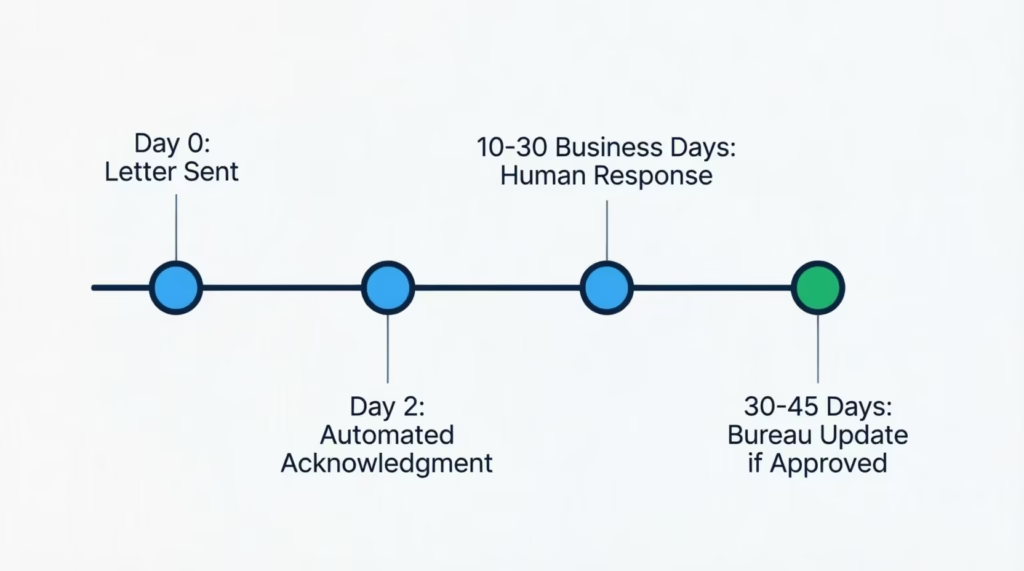
Most people hear back from Capital One’s Executive Office within 10 to 30 business days. Emails often get an automated acknowledgment within 48 hours, followed by a human response two to four weeks later.
Three outcomes are possible:
- Approval. Capital One instructs the credit bureaus to remove the late payment. Updated tradelines typically appear on your credit report within 30 to 45 days. You should see a score jump on your next update.
- Partial adjustment. Occasionally, Capital One will re-age the account, adjust the reported severity, or waive fees without removing the late. Any positive movement helps.
- Denial. You’ll get a polite letter or email stating that Capital One is required to report accurately and cannot make the adjustment. This is not the end of the road.
How to Follow Up
If 30 business days pass without a response, send one polite follow-up. Reply to your original email chain so the reviewer sees the history. Keep it to two sentences: “I wanted to gently follow up on my goodwill request sent on [date]. I appreciate any update you can share.”
That’s it. Do not send a third message. Do not call customer service to ask about it. Both signal impatience and can hurt your case.
If Capital One Denies Your Request
A first-round denial is common. It doesn’t mean your case is closed.
Can You Send a Second Goodwill Letter?
Yes, but wait at least 60 to 90 days before trying again, and change something meaningful in the second letter. Sending the same letter twice in a row rarely works.
Second-letter improvements that help:
- A new reviewer sometimes sees the same facts differently. That alone can flip the outcome.
- Add a new piece of context you didn’t include the first time. Maybe a supporting document (medical bill, layoff notice, obituary) if you’re comfortable sharing.
- Reference more on-time payments now that additional months have passed.
- Mention a specific upcoming milestone (mortgage app in 45 days) that gives the request urgency.
Some myFICO users report success on their second or third attempt, especially after 6 to 12 months of clean payment history. Persistence, spaced out, works.
When to Escalate to CFPB or OCC
If two goodwill attempts don’t work and you think Capital One misreported something, or if the customer service was bad, you can file a formal complaint. This is not a threat, and it’s not appropriate for accurate late payments alone. Use it when there’s a real issue.
Consumer Financial Protection Bureau (CFPB): File at consumerfinance.gov/complaint. Capital One is required to respond within 15 days, and most consumers get a substantive response within 60 days. Complaints route directly to Capital One’s regulatory response team, which sometimes reopens goodwill decisions.
Office of the Comptroller of the Currency (OCC): File at helpwithmybank.gov. Capital One, N.A. is a national bank regulated by the OCC, so this is a valid channel for banking complaints.
A CFPB filing sometimes prompts a fresh review that a goodwill letter alone did not. But use it sparingly, and only when you have a genuine grievance beyond wanting an accurate late removed.
📌 Did You Know: A late payment can stay on your credit report for up to seven years under the FCRA. However, its effect on your score drops significantly after 24 months. If you’re within a year of that fade point, a goodwill removal is still worth pursuing, since it can jump your score meaningfully right now.
Frequently Asked Questions (FAQs)
Will Capital One accept a goodwill letter?
Capital One has no published goodwill policy but reviews requests case by case through its Executive Office. Approval isn’t guaranteed, but isolated late payments with a strong recovery history stand the best chance.
Can I send a goodwill letter to Capital One?
Yes, you can email the Executive Office at richard.fairbank@capitalone.com or mail a certified letter to 1680 Capital One Drive, McLean, VA 22102. Avoid the payment address on your billing statement, since that team can’t grant adjustments.
How to write a goodwill letter to remove late payments?
Open by identifying yourself and your account, then take responsibility for the late payment in two to three sentences without blaming Capital One. Close with a specific ask, such as removing the exact month’s late payment as a one-time courtesy.
What is the success rate of goodwill letters?
There’s no official success rate since Capital One doesn’t publish one. Members on myFICO forums regularly report removals for isolated 30-day lates, with score bumps of 20 to 30 points afterward, though multiple lates or recent delinquencies are denied more often.
Can a goodwill letter remove a late payment?
Yes, if Capital One’s Executive Office approves the request, they instruct the credit bureaus to remove the late payment. Updated tradelines typically appear on your credit report within 30 to 45 days of approval.
How long does a goodwill letter take to process?
Most people hear back within 10 to 30 business days. Emails often get an automated acknowledgment within 48 hours, followed by a human response two to four weeks later.
Who to email a goodwill letter to at Capital One?
Email richard.fairbank@capitalone.com, the address for CEO Richard Fairbank’s Executive Office. Staff there triage messages and route goodwill requests to the team with authority to grant them.
Do goodwill letters work?
They can work, but results vary by issuer and account history. Isolated late payments with years of clean history and consistent on-time payments since the incident have the best odds of approval.
What’s the difference between a goodwill letter and a credit dispute?
A goodwill letter admits the late payment is accurate and asks for removal as a courtesy, while a credit dispute challenges a late payment that’s factually wrong. Use a dispute only if you have proof the payment posted on time or the details are incorrect.
The Bottom Line
You can’t be sure that Capital One will remove a late payment, but it’s easier than many articles suggest. Just write a brief, polite goodwill letter and send it to the Executive Office or CEO email, not customer service.
The best way is to send a certified mail letter and an email on the same day. Use a humble tone, take full responsibility, and make one clear, specific request.
Based on the myFICO and Reddit success patterns cited above, isolated lates with a strong recovery history stand the best chance
If you know someone whose credit is being held back by one old Capital One late payment, share this guide with them. It could help them qualify for a mortgage or car loan they thought was out of reach.