
I’ve spent hours helping readers try to fix Chase late payments, and I know how stressful it feels to see that one 30-day slip drag your score down. You’ve probably read that a goodwill letter can help, but Chase is different from most banks, and generic advice won’t cut it here.
The good news? A goodwill letter to Chase can still work when it’s written the right way and sent through the right channel.
In this guide, we’ll walk through templates, addresses, timelines, and what to do if Chase says no.
Key Takeaways
This guide explains how to write and send a goodwill letter to Chase, including a sample template, mailing and online submission channels, realistic response timelines, and next steps if the request is denied.
Core Facts:
- Chase states it does not make goodwill or courtesy adjustments because reported information must be complete and accurate, though reps retain some discretion.
- A goodwill letter applies when a late payment is accurate; an inaccurate late payment should be handled through a dispute with the credit bureaus instead.
- Odds are strongest for a single 30-day late payment on an otherwise clean account, and lowest for charge-off or collections accounts.
- The letter should follow a four-part structure: acknowledge the late payment, explain briefly, show what has changed, and clearly state the request.
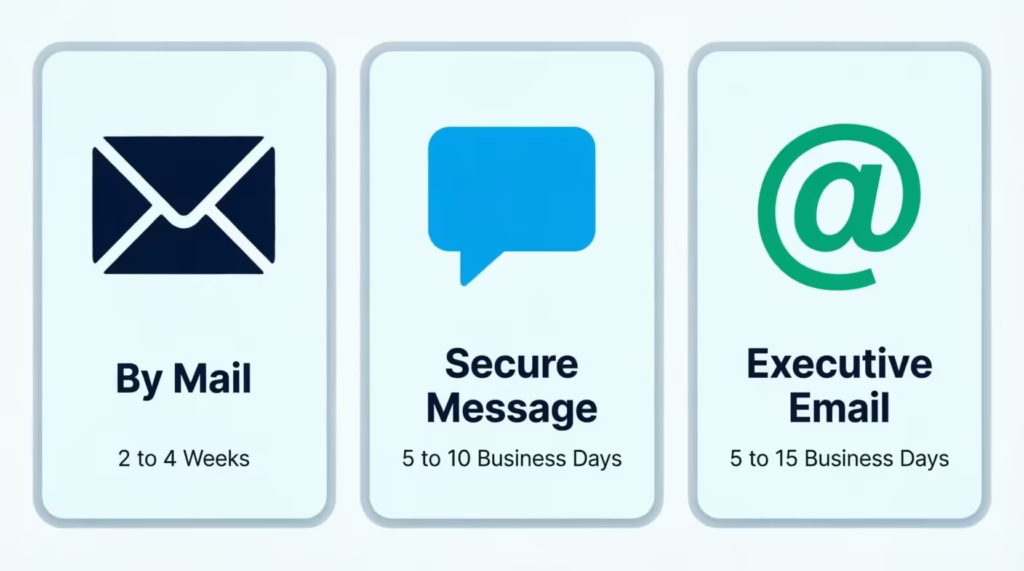
- Response times vary by channel: about 5 to 10 business days for secure messages, 2 to 4 weeks for certified mail, and 5 to 15 business days for Executive Office email.
- A recommended retry pattern spans four attempts, from an initial secure message up to a fourth attempt made only with new supporting information.
Best for:
- Chase cardholders or loan customers with one isolated late payment who want to draft and send a request themselves.
- Readers unsure whether their situation calls for a goodwill letter or a formal credit dispute.
- Anyone who received an initial denial from Chase and needs a follow-up or escalation plan.
Does Chase Accept Goodwill Letters?
Chase does not officially accept goodwill adjustments, and that’s the honest truth most articles skip. On its own auto loan help page, Chase states plainly that “the information we report is required to be complete and accurate. Because of this, we don’t make goodwill or courtesy adjustments”.
That sounds like a dead end, but it isn’t. “No official policy” doesn’t mean zero chance. Chase reps have discretion. Users on the myFICO forums and Reddit report occasional wins, usually after two or three tries and a polite tone. One user on r/CRedit shared that Chase agreed to review a one-time late payment after a supervisor listened back to the original phone call.
Why does this matter? Because with Chase, persistence and channel choice count more than the letter itself. A well-written note sent to the wrong inbox goes nowhere. The same note sent to the Executive Office, followed by a polite phone call, sometimes gets a second look.
📌 Did You Know: Chase is tougher on goodwill adjustments than most major issuers. Still, its reps have some leeway under the FCRA’s “reasonable accuracy” standard. That gap is where goodwill requests occasionally succeed.
Goodwill Letter vs. Dispute: Which One You Need
Pick the wrong tool, and you waste weeks. The rule is simple.
If the late payment is accurate and you just paid late, you need a goodwill letter. You’re asking Chase for a favor, not challenging the record.
If the late payment is wrong in some way (wrong date, wrong amount, not your account, already paid on time), you need a dispute, not a goodwill letter. A dispute challenges the accuracy of the reporting under the Fair Credit Reporting Act. You file it with the credit bureaus (Experian, Equifax, TransUnion) or directly with Chase.
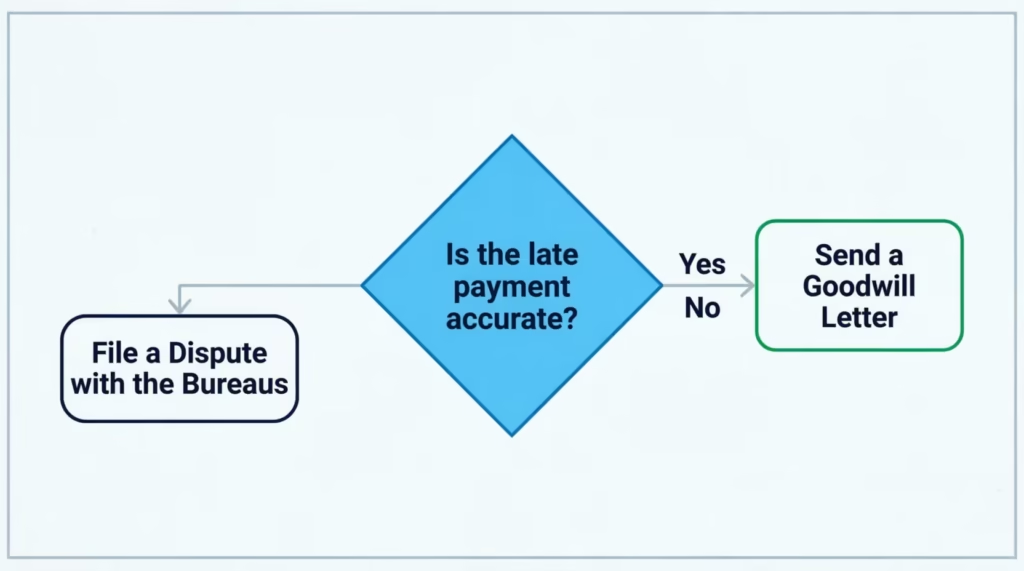
Mixing these up is a common mistake. A dispute forces Chase to investigate. A goodwill letter asks Chase to be kind. If you dispute an accurate item, Chase will verify it, and it will stay. If you send a goodwill note about an inaccurate item, you’re giving up your legal leverage.
For inaccurate items, first use the standard credit dispute process with each bureau. Then, follow this guide only if the record is actually correct.
Who Has the Best Odds With a Chase Goodwill Letter
Not every situation qualifies. Be honest with yourself before you write.
Your odds are best when you have one isolated 30-day late payment on an account that is otherwise in good standing. A single slip after years of on-time payments is the classic “forgivable” case. Reps see a clean payment history and a plausible one-off reason.
Your odds drop fast if you have multiple recent lates, a 60- or 90-day late, or a pattern of missed payments. Chase reads that as a habit, not a mistake.
Your odds are near zero if the account is charged-off, in collections, or was settled for less than the full balance. A charge-off is a formal write-down. Chase rarely edits that record because doing so could conflict with the Metro 2 reporting standard the bureaus rely on.
A long-standing Chase relationship helps as a soft factor. Ten years of Chase Sapphire, Freedom, or Ink cards, a mortgage, or an auto loan tells the rep you’re a real customer, not someone gaming the system. It won’t override a weak case, but it can tip a borderline one.
| Situation | Realistic Odds |
|---|---|
| One 30-day late, otherwise clean | Fair to decent |
| One 60- or 90-day late, otherwise clean | Low to fair |
| Multiple lates in the past 24 months | Low |
| Charge-off or collections | Very low |
| Long Chase tenure, one slip | Tips borderline cases up |
What to Gather Before You Write
Get your file in order before you touch a keyboard. A vague letter is a dead letter.
Pull together:
- Your full account number and the exact date(s) of the late payment
- A recent copy of your credit report from Experian, Equifax, or TransUnion so you can quote what’s reported
- The Chase department that handles your product (credit card, mortgage, auto, or personal loan)
- A short personal timeline: what happened in the days around the missed payment, when you paid, and what you’ve done since
Also check the current status of the account in good standing. Chase reps will pull it up in seconds. If you’re behind again, fix that first. Nobody gets goodwill while still late.
Supporting Documentation to Include
Documentation is optional, but the right proof can lift a borderline request.
Useful examples include:
- A medical bill or hospital discharge summary if illness caused the miss
- A layoff notice, severance letter, or unemployment claim if you lost a job
- A bank statement showing the account was funded, but the payment failed
- A death certificate or funeral bill if a family loss disrupted your finances
Attach copies, never originals. Redact anything sensitive like Social Security numbers or full account numbers from other institutions. Keep it to one or two pages of supporting documentation at most. More paper does not mean more sympathy.
⚠️ Mistake to Avoid: Sending original medical records or full financial statements. Chase reps skim, they don’t audit. Send only the one page that proves your point, and redact private data.
How to Structure the Letter
Use a standard business letter format. Keep it to one page. Reps read fast.
The top of the page should show your name, address, phone, and email, then the date, then Chase’s mailing address. Below that, add a subject line naming your account and the reason for writing.
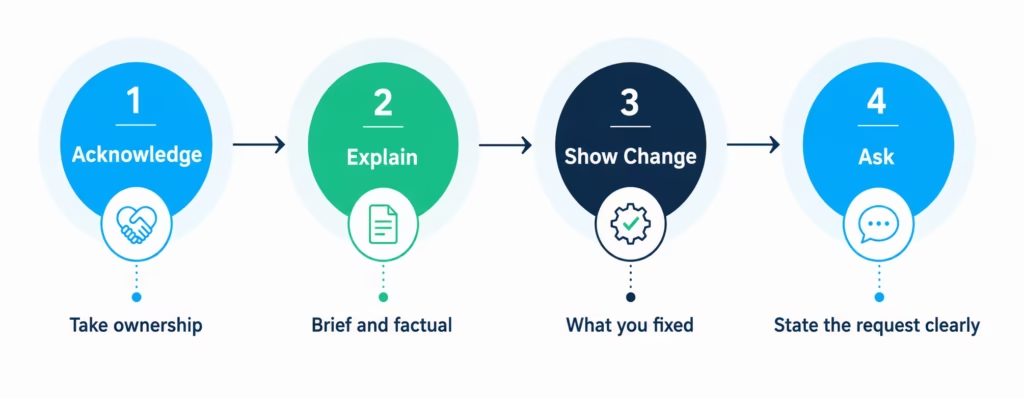
The body has four required parts:
- Acknowledge the late payment and take full ownership
- Explain briefly what happened, without drama
- Show change by describing what you’ve fixed to prevent a repeat
- Ask clearly for the late payment to be removed
That’s it. No essays. No blame. A one-page letter that hits all four beats beats a three-page life story every time.
Opening and Salutation
If you don’t have a specific person’s name, address it to “Dear Chase Customer Service Team” or “Dear Chase Credit Bureau Reporting Team.” Avoid “To Whom It May Concern,” which reads cold and dated.
State your purpose in the first sentence. I’m writing about a late payment on my Chase credit card ending in 1234. It was reported 30 days late in March 2026. I’m kindly asking for a goodwill review.
That single sentence tells the rep who you are, what account you mean, what happened, and what you want. No mystery.
The Body: Explain and Take Responsibility
Keep the explanation to three or four sentences. Say what happened, own it, and move on.
For example: “In March 2026, I was hospitalized for a week following a car accident and missed the payment due date. The balance was paid in full on April 12, 2026, and the account has been current ever since.”
Notice the tone. No blaming the hospital, the mail, or Chase’s app. Just facts. “I’ve now signed up for autopay with my Chase account and set payment alerts, so this won’t happen again.”
That short paragraph does the heavy lifting. It shows you’re a responsible customer who had a real reason, fixed the problem, and put safeguards in place.
The Ask and Closing
Say exactly what you want. Reps can’t read minds.
Try this: “As a goodwill gesture, I respectfully request that Chase remove the 30-day late payment reported to Experian, Equifax, and TransUnion for March 2026.”
Follow with a short thank-you that references your history: “I’ve been a Chase customer since 2018 and value the relationship. Thank you for taking the time to review my request.”
Close with a professional sign-off (“Sincerely,” or “Respectfully,”), then your typed name and signature. Add your phone number and email one more time so the rep can reply without hunting.
Tone and Wording That Work And What to Avoid
The tone that works with Chase is short, warm, and professional. Think of it as a note to a busy manager who wants to help but has 40 other files on the desk.
Use plain words. Say “please” and “thank you.” Skip legal threats. Never scarily mention the FCRA. Never demand. Never guilt-trip. And never, ever attach a “credit repair” script pulled from a shady site. Chase reps spot those instantly and reject them on sight.
Be specific and factual. “I missed the March 2026 payment because I was hospitalized” beats “life has been really hard lately.” One is a fact. The other is a feeling. Reps act on facts.
Keep it under 300 words. One page. Single-spaced. Simple font.
Common Oversharing and Tone Mistakes
The three biggest mistakes:
- Oversharing. A three-paragraph medical story or a full divorce timeline makes the rep uncomfortable and no more likely to help.
- Sounding entitled. Phrases like “I deserve” or “you owe me” flip the tone. You’re asking a favor, not calling in a debt.
- Rambling. If the rep can’t find the ask in five seconds, the letter loses. One clear sentence per idea. One clear request at the end.
Cut anything that doesn’t move the rep toward “yes.”
Sample Chase Goodwill Letter Template
Here’s a full sample you can adapt. Replace the bracketed parts with your own details.
[Your Full Name] [Your Street Address] [City, State ZIP] [Phone] | [Email]
[Date]
JPMorgan Chase Bank, N.A. Executive Office 3415 Vision Drive Columbus, OH 43219
Re: Goodwill Adjustment Request — Account ending in [last 4 digits]
Dear Chase Customer Care Team,
I’m writing to respectfully ask for a goodwill review of a [30-day / 60-day] late payment reported on my Chase [credit card/mortgage/auto loan] account ending in [1234] for [Month, Year].
I take full responsibility for the missed payment. At the time, [brief one-sentence reason: I was hospitalized following surgery / I lost my job during a company layoff / a family emergency disrupted my finances]. The balance was brought current on [date], and the account has been paid on time every month since.
To prevent this from happening again, I’ve enrolled in autopay through my Chase online account and set up payment reminders through the Chase mobile app.
As a goodwill gesture, I respectfully request that Chase remove the [30-day] late payment reported to Experian, Equifax, and TransUnion for [Month, Year]. I’ve been a Chase customer since [year] and value the relationship. I’d be grateful for any consideration you can give this request.
Thank you for your time.
Sincerely,
[Signature] [Typed Name]
Enclosures: [Copy of hospital discharge/layoff notice, if applicable]
Keep the whole letter under one page. If your reason needs more space, cut, don’t expand.
Where and How to Send Your Letter to Chase
Chase does not publish a single Chase goodwill letter address because it’s not an official process. The channel you pick matters as much as the words.
Three channels tend to work best. Try them in this order.
By Mail
Send a signed paper letter to Chase’s Executive Office by certified mail with return receipt. This gives you a paper trail and a delivery date.
The most widely used address for goodwill requests is:
JPMorgan Chase Bank, N.A. Executive Office 3415 Vision Drive Columbus, OH 43219
For credit card billing correspondence, Chase also lists Customer Service, PO Box 15299, Wilmington, DE 19850-5299. That address is for disputes and billing rights, not goodwill, but you can send a courtesy copy there if your case involves both.
Use certified mail for anything you send by post. It costs a few dollars and gives you proof of delivery, which matters if you follow up later.
Through Chase’s Secure Message Center
The secure message center is often the fastest channel. Chase reps see it inside the same system they use for account service, and replies usually land within 5 to 10 business days.
To send one:
- Log in at chase.com
- Open the side menu (three-line icon, top left)
- Choose “Secure messages”
- Click “New message”
- Pick a reason like “I have a question about my account” or “Credit bureau reporting”
- Paste your letter into the message body and attach any supporting documents
Keep the same one-page structure. Attach the letter as a PDF if you’d rather, but paste the text into the message too so the rep sees it without opening a file.
Email or Phone as a Backup
If mail and secure message both fail, escalate.
Users on Reddit have shared executive.office@chase.com as a documented escalation address that routes to Chase’s Executive Office team, not the CEO directly. Use it after your first written attempt, not before. Include a short email note and attach your original letter as a PDF.
Phone follow-up complements the letter; it doesn’t replace it. Call the number on the back of your Chase card, ask for a supervisor, and reference your written request by date. Reps can pull your secure message or logged letter and add a note to the file, which sometimes tips the review.
How Long Chase Takes to Respond
Response times vary by channel.
- Secure message center: usually 5 to 10 business days
- Certified mail to Columbus: 2 to 4 weeks
- Executive office email: 5 to 15 business days
The first reply is often a form response repeating Chase’s standard line about accurate credit bureau reporting. Don’t panic. A form “no” is not a real “no.” It usually means the front-line rep did not have authority to make the change and did not push it up.
A real review looks different. It references your account, your specific late date, your history, and sometimes asks a follow-up question. That’s the reply you want. If you get it, respond quickly, politely, and with any documents they ask for.
If four weeks pass with no reply at all, follow up. Don’t assume the letter arrived.
What to Do If Chase Says No
An initial “no” is common. It’s not the end of the road.
Chase’s front-line reps often decline goodwill requests by default. Supervisors and Executive Office staff have more room to say yes. The trick is to escalate calmly and give them a reason to reopen the file.
Following Up by Phone
Wait at least 7 to 10 business days after the “no.” Then call the number on the back of your card.
Ask politely to speak with a supervisor or the Executive Office team. Reference your original letter by date. Say something like: “I sent a goodwill review request on [date] and received a form response. I’d like to ask a supervisor to take a second look at my account history.”
Keep your voice friendly. Reps have full discretion to escalate or to end the call. A calm tone gets escalations. A frustrated tone gets a script.
If the supervisor still says no, ask if they can note your file so a future review is possible. That note matters if you try again in a few months.
Trying a Different Department or Contact
If the credit card team says no, try the Executive Office by email at executive.office@chase.com. If the mortgage team says no, try the credit bureau reporting team through secure message.
Vary the channel and the department on each attempt. Never send the same letter to the same inbox twice; that just annoys the rep. Instead, rewrite the letter with any new context, like six more months of on-time payments, and route it somewhere new.
💡 Pro Tip: When you re-send, lead with what’s changed since your last request. “Since my March letter, I’ve made six on-time payments and reduced my balance by 40 percent” gives the rep a fresh reason to reopen the review.
How Many Times You Can Reasonably Try
There’s no hard cap, but there are diminishing returns.
A reasonable pattern is:
- First attempt: secure message
- Second attempt (30 to 45 days later): certified mail to the Executive Office
- Third attempt (60 to 90 days later): Executive Office email + phone follow-up
- Fourth attempt: only if you have new information, like a completed hardship program
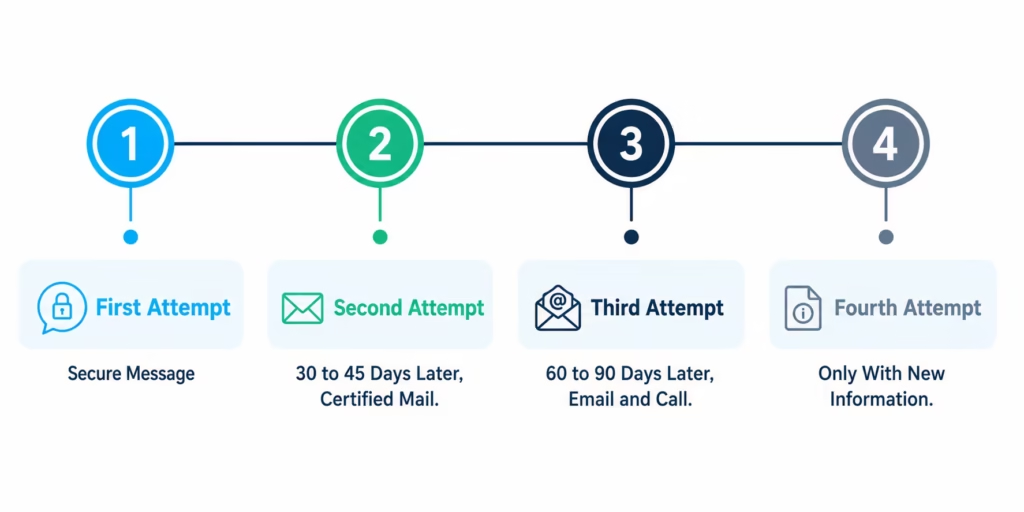
Beyond three or four tries without any positive signal, it’s time to stop. Focus on new on-time payments and lower balances instead.
A single late falls off your report seven years after the original delinquency date, and its impact on your FICO score fades sharply after 24 months. Sometimes waiting is the winning move.
Frequently Asked Questions (FAQs)
Does Chase Bank accept goodwill letters?
Chase does not officially accept goodwill adjustments and states its credit reporting must stay complete and accurate. Reps still have some discretion, so occasional approvals happen after two or three attempts and a polite, persistent approach.
Is a goodwill letter considered a dispute?
No, a goodwill letter and a dispute are different tools. A goodwill letter asks for a favor on an accurate late payment, while a dispute challenges inaccurate information through the credit bureaus.
Where do I send a goodwill letter to Chase?
Mail a certified letter to JPMorgan Chase Bank, N.A. Executive Office, 3415 Vision Drive, Columbus, OH 43219. You can also send it through the Secure Messages option in your chase.com account, which often gets a reply in 5 to 10 business days.
How do I send documents to Chase?
Attach copies (never originals) to your secure message, or include one to two pages of supporting proof, like a medical bill or layoff notice, with your mailed letter. Redact sensitive details like Social Security numbers first.
Do goodwill deletion letters work?
They can work, but success is inconsistent, especially with Chase. Odds are best with a single 30-day late payment on an otherwise clean account, and much lower with repeated lates or a charge-off.
How long does a goodwill letter take to process?
Response times vary by channel: about 5 to 10 business days for a secure message, 2 to 4 weeks for certified mail, and 5 to 15 business days for an Executive Office email. Follow up if four weeks pass with no reply.
What should I do if Chase says no to my goodwill letter?
A first “no” is usually a form response, not a final answer. Wait 7 to 10 business days, then call and ask to speak with a supervisor or try a different department, like the Executive Office, on your next attempt.
How to start a goodwill letter?
Open by stating your account number, the exact late payment date, and your request in one sentence, such as asking for a goodwill review of a 30-day late reported in March 2026. Skip “To Whom It May Concern” in favor of “Dear Chase Customer Service Team.”
How many times can I send a goodwill letter to Chase?
There’s no hard limit, but a reasonable pattern is a secure message first, then certified mail 30 to 45 days later, then an email and phone follow-up after another 60 to 90 days. Stop after three or four tries unless you have new information, like months of on-time payments, to add.
What is a good reason for a late payment letter?
Strong reasons include a documented hospitalization, a job loss or layoff, or a family emergency like a death in the family. State the reason in one factual sentence, such as being hospitalized after a car accident, rather than describing it emotionally.
Wrapping Up
Writing a goodwill letter to Chase takes more care than it does with most banks, but it isn’t a lost cause. The best way is to send a one-page letter. This letter should acknowledge the mistake, explain it briefly, highlight what has changed, and make a clear request. Then, send it via certified mail through Chase’s Executive Office or use the secure message centre.
Chase’s stance and real cardholder feedback show something important. Being persistent and politely escalating issues matters more than finding the perfect words.
If you know someone with one bad mark on their clean report, share this guide. A careful letter could save them years of a lower credit score.