
If you’ve been stacking Amex Membership Rewards points for months without cashing them in, you’re probably worried about one thing. You don’t want to waste them. Many cardholders feel stuck because the easy choices, like statement credits or Amazon checkout, feel safe but quietly burn value.
That fear is fair. The gap between the worst and the best use of Amex points can be huge, sometimes over a thousand dollars on the same balance.
The single highest-value way to use Amex Membership Rewards points is to transfer them to an airline partner for a premium cabin award flight.
This guide walks through every redemption path, ranks them by real value, and shows you exactly how to act with confidence.
Key Takeaways
This guide explains how to maximize Amex Membership Rewards points, covering every redemption path ranked by value, how airline transfer partners can deliver 4 to 8 cents per point, which six partners offer the best results, and which redemptions to avoid entirely.
Core Facts:
- Amex Membership Rewards points are valued at approximately 2 cents per point by major travel analysts, but actual value ranges from 0.5 cents (merchandise) to 8 cents (premium cabin airline transfers) depending on how they are redeemed.
- Transferring points to an airline partner for a premium cabin award flight consistently produces the highest value, with business and first class redemptions often delivering 4 to 8 cents per point.
- Statement credits return only 0.6 cents per point, meaning 100,000 points yield roughly $600 as a credit versus a potential $5,000 or more through an airline transfer sweet spot.
- Transfers to U.S.-based programs (Delta SkyMiles and JetBlue TrueBlue) trigger a federal excise tax offset fee of 0.06 cents per point, capped at $99 per transfer; non-U.S. airline and hotel transfers carry no fee.
- Amex points transfers are irreversible. Points cannot be returned once sent to a partner program, so award availability must be confirmed before initiating any transfer.
- The six highest-value transfer partners identified in this guide are Air Canada Aeroplan, Virgin Atlantic Flying Club, Singapore Airlines KrisFlyer, Air France/KLM Flying Blue, Iberia Plus, and British Airways Avios.
Best for:
- Amex cardholders with 50,000 or more Membership Rewards points who want to maximize value through international premium cabin flights rather than statement credits or portal bookings.
- Gold and Platinum cardholders who earn large point balances through dining, grocery, and flight spending and need a clear framework for deciding when and where to transfer.
- Anyone who has been defaulting to statement credits or Amazon Pay with Points and wants to understand how much value they have been leaving behind.
What Are Amex Membership Rewards Points Worth?
Most travel experts peg Amex Membership Rewards points at around 2 cents each. The Points Guy values them at 2 cents per point as of April 2026, making them one of the most flexible point currencies in the market. That number is a useful baseline, but it is not a promise.
Think of 2 cents per point (CPP) as an average across all the smart things you can do with your points. It is not a floor. You can earn far more, or far less, depending on how you redeem.
The real value range is wide. On the low end, statement credits return only about 0.6 cents per point. On the high end, a smart transfer to an airline partner for a business or first class seat can deliver 4 to 8 cents per point in real value. That is a huge swing.
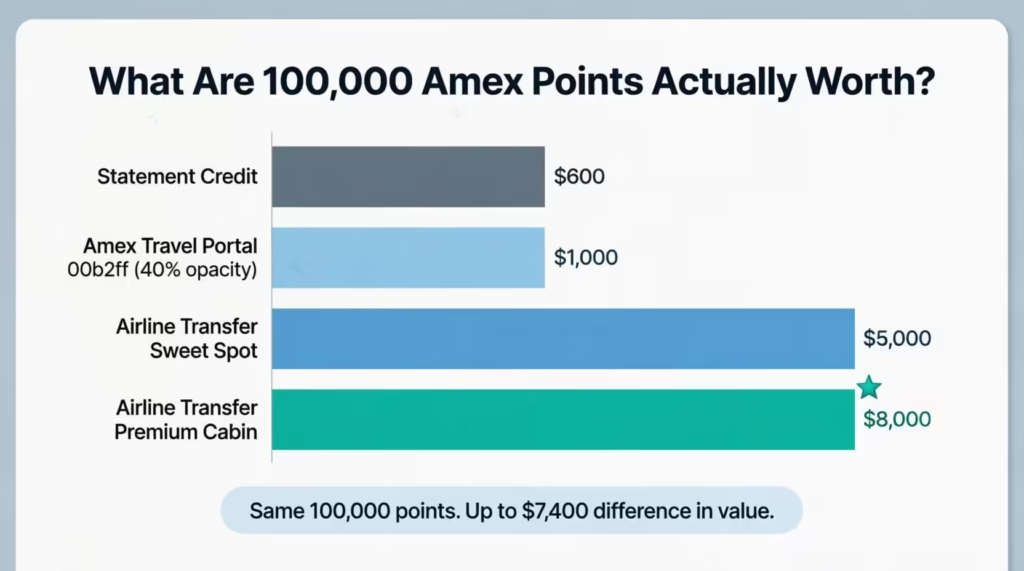
Here is what that swing means in plain dollars. Picture a balance of 100,000 points.
| Redemption Method | Value Per Point | Total Value of 100,000 Points |
|---|---|---|
| Statement credit | 0.6 CPP | $600 |
| Amex Travel portal flight | 1.0 CPP | $1,000 |
| Airline transfer (sweet spot) | 5.0 CPP | $5,000 |
| Airline transfer (premium cabin peak) | 8.0 CPP | $8,000 |
The difference between the worst and best path is $1,400 or more on most balances, and it can easily climb past $4,000 for premium cabin flyers. Those are real dollars left behind when you click the wrong button.
One more thing matters. Membership Rewards points do not expire while your card account stays open and in good standing. If your account closes, though, you only have about 30 days before the balance is forfeited. So you do not need to rush, but you should not sit on a huge stash forever either.
📌 Did You Know: Points have no fixed dollar value on your statement, but the IRS treats them as a rebate, not income. That means you do not owe tax on the value you redeem.
Every Way to Redeem Amex Points, Ranked by Value
Not all redemptions are equal. The list below ranks every common path from the most valuable to the least, with the real cents-per-point (CPP) you can expect.
- Airline transfer partners — 4 to 8 CPP. This is the top of the pyramid. Transferring points to programs like Air Canada Aeroplan, Virgin Atlantic, or Singapore KrisFlyer can unlock great value. Booking premium cabin seats is where the big rewards are.
- Hotel transfer partners — variable, often 2 to 5 CPP on luxury stays. Transfers to Hilton or Marriott can shine when peak-night cash rates spike.
- Amex Travel portal flights — 1.0 CPP. A flat rate. Fine when no award seats exist, but never a value play.
- Pay with Points — 1.0 CPP standard. Business Platinum cardholders get a 35% rebate on select airline bookings, which lifts the effective value.
- Gift cards — about 0.7 to 1.0 CPP. Depends on the retailer and any current discounts.
- Cash back or bank deposit — 0.6 to 0.8 CPP. Schwab Platinum cardholders can squeeze out 1.1 CPP, which is the lone exception worth knowing.
- Statement credits — 0.6 CPP. Easy, fast, and quietly one of the lowest payouts.
- Shopping portal or merchandise — 0.5 CPP. Among the worst options. Avoid unless points are about to expire.
The key insight is simple. Transfers can deliver 2x to 8x more value than any fixed-rate option on this list. Once you see the gap, going back to a 0.6 CPP statement credit feels like leaving free money on the table.
Why Transfer Partners Deliver the Highest Value
Fixed-rate redemptions, like the Amex Travel portal or statement credits, lock your point at a set value. One point equals one cent. That ceiling never moves up, no matter how nice the flight or hotel is.
Transfer partners work differently. When you move points into an airline program, the value depends on what that program charges in miles for a specific flight, not on a fixed conversion. That decoupling is the magic.
A simple example shows the math. A one-way business class ticket from New York to Paris on Air France often costs around $4,500 in cash.
The same flight, booked through Flying Blue using Amex points, can cost 55,000 to 65,000 miles plus a few hundred dollars in taxes. Run the formula (cash price minus taxes, divided by miles used), and you land at roughly 6 to 7 CPP.
The portal would have charged 450,000 points for the same seat at 1 CPP. The transfer charged 60,000. That gap, almost 400,000 points saved, is the entire reason transfer partners sit at the top of the ranking.
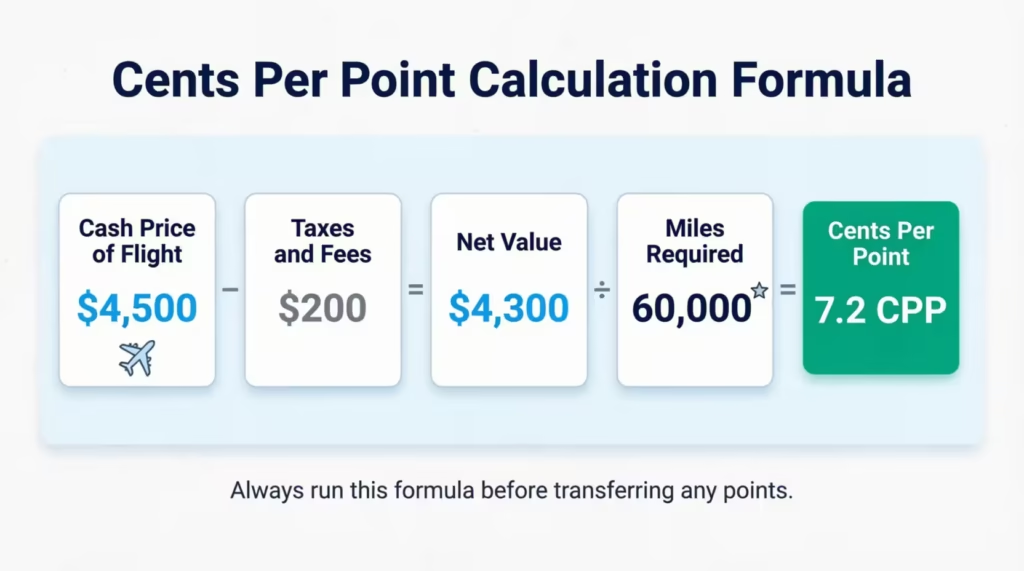
💡 Pro Tip: Always run the CPP math before transferring. Take the cash price of the flight, subtract the taxes and fees you’ll still pay, then divide by the miles required. If the answer is below 1.5 CPP, the portal or a cash booking is probably the smarter call.
Best Amex Transfer Partners for Airline Redemptions
The Amex transfer list has 16 airline partners as of mid-2026. Most cardholders never need to learn all of them. A short list of six covers the vast majority of high-value redemptions.
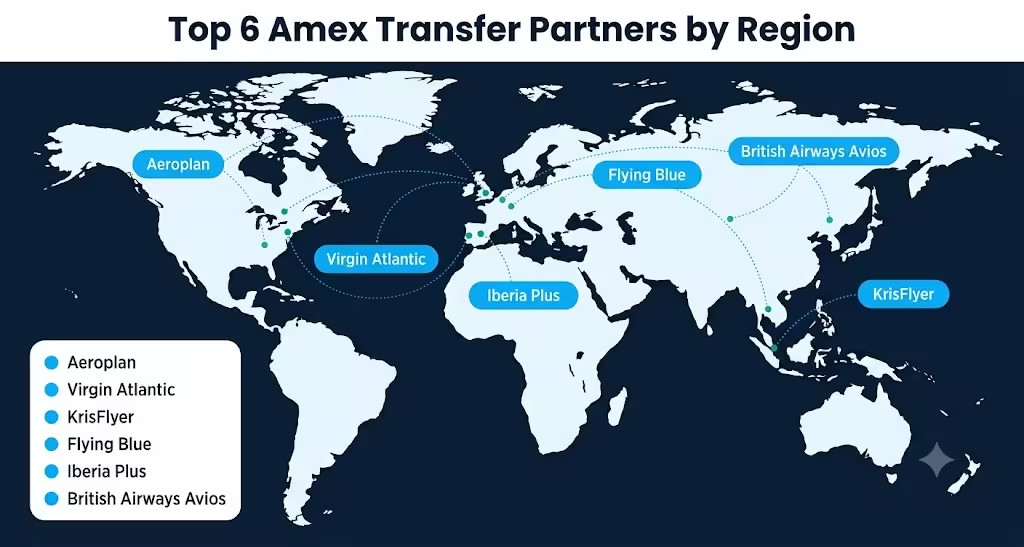
Air Canada Aeroplan.
Aeroplan opens up the full Star Alliance network, including United, Lufthansa, Swiss, and ANA. Strong points include no fuel surcharges on most partners, generous stopover rules, and clear award pricing. A great default for North America trips and long-haul flights to Asia or Europe.
Virgin Atlantic Flying Club.
This is the go-to program for booking Delta One business class on transatlantic routes, often at 50,000 to 60,000 miles one-way. Virgin Atlantic often gets Amex transfer bonuses, sometimes over 30%. This raises the effective rate above 7 CPP.
Singapore Airlines KrisFlyer.
KrisFlyer is the only way to book Singapore Suites and many of their premium cabin seats with points. The lie-flat business class is one of the most loved products in the sky. Award space is tight but bookable if you plan early.
Flying Blue (Air France and KLM).
Flying Blue runs monthly Promo Rewards that cut award prices by 25% to 33%. These promos make Europe business class affordable in a way few other programs match.
Iberia Plus.
Iberia uses a distance-based chart. Off-peak business class from the U.S. East Coast to Madrid can run as low as 40,500 Avios one-way. That is one of the cheapest premium cabin redemptions to Europe anywhere.
British Airways Avios.
Skip the long-haul BA flights (the fuel surcharges are brutal). Instead, use Avios for short-haul domestic flights on American Airlines partners and intra-Europe hops. Pricing starts around 4,000 to 6,000 Avios one-way.
A quick note on fees. Transfers to U.S.-based airline programs (Delta and JetBlue) trigger a federal excise tax offset fee. American Express charges 0.06 cents per point on these transfers, capped at $99 per single transfer, according to The Points Guy. Transfers to non-U.S. programs and to hotel partners carry no fee at all.
How Transfer Bonuses Can Amplify Your Value
Amex runs transfer bonuses several times a year. These promos add 20% to 40% extra miles on top of your transfer. So 50,000 Membership Rewards points with a 30% bonus become 65,000 partner miles.
That bonus can turn a good redemption into a great one. Take a business class flight that already costs 60,000 Virgin Atlantic miles. With a 30% bonus, you only need to transfer about 46,000 points instead of 60,000. The CPP on that same flight jumps by roughly a third.
Virgin Atlantic gets the most frequent bonuses. Air France-KLM Flying Blue, British Airways, and Aer Lingus also see them often. If your trip isn’t urgent, it can pay to wait a few weeks for a bonus to drop. Sites like Frequent Miler and AwardWallet track them in real time.
One warning. Never transfer just because a bonus exists. The bonus only adds value if you actually need those partner miles for a flight you plan to book. Stranded miles in a partner account are less valuable than Amex points. This is because Amex points are flexible, while partner miles are not.
Hotel Transfer Partners: When It Makes Sense
Amex has three hotel transfer partners. They are useful in narrow cases.
Hilton Honors. Transfers at a 1:2 ratio. That sounds great, but Hilton points are worth far less than airline miles, usually about 0.5 cents each. So 1,000 Amex points become 2,000 Hilton points worth roughly $10. That’s only 1 CPP at best.
Marriott Bonvoy. Transfers at a flat 1:1 ratio. Useful only for very specific high-end stays where the per-night cash rate is unusually high. In most cases, the math does not beat a direct airline transfer.
Choice Privileges. A 1:1 transfer, but Choice points can deliver strong value at European partner hotels like Preferred Hotels and certain all-inclusive resorts.
The honest take? Hotel transfers rarely beat airline transfers on a CPP basis. Use them only when you have a specific stay in mind, and the math actually clears 2 CPP after you check current rates.
Best Use of Amex Points for Travel
The core principle is simple. Premium cabin international award flights offer the best CPP in the Membership Rewards program. Every other use of points for travel ranks below that.
There are two tiers of travel use, and both have their place.
Tier 1: Aspirational travel. This is where Membership Rewards points truly shine. Business class on Virgin Atlantic flights operated by Delta from New York to London. First class on ANA via Aeroplan. Singapore Suites on KrisFlyer. These bookings regularly hit 5 to 8 CPP and turn a $400 cash flight equivalent into a $4,000 experience.
Tier 2: Practical travel. Short-haul economy flights using British Airways Avios. Europe economy via Flying Blue Promo Rewards. These trips will not blow your mind on a CPP basis, but they still beat the portal. A 4,500-Avios one-way from Miami to Chicago on American Airlines often produces 2 to 3 CPP, which is solid.
When does the Amex Travel portal make sense? Two cases. First, when no award seat exists on any partner, and you need to be on a specific flight. Second, when the trip is short, cheap, and the math doesn’t justify the effort of a partner search. Booking a $150 domestic flight at 1 CPP through the portal is fine. Burning 200,000 points on a $2,000 portal flight is not.
Best Use of Amex Points for Hotel Stays
Hotel redemptions are more nuanced than flight redemptions. The best moves depend on what kind of stay you want.
Luxury properties via Hilton transfers. High-end Hilton properties like the Conrad Maldives or Waldorf Astoria Maldives can spike to $1,500+ per night in cash. Transferring Amex points to Hilton at 1:2 can sometimes clear 2 CPP on these stays. Run the math before committing.
Fine Hotels + Resorts (FHR) bookings. Platinum cardholders enjoy FHR, a selection of luxury hotels with great perks. These include free breakfast for two, a $100 property credit, room upgrades when available, and early check-in or late check-out. You can pay with cash or use Pay with Points at 1 CPP. The perks alone often justify the FHR booking compared to booking direct.
Skip the portal for non-flight bookings. The Amex Travel portal pays only 0.7 CPP on hotel bookings, vacation packages, and cruises. That is one of the lowest non-trap rates on the list. If you cannot transfer to a partner or use FHR, paying cash and earning points on the spend is often the better move.
Best Use of Amex Gold Points
Gold cardholders sometimes assume they have weaker redemption options than Platinum holders. That’s a myth. The Amex Gold card has access to the exact same Membership Rewards transfer partners as Platinum, at the same ratios. There is no second-tier program. Every airline and hotel partner is wide open.
Where Gold actually shines is on the earning side. The card pays 4x on restaurants worldwide, 4x at U.S. supermarkets (up to $25,000 per year), and 3x on flights booked directly with airlines. Many users notice their Amex Gold points add up quickly. This happens because dining and groceries are common spending areas.
The smart play for Gold cardholders is exactly the same transfer-partner strategy any other MR holder would use. Send points to an airline partner for premium cabin flights or strong economy sweet spots.
Two sweet spots fit Gold cardholders especially well. First, Flying Blue and Iberia for Europe trips, since Gold holders often build balances large enough for a Europe business class redemption in under a year of dining and grocery spend. Second, Aeroplan for North America short-hauls and long-haul flights to Asia or the South Pacific.
The Amex Gold card has a $325 annual fee as of 2026. The clearest way to justify that fee is to consistently redeem at 4 CPP or better through transfers. At that rate, even a single Europe business class redemption per year more than covers a decade of fees.
⚠️ Mistake to Avoid: Many Gold cardholders cash out points for statement credits “just to use them.” On a 100,000-point balance, that decision costs roughly $4,400 versus a strong transfer redemption. Sit on the points until you have a transfer plan.
Best Use of Amex Platinum Points
Just like Gold, the Amex Platinum card uses the same Membership Rewards transfer partners at the same ratios. Holding Platinum does not unlock any premium redemption tier that Gold cardholders can’t reach.
Where Platinum stands out is on the earning side and a few specific travel perks.
5x points on flights. Platinum earns 5 Membership Rewards points for every dollar spent on flights. This applies to bookings made directly with airlines or through Amex Travel. The limit is $500,000 in spending each calendar year. For frequent travelers, this earn rate fills the points pool quickly.
International Airline Program (IAP). Platinum cardholders can use IAP to book discounted premium cabin tickets on select international carriers through Amex Travel. The savings are real but case-by-case. Always compare the IAP price against a normal transfer-partner redemption before booking.
Fine Hotels + Resorts and The Hotel Collection. As covered in the hotel section, these benefits add real cash value to luxury stays.
The smartest use of Platinum points is the same transfer-partner strategy at the top of this guide. Platinum simply gets you to a redeemable balance faster, especially if you book a lot of flights on the card.
Business Platinum’s 35% Pay with Points Rebate
Business Platinum cardholders have one redemption tool the personal cards don’t. The 35% Pay with Points rebate refunds 35% of the points used to book eligible airfare through Amex Travel, up to 1 million points back per calendar year.
The math works like this. A flight that normally costs 100,000 points at 1 CPP gets a 35,000-point rebate back to your account. Effective cost: 65,000 points for a $1,000 flight. That works out to roughly 1.54 CPP.
The rebate covers airfare booked on your chosen qualifying airline (you pick one each year) in any class of service. It also covers all business and first class fares on any airline through Amex Travel.
Is 1.54 CPP great? No. It still loses to most transfer-partner redemptions. But it is the highest-value fixed-rate redemption available anywhere in the program, and it makes sense when no award seats exist on the specific route you need. Many business travelers use it as a fallback when partner availability fails.
Best Use of Amex Points If You Don’t Travel
If travel is not in the picture, the honest answer is this. Non-travel redemptions are low-value compared to transfers. Even an economy redemption to a domestic destination usually beats the best non-travel option. That said, life happens, and sometimes you just want to use your points.
The clear winners for non-travel redemptions are gift cards or Pay with Points. The clear losers are statement credits and Amazon checkout.
Gift cards. Pay roughly 0.7 to 1.0 cent per point, depending on the retailer. Watch for occasional promotions that lift specific gift cards to 1 CPP or slightly above. Better than statement credits, but still well below transfer territory.
Statement credits. Pay only 0.6 CPP. Best reserved for emergencies, not routine redemptions. A $1,000 charge offset costs about 167,000 points, points that could have covered a $3,300+ business class ticket on a partner.
Cash back or bank deposit. Pay 0.6 to 0.8 CPP depending on card and account type. The big exception is the Charles Schwab Platinum card, which allows points cash-out at 1.1 cents per point on up to 1 million points per calendar year. According to a Schwab Platinum cardholder analysis on Miles to Memories, this is the best fixed-rate cash-out available in the program. If you hold a Schwab Platinum card and want pure cash, this is the path.
Charitable donations via JustGiving. Run at about 0.7 CPP. Viable when the charitable impact matters more than the value.
The Amazon trap. Amex lets you link your Membership Rewards account to Amazon and pay with points at checkout. The rate is only 0.5 CPP, one of the worst in the entire program. Go into your Amazon account settings and turn off the auto-fill payment setting so you don’t accidentally burn points on toothpaste.
The bottom line for non-travel redemptions is honest. If travel could ever fit in your life, even an occasional economy domestic flight, points will work much harder there than anywhere else.
Redemptions to Avoid With Amex Points
Some redemption paths are not just low-value. They are actively bad. Knowing what to skip can save thousands of dollars over the life of your card.
Amex Travel portal for non-flight bookings. Hotels, vacation packages, and cruises through the portal pay only 0.7 CPP. That is barely above the floor. Pay cash for these and earn points on the spend instead.
Amazon Pay with Points auto-fill. Defaults to 0.5 CPP. It’s the click of a button to redeem, which is exactly why so many cardholders accidentally burn points here. Turn off the setting permanently.
Shopping portal merchandise. Pays 0.5 CPP. No travel option in the entire program is this low. There is no scenario where buying a blender with points beats a Europe redemption.
Statement credits as a default. 0.6 CPP. Acceptable in emergencies, but not as the regular way you use points. Those same points could be worth 4x to 8x more on a partner award.
Transferring without confirming award availability. This one is different from the others. It’s not a low-value trap; it’s a high-risk process error. Membership Rewards transfers are irreversible.
Once points leave Amex for an airline partner, they cannot come back. If you transfer first and then find no award seat for your dates, you’re left with a partner balance. This balance might be less flexible than your original Amex points. Always confirm the seat is bookable before you press transfer.
The bottom line framing. On a 100,000-point balance, the gap between the best and worst redemption can exceed $4,000 in real-world value. Those are the stakes.
How to Transfer Amex Points to Airline and Hotel Partners
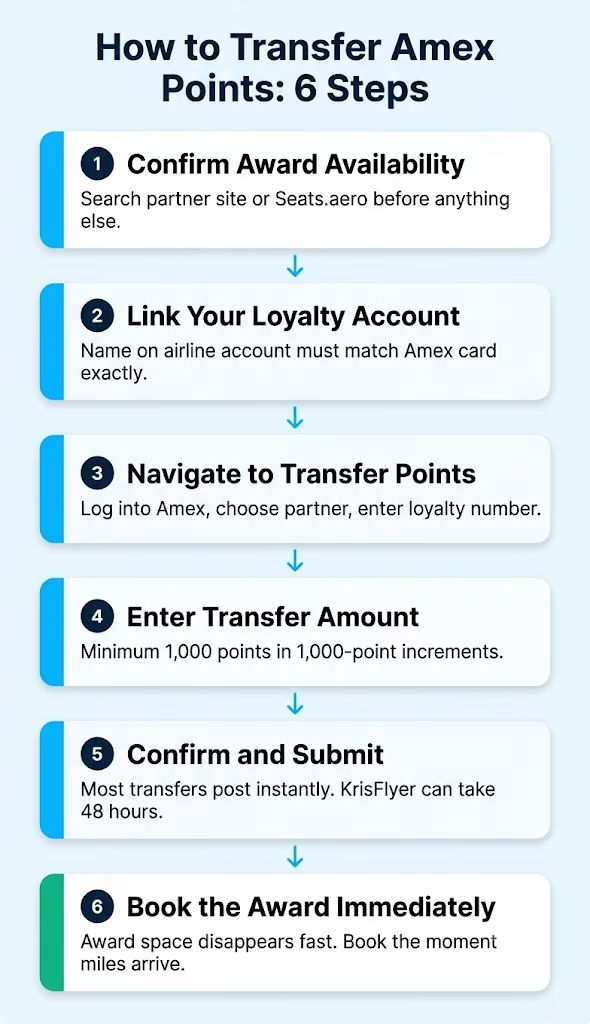
Once you’ve picked a partner and confirmed availability, the actual transfer is quick. Six clear steps.
Step 1: Confirm award availability on the partner program before doing anything else. This is the most important step in the whole process. Log into the airline’s website (or use a tool like Seats.aero to scan multiple programs at once) and confirm the exact flight, date, and award price are available. Do not start the transfer until you see the seat with your own eyes.
Step 2: Link your loyalty account to your Amex account. Visit the Amex Membership Rewards transfer page and select your chosen partner. The name on your airline account must match the name on your Amex card exactly. Even a middle initial mismatch can cause a failed transfer. This is the most common point of failure.
Step 3: Navigate to Membership Rewards, then Transfer Points in the Amex portal. Once logged in, choose the partner and enter your loyalty number. The system will confirm the link.
Step 4: Enter the transfer amount. Minimum is 1,000 points, in 1,000-point increments. Double-check the math one more time. Make sure you’re transferring exactly the amount needed for your award, plus a small buffer if the partner requires more for taxes paid in miles.
Step 5: Confirm and submit. Most airline transfers post instantly. A handful (like Singapore KrisFlyer) can take up to 48 hours. Hotel transfers usually take 1 to 2 business days. Plan for the longer window if your booking has a deadline.
Step 6: Book the award immediately after the transfer confirmation. Award space can disappear in minutes, especially on premium cabin routes. Log into the partner program the moment your miles arrive and complete the booking. Do not wait until tomorrow.
Excise Tax and Transfer Fees Explained
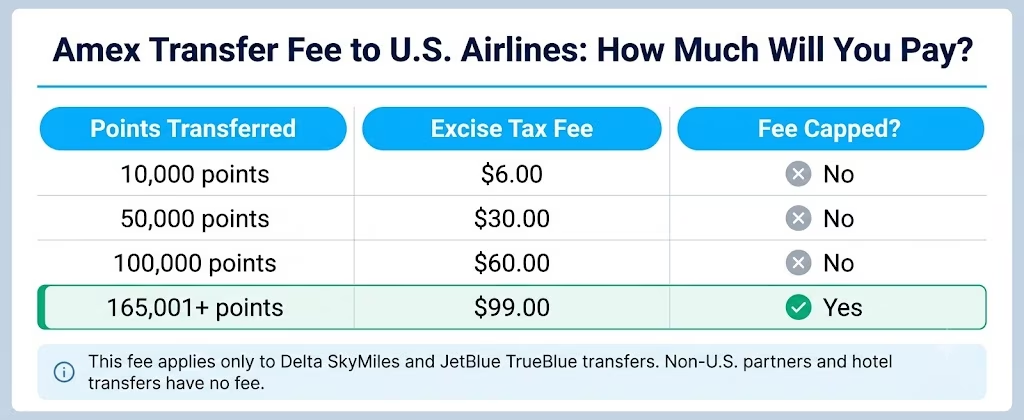
When you transfer Membership Rewards points to a U.S.-based airline frequent flyer program, American Express adds a federal excise tax offset fee. The fee is 0.06 cents per point, capped at $99 per single transfer.
Here’s what that looks like in real dollars.
| Points Transferred | Excise Tax Fee | Capped? |
|---|---|---|
| 10,000 points | $6.00 | No |
| 50,000 points | $30.00 | No |
| 100,000 points | $60.00 | No |
| 165,001 points or more | $99.00 | Yes |
The fee applies to Delta SkyMiles and JetBlue TrueBlue transfers (the two U.S. partners currently on the Amex list). It does not apply to non-U.S. airline partners (Aeroplan, Virgin Atlantic, Singapore KrisFlyer, Flying Blue, and others) or to any hotel transfers.
The fee is small compared to the value you’ll get from a good redemption, but it does mean that very small transfers (say, 1,000 to 5,000 points to top off a Delta account) are slightly less efficient than larger ones. The cap protects you on big transfers.
Confirming Award Availability Before You Transfer
Award availability is the single biggest factor that decides whether a transfer is worth it. The drill is always the same. Search first, transfer second.
Use the partner’s own search tool. For Air Canada Aeroplan, log into aeroplan.com and run the award search. For Virgin Atlantic, use the Virgin Atlantic Flying Club search. For Flying Blue, use the Air France or KLM site. Each program shows you award seats in real time.
Use a multi-program tool to save hours. Seats.aero, point.me, and AwardLogic scan dozens of programs at once. Plug in your dates and route, and the tool shows where award space exists. This is the fastest way to find premium cabin sweet spots.
Search a few extra dates around your target. Award space often opens up one or two days before or after the date you have in mind. Flexibility almost always saves miles.
Check for transfer bonuses before you transfer. A 30% bonus to Virgin Atlantic, for example, means you’ll transfer fewer points to cover the same award. Always check the Amex transfer bonus page before initiating.
Hold the award if possible. A few programs (Aeroplan, in particular) let you put an award on hold for several days while you transfer the points. This keeps you from losing the seat while you wait for your points to arrive after confirming availability.
Frequently Asked Questions (FAQs)
How much are 100,000 Amex points worth?
It depends on how you redeem them. At the low end, statement credits return about $600, while a smart airline transfer for a premium cabin flight can make the same 100,000 points worth $5,000 or more.
How much are 50,000 Amex points worth in cash?
Cashed out as a statement credit, 50,000 Amex points are worth about $300 at 0.6 cents per point. Transferred to an airline partner for a business class award, those same points can be worth $2,000 to $4,000 in real travel value.
How much are 70,000 AmEx points worth?
At the standard 2 cents per point benchmark used by most travel experts, 70,000 Amex points are worth about $1,400 when redeemed well. A statement credit would return only around $420, while a premium cabin transfer redemption could exceed $3,500.
How much are 100,000 Amex points worth in cash back?
Redeemed as a statement credit, 100,000 Amex points return about $600 at 0.6 cents per point. The lone exception is the Charles Schwab Platinum card, which allows a cash-out at 1.1 cents per point, making 100,000 points worth $1,100.
What will 30,000 Amex points get me?
At 0.6 cents per point, 30,000 points cover about $180 as a statement credit. Spent more strategically, 30,000 points can book a short-haul economy flight through British Airways Avios, such as a domestic American Airlines hop starting around 4,500 to 6,000 Avios per segment.
Is 1,000,000 Amex points a lot?
Yes, one million Membership Rewards points is an exceptionally large balance. At a conservative 2 cents per point, that balance represents $20,000 in travel value, and at 5 cents per point through an airline partner transfer, it could cover $50,000 in premium cabin flights.
What are the disadvantages of Amex points?
The two biggest drawbacks are transfer irreversibility and uneven redemption value. Once points move to an airline partner, they cannot return to your Amex account, and low-value options like statement credits or Amazon checkout quietly pay as little as 0.5 to 0.6 cents per point.
Is 200,000 Amex points a lot?
Yes. At the program’s benchmark of 2 cents per point, 200,000 points represent $4,000 in travel value. Transferred to an airline partner for a business class redemption at 5 cents per point, that balance is worth $10,000 in real flight value.
Can you transfer Amex points to someone else’s airline account?
No. American Express requires the name on the linked loyalty account to match the name on the Amex card exactly. Even a middle initial mismatch can cause the transfer to fail, and transfers to another person’s account are not permitted.
Wrapping Up
The Membership Rewards program rewards patience and a plan. The best use of Amex points consistently sits with airline transfer partners for premium cabin flights, where redemptions of 4 to 8 cents per point are common. Lower down the ranking, hotel transfers, the Amex Travel portal, and the Business Platinum 35% rebate all have niche cases.
Non-travel uses like gift cards and Schwab cash-out have honest, narrow places too. The redemptions to skip, especially Amazon Pay with Points and merchandise, can quietly drain thousands in value.
The best strategy for most cardholders is to build a balance. First, confirm a specific partner award. Then, transfer only when you’re ready to book.
If you know someone with a growing pile of Amex points but no plan, share this guide. It could save them thousands on their next big trip.