
You’ve built up a solid Amex Membership Rewards balance. Now what? Many cardholders redeem their points for statement credits or Amazon purchases without realizing they’re getting a fraction of what those points could actually be worth.
The best way to use Amex Membership Rewards points is to transfer them to airline partners.
In this guide, we’ll walk you through every redemption option, show you the real dollar gaps between them, and give you the step-by-step process to transfer points safely and confidently.
Key Takeaways
This guide explains how to redeem Amex Membership Rewards points for maximum value, covering all redemption methods from statement credits (0.6 cents per point) to strategic airline transfers (1.5 to 8+ cents per point), with step-by-step transfer instructions and top partner recommendations.
Core Facts:
- Airline transfer partners deliver the highest value at 1.5 to 8+ cents per point; statement credits return only 0.6 cents per point, and Amazon Pay with Points returns approximately 0.7 cents per point.
- Transfers are completely irreversible; once points leave your Membership Rewards account, they cannot be returned under any circumstances.
- Confirm award seat availability before transferring points, as seats can disappear between your transfer and booking attempt.
- Most airline transfers complete instantly at a 1:1 ratio; Delta SkyMiles transfers incur an excise tax fee capped at $99, making fee-free partners preferable for most travelers.
- Top airline partners for premium cabin value include Air Canada Aeroplan, ANA Mileage Club, and Virgin Atlantic Flying Club, with returns of 3.8 to 13 cents per point on select routes.
- Points do not expire while your account remains open, but canceling your last Membership Rewards-earning card will forfeit your entire balance.
Best for:
- Cardholders with 50,000 or more Membership Rewards points planning international business or first class travel within the next 6 to 12 months.
- Points holders currently redeeming for statement credits or Amazon purchases who want to understand the full dollar cost of those choices.
- Anyone planning to close an Amex card who needs to act before their balance is forfeited.
What Amex Membership Rewards Points Are Worth
Here’s the most important thing to understand about Membership Rewards: the points don’t have a fixed dollar value. Their worth depends entirely on how you redeem them.
TPG’s April 2026 valuations place Amex Membership Rewards points at 2 cents per point. That’s the benchmark. A strong redemption beats it. A poor one falls well short of it.
That 2-cent figure is only achievable through airline transfer partners. Pick the wrong path, like a statement credit or an Amazon checkout, and you’ll get less than a third of that value.
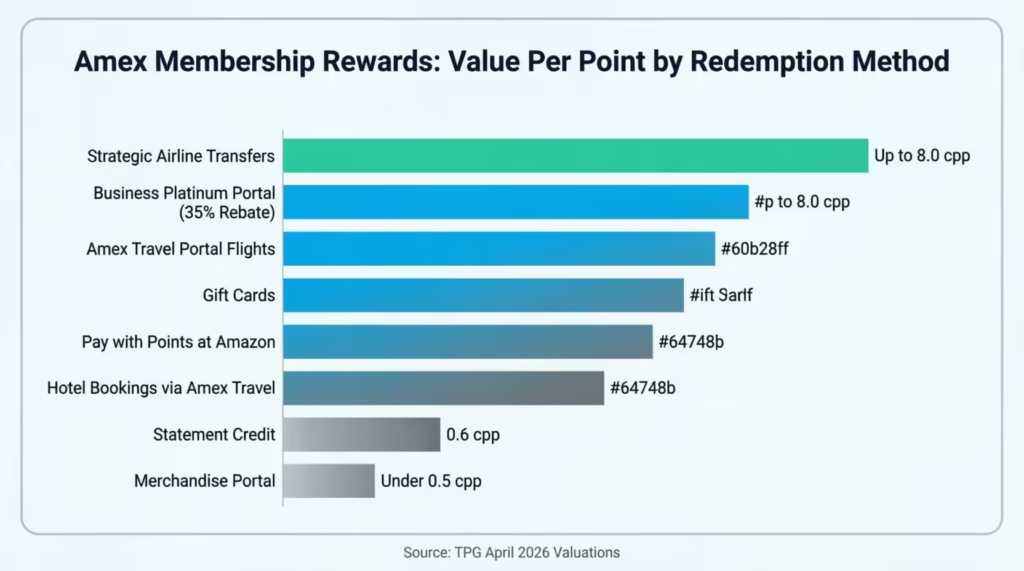
Before diving into each option, here’s a single reference table. Every redemption method, ranked by value:
| Redemption Method | Value Per Point |
|---|---|
| Merchandise through Amex portal | Under 0.5 cents |
| Statement credit | ~0.6 cents |
| Pay with Points at Amazon/retailers | ~0.7 cents |
| Hotel bookings through Amex Travel | ~0.7 cents |
| Gift cards | 0.5 to 1.0 cents (varies by merchant) |
| Flights through Amex Travel portal | 1.0 cents |
| Business Platinum portal with 35% rebate | ~1.54 cents |
| Strategic airline transfers | 1.5 to 8+ cents |
The real-world gap is striking. Redeem 100,000 points as a statement credit, and you’ll get roughly $600. Transfer those same 100,000 points to Aeroplan for a Lufthansa First Class flight, and the travel value is a conservatively estimated $3,200 to $4,000+. Same points. Very different result.
This guide will help you aim for the top of that table, not the bottom.
How Cents Per Point (CPP) Works
Cents per point is the measuring tool you’ll use throughout this guide. It lets you check any redemption on its own merits, without needing someone else’s ranking.
The formula is simple:
CPP = (cash value of the redemption/number of points required) x 100
Here’s a quick example. A $400 flight booked with 40,000 points returns 1.0 cpp. That’s the standard portal rate. The same 40,000 points used for a business class seat worth $1,600 returns 4.0 cpp. That’s four times the value for the same number of points.
Use 1.0 cpp as your floor. Anything below that means the portal would have been a better choice. Anything above 2.0 cpp means you’re beating the benchmark. That’s the target.
Do Amex Points Expire? Account Rules and Card Cancellation
Points don’t expire while your account stays open and in good standing. There’s no anniversary deadline, no use-by window, and no need to redeem in a rush just because your card renewal is coming up.
The real risk is closing your card. If you cancel your last Membership Rewards-earning card, your entire balance is typically forfeited. That’s the one situation that should push you to act fast.
If you’re planning to close an Amex card, transfer your points to a linked airline or hotel loyalty account first. Once the points are in that external account, they’re no longer connected to your Amex balance. A card closure won’t touch them.
One key rule: points can only be transferred to loyalty accounts in the cardholder’s name or an authorized user’s name. You can’t send points to a spouse’s frequent flyer account unless they’re listed as an authorized user on your card.
Redeeming Amex Points Through the Amex Travel Portal
AmexTravel.com is the built-in booking experience on your account. It’s easy to use and gives you a fixed, predictable value for every flight you book.
For flights, that fixed value is 1.0 cent per point. So 50,000 points cover a $500 flight. No guesswork, no research, no transfer required. You can also book hotels, vacation packages, cruises, and rental cars through the portal.
The portal is a solid tool for the right trips. It’s just not the highest-value path. Knowing its limits lets you use it on purpose rather than by default.
One feature worth knowing: Amex Travel occasionally offers “Insider Fares” on select airlines when you cover the full flight cost with points. These fares can unlock lower-priced inventory not shown publicly. They appear sporadically, so it’s worth checking the portal when you’re booking to see if any apply to your route.
The portal works best in these situations:
- Economy flights on domestic or short-haul routes where the cash price is roughly $300 or under
- Bookings where simplicity matters more than maximizing value
- Cases where you haven’t confirmed award space with a transfer partner yet
The Business Platinum 35% Rebate — How It Changes the Portal Math
If you carry the Business Platinum card, the portal math changes in your favor. Business Platinum cardholders earn a 35% points rebate on eligible bookings made through Amex Travel. This applies to:
- Economy class on your one selected qualifying airline
- Business and first class on any airline booked through Amex Travel
The rebate cap is 1,000,000 points returned per calendar year. After the rebate, the effective value of your points rises to roughly 1.54 cents per point. That’s meaningfully higher than the standard 1.0 cpp portal rate.
At 1.54 cpp, the portal becomes competitive with some lower-end transfer redemptions. For Business Platinum holders booking business class on a major carrier, this can be both a simpler and a genuinely strong choice.
Booking Hotels Through the Amex Travel Portal
Most hotel bookings through the portal return around 0.5 to 0.7 cents per point. That’s lower than the flight rate and generally makes the portal a weak choice for lodging.
The exception is Amex Fine Hotels + Resorts properties. Prepaid bookings at these properties offer great perks. You get room upgrades when available, daily breakfast for two, and late checkout.
Those benefits add real dollar value on top of the base redemption rate. At some properties, those perks are worth $150 to $300, which can make the effective return competitive.
Before booking any hotel through the portal, check if a direct Hilton or Marriott transfer could provide a better outcome for that specific property.
How to Transfer Amex Points to Airline Partners
Transferring points is where the serious value is. Instead of the portal’s fixed 1.0 cpp, you move points into an airline loyalty program and use them to book an award ticket. On premium cabin routes, you can return 2, 4, or even 8+ cents per point.
Here’s how it works. Your Membership Rewards points move from your Amex account into a separate airline or hotel account. From there, you search for and book award flights directly with that airline.
Most transfers require a minimum of 1,000 points. JetBlue TrueBlue allows 250 points as a minimum. Qantas allows 500. Most transfers complete instantly. ANA Mileage Club is a notable exception and can take up to 48 hours.
What to Confirm Before You Transfer — Name Matching, Excise Tax, and the Irreversibility Rule
Before you start any transfer, confirm these four things. Getting one of them wrong is an expensive lesson.
Transfers are one-way and cannot be undone. Once points leave your Membership Rewards account, they’re gone from it permanently. There’s no reversal process and no appeal that will bring them back. This is the most critical rule in the entire process.
The names on both accounts must match exactly. The name on your Membership Rewards account must be identical to the name on the loyalty account you’re transferring into. A middle name present in one and missing in the other can cause a transfer failure. Check this before you confirm.
Delta SkyMiles transfers include an excise tax offset fee. Amex charges $0.0006 per point when you transfer to Delta, capped at $99. A 100,000-point transfer to Delta costs $60 in fees. Run that math before choosing Delta over a fee-free partner.
Only transfer after you’ve confirmed award space. Search for the specific flight and dates you want using the airline’s own booking tool or point.me, which is complimentary for Amex cardholders. Do this before moving any points. Award seats can disappear between your transfer and your booking attempt.
Step-by-Step: How to Begin a Transfer
Once you’ve confirmed award availability and verified the name on your loyalty account, here’s how to execute the transfer:
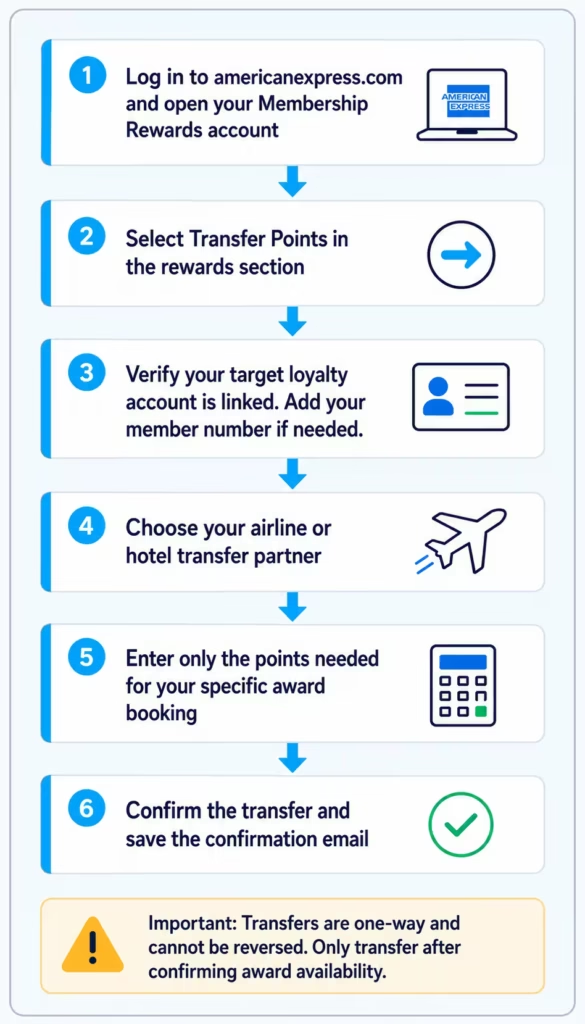
- Log in at americanexpress.com and go to your Membership Rewards account.
- Select “Transfer Points” in the rewards section.
- Check that your target loyalty account is linked. If it isn’t linked yet, add it before starting the transfer. You’ll need your loyalty program member number.
- Choose the transfer partner you want.
- Enter the number of points to transfer. Move only what you need for the specific award.
- Confirm the transfer and save the confirmation email. It will show the expected completion time for that partner.
Keep the confirmation email until you see the points in your loyalty account, and you’ve completed the award booking.
Transfer Bonuses — What They Are and When to Act
Amex runs transfer bonuses on specific partners from time to time. These bonuses increase the number of miles you receive per point transferred, typically by 10% to 40%, for a limited window.
The math shift can be significant. A 30% bonus on a Virgin Atlantic transfer means 70,000 Membership Rewards points deliver 91,000 Virgin points instead of 70,000. Historically, Amex has offered as many as 17 transfer bonuses in a single year, though they’ve become less frequent in recent years.
The right move: if you were already planning to transfer to a partner and a bonus goes live, use it. The wrong move: transferring to a partner purely because of a bonus, without a confirmed award seat in mind. The irreversibility rule doesn’t pause during a bonus window. Points transferred without a confirmed booking are points at risk.
To track active bonuses, check NerdWallet’s transfer bonus tracker and The Points Guy’s transfer alerts page.
How to Find Award Availability Before You Transfer
Confirming award space before transferring is the most important habit in the entire transfer process. Here’s how to do it efficiently.
Start with the airline’s own booking tool. Search directly on the airline’s website for your target route, dates, and cabin class. Most programs display award availability clearly. Once you see the seat, note the exact point cost, then transfer.
For more complex searches, use point.me. Amex cardholders get complimentary access, and it searches award availability across many programs at once. It’s really helpful when you compare Aeroplan, ANA, and Virgin Atlantic for the same route. You can see which program has space and the costs involved.
Be flexible with dates. Availability is the main constraint for premium cabin award travel. Searching a 7 to 10 day window around your target date improves your chances considerably. Off-peak seasons and midweek departures typically show more open space.
Once you’ve confirmed availability, transfer exactly the points you need and book as quickly as possible.
Best Airline Transfer Partners for Maximum Value
As of mid-2026, Amex has 18 airline transfer partners, following the end of the Etihad Guest partnership on June 30, 2026. Most transfer at a 1:1 ratio, meaning 1,000 Membership Rewards points become 1,000 airline miles. A few exceptions:
- Aeromexico Club Premier transfers at 1:1.6, a favorable ratio for Aeromexico redemptions
- JetBlue TrueBlue transfers at 250:200, a small built-in loss on every transfer
- Cathay Pacific Asia Miles transfers at 1:1 following recent program changes
Not all 18 partners deliver strong value. The programs below consistently return the most for your points.
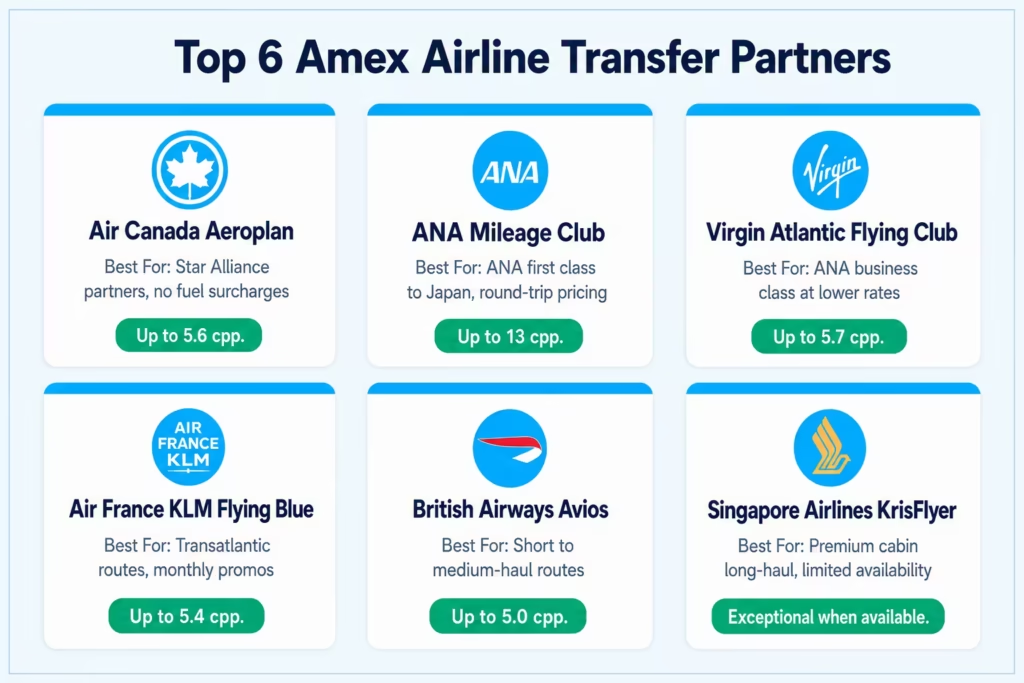
Air Canada Aeroplan is the most versatile partner in the program. It gives access to Star Alliance carriers, including Lufthansa, Swiss, ANA, and Singapore Airlines, at fixed award chart prices. Aeroplan charges no fuel surcharges on partner bookings. It also has more bank transfer partners than any other airline loyalty program.
ANA Mileage Club is the top choice for flying ANA itself, particularly in premium cabins to Japan. The award chart is zone-based and priced for round-trip flights, with some of the best per-point returns available on transpacific routes.
Virgin Atlantic Flying Club is primarily useful not for Virgin Atlantic flights, but for booking ANA and Air New Zealand at rates often lower than those airlines’ own programs. It transfers 1:1 from Amex and charges no fuel surcharges on ANA awards.
Air France/KLM Flying Blue covers transatlantic routes well and runs monthly promotional awards that temporarily discount specific routes. It’s a strong option for Paris, Amsterdam, and other Air France or KLM destinations.
British Airways Avios works best for short to medium-haul routes where the distance-based pricing is favorable. US domestic segments on American Airlines, and London to European cities, can be strong value at under 15,000 Avios each way.
Singapore Airlines KrisFlyer provides access to Singapore Airlines’ premium cabin products. Award availability is limited, but when space opens up, the return per point is exceptional.
⚠️ Mistake to Avoid: Etihad Guest transfers from Amex end permanently on June 30, 2026. If you have a specific Etihad redemption in mind, you must act before that date. After June 30, the transfer option disappears entirely.
Top Partners for Long-Haul Premium Cabin Flights
For international premium travel, a few redemptions define what “maximizing” actually looks like in practice.
Aeroplan for Lufthansa First Class is one of the most well-known sweet spots in points travel. A one-way ticket on a shorter transatlantic band, such as Frankfurt to Boston, costs roughly 90,000 Aeroplan points at current pricing.
The cash equivalent for Lufthansa First Class on that route runs $3,000 to $5,000+. At 90,000 points for a $4,000 seat, that’s approximately 4.4 cents per point. Aeroplan adjusted its award chart in June 2026. Some longer transatlantic first class bands now cost 120,000 points one-way. The shorter transatlantic bands remain the better value.
ANA Mileage Club for ANA first class on transpacific routes is another landmark redemption. ANA prices its own award flights on a round-trip zone chart. First class from North America to Japan costs 150,000 ANA miles round-trip. Against a cash price of $15,000 to $20,000+, that’s a return of 10 to 13 cents per point. The limiting factor is availability. ANA typically releases very few first-class award seats, often just one per flight.
Virgin Atlantic Flying Club for ANA business class from the US West Coast to Japan costs 52,500 Virgin points one-way. A nonstop ANA business class seat on that route carries a cash value of $2,000 to $3,000, delivering roughly 3.8 to 5.7 cents per point.
Note that Virgin Atlantic doesn’t display these awards on its own site. You’ll need to search United.com or Aeroplan to confirm space, then call Virgin to complete the booking. Taxes and fees on ANA awards typically run $300 to $500.
Flying Blue for transatlantic routes is most useful during the monthly promotional awards. These limited-time discounts can lower business class fares to Paris or Amsterdam well below the usual rate. If your travel dates are flexible, timing your search around these promotions is well worth it.
Partners That Offer Limited or Situational Value
Some partners belong on a caution list for most travelers, even though they’re available in the program.
Hilton Honors transfers at a 1:2 ratio. That double conversion sounds appealing, but Hilton points carry lower individual value than airline miles. The 1:2 ratio mostly compensates for Hilton’s lower per-point value rather than genuinely doubling it. For most travelers, airline transfers will outperform Hilton transfers.
Delta SkyMiles is familiar to US domestic travelers but comes with two drawbacks: the excise tax offset fee on every transfer, and award prices that have risen considerably in recent years. For a Delta domestic booking, run the portal math first before committing points.
Emirates Skywards now transfers at 1:1 after a previous ratio disadvantage was corrected. Emirates awards can have high taxes and fees on certain routes. This reduces their true value, even if the points cost seems fair. Research the full out-of-pocket cost before transferring.
JetBlue TrueBlue transfers at 250:200, a built-in 20% loss before you’ve redeemed anything. Outside of very specific JetBlue partner award bookings, this is rarely the most efficient path.
Marriott Bonvoy transfers at 1:1 but with slower processing times than airline partners. Hotel transfers are generally less efficient than airline transfers, and Marriott’s cents-per-point return on most properties is modest.
High-Value Redemption Examples — What 50,000 to 100,000 Points Can Actually Get You
Reading about sweet spots is useful. Seeing the actual numbers is what makes it click. Here are four specific, bookable redemptions. Each follows this structure: route, partner, point cost, cash equivalent, and cents per point.
Example 1: New York to Paris, Air France Business Class, via Flying Blue
Points needed: 55,000 to 65,000 Flying Blue miles one-way (varies with dynamic pricing and monthly promotions). Cash equivalent: $2,500 to $3,500+ for a transatlantic business class seat.
Resulting CPP: roughly 3.8 to 5.4 cents per point. Flying Blue runs monthly promotional awards with discounts on specific routes. Flexibility with travel dates within a promotional window is what makes this achievable at the lower point cost.
Example 2: US West Coast to Japan, ANA Business Class, via Virgin Atlantic
Points needed: 52,500 Virgin Atlantic points one-way from Los Angeles or San Francisco. Cash equivalent: $2,000 to $3,000 for a nonstop ANA business class seat. Resulting CPP: roughly 3.8 to 5.7 cents per point.
Transfer 52,500 Membership Rewards points to Virgin Atlantic at a 1:1 ratio; the transfer is instant. Confirm space on United.com or Aeroplan first, then call Virgin to book. Taxes and fees average $300 to $500.
Example 3: New York to Frankfurt, Lufthansa First Class, via Aeroplan
Points needed: approximately 90,000 Aeroplan miles one-way on a shorter transatlantic band. Cash equivalent: $3,500 to $5,000+ for Lufthansa First Class. Resulting CPP: roughly 3.9 to 5.6 cents per point.
Aeroplan doesn’t pass fuel surcharges on to the traveler for partner flights. Award space in Lufthansa First is limited but genuinely available. Search Aeroplan.com directly across multiple dates and transfer points only after confirming a seat.
Example 4: New York to London, British Airways Club World, via Avios
Points needed: approximately 50,000 to 60,000 Avios one-way, JFK to Heathrow. Cash equivalent: $2,000 to $3,000 for a one-way business class ticket. Resulting CPP: roughly 3.3 to 5.0 cents per point.
Avios uses distance-based pricing, and JFK to Heathrow lands in a favorable band. British Airways charges fuel surcharges on its own flights, which can add $400 to $600 in fees. Search 6 to 11 months out for the best availability on peak dates.
These are real redemptions. They’re not theoretical ceilings. Award space fluctuates, and availability on top routes fills quickly. All four need flexible dates and some planning. But, they’re doable for any cardholder ready to research before transferring.
Hotel Transfer Partners — Hilton, Marriott, and Choice Hotels
Amex offers three hotel transfer partners. Here’s what each one delivers and when it makes sense to use one.
Hilton Honors transfers at a 1:2 ratio. One thousand Membership Rewards points become 2,000 Hilton points. The double ratio looks strong on paper. In practice, Hilton points hold less value than airline miles. Therefore, the 2x conversion mainly offsets that lower value rather than truly multiplying it. A mid-tier Hilton property costs 30,000 to 50,000 Hilton points per night, which translates to 15,000 to 25,000 Membership Rewards points.
Marriott Bonvoy transfers at a 1:1 ratio. Transfer times are longer than those of most airline partners. Marriott uses dynamic pricing on most properties, which makes it harder to predict the value you’ll get before you commit. For most redemptions, the cents-per-point return is modest.
Choice Hotels transfers at a 1:1 ratio. It’s a niche option with the best value at higher-end Choice properties. It’s not a general-purpose hotel strategy for most travelers.
The overall rule with hotel transfers: they’re less efficient than airline transfers in most cases. Evaluate each specific property before moving points.
When Hotel Transfers Make Sense
There are specific situations where a hotel transfer can deliver genuinely strong value.
The clearest case is a high-end aspirational property where the nightly cash rate far exceeds the points cost. At a Waldorf Astoria or St. Regis property bookable through Hilton Honors, cash rates often run $600 to $1,000+ per night. At those prices, the Hilton transfer can return 1.5 to 2+ cents per point, well above the standard Hilton baseline.
Hilton’s Points + Cash option is another scenario worth checking. Partial cash payment reduces the number of points required. If a full points redemption would strain your balance, Points + Cash can make a premium property more accessible.
A third option is the Amex Fine Hotels + Resorts booking through the portal. The free perks that come with these bookings, like breakfast, upgrades, and late checkout, add $100 to $300 in value on top of the base redemption rate. For some premium hotels, this can outperform a direct hotel transfer.
Non-Travel Redemptions — Gift Cards, Shopping, and Statement Credits
Non-travel redemptions give you consistent, predictable returns. They’re also consistently below what airline transfers deliver. Here’s what each option actually returns in cpp terms, so the choice is an informed one rather than a default.
Gift cards return between 0.5 and 1.0 cents per point, depending on the merchant. At the high end, select merchants match the portal’s flight rate. Which merchants currently hit 1.0 cpp changes over time, so check the Membership Rewards gift card catalog before redeeming. Gift cards are the strongest non-travel option in the program and a reasonable choice if travel isn’t on the horizon.
Pay with Points at Amazon, Best Buy, Grubhub, and other integrated retailers returns approximately 0.7 cents per point. That’s 30% less than the portal’s flight rate. The trap here is subtle: Amazon pre-fills the “Use Points” option at checkout. It’s easy to confirm without noticing the rate.
Statement credits return approximately 0.6 cents per point, the weakest rate of any standard redemption option. One exception is the American Express Platinum for Schwab. It lets you redeem points for cash at 1.1 cents each, but only if you have a qualifying Schwab account. That’s worth noting for Schwab cardholders.
Annual fee payment with points carries similarly low value and is only appropriate as a last resort when no other redemption fits your situation.
Gift Cards — Best Merchants and What to Expect
Gift card rates vary by merchant, and the catalog updates periodically. Before redeeming, check the current rate for your target merchant in the Membership Rewards gift card section of your account.
Some retailers offer 1.0 cpp during specific promotional periods. If you’re planning a gift card redemption, check the catalog first rather than assuming a rate. A gift card at 1.0 cpp matches the portal’s flight rate. At 0.5 cpp, it matches a statement credit. Which end you land on depends entirely on the merchant you choose.
Pay with Points at Online Retailers
Amazon is the most visible Pay with Points option, and it’s also the easiest place to accidentally redeem at below-portal value. The “Apply points to this order” option appears at checkout. The rate across Amazon, Best Buy, and Grubhub is approximately 0.7 cents per point.
That’s 30 cents per 100-point gap compared to a portal flight booking. Over a large balance, it adds up fast. Consider James, a finance director who had 120,000 Membership Rewards points and habitually used them at Amazon checkout over six months. At 0.7 cpp, he got $840 in value. At the portal’s 1.0 cpp, those same points would’ve covered $1,200 in flights. He unknowingly left $360 on the table.
If you’ve consciously decided Pay with Points fits your situation, that’s a valid choice. The goal is to make it a conscious one.
Statement Credits and Cash-Equivalent Redemptions
Statement credits return approximately 0.6 cents per point. They appear in your account as a simple credit against your balance. That convenience comes at a cost: roughly 40% less value than a portal flight booking, and 70% or more less than a strong airline transfer.
The Amex Platinum for Schwab offers 0.8 cents per point for cash deposits into a qualifying Schwab account. This rate is better than a standard statement credit, but still lower than the portal rate.
Statement credits are appropriate when points genuinely can’t be used for travel. Outside of that, they’re a value floor, not a strategy.
Redemptions That Destroy Points Value — What to Avoid and the Dollar Cost of Each Mistake
Some redemption options look convenient and feel accessible. They’re also where the most value disappears. Here’s what each mistake actually costs in dollar terms.
Merchandise through the Amex Shopping portal typically returns under 0.5 cents per point. A common household appliance priced at $499 in cash might require 139,000+ points through the merchandise portal. At 1.0 cpp, those 139,000 points are worth $1,390. You’re effectively spending $1,390 in points for a $499 product. The merchandise catalog is an option, not a recommendation.
Statement credits set the real dollar-cost baseline. Redeeming 100,000 points as a statement credit returns roughly $600. The same 100,000 points transferred to Aeroplan and used for a Lufthansa First Class ticket can return conservatively $3,500 to $4,000+ in travel value. That’s a difference of $2,900+ from the same balance, depending entirely on the redemption path chosen.
Charitable donation redemptions return roughly 0.6 to 0.7 cents per point, depending on the program. For readers who want to give, this redemption is legitimate. But it returns a statement-credit-level value. An alternative worth considering: redeem for travel value and donate cash instead. The charitable outcome is the same; the points go further.
Pay with Points at Amazon returns about 0.7 cpp. For occasional use, the gap is small. For habitual use, it compounds. Using 15,000 points per month at checkout versus the portal for flights costs roughly $45 per month in lost value, or about $540 per year.
The thread connecting all of these: convenience is built into the pricing. Every option that requires no research and no transfer delivers dramatically less than the options that require a little of each.
Portal vs. Transfer — How to Choose the Right Method for Each Trip
The portal and airline transfers aren’t in competition. They’re tools for different situations. Here’s a clear framework for choosing between them.
The decision boils down to three factors: the type of travel you’re booking, the cash price of the trip, and whether you have the Business Platinum card.
Use the Amex Travel portal when:
You’re booking economy on a domestic or short-haul international route where the cash price is roughly $300 or under. At that price point, the portal’s 1.0 cpp is efficient, and the research time a transfer requires isn’t justified by the gain.
Your trip is within two weeks. Transfer partners need confirmed award space before you move points. Also, last-minute premium cabin availability is hard to find.
You hold the Business Platinum, and the 35% rebate applies to your booking. At 1.54 cpp, the portal becomes competitive with lower-end transfer redemptions for certain business class bookings.
Simplicity matters more than optimization for a specific booking. A clean 1.0 cpp redemption is sometimes the right answer.
Use a transfer partner when:
You’re targeting business or first class on an international route. This is where transfers deliver 3 to 8+ cents per point, and the research investment pays off.
The cash price of your target flight is significantly more than what the portal would cost in points. If the portal takes 50,000 points for a $500 flight but a transfer gets you a $2,000 seat for those same 50,000 points, the transfer wins easily.
A transfer bonus is active on the partner you were already planning to use. This is one of the clearest signals in the program to act now.
You’ve already confirmed award availability in the partner’s booking system. If the seat is confirmed and the math works, transferring is the right call.
A worked comparison on a real route:
Take a one-way business class seat from New York to London. The cash price runs approximately $2,500 to $3,500.
Through the Amex Travel portal: at 1.0 cpp, a $3,000 ticket costs 300,000 points.
Through British Airways Avios, the same seat costs approximately 50,000 to 60,000 Avios, plus fuel surcharges of $400 to $600. At 55,000 points transferred and a $3,000 seat, that’s 5.4 cents per point and 245,000 fewer points spent.
The transfer uses roughly 82% fewer points for the same seat. That’s the core advantage transfers offer on international premium cabin routes. It’s also why the portal, convenient as it is, isn’t the right tool for this class of booking.
The simple rule: for short domestic trips and economy seats under $300, the portal wins on speed and simplicity. For international premium cabins where the cash price is high, and you’re willing to do the research, transfers win on value.
Frequently Asked Questions (FAQs)
Are 80,000 Amex points worth it?
At the statement credit rate, 80,000 points return about $480. Transfer those same points to an airline partner for a premium cabin award, and they can deliver $1,600 to $3,200+ in travel value, depending on the route and program you choose.
How much are 200,000 Amex Platinum points worth?
At the industry benchmark of 2 cents per point, 200,000 Membership Rewards points are worth roughly $4,000 in travel value through airline transfers. Redeemed as a statement credit at 0.6 cents per point, the same balance returns only $1,200.
What’s 150,000 Amex points worth?
Through airline transfer partners at the 2-cent benchmark, 150,000 Membership Rewards points are worth approximately $3,000 in travel. At the statement credit rate of 0.6 cents per point, they return just $900.
Are 300,000 Amex points a lot?
Yes. At the 2-cent-per-point benchmark, 300,000 Membership Rewards points represent roughly $6,000 in travel value through airline transfers — enough for multiple premium cabin international flights or several well-chosen business class redemptions.
Is it worth giving 200,000 Amex points for $2,000?
No. At the standard statement credit rate of 0.6 cents per point, 200,000 points are worth $1,200 in cash, less than the $2,000 being offered. Transferred to an airline partner, that same balance can deliver $4,000 or more in travel value.
Is 50,000 points worth $500?
At the Amex Travel portal rate of 1.0 cent per point, 50,000 points cover exactly a $500 flight. Transferred to an airline partner for a premium cabin award, those same 50,000 points can return $1,000 to $2,000+, depending on the route.
What are the disadvantages of Amex points?
The main drawbacks are that transfers to airline partners are irreversible once confirmed, Delta SkyMiles transfers carry an excise tax fee of up to $99, and award space must be confirmed before transferring, since seats can disappear. Points also lose significant value when redeemed through low-value options such as statement credits or Amazon checkout.
How many Amex points is a $500 flight?
Booked through the Amex Travel portal at the fixed rate of 1.0 cent per point, a $500 flight costs 50,000 Membership Rewards points. Through an airline transfer partner at 2 cents per point, you could get a $500 flight equivalent for around 25,000 points.
Can you transfer Amex points to someone else’s account?
Membership Rewards points can only be transferred to a loyalty account held in the cardholder’s name or an authorized user’s name on the same Amex account. Transfers to a spouse, friend, or family member are not permitted unless that person is listed as an authorized user.
Conclusion
Membership Rewards points can return anywhere from 0.6 cents to 8+ cents each. The table at the top of this article clearly shows that range. Statement credits and retail checkouts sit at the bottom. Strategic airline transfers to programs like Aeroplan, ANA Mileage Club, and Virgin Atlantic sit at the top.
For most cardholders with a meaningful balance, the most effective approach is to identify a specific premium cabin trip, confirm award availability before transferring, and move only the exact points needed.
If travel isn’t a near-term priority, gift cards from select merchants at 1.0 cpp are the strongest non-travel option. The portal is a reliable middle ground for straightforward economy bookings.
If you know someone sitting on a large Amex balance and redeeming for statement credits, this guide could save them thousands of dollars. Share it with anyone who earns Membership Rewards points and hasn’t yet looked at what airline transfers can actually do.