
I’ve stared at the Amex rewards dashboard with a pile of points and no clue if the redemption in front of me is a smart move or a quiet rip-off. Maybe you have too. One site swears your Amex points value is 2 cents. Amex itself shows 0.7. Your neighbor cashed out for travel and got even more. So which number is real?
Here’s the short answer: an Amex Membership Rewards point is worth what your specific redemption gives back, usually 0.6 cents to 2 cents.
In this guide, I’ll walk you through a clean cents-per-point formula, a ranked redemption chart, the few transfer partners that matter, and the traps that bleed value without you noticing.
Key Takeaways
This guide explains what Amex Membership Rewards points are worth in 2026, covering redemption values from 0.6 cents to 2 cents per point, a cents-per-point formula, ranked redemption options, top transfer partners, and the low-value traps cardholders most often fall into.
Core Facts:
- Amex Membership Rewards points are worth between 0.6 cents (statement credit) and 2 cents per point (airline partner transfers), a range of $1,400 on a 100,000-point balance.
- Transferring to airline or hotel partners consistently delivers the highest value, with The Points Guy’s April 2026 valuation pegging the consensus rate at 2 cents per point.
- Use this formula to evaluate any redemption: (cash price divided by points required) multiplied by 100 equals cents per point. Anything below 1 cent is a poor deal.
- The Amex Travel portal returns 1 cent per point on flights, making it an acceptable floor for domestic bookings and last-minute travel when award space is unavailable.
- Five transfer partners handle most high-value redemptions: Air Canada Aeroplan, Virgin Atlantic Flying Club, Delta SkyMiles, ANA Mileage Club, and Hilton Honors.
- Schwab Platinum cardholders can cash out points into a brokerage account at 1.1 cents per point, the only legitimate cash-out path Amex offers for non-travelers.
Best for:
- Amex cardholders sitting on a Membership Rewards balance who want to know whether a specific redemption is worth taking before clicking confirm.
- Travelers comparing the Amex Travel portal against partner transfers and trying to decide which route maximizes points value for flights or hotels.
- Non-travelers or low-frequency redeemers evaluating whether Amex points beat a flat 2% cash back card for their actual spending and redemption habits.
How Much One Amex Point Is Actually Worth (The Short Answer)
One Amex Membership Rewards point is worth between 0.6 cents and 2 cents, depending on how you redeem it. There isn’t a single fixed number, and that’s the part most cardholders miss when they open the rewards dashboard.
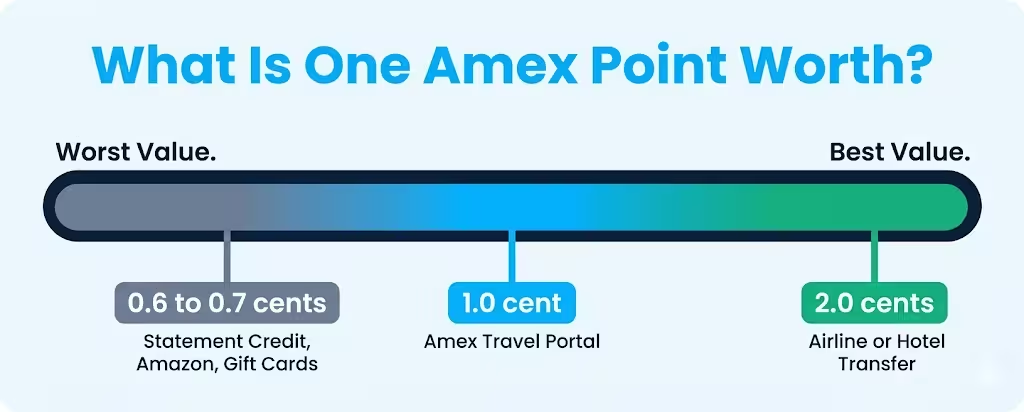
Here are the three benchmarks that matter most:
- Around 2 cents per point when transferred to a strong airline or hotel partner. The Points Guy puts the consensus value at 2 cents in its April 2026 monthly valuations.
- 1 cent per point when booking flights through Amex Travel. This is the floor for travel use.
- 0.6 to 0.7 cents per point when used for statement credit, Amazon checkout, or most gift cards. American Express confirms these lower rates on its own Credit Intel page.
The value isn’t decided when you earn the point. It’s decided the moment you click “redeem.”
Why “1 Point = X Cents” Isn’t a Fixed Number
Membership Rewards points aren’t like cash sitting in a checking account. They’re a flexible currency. Their worth shifts based on the redemption channel you choose. The same 50,000 points might get you $300 in statement credit or $1,000 in business class flights. Same points. Different exit doors. Different outcomes.
That’s why publishers like NerdWallet and The Points Guy publish “consensus” or “baseline” values rather than a single rate. NerdWallet currently pegs the average at 1.6 cents per point when transferred to partners. TPG sits higher at 2 cents. Both numbers are averages, not promises.
What 100,000 Amex Points Are Worth in Real Dollars
A round number helps cut through the noise. Here’s what 100,000 points convert to under each main redemption path:
- $600 as a statement credit (0.6¢)
- $700 at Amazon checkout (0.7¢)
- $1,000 through Amex Travel (1¢)
- $1,100 as a Schwab Platinum cash deposit (1.1¢)
- $2,000 through a strong airline transfer (2¢)
That’s a swing of $1,400 on the exact same point balance. The point itself didn’t change. The choice did.
Amex Points Value by Redemption Type (Full Ranked Chart)
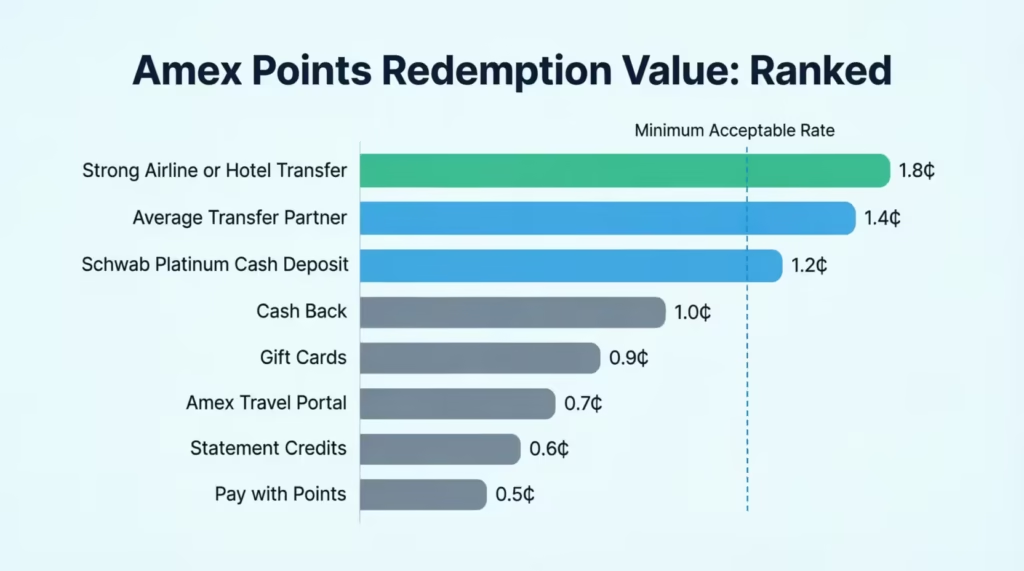
Here’s the full ranked chart of every common redemption, sorted from best to worst. Save this. It’s the answer to “Is this a good deal?” in one glance.
| Redemption Type | Value Per Point | Value of 100,000 Points |
|---|---|---|
| Strong airline/hotel transfer | ~2.0¢ | $2,000 |
| Average transfer partner | ~1.6¢ | $1,600 |
| Schwab Platinum cash deposit | 1.1¢ | $1,100 |
| Amex Travel (flights) | 1.0¢ | $1,000 |
| Amex Travel (hotels/cars, “Pay with Points”) | 0.7¢ | $700 |
| Amazon checkout | 0.7¢ | $700 |
| Most gift cards | 0.5¢ to 1¢ | $500 to $1,000 |
| Statement credit / cover charges | 0.6¢ | $600 |
The cents per point you receive depend on the specific line you choose. Anything below 1 cent is a poor deal in almost every case, and anything 1.5 cents or higher is solid. The 2-cent club is where the headline value lives, and it almost always involves an airline transfer.
📌 Did You Know: When you click “Pay with Points” on the Amex checkout screen for a hotel or car rental, Amex caps the value at 0.7 cents per point. That’s the same as if Amex paid you in dimes for every dollar you earned. Most cardholders never notice the rate, because Amex never shows you the math.
How to Calculate the Value of Your Own Points on Any Redemption
You don’t have to trust any blog’s number. You can run the math in ten seconds with one simple formula. This is the single most useful tool in this guide.
The formula:
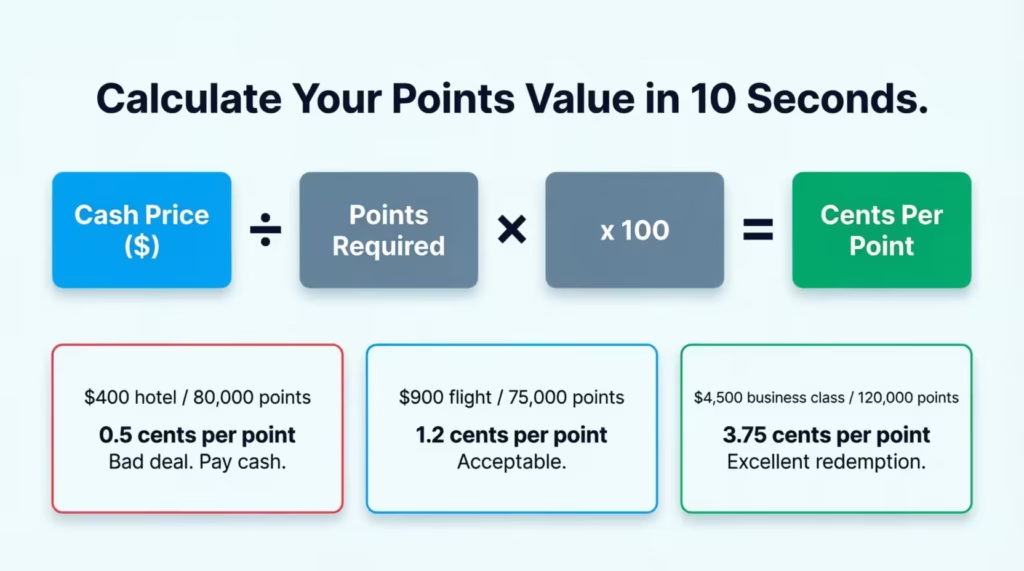
(Cash price ÷ Points required) × 100 = Cents per point
Take the cash price of whatever you’re booking. Divide it by the number of points Amex wants. Multiply by 100. That’s your cents per point for that exact redemption.
Example 1: A flight on Delta. A flight costs $900 in cash, or 75,000 points through a transfer. Math: ($900 ÷ 75,000) × 100 = 1.2¢ per point. That’s acceptable but not great.
Example 2: A hotel night. A room costs $400 in cash, or 80,000 points through Amex Travel. Math: ($400 ÷ 80,000) × 100 = 0.5¢ per point. That’s a bad deal. Pay cash and keep the points.
Example 3: A business class flight. A seat costs $4,500 in cash, or 120,000 points through a partner transfer. Math: ($4,500 ÷ 120,000) × 100 = 3.75¢ per point. That’s an excellent redemption.
Now match your result to this simple scale:
- Under 1¢: Stop. Pay cash. Don’t burn points here.
- 1¢ to 1.5¢: Acceptable if you need the booking and have no better option.
- 1.5¢ to 2¢: Good. Go ahead.
- 2¢ and up: Excellent. This is what points are for.
💡 Pro Tip: Always check the cash price first before logging into the rewards portal. If you start by looking at point prices, your brain anchors to the number of points, and you lose the ability to judge whether the redemption is fair. Cash price first, points price second, formula third.
The Best Ways to Redeem Amex Points for Maximum Value
The highest cents per point almost always comes from transferring points to an airline or hotel partner. That’s the “secret” sitting behind every 2¢-and-up redemption you’ve ever read about. But you don’t need to learn all 18 transfer partners. Five do almost all the heavy lifting.
The Transfer Partners Most Cardholders Actually Need
These five partners cover most of the high-value redemptions a typical cardholder will ever make:
Air Canada Aeroplan (1:1)
Strong for booking United and other Star Alliance flights inside North America. Short-haul economy awards often start around 6,000 to 12,000 points. Aeroplan also has reasonable business class pricing to Europe.
Virgin Atlantic Flying Club (1:1)
Famous for booking ANA business and first class between the U.S. and Japan at well under retail. Also useful for Delta domestic awards.
Delta SkyMiles (1:1)
Useful when you have a specific Delta flight in mind and the cash price is high. Delta SkyMiles pricing fluctuates, so always run the formula.
ANA Mileage Club (1:1)
Best for round-the-world style awards and Star Alliance long-haul. Requires more planning because awards must be round-trip.
Hilton Honors (1:2)
One point becomes two Hilton points. Best used for mid-tier Hilton properties where each Hilton point clears around 0.5 cents, which equals 1 cent of Amex value, plus the fifth-night-free perk on award stays.
Stick to these five, and you’ll handle 80% of your high-value redemptions. The other 13 partners are for edge cases.
Transfer Bonuses, When to Take Them and When to Skip
Amex frequently provides transfer bonuses, ranging from 20% to 40% extra points to a specific partner. These boost an already-strong redemption from 2¢ to closer to 2.5¢ or 3¢.
Take the bonus when:
- You already have a specific award in mind.
- The partner is one you’d transfer to anyway.
- Award space exists for your dates before you transfer.
Skip the bonus when:
- You’re transferring “just in case.” Once points leave Membership Rewards, they’re stuck with that airline forever.
- The partner is one you’ve never used, and the bonus is your only reason to transfer.
Award availability matters more than the bonus size. A 40% bonus on a seat that doesn’t exist is worth zero.
When the Amex Travel Portal (at 1¢) Is Actually the Right Choice
The portal gets a bad reputation because 1 cent per point is below the transfer rate. But the portal is the right move in three specific cases:
- Domestic flights under $300. Transfer redemptions rarely beat the portal on short, cheap routes.
- Last-minute travel. Award space dries up fast. The portal sells the same revenue seats the public sees.
- You don’t have time to learn transfer partners. A 1¢ redemption beats letting points lose value to devaluation while you study.
The portal isn’t a trap. It’s a tool. Just don’t use it for the redemptions where transfers clearly win.
The Worst Ways to Redeem Amex Points (And How Much Value You Lose)
The lowest-value redemptions are the ones Amex pushes at the top of your dashboard. That’s not an accident. These are also the redemptions that destroy your cents per point the fastest.
Why Amex’s Own Checkout Options Are the Lowest-Value
When Amex shows you “Use Points at Checkout” for a $50 Amazon purchase or a $200 statement credit, the bank is offering you the worst rate on the menu. The reason is simple. Amex loses money when you transfer to a partner, because the partner charges Amex per point. Amex loses significantly less when you cash out internally at 0.6 to 0.7 cents.
So the dashboard is built to nudge you toward the cheapest exit for Amex, which is the worst exit for you.
Pay with Points at Checkout, The 0.7¢ Trap
The “Pay with Points” button at Amazon, PayPal, and other partner checkouts uses points at 0.7 cents each. That means 10,000 points cover $70 of your purchase. Compare that to a partner transfer where the same 10,000 points might cover a $200 flight. You just lost $130 of value for the convenience of one click.
The math is brutal at scale. 100,000 points at the 0.7¢ rate equals $700. The same 100,000 points at 2¢ equals $2,000. That single click costs you $1,300.
Statement Credit and Cover Charges, When 0.6¢ Is Still Okay
Statement credits sit at the bottom at 0.6 cents per point. Gift cards range from 0.5 to 1 cent. These rates are clearly poor. But there are two narrow cases where they’re acceptable:
- You have a small leftover balance (under 5,000 points), and you’ll never accumulate enough for a meaningful transfer.
- You’re closing the card and can’t transfer the points to a household member. Burning them at 0.6¢ beats losing them entirely.
Outside of those two situations, statement credit and gift card redemptions are where Amex point value goes to die.
⚠️ Mistake to Avoid: Using points to “cover” a charge you already paid for. Amex calls this feature handy. It’s actually the worst rate the bank offers. You’re trading dollars worth of points for sixty cents on the dollar. Pay cash and keep the points for travel.
Can You Cash Out Amex Points? The Schwab Platinum Option
Yes. If you hold The Platinum Card from American Express Exclusively for Charles Schwab, you can deposit points into a Schwab brokerage account at 1.1 cents per point, up to 1 million points per calendar year. This is the only legitimate cash-out path Amex offers, and it matters for cardholders who don’t travel.
Here’s the math that decides if the card makes sense for cash-out only.
The Schwab Platinum carries the full Platinum annual fee, which sits at $695 at current pricing. To break even on the fee through cash-out alone, you’d need to redeem roughly 63,000 points per year at the 1.1¢ rate. Most cardholders earning Platinum-level rewards can hit that.
But here’s the harder question. Even at 1.1¢, you’re leaving real money on the table compared to a 2¢ transfer. On 100,000 points, that’s a $900 gap. So Schwab Platinum cash-out makes sense only if:
- You genuinely don’t travel and never will.
- You don’t want to learn the partner game.
- You value liquid cash more than potential travel value.
For travelers, the math almost always favors transferring. For non-travelers, 1.1¢ is far better than the 0.6¢ statement credit alternative, and the Schwab Platinum is the only card that unlocks it.
Do Amex Points Lose Value Over Time?
Amex Membership Rewards points don’t expire as long as your account stays open and in good standing. So in pure shelf-life terms, your balance is safe.
But the point value absolutely erodes. Industry watchers and frequent-flyer publications consistently observe that transferable point currencies lose roughly 5 to 10 percent of their real-world value each year through partner devaluations. That’s award charts being quietly raised, fuel surcharges added, sweet spots removed, and transfer ratios cut.
Real recent examples make this concrete. Delta SkyMiles raised pricing on multiple international routes. Emirates Skywards has restructured its award chart more than once in the last three years. ANA has tightened partner award rules. Each change shaved value off every point sitting in your account, even though the points themselves stayed the same.
The practical rule of thumb is redeem within 12 to 18 months of earning for any specific trip you can name. Long-term hoarding without a target is a slow leak. You don’t need to spend points the moment you earn them, but sitting on a 400,000-point balance “for someday” usually ends with you watching that someday cost 600,000 points instead.
Are Amex Points Worth More Than Cash Back?
This is the honest comparison most articles skip. A flat 2% cash back card returns 2 cents per dollar spent, no strategy required. Amex points only beat that if you redeem above 2 cents per point and earn at least 1 point per dollar.
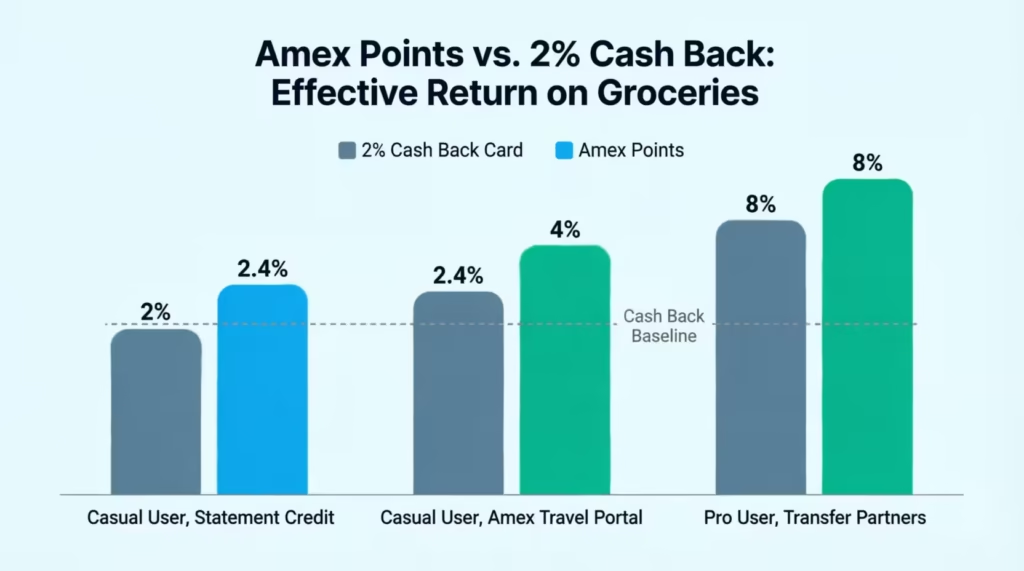
Here’s the break-even logic:
- Casual user, statement credit redeemer. At 0.6¢ redemptions, an Amex Gold’s 4x grocery category effectively returns 2.4% cash back equal. Decent, but the same spending on a flat 2% card returns 2% with zero effort. Slight edge to Amex, but barely.
- Casual user, Amex Travel only. At 1¢ through the portal, 4x grocery = 4% effective return. That comfortably beats 2% cash back, even without learning transfers.
- Pro user, transfer partners. At 2¢ through transfers, 4x grocery = 8% effective return. Cash back can’t touch this. This is where points dominate.
The takeaway is straightforward. If you’ll never redeem above 1 cent per point, a 2% flat cash back card is probably the better choice and a lot less work.
If you’ll redeem through transfers even occasionally, Amex points pull ahead clearly. The system rewards effort, and there’s no shame in opting out if effort isn’t your thing.
Common Mistakes That Quietly Destroy Amex Point Value
Most lost value isn’t dramatic. It’s a slow drip of small wrong moves. Watch for these:
Speculative transfers
Moving points to a partner because of a 30% bonus, with no specific award booked. Once points leave Membership Rewards, they’re stuck. If your dates don’t work, you’re holding airline miles you didn’t want.
Closing an Amex card without using points first
Closing your last Membership Rewards-earning card forfeits the balance within 30 days. Transfer or redeem before you cancel, every single time.
Ignoring transfer bonuses on partners you actually use
A 25% bonus to Air Canada or Virgin Atlantic, when you have a real trip in mind, can push a 2¢ redemption to 2.5¢. Skipping it costs hundreds of dollars on a big award.
Hoarding without a target
Sitting on 500,000 points for “someday” while devaluation chips 5 to 10% off the pile every year. Points are a tool, not a savings account. Use them.
Using points for gift cards or Amazon at checkout
This is the single most expensive habit in the rewards game. Every click at 0.7¢ costs you the difference between that and what a transfer would have returned.
Forgetting that award availability matters more than rate
A 2¢ redemption you can’t book is worth nothing. Always check that the seat exists before you transfer.
Avoiding these six mistakes will protect more value than any clever maximization trick. The points game is mostly about not losing, not about winning huge.
Frequently Asked Questions (FAQs)
How much are 50,000 Amex points worth in cash?
50,000 Amex Membership Rewards points are worth between $300 and $1,000, depending on how you redeem them. A statement credit returns about $300 at 0.6 cents each, while transferring to a strong airline partner can push that same balance to $1,000 or more.
How many Amex points is a $500 flight?
Booked through the Amex Travel portal at 1 cent per point, a $500 flight costs 50,000 points. Transferred to an airline partner at 2 cents per point, the same flight could cost as few as 25,000 points.
Is it worth giving 200,000 Amex points for $2,000?
At $2,000 for 200,000 points, you’re getting exactly 1 cent per point, which is the minimum acceptable rate for travel. The same balance transferred to an airline partner typically returns $3,000 to $4,000 instead.
What is 300,000 Amex points worth?
300,000 Amex Membership Rewards points are worth between $1,800 and $6,000, depending on the redemption. A statement credit returns about $1,800 at 0.6 cents each, while airline partner transfers at the 2-cent rate push the value to $6,000.
What will 200,000 Amex points get you?
Through the Amex Travel portal at 1 cent per point, 200,000 points cover $2,000 in flights. Transferred to a strong airline partner at 2 cents per point, that same balance can cover $4,000 in travel, including business class long-haul seats.
Are 100,000 Amex points a lot?
100,000 Amex Membership Rewards points is a meaningful balance worth between $600 in statement credit and $2,000 through a partner transfer. At the 2-cent transfer rate, it covers a transatlantic business class seat or multiple domestic round-trip tickets.
How much are 175,000 Amex points worth?
175,000 Amex Membership Rewards points are worth between $1,050 and $3,500, depending on how you redeem them. Statement credit returns about $1,050 at 0.6 cents each, while a partner transfer at the 2-cent rate returns $3,500 in travel value.
How to best use 200,000 Amex points?
The highest-value path for 200,000 points is transferring to an airline partner like Air Canada Aeroplan or Virgin Atlantic Flying Club, where the 2-cent rate delivers $4,000 in flights. The Amex Travel portal is a solid backup at 1 cent per point, returning $2,000.
Are 300,000 Amex points a lot?
300,000 Amex Membership Rewards points is a strong balance that covers $3,000 in flights through the Amex Travel portal or up to $6,000 through an airline partner transfer. It’s a balance worth protecting from low-value redemptions like statement credits, which return only $1,800.
Final Thoughts
So what’s an Amex Membership Rewards point really worth? Anywhere from 0.6 cents to 2 cents, set the moment you redeem. The cash-price-divided-by-points formula tells you the answer for any specific redemption. A short list of five transfer partners handles most high-value bookings. Schwab Platinum gives non-travelers a clean 1.1¢ cash-out path. And the dashboard’s default options are almost always the worst options.
Based on the math throughout this guide, the most effective approach for most cardholders is simple: redeem at 1.5 cents per point or higher, use the portal as a floor, and skip everything below 1 cent unless you’re closing the account.
If you know someone sitting on a pile of Membership Rewards points and second-guessing every redemption, share this guide. It could save them hundreds of dollars on their next click.