
You need more cash than your Chase ATM limit allows. Maybe you’re buying a used car, paying a mover, or covering a rent deposit. Whatever the reason, hitting that daily cap is frustrating, especially when the money is sitting right there in your account.
Yes, you can often increase your Chase ATM withdrawal limit by calling customer service at 1-800-935-9935 and asking for a temporary or permanent bump, though approval and amounts depend on your account type and history.
below you account and ATM limit ranges, how to check your number, what to say when calling, and quick workarounds for urgent increases.
At a Glance
This guide explains how to increase your Chase ATM withdrawal limit, including exact limit ranges by account type, how to request a temporary or permanent increase, and same-day cash alternatives if your request is denied.
Core Facts:
- Chase ATM withdrawal limits typically range from $500 to $3,000 daily depending on account type and which ATM you use.
- In-branch Chase ATMs allow the highest withdrawals, up to $3,000, while non-Chase ATMs typically cap out around $500.
- To request a limit increase, call 1-800-935-9935 or the number on the back of your debit card and specify a temporary or permanent change.
- Temporary limit increases are generally easier to get approved and are often handled the same day, while permanent increases depend more on account history and type.
- Non-Chase ATM withdrawals cost $3 domestically and $5 internationally, with Premier Plus and Sapphire Banking accounts waiving some or all of these fees.
- Branch teller withdrawals are not bound by ATM daily limits, making them the most reliable option for large cash amounts like $5,000 or $10,000.
Best for:
- Chase customers who have hit their daily ATM limit and need cash for a one-time purchase, such as a car or large deposit.
- Customers who need cash urgently and want to compare a phone request against same-day alternatives like a teller withdrawal.
- Chase customers who repeatedly hit their ATM limit and want to understand account tier upgrades as a permanent solution.
Chase ATM Withdrawal Limits by Account Type and ATM Location
Your limit isn’t one flat number. It changes based on your account type and which ATM you use. Chase doesn’t publish a full public chart for every account, but the bank confirms that ATM withdrawal limits vary by bank and account type, along with factors like how long you’ve been a customer.
Based on Chase’s published materials and account documents, these are the typical ranges:
| Account Type | In-Branch Chase ATM | Standalone Chase ATM | Non-Chase ATM |
|---|---|---|---|
| Chase Total Checking / Secure Checking | Up to $3,000 | Up to $1,000 | Up to $500 |
| Chase Premier Plus / Sapphire Banking | Up to $3,000 | Up to $1,000 | Often $500–$1,000 |
| Chase Private Client | Up to $3,000 | Up to $3,000 | Up to $2,000–$3,000 |
Chase confirms that Private Client accounts carry a daily ATM withdrawal limit of up to $3,000, paired with a much higher purchase limit.
One important caveat: your personal limit can differ from this table. Chase sets limits per account based on your history and standing, so two people with the “same” checking account can have different caps. Treat these numbers as ceilings, not guarantees.
Why Limits Differ by ATM Location
The ATM you pick matters as much as the account you hold. In-branch Chase ATMs allow the biggest withdrawals because the bank controls the machine directly, which lowers fraud risk. Standalone Chase ATMs, like the ones in a vestibule or drive-up, sit in the middle. Non-Chase ATMs come with the lowest caps, since outside networks add their own security limits and risks.
The practical takeaway: when you need a large amount of cash, walk up to an in-branch ATM during branch hours. That single choice can move you from a $500 cap to a much higher one, with no phone call needed.
Per-Transaction ATM Limits vs. Daily Bank Limits
There’s a second, hidden cap that trips people up. An ATM’s cash cassettes often limit every single transaction to around $300–$500, no matter what your daily bank limit says. So even with a $1,000 daily limit, one machine may only hand you $500 at a time.
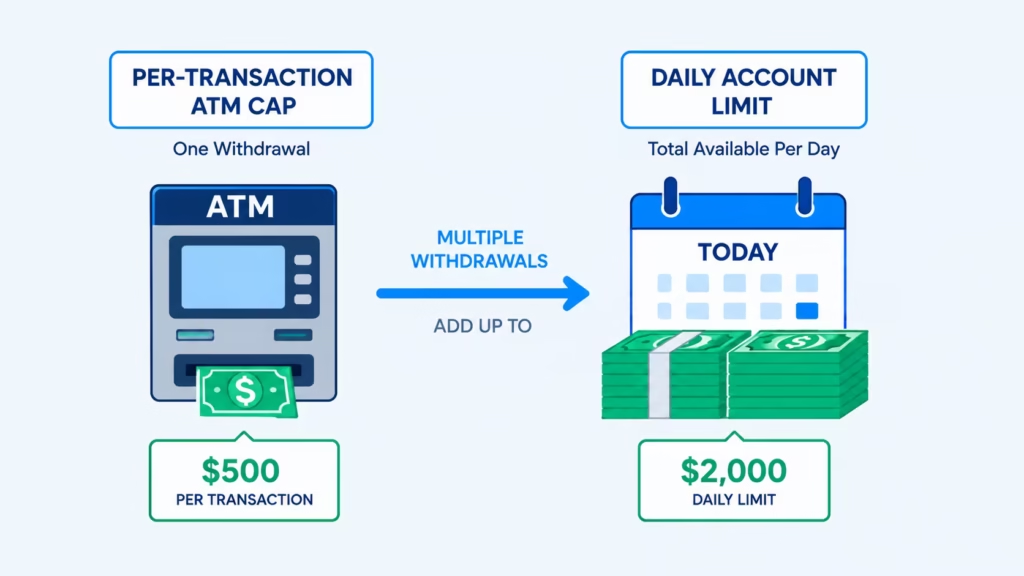
The fix is simple: run multiple transactions at the same ATM until you reach your daily limit. This is a machine limit, not a Chase decision, and it doesn’t affect your account in any way.
📌 Did You Know: Getting declined at $800 doesn’t always mean your daily limit is $800. It may just be the machine’s per-transaction cap. Try a second, smaller withdrawal before assuming you’ve hit your limit.
How to Check Your Exact Current Chase ATM Withdrawal Limit
Before you request anything, find out your real number. It takes a couple of minutes:
- Open the Chase Mobile app. Sign in, tap your checking account, then look under account or card settings for limit details.
- Log in at chase.com. Go to your account details and look for card or spending limit information.
- Call if it’s not shown. Some accounts don’t display limits online. The Chase customer service page lists 1-800-935-9935 for personal banking, or you can call the number on the back of your debit card and ask the representative to confirm your exact ATM limit.
Knowing your exact number stops wasted trips and repeated declines, which can also trigger fraud monitoring on your card.
When Daily Limits Reset
ATM limits typically reset once every 24 hours, and customers commonly report the reset happens around midnight Eastern Time. Chase doesn’t publish an official reset schedule, so treat that timing as approximate. If timing is important, like when traveling across time zones, check with Chase before scheduling back-to-back withdrawal days.
If you reach your limit, you will need to wait until the next cycle begins to withdraw more cash. You can also visit a local Chase branch to speak with a teller. They can often provide larger cash withdrawals than an ATM allows.
Please bring a valid form of identification, such as your driver’s license or passport, to verify your identity. This is the fastest way to access a larger amount of money when you are in a hurry.
ATM Withdrawal Limit vs. Debit Card Purchase Limit
These are two separate caps, and mixing them up is one of the most common mistakes.
- ATM withdrawal limit covers only cash pulled from an ATM.
- Debit card purchase limit covers point-of-sale spending and is usually much higher. For example, Chase lists a daily purchase limit of up to $7,500 for Private Client cards, and standard accounts commonly land in the $3,000 range.
So a maxed-out ATM limit doesn’t mean your card is “maxed out” for the day. You may still be able to pay a merchant directly by card, or use the cash-back trick covered below. But it also means a “$5,000 daily limit” you saw in your paperwork probably refers to purchases, not cash.
Non-Chase ATM Fees to Factor In
If you’re thinking about using an outside ATM to get cash faster, count the cost first. Under the standard Chase fee schedule, withdrawals at non-Chase ATMs cost $3 each in the U.S. and its territories, and $5 outside the U.S. The ATM owner can tack on its own surcharge too, so one withdrawal can cost you $6 or more.
Higher tiers soften this: Premier Plus customers pay no Chase fee at non-Chase ATMs, though the ATM owner’s surcharge still applies, and Sapphire Banking charges no Chase ATM fees worldwide and refunds third-party surcharges.
⚠️ Mistake to Avoid: Making several small non-Chase ATM withdrawals to work around a low cap. Each one costs $3 plus the machine’s surcharge. Three withdrawals can easily cost $15–$20 in fees for cash you could have pulled free at a branch.
How to Request a Temporary Chase ATM Withdrawal Limit Increase
This is the fastest, most common fix, and it’s what most people searching this topic actually need.
- Call 1-800-935-9935, or the number on the back of your card. You can also ask at a branch, though the phone is usually quicker.
- Say exactly what you want. Clear phrasing helps: “I’d like a temporary increase to my ATM withdrawal limit. I need to withdraw $2,500 today for a one-time cash purchase.” Stating an amount and a reason up front keeps the call short.
- Set realistic expectations. Temporary increases are generally easier to get than permanent ones and are often handled the same day. Typical bumps run from a few hundred to a couple thousand dollars over your standard limit, depending on your account standing. Approval is never guaranteed, and Chase doesn’t publish approval criteria, so treat any amount you read online as a rough guide, not a promise.
What to Expect During the Request Call
The representative will ask why you need the higher limit. Have a specific reason ready: a private car sale, a contractor payment, moving costs, travel cash. Vague answers like “I just need more cash” tend to get smaller bumps.
Identity verification is standard, and it protects you rather than signals suspicion. You’ll confirm details tied to your account before any change is made.
For a temporary increase, documentation usually isn’t required, but be ready to explain your situation clearly. If the representative can’t help, asking to speak with a supervisor is a fair next step.
💡 Pro Tip: Make the call early in the day, ideally before you need the cash. If anything goes sideways, you still have time to visit a branch the same afternoon.
How to Request a Permanent Chase ATM Withdrawal Limit Increase
If you need a higher limit regularly, not just once, ask for a permanent change instead. Same phone line, but say the word “permanent” explicitly: “I’d like to permanently raise the ATM withdrawal limit on my debit card.”
Set your expectations lower than for a temporary bump. Permanent increases are less automatic and lean heavily on your account history and account type.
In some cases, the phone team may direct you to a branch banker for the conversation, especially for a large jump. Chase doesn’t publish the exact approval process, so be prepared for a review rather than an instant yes.
Factors That Affect Approval
Chase doesn’t disclose its internal scoring, but several factors are widely understood to matter:
- Account tenure and standing. Longer customer history with the account in good standing generally helps.
- Account type. Higher tiers carry higher standing limits by design.
- Balance and activity. Consistent balances and regular account use work in your favor.
- New accounts. If you opened your account within the past few months, expect a lower starting limit. This is standard fraud protection, not a judgment on you. Don’t assume an increase is impossible; ask, but know that very new accounts face tighter caps. If a friend with the “same” account has a higher limit, account age is often the reason.
What to Do If Chase Denies Your Limit Increase
A denial isn’t the end of the road. Work through it in this order:
- Ask why, and ask for a smaller amount. A request for $3,000 might get declined while $1,500 gets approved. Partial increases are common, so don’t hang up without testing a lower number.
- Visit a branch with ID. In-person bankers often offer more than phone support. A face-to-face chat is important for bigger requests.
- Ask about a one-time accommodation. Even when a limit change isn’t possible, a banker may be able to help you access your money another way on the spot.
- Pivot to a same-day alternative. The options below can get cash in your hands today, no approval needed.
Always keep your records organized. If you get a denial by phone, write down the reference number they give you. This makes your next conversation easier. Focus on building good habits with your current limit for now.
Use your card responsibly and pay your balance on time each month. These consistent actions help prove your reliability to the bank. A higher limit will likely come naturally after your account has more history.
Same-Day Alternatives to Get More Cash
If the clock is ticking and the ATM route won’t cover the full amount, these options close the gap:
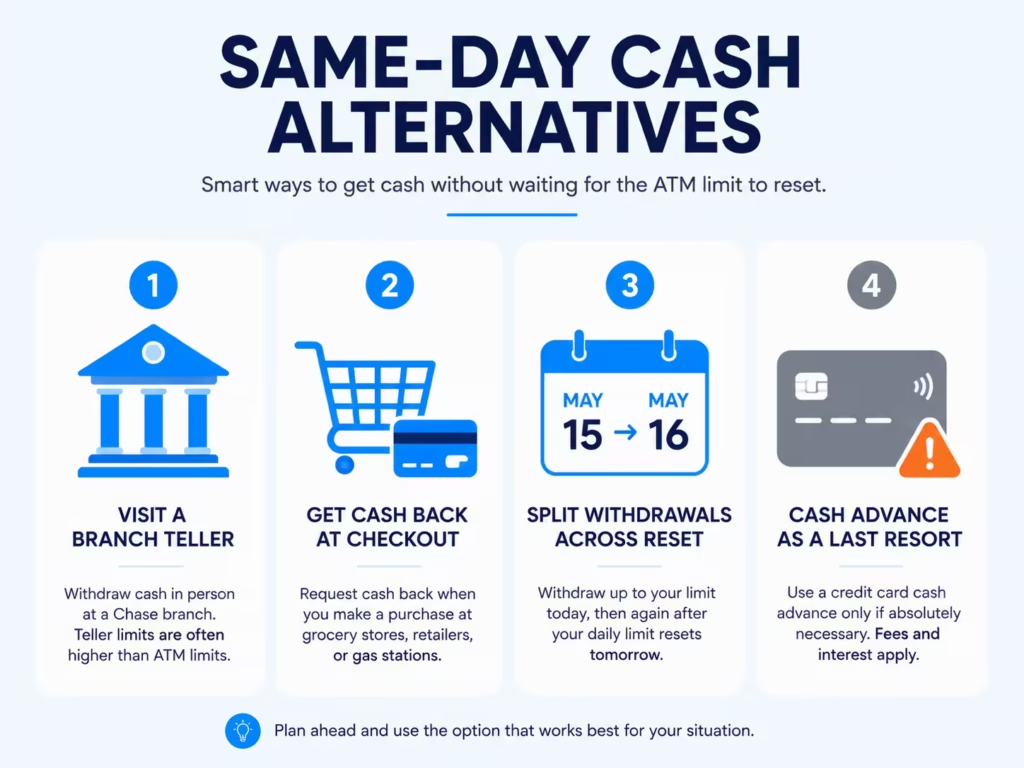
- Teller withdrawal at a Chase branch. This is the strongest workaround. Teller withdrawals aren’t bound by your ATM limit, so you can often pull the full amount you need straight from your account. Bring a government-issued photo ID and your debit card. For very large amounts, calling the branch ahead helps, since branches keep limited cash on hand and may need a day’s notice for unusually big withdrawals.
- Cash back with a debit purchase. Many grocery stores, pharmacies, and big-box retailers let you add cash back at checkout, typically $20 to $100 per transaction depending on the store. It won’t fund a car purchase, but it’s free and useful for topping up a few hundred dollars.
- Split across the reset. If your need isn’t strictly same-day, withdraw up to your limit today and again after the daily reset. Two days at $1,000 covers $2,000 with zero phone calls.
- Pay by debit card instead of cash. Ask the seller or contractor whether they’ll accept a card payment. Your purchase limit is often much higher than your ATM limit. Many private sellers now accept card payments using mobile readers or payment apps.
A quick cost-benefit note: a $3 non-Chase ATM fee is worth paying when it saves you a 40-minute round trip to a branch. It stops making sense when you’re chaining multiple fee-charged withdrawals to work around a low cap.
⚠️ Mistake to Avoid: Don’t reach for a credit card cash advance out of frustration. Cash advances typically carry a fee of 3–5% of the amount plus interest that starts accruing immediately at a higher APR than purchases. On $2,000, that can mean $60–$100 in fees before interest even starts. A teller withdrawal costs nothing and comes straight from your own money.
Upgrade Your Account for a Permanently Higher Limit
If you hit your ATM cap more than once or twice a year, the structural fix is moving to an account tier with a higher standing limit.
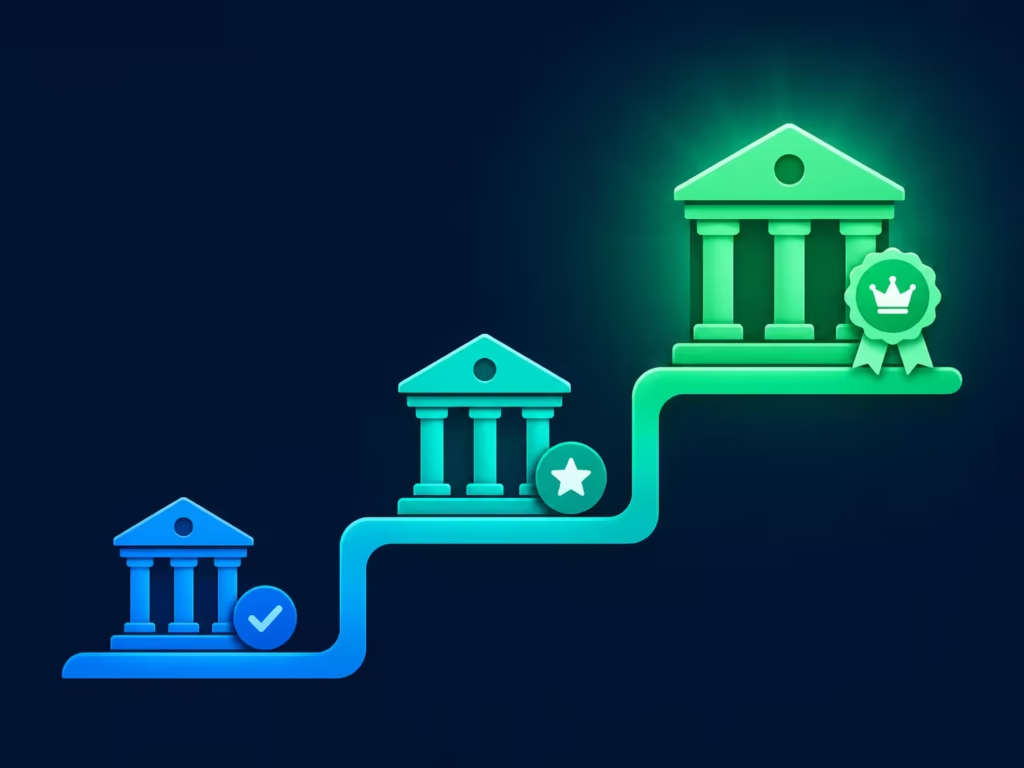
- Premier Plus Checking pairs higher ATM limits with no Chase fee at non-Chase ATMs. The monthly service fee is waived with a $15,000 average beginning-day balance across linked qualifying accounts, among other options.
- Sapphire Banking adds worldwide ATM fee waivers and surcharge refunds on top of higher limits.
- Private Client sits at the top, with the $3,000 daily ATM limit and $7,500 purchase limit plus a dedicated banker who can handle larger requests. Note that qualification thresholds are significant: Chase states Private Client requires at least $150,000 in qualifying balances, and that requirement has been reported as rising.
For a one-time cash need, upgrading makes no sense. For a recurring pattern, like paying contractors or buying inventory with cash, it can end the cycle of emergency phone calls for good.
To switch your account type, visit a local branch or log in to your mobile app. A banker will review your existing balances and transactions to confirm your eligibility. They can also explain the specific benefits associated with each premium tier.
Once you upgrade, the new daily limits usually take effect immediately. These tiers often come with extra perks. You might get waived wire transfer fees or discounted safe-deposit boxes. These benefits can add value beyond just cash access.
Frequently Asked Questions (FAQs)
Can I withdraw $1,000 from a Chase ATM?
Yes, most Chase debit cards allow up to $1,000 daily at a standalone Chase ATM. Your exact limit depends on your account type, so Total Checking and Premier Plus customers may see slightly different caps.
What ATM will let me withdraw $3,000 from Chase?
An in-branch Chase ATM offers the highest limit, often up to $3,000 per day for most account types. Standalone Chase ATMs and non-Chase ATMs cap out much lower, typically $1,000 and $500 respectively.
Why can’t I withdraw more than $1,000 from an ATM?
Your cap depends on both your account type and the ATM you’re using, since non-Chase and standalone machines carry lower limits than in-branch ATMs. A single machine may also limit each transaction to around $300 to $500, even if your daily limit is higher.
Can I withdraw $5,000 from a Chase ATM?
Not in one visit, since no single ATM tier reaches that amount. To get $5,000 in cash, visit a Chase branch teller, who isn’t bound by ATM withdrawal limits.
Can I withdraw $10,000 from my Chase account?
Not through an ATM, but yes through a branch teller with valid photo ID. For large withdrawals like this, call your branch ahead of time since branches keep limited cash on hand.
How much can I withdraw from Chase in one day through an ATM?
It ranges from $500 to $3,000 daily depending on your account type and which ATM you use. Private Client accounts get the highest ATM ceiling, up to $3,000 even at non-Chase machines.
Does it cost anything to withdraw cash at a Chase-owned ATM?
No, using a Chase-owned ATM, whether in-branch or standalone, carries no Chase fee. Fees only apply at non-Chase ATMs, which cost $3 domestically and $5 internationally, plus any surcharge from the machine owner.
Can I request a Chase ATM limit increase through the mobile app?
The app lets you check your current limit, but increase requests are handled by calling 1-800-935-9935 or the number on your card. A branch visit is sometimes needed for larger, permanent increase requests.
Will calling to request a limit increase affect my credit score?
No, requesting a temporary or permanent ATM withdrawal limit increase doesn’t involve a credit check or affect your credit score. It’s a routine account service request handled through identity verification, not a lending decision.
Wrapping Up
To raise your Chase ATM withdrawal limit, just make a quick call. Dial 1-800-935-9935, tell them how much you need and why. Then, ask for a temporary or permanent increase. Temporary bumps offer a quick same-day fix. Permanent increases rely on your account history and tier.
If the answer is no, a teller withdrawal in the branch skips the ATM limit. Cash back at checkout or splitting withdrawals across the daily reset can help fill smaller gaps.
Because Chase sets limits per account and doesn’t guarantee approval or amounts, your best move is to check your exact limit first and plan around the number you actually have.
If someone you know is about to make a big cash purchase, send them this guide before they waste a trip to the wrong ATM or pay fees they didn’t need to.