
I know the feeling. Your finger hovers over the “Apply Now” button, and suddenly you pause. Will this drop your score? Or maybe you just spotted a strange line on your credit report labeled “inquiry” and your stomach dropped. The confusion around a hard pull vs. a soft pull is one of the most common reasons people delay smart financial decisions or panic over harmless ones.
Here’s the short answer: a hard pull can lower your credit score by a few points, while a soft pull never affects it at all.
Below, you’ll get the exact point ranges, timing rules, real examples, and a simple way to tell which type any application will trigger before you click.
Key Takeaways
This guide explains the difference between a hard pull and a soft pull, including which actions trigger each type, exact point ranges, recovery timelines, and the rate shopping window for loan applications.
Core Facts:
- A hard pull requires your permission, can lower your score by a few points, and stays visible to other lenders for two years, though it only affects your score for the first 12 months.
- A soft pull never affects your credit score and is visible only to you, never to other lenders reviewing your file.
- Most hard inquiries lower a FICO Score by fewer than 5 points, though people with thin credit files may see drops closer to 10 points.
- Mortgage, auto loan, and student loan applications within a 14 to 45 day window count as a single hard inquiry under FICO’s rate shopping rules.
- Credit card applications do not receive rate shopping protection, so each card application counts as a separate hard pull even if submitted the same week.
- Pre-qualification is almost always a soft pull, while a full credit application is always a hard pull regardless of the product type.
Best for:
- Readers deciding whether to click apply on a credit card, loan, or rental application and wanting to know the score impact first.
- Anyone shopping for a mortgage, auto loan, or student loan who wants to compare rates without multiple separate hard inquiries.
- Readers who spotted an unfamiliar inquiry on their credit report and need to determine if it is harmless or worth investigating.
What a Hard Pull Is
A hard pull, also called a hard inquiry, happens when a lender checks your full credit report to decide whether to approve you for new credit. This type of credit check requires your direct permission. You give that permission when you submit an application for a credit card, a car loan, a mortgage, a personal loan, or sometimes an apartment lease.
The lender uses this check to judge risk. They want to see your full borrowing history, your payment record, your current debts, and any red flags. Because it signals that you are seeking new credit, it counts against your score by a small amount.
A hard credit check meaning is simple someone is deciding whether to lend you money or extend credit, and they need the full picture. A credit card issuer pulling your file before approving a new card is a hard pull. A mortgage lender doing the same before offering a home loan is a hard pull.
These inquiries show up on your credit report and stay visible to other lenders for two years. More on that timing below.
💡 Pro Tip: If a form asks for your full Social Security number and says, “by submitting, you authorize us to check your credit,” it will likely cause a hard pull. Read that fine print before you click.
What a Soft Pull Is
A soft pull, also called a soft inquiry, is a credit check that does not affect your score in any way. It happens when someone looks at your credit file for a reason other than approving new credit.
You trigger a soft pull every time you check your own score through a credit monitoring app. Companies also perform them when they send you a pre-approved credit card offer in the mail. Employers may run one during a background check with your written consent. Your current credit card company may pull your file to review your account or decide whether to raise your limit.
The key thing to know: a soft inquiry is invisible to other lenders. Only you can see it on your personal credit report. It doesn’t show up on the version of your report that banks or car dealers review when deciding to approve you.
So if you check your own score twice a day for a month, nothing happens. If Capital One sends you three “you’re pre-approved” letters, nothing happens. These are all soft credit check examples, and none of them cost you a single point.
The Core Difference: Permission and Score Impact
The clearest way to see the difference between a soft inquiry vs. a hard inquiry is to look at three things: who gave permission, whether your score changes, and who can see it later.
| Feature | Hard Pull | Soft Pull |
|---|---|---|
| Requires your permission | Yes, explicit | Sometimes, sometimes not |
| Affects your credit score | Yes, small drop | No effect |
| Visible to other lenders | Yes, for 2 years | No, only you see it |
| Common trigger | New credit application | Self-check, pre-approval, account review |
| Recovery time | Score bounces back in months | Nothing to recover from |
A hard pull needs your active authorization for a specific application. A soft pull may happen without any action from you, like when a card issuer sends a marketing offer. The credit score impact is the biggest practical difference and the reason people ask about this in the first place.
How Many Points a Hard Inquiry Actually Costs
Most hard inquiries lower your FICO Score by fewer than 5 points, according to FICO’s official guidance. Some people see a drop closer to 10 points, but that is on the higher end.
The dip is temporary. Your score usually bounces back within a few months, as long as you make your payments on time and keep your balances low. After 12 months, the inquiry stops affecting your score entirely, even though it stays visible on your report for another full year.
So if you’re worried that one credit card application will tank your score, it won’t. A single hard pull is a small, short-term dent, not a lasting scar.
Why the Impact Is Bigger for Some People
Not everyone loses the same number of points. The size of the FICO score dip depends on how thick your credit file is.
A thin file means you have few accounts, a short credit history, or limited borrowing experience. If you only have one or two credit cards and you’ve been building credit for less than two years, a hard inquiry can pull more weight. You might see a drop closer to 10 points because there’s less data to balance it out.
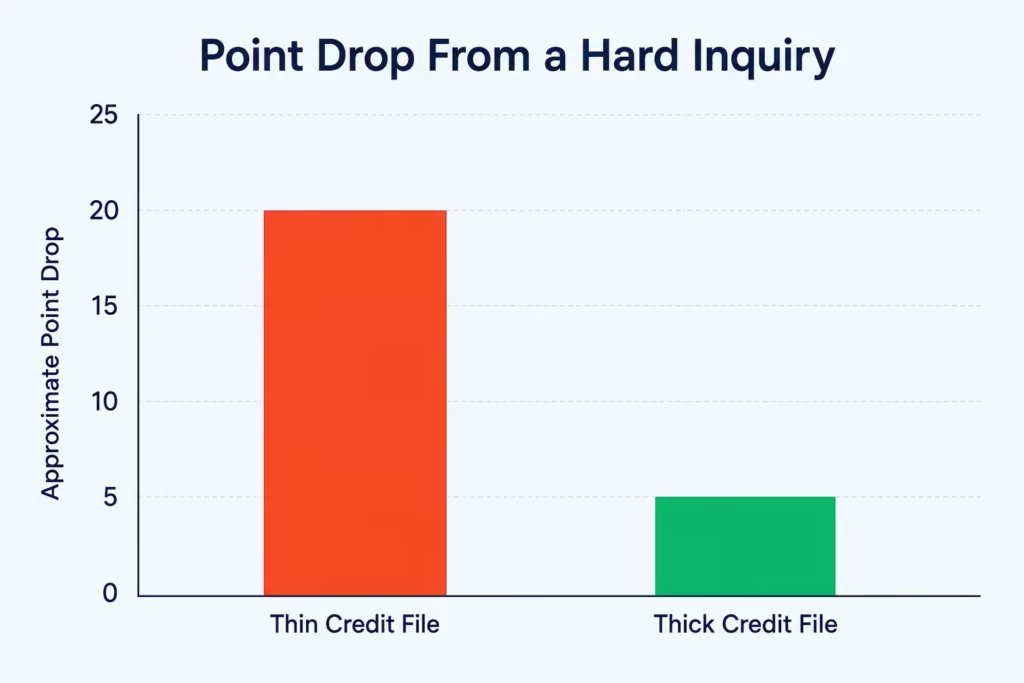
A thick file means you have several accounts, years of on-time payments, and a strong track record. In that case, a hard inquiry might barely register. You could lose 2 or 3 points, and your score might recover in weeks rather than months.
This is why the same action affects two people differently. A recent college graduate applying for their first car loan will feel it more than a 45-year-old with a mortgage, two cards, and a decade of clean payment history.
How Long a Hard Inquiry Sticks Around
A hard inquiry stays on your credit report for two years from the date it was made. That’s the reporting window used by Experian, Equifax, and TransUnion.
But there’s an important twist. The FICO Score only factors in hard inquiries from the past 12 months. So even though the inquiry remains visible for two full years, it stops hurting your score after the first year. During the second year, it’s just sitting there for other lenders to see, but it isn’t dragging your number down anymore.
This distinction matters when you’re planning a big application. If you applied for a store card 14 months ago, that inquiry won’t hurt your score anymore. However, a mortgage lender checking your report today can still see it.
Who Can See an Inquiry on Your Report
Any lender who pulls your credit report during those two years can see the hard inquiry. That includes future card issuers, auto lenders, mortgage brokers, and personal loan companies.
They read it as a signal. One or two inquiries usually don’t raise concern. But if a mortgage lender sees six hard inquiries in the last six months, they may worry that you’re taking on debt in multiple places at once. This is called stacking risk, and it can lead to a denial or a higher rate even if your score itself still looks fine.
Soft pulls stay out of this picture. They show up only on your personal version of the report, so lenders never see them and can’t factor them into their decisions.
How to Tell Which Type a Specific Application Will Trigger
Before you click submit, you can usually tell whether a form will pull hard or soft. Look for these signals.
A form triggers a hard pull if it asks for your full Social Security number or date of birth. It also needs phrases like “you authorize us to obtain your credit report” or “by submitting this application.” These are the standard authorization phrases lenders use.
A form will trigger a soft pull if it asks only for the last four digits of your SSN, uses phrases like “check if you pre-qualify,” “see your rates,” or “estimate your offers,” and clearly states “this will not affect your credit score.”
If the page is unclear, look for a small disclaimer near the submit button. Most lenders now spell this out because of consumer protection rules. If you still can’t tell, close the tab and call the lender directly before submitting.
Pre-Qualification vs. Pre-Approval vs. Full Application
These three terms confuse a lot of people, and lenders don’t always use them the same way. Here’s the practical breakdown.
Pre-qualification is almost always a soft pull. You share basic info like income, address, and the last four digits of your SSN. The lender uses this to estimate whether you’d likely be approved and at what rate. No score damage.
Pre-approval is trickier. In credit cards, pre-approval is usually still a soft pull, based on offers the issuer already sent you. In mortgages, pre-approval is typically a hard pull because the lender is doing a real underwriting review.
A full application is always a hard pull. You’re formally asking for the credit, and the lender is formally deciding.
So the same word can mean different things depending on the product. When in doubt, check the disclosure text on the form itself.
Common Examples of Hard Pulls
These are the actions that count as a hard inquiry:
Credit card applications, including store cards and co-branded airline or hotel cards. Every new card application is a separate hard pull, even if you apply to two cards from the same bank on the same day.
Auto loan applications, whether you apply through a bank, a credit union, or the dealer’s financing desk. Note that dealers sometimes send your application to multiple lenders, which can create multiple inquiries. Rate shopping rules can protect you here, covered later.
Mortgage applications, including refinances and home equity loans. A mortgage lender will pull a hard credit check as part of underwriting.
Personal loans and student loan refinancing. Both require a full credit review before approval.
Apartment rentals, in some cases. Many landlords use tenant screening services that trigger a hard pull, though some use soft pulls. Ask before signing the application.
Common Examples of Soft Pulls
These actions do not affect your score:
Checking your own credit score through your bank’s app, Credit Karma, Experian, or any credit monitoring app. Self-checks are always soft.
Receiving pre-approved credit card offers in the mail or by email. The issuer soft-pulled your file to decide you fit their marketing criteria.
Employment background checks. Employers can only pull your credit with your written consent, and it’s always a soft inquiry.
Insurance quotes. Auto and home insurers often check credit to set premiums, but this is a soft pull.
Account reviews by your current lenders. Your credit card company may soft-pull your file periodically to decide whether to raise your limit, lower it, or offer you a new product.
Who Can Pull Your Credit Without You Applying for Anything
Many parties can check your credit file for a “permissible purpose” under federal law, even if you haven’t applied for anything new.
Your existing credit card issuers can run account review pulls to check your risk level. Utility companies may check when you set up service. Landlords, with your consent on a rental application, can pull it. Insurance companies use it for underwriting quotes. Employers use it during hiring, but only with your written consent.
All of these are soft pulls. They don’t hurt your score, but you can request a copy of your own credit report to see who’s been looking.
📌 Did You Know: Credit card issuers can check your file for pre-screened offers. They can do this without telling you, as long as it’s allowed under the Fair Credit Reporting Act. You can opt out of these prescreened offers at OptOutPrescreen.com.
The Rate Shopping Window for Mortgages, Auto Loans, and Student Loans
Here’s where things get more forgiving. When you shop for a mortgage, an auto loan, or a student loan, FICO groups all the hard inquiries from that shopping period into a single inquiry for scoring purposes. This is called the deduplication window.
The exact window depends on the FICO version being used. Older FICO versions use a 14-day window. Newer versions, including FICO 8 and 9, use a 45-day window. Because you don’t know which version a lender is using, the safest move is to keep all your applications within 14 days if you can.
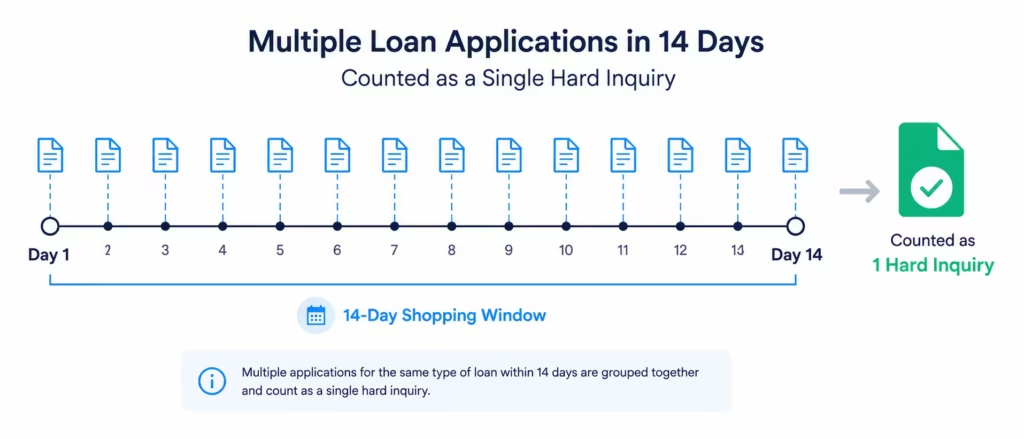
So if you apply to five mortgage lenders within two weeks, FICO treats it as one hard inquiry, not five. Your score takes one small hit instead of five. This rate shopping window helps borrowers compare offers. Regulators want to encourage smart choices, not punish them.
There’s also a 30-day buffer for mortgages and auto loans. Any inquiries in the 30 days before your score is calculated are ignored entirely, giving you extra breathing room right before a lender pulls your final score.
⚠️ Mistake to Avoid: Spreading auto loan applications over six weeks assumes you’re using the 45-day window. If the lender scores you on an older FICO version, each application counts separately. Keep it tight at 14 days to be safe.
Why Credit Card Applications Don’t Get the Same Protection
Credit card applications are treated differently. Every card application counts as a separate hard pull, no matter how close together you submit them.
If you apply for three cards in a single week, that’s three separate hits to your score. The rate shopping window does not apply to credit cards. FICO’s reasoning is that card applications aren’t about finding the best rate on one loan. They’re about opening multiple new lines of credit, which carries different risk.
This is why the credit score impact from stacking card applications can add up quickly. If each card costs you 5 points, three cards in a week could drop you 15 points. That’s a meaningful hit for someone about to apply for a mortgage.
The rule of thumb: space out card applications by at least 3 to 6 months. If a big loan is coming up in the next year, avoid new card applications entirely until after that loan closes.
What to Do If You See an Inquiry You Don’t Recognize
Spotting an unfamiliar inquiry can feel scary, but most of the time there’s a simple explanation. Here’s the step-by-step diagnostic path.
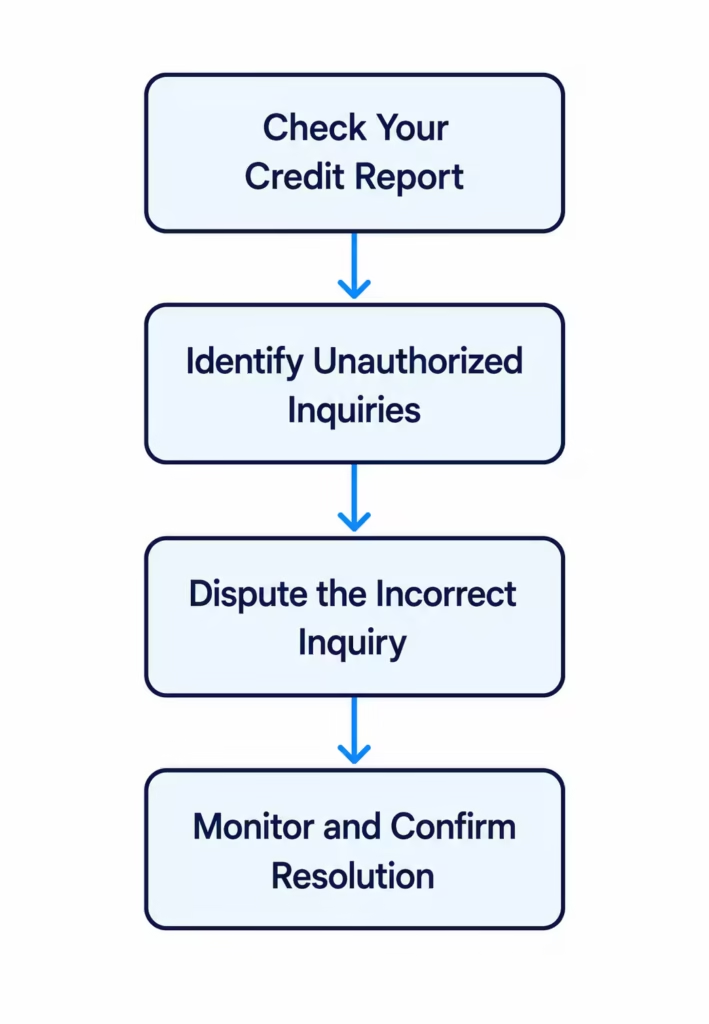
Step 1: Check whether it’s hard or soft. Your credit report labels each inquiry. Soft inquiries are usually listed in a separate section and clearly marked “does not affect your score.” If it’s soft, you can almost always stop worrying.
Step 2: Identify the source. The lender or company name will be listed. Sometimes it’s a parent company name you don’t recognize, like a bank that owns a store card you applied for. Search the name online to see if it matches something you did.
Step 3: Check the date. Match it against your own activity. Did you apply for something around that time? Did you request an insurance quote? Did you set up utilities in a new home?
Step 4: If it’s still unexplained and it’s a hard inquiry, contact the creditor listed and ask what triggered it. If they can’t verify a legitimate reason, file a dispute with the credit bureau reporting it. You can also place a fraud alert or freeze your credit through AnnualCreditReport.com, the official free service authorized by federal law.
Unauthorized hard inquiries can be signs of identity theft. Acting fast protects you.
How to Minimize Hard Inquiry Damage Before You Apply
You can do several things to keep the score impact low before you submit an application.
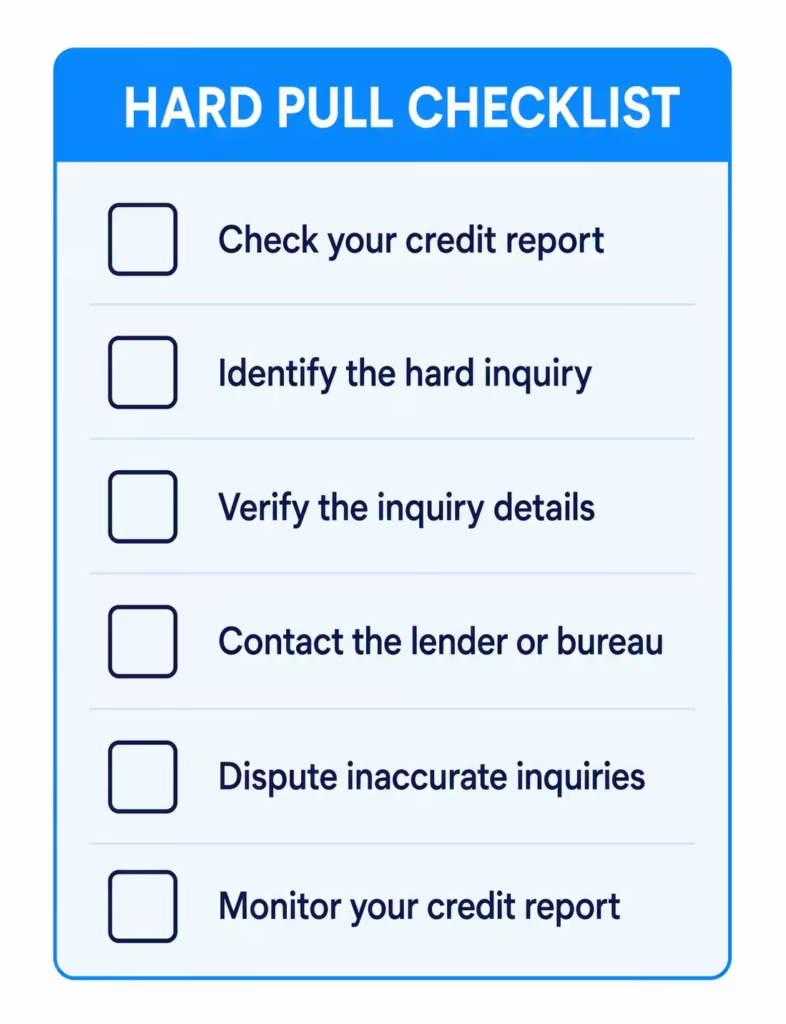
Bundle your rate shopping. If you’re getting a mortgage or auto loan, do all your applications within a 14-day window so they count as one inquiry.
Space out your credit card applications. Wait at least 3 months between card apps, and ideally 6 months if you have a major loan coming up soon.
Use pre-qualification tools first. Most major card issuers let you check whether you’re likely to be approved with just a soft pull. Do this before submitting the real application to avoid wasting a hard pull on a card you won’t get.
Check your report before applying. Pull your own file from AnnualCreditReport.com to spot any errors that could hurt your approval. Fixing mistakes first can raise your score and improve your terms.
Time it right. Don’t apply for new credit in the 6 months before a big loan like a mortgage. Every point matters when a lender is deciding your rate.
Pay down balances first. Lowering your credit utilization before an application can offset the small dip from the new hard inquiry and keep your score steady.
Frequently Asked Questions (FAQs)
Is there any downside to a soft credit pull?
No. A soft pull never affects your credit score, no matter how many times it happens. You can check your own score daily or receive dozens of pre-approval offers without losing a single point.
Can I see if someone did a soft pull on my credit?
Yes. You can request a free copy of your credit report through AnnualCreditReport.com to see a full list of soft inquiries, including account reviews and pre-approval checks you may not remember.
How many soft inquiries is too much?
No limit matters. Soft inquiries never affect your score and aren’t visible to other lenders, so having 50 in a year has the same zero impact as having one.
Is 2 hard inquiries in 1 year bad?
No, 2 hard inquiries in a year is normal and typically costs just a few points each, often under 5. Someone with a thick credit file may barely notice the dip, while a thin file may see a slightly larger drop.
How long does a soft pull stay on a credit report?
A soft pull can remain listed on your personal credit report, but it never shows up on the version lenders see and never impacts your score. Only you can view it when you pull your own report.
Does a hard inquiry lower my score even if I’m not approved?
Yes. The score impact happens the moment the lender pulls your report, regardless of whether you’re approved or denied afterward. Approval status has no bearing on the inquiry’s effect on your score.
Will paying off my credit card balance remove a hard inquiry?
No. Paying down your balance can improve your credit utilization, but it does not remove or offset a hard inquiry directly. The inquiry itself fades from your score naturally after 12 months, regardless of your payment activity.
Do multiple mortgage applications count as separate hard pulls?
No, as long as they happen within the same shopping window. FICO treats multiple mortgage inquiries within 14 to 45 days as a single hard pull, so applying to five lenders in two weeks results in one score hit, not five.
Does applying for a store credit card count the same as a regular credit card?
Yes. A store credit card application triggers its own separate hard pull, just like a regular credit card. It does not receive the rate-shopping protection that mortgage, auto, and student loan applications get.
Final Thoughts
Understanding the difference between a hard pull vs. a soft pull comes down to three things: permission, score impact, and visibility. Soft pulls are harmless checks that never touch your score. Hard pulls cause a small, temporary dip and stay visible for two years. Rate shopping protects you on loans but not on credit cards. And an unfamiliar inquiry usually has a simple explanation, though it deserves quick action if it doesn’t.
For most readers, the best approach is to pre-qualify first, bundle loan shopping within 14 days, and space out card applications.
If this guide helped clear things up, share it with a friend who’s about to apply for a car loan or new card. It could save them from an avoidable score drop.