
You see ads for travel cards everywhere. Big welcome bonuses, free flights, airport lounge access. It all sounds great, but it also raises a fair question: what is a travel credit card, really, and would one actually save you money? Many people sign up for the perks and later find the fees and rules eat up the value.
A travel credit card is a rewards card that earns points or miles you can redeem for travel, and it often includes travel perks like insurance or lounge access.
Below, you’ll get a clear, plain-English walkthrough of how these cards work, what they cost, who they suit, and how to compare your options before you apply.
Key Takeaways
This guide explains what a travel credit card is, how rewards and redemptions work, what fees and perks to compare, and when a card can provide more value than cash back.
Core Facts:
- Travel credit cards earn points or miles from everyday spending, bonus categories, and welcome offers that can be redeemed for travel.
- Common redemption methods include issuer travel portals, statement credits, and transfers to airline or hotel partners.
- Annual fees range from no fee to $95 for mid-tier cards and $395 to $695 or more for premium cards.
- Foreign transaction fees can reach about 3%, while most dedicated travel cards waive them for international spending.
- Travel card rewards only make financial sense when the statement balance is paid in full each month, because APRs commonly range from 20% to 30%.
- The net value test adds realistic annual rewards and benefits, then subtracts the annual fee to judge whether a card fits.
Best for:
- People who travel several times a year and can consistently use travel rewards and card benefits.
- Occasional travelers with meaningful trip spending who prefer a no-fee or low-fee travel card.
- International travelers who can benefit from avoiding foreign transaction fees.
What Is a Travel Credit Card?
A travel credit card is a credit card built around travel value. Instead of (or in addition to) cash back, it rewards your spending with points or miles that you can trade for flights, hotel stays, or other trip costs.
Here’s the part that surprises most beginners: you don’t have to spend money on travel to earn travel rewards. Most of these cards pay rewards on everyday purchases like groceries, gas, and dining. The “travel” label describes how you use the rewards, not just how you earn them. So a travel points card might earn 2 points per dollar at the supermarket, and those points can later pay for a plane ticket.
The second half of the definition is benefits. Many travel rewards cards offer more than just points. They also provide perks like travel insurance, free checked bags, and credits for faster airport screening. A travel miles card and a regular rewards card may look similar at checkout. The difference shows up at redemption time and at the airport.
One more clarification: “travel card” does not automatically mean “airline card.” Some cards are tied to one airline or hotel chain. Others earn flexible rewards you can use across many brands. That difference matters a lot, and the next sections break it down.
How Travel Credit Cards Work
Every travel card runs on the same basic cycle: you spend, you earn rewards, you redeem those rewards for travel value. Once you see that loop clearly, the marketing language around any card gets much easier to judge.
How Travel Rewards Are Earned
Rewards pile up in three main ways:
- Everyday spending. Most cards pay a base rate, often 1 point or mile per dollar, on every purchase.
- Bonus categories. Many cards pay a higher rate in certain categories. Common ones include travel purchases, dining, and gas. A card might pay 1 mile per dollar on most things but 3 miles per dollar on flights booked directly with airlines.
- Welcome bonuses. Many cards offer a large lump of points or miles if you spend a set amount in the first few months, such as 60,000 points after $4,000 in purchases within 3 months.
Here’s a concrete example. Say your card earns 2 miles per dollar on travel and dining, and 1 mile per dollar on everything else. You spend $500 on a flight, $300 on restaurants, and $1,200 on other purchases in a month. You’d earn 1,000 miles from the flight, 600 from dining, and 1,200 from the rest, for 2,800 miles total.
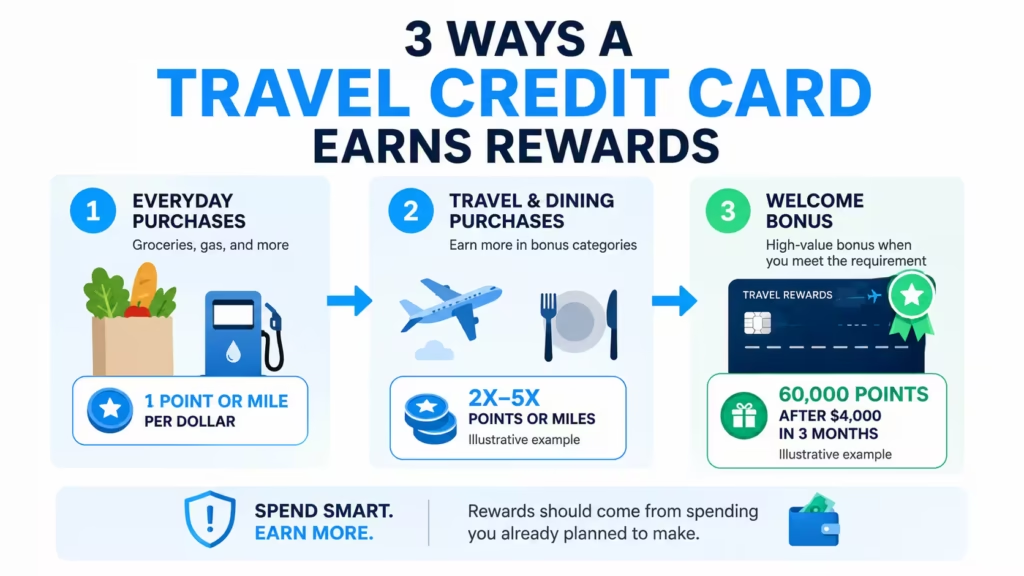
One warning matters more than any earning rate: never spend extra just to earn rewards. Points are typically worth about 1 to 2 cents each. If you spend $100 you didn’t need to spend in order to earn 200 miles worth roughly $2 to $4, you lost money. Rewards should come from spending you were going to do anyway.
How Travel Rewards Are Redeemed
Earning is only half the story. Redemption is where a card’s real value gets decided, because the same number of points can be worth very different amounts depending on the card’s rules.
Common redemption options include:
- Booking travel through the card issuer’s portal. You log in, search for flights or hotels, and pay with points, often at a fixed value like 1 cent or 1.25 cents per point.
- Statement credits against travel purchases. You pay for a trip with the card, then erase some or all of the charge using points. This is simple and flexible.
- Transfers to airline and hotel partners. Some flexible cards let you transfer points to airline or hotel loyalty programs. This can help your points go further, especially for premium cabins.
Why do the rules matter so much? Imagine two cards that each give you 50,000 points. On one card, those points book travel at 1 cent each through a portal: $500 of value. On another, they transfer to an airline program where they cover a $900 flight.
Same points, nearly double the value. When you compare cards, the redemption rules tell you what your rewards are actually worth, not the number of points on the marketing page.
Types of Travel Credit Cards
Travel cards fall into three main groups. Knowing which group a card belongs to tells you most of what you need to know about how its rewards behave.
General (flexible) travel cards earn points in the card issuer’s own program. You can usually redeem them for travel through the issuer’s travel portal, as statement credits against travel charges, or by transferring them to partner airlines and hotels. Flexibility is the selling point. You’re not tied to one brand, so these cards suit people who fly different airlines or book wherever the price is best.
Airline co-branded cards are issued in partnership with a specific airline. They earn airline miles from the carrier's loyalty program. They often include perks like a free checked bag and priority boarding. These fit travelers who fly one airline most of the time, often because of a home airport hub.
Hotel co-branded cards work the same way on the lodging side. They earn hotel points in one chain’s program and may include perks like automatic elite status or a free night each year. They make the most sense for travelers loyal to one hotel brand.
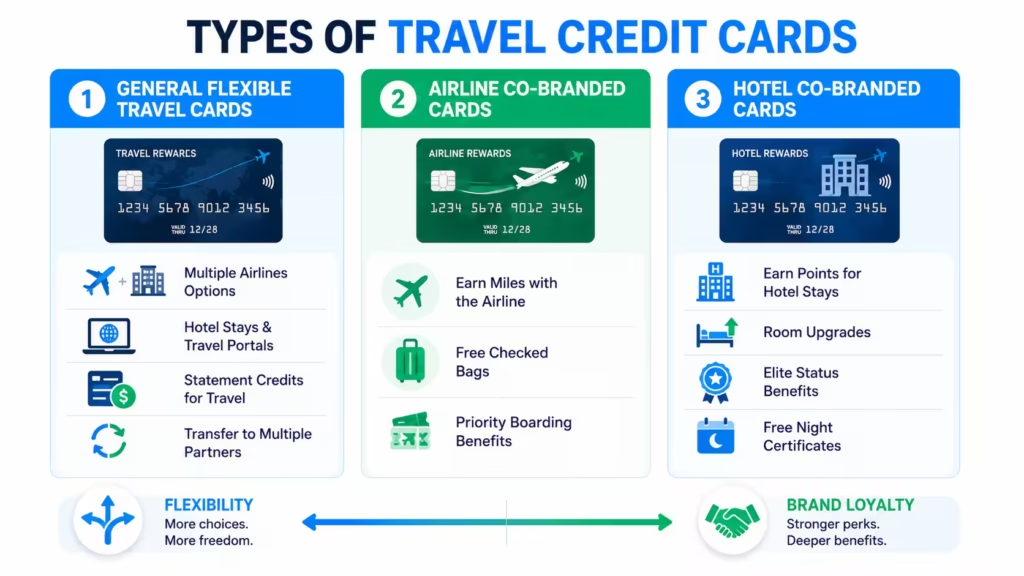
The core tradeoff is flexibility versus depth. Flexible cards spread value across many brands. Co-branded cards concentrate value in one brand and often add perks that flexible cards don’t offer. A traveler who flies twice a year on whatever airline is cheapest will usually get more from a flexible card. A traveler who flies Delta every month for work will likely do better with that airline’s card.
Travel Benefits and Perks
Rewards get the headlines, but benefits often deliver the steadiest value. The catch: a benefit is only worth what you’ll actually use. Here’s what the common ones do, and who they tend to fit.
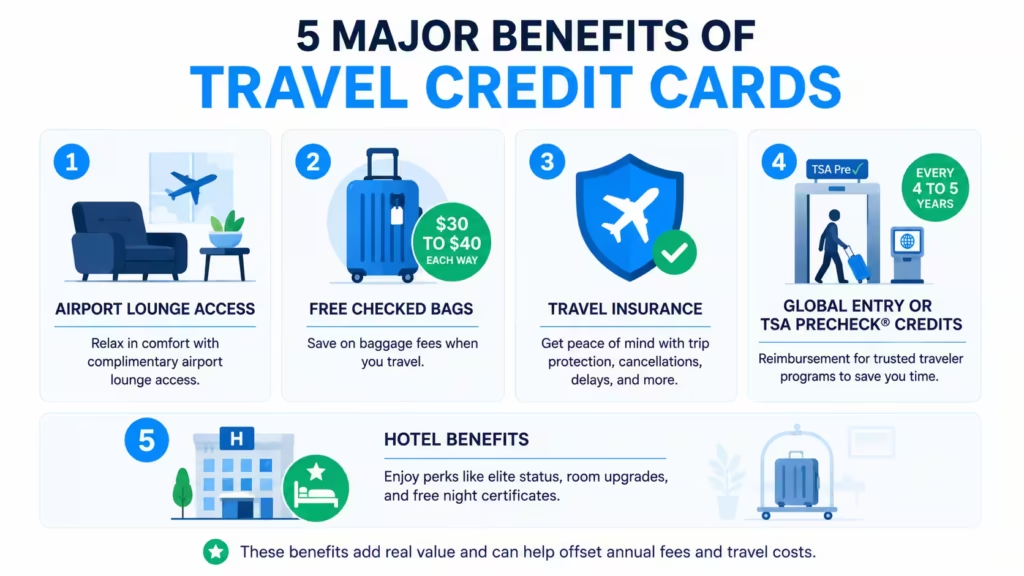
- Airport lounge access. Cardholders get into airport lounges, which offer free food, drinks, and quieter seating. Lounges are genuinely valuable for frequent flyers with long layovers. If you fly once a year and arrive 90 minutes before departure, you’ll barely touch this perk.
- Free checked bags. Common on airline cards. Checked bags often cost $30 to $40 each way, so a couple checking one bag each on one round trip could save $120 to $160 a year. This perk alone can justify a modest annual fee for some travelers.
- Travel statement credits. Some cards reimburse specific travel charges, such as airline incidental fees or a general annual travel credit. Read the fine print, because “travel credit” can mean very different things from card to card.
- Travel insurance and protections. Many cards include trip cancellation or interruption coverage, rental car damage coverage, lost luggage reimbursement, and trip delay protection. These only pay out when something goes wrong, but one disrupted trip can return hundreds of dollars.
- Global Entry or TSA PreCheck credits. Many mid-tier and premium cards refund the application fee for one of these expedited screening programs every 4 to 5 years. If you want to apply, you can do so through the official TSA PreCheck or Global Entry pages, then pay with the card to trigger the credit.
- Hotel benefits. Hotel cards may include elite status, room upgrades, late checkout, or an annual free night.
💡 Pro Tip: Before you get excited about a perk, check your last 12 months of travel. Count your flights, checked bags, and hotel nights. A benefit you used zero times last year is worth $0 to you, no matter what the card’s marketing says it’s “worth.”
The pattern to remember: value lives at the intersection of the benefit and your behavior. Impressive perks you never use are just an expensive annual fee in disguise.
Annual Fees and Other Costs
An annual fee is a once-a-year charge for holding the card. Travel cards range from no annual fee at all to $95 for mid-tier cards and $395 to $695 or more for premium cards with lounge access and large credits.
No-fee and fee-based cards serve different travelers. A no-fee card is low risk: any rewards you earn are pure upside. A fee-based card is a bet. You’re paying upfront, and you need the rewards and benefits to pay you back more than the fee.
The math is simple, and you should run it before applying. Take a card with a $95 annual fee. The card offers a free checked bag worth $140 a year and a $50 travel credit you’ll likely use. So, it gives you about $190 in value for a $95 cost. That’s a win. If you’d only use $60 of value, the card costs you $35 a year. That’s a loss, even if the welcome bonus looked great in year one.
The Consumer Financial Protection Bureau advises cardholders to weigh a card’s rewards and benefits against its fees and interest costs, and to review the card’s disclosed rates and fee schedule before applying. That disclosure, often called the Schumer box, lists the annual fee, APR, and every transaction fee in one standard table. It’s the single most honest page of any card offer.
Beyond the annual fee, two costs deserve their own close look.
Foreign Transaction Fees
A foreign transaction fee is a charge, usually about 3%, that some cards apply. This fee appears when you buy in a foreign currency, shop with a foreign merchant, or purchase the United States. Notably, you don’t have to be standing abroad to trigger it. Buying from a foreign website while sitting at home in Ohio can count.
Three percent sounds small until it compounds. Spend $3,000 on a two-week trip to Italy on a card with a 3% fee, and you’ve paid $90 for nothing. Most dedicated travel cards waive this fee entirely, which is one of the clearest reasons international travelers choose them. If you travel outside the U.S. even once a year, a no-foreign-transaction-fee card should be near the top of your checklist.
One related trap: dynamic currency conversion. Some foreign merchants or ATMs offer to charge you in U.S. dollars instead of the local currency. That sounds easy, but their exchange rate is usually worse than what your card network offers. Visa or Mastercard sets the base rate for card transactions. Pay in the local currency and let your card do the conversion.
Interest and Carrying a Balance
This is the cost that quietly erases everything else. A credit card’s APR (annual percentage rate) is the interest rate you pay on any balance you don’t pay off by the due date. Rewards cards tend to carry APRs in the 20% to 30% range.
Here’s why that overwhelms rewards. Suppose your card earns points worth about 2 cents per dollar spent, a strong 2% return. If you carry a $2,000 balance at a 25% APR for a year, you pay roughly $500 in interest. To earn $500 in rewards at 2%, you’d need to spend $25,000. The interest from even one carried balance can cancel out a full year of reward earnings for an average spender.
The rule that makes travel cards work is simple: pay the statement balance in full every month. Rewards and interest should be judged separately. A card that pays you 2% while charging you 25% is not a 2% card if you carry debt. It’s a borrowing tool with a loyalty program attached.
⚠️ Mistake to Avoid: Chasing a welcome bonus with spending you can’t pay off. If a $4,000 spending requirement pushes you into carrying a balance, the interest will likely cost more than the bonus is worth. Only pursue a bonus your normal budget can cover.
Travel Credit Cards vs. Cash-Back Cards
Cash back is the main alternative, and the choice between the two comes down to how you want to receive value.
Cash back is simple and fully flexible. You earn a percentage of your spending, usually 1.5% to 2% on flat-rate cards, and you receive it as a statement credit, deposit, or check. There are no redemption rules to learn, no transfer partners, no award charts. A dollar of cash back is worth a dollar, every time, on anything.
Travel rewards are less flexible but can be worth more per dollar. Points and miles often redeem at roughly 1 cent each for simple uses, but portal bonuses and airline or hotel transfers can push them to 1.5 or 2 cents or more. Travel cards offer benefits that cash-back cards usually don’t. These include insurance, lounge access, baggage perks, and no foreign transaction fees.
So when does each side win?
- Travel card wins when: you travel at least a couple of times a year, you’ll actually redeem rewards for travel expenses, and you’ll use benefits like bag fee waivers or trip protections. The rewards plus benefits can outpace a flat cash-back rate.
- Cash-back card wins when: you travel rarely, you don’t want to learn redemption systems, or you’d rather have money than trips. Simplicity has real value, and cash never expires into a program you forgot about.
Neither answer is universal. A household taking one road-trip vacation a year will usually get more from a 2% cash-back card. A consultant flying monthly will almost always come out ahead with travel rewards and perks.
Who Should Get a Travel Credit Card?
Rather than abstract criteria, here are the profiles that tend to get real value from a credit card for travel:
- The frequent traveler. Someone who flies or stays in hotels several times a year. This person uses lounge access, insurance, and bag perks repeatedly, so both the rewards and the benefits pay off.
- The occasional traveler with meaningful trip spending. Even two or three trips a year can justify a card, especially a no-fee or low-fee one. If a family spends $6,000 a year on travel expenses, a card earning 2% to 3% on that spending returns $120 to $180 annually, before any perks.
- The international traveler. Anyone who spends money abroad. Avoiding a 3% foreign transaction fee on $4,000 of overseas spending saves $120 per trip, and that’s before earning a single point.
- The consistent benefit user. Someone whose habits line up with the perks: checks bags, flies one airline, uses lounges during long layovers. For this person, benefits alone can cover an annual fee.
- The pay-in-full cardholder. This one is non-negotiable. Travel cards only make financial sense for people who pay the full statement balance each month.
- The natural spender. Someone whose normal budget already matches the card’s bonus categories. A big dining spender gets more from a card that pays 3X on restaurants, with no behavior change required.
Notice what ties these profiles together: the card fits the life, not the other way around.
When a Travel Credit Card May Not Be Worth It
The counter-case matters just as much, because the wrong card costs money quietly. A travel credit card is probably a poor fit if any of these describe you:
- You travel infrequently. If you take one vacation a year, a premium card’s benefits will mostly go unused. Consider a no-fee travel card or a cash-back card instead.
- You can’t use the headline benefits. Lounge access means nothing if your home airport has no lounge you can enter. A hotel credit means nothing if you stay with relatives. Count realistic usage, not advertised value.
- The annual fee exceeds your return. Run the subtraction: realistic annual rewards value plus realistic benefits value minus the annual fee. If the result is negative, the card costs you money.
- You carry a balance. At a typical travel-card APR, interest will outrun your rewards quickly. Cash back on a lower-rate card, or focusing on paying down the balance first, is the better path.
- You prefer simplicity. If learning transfer partners and award charts sounds like homework, that’s a real cost. Simple cash back has a value all its own, and a rewards system you don’t use earns you nothing.
- The welcome bonus would stretch your budget. If hitting a spending requirement means buying things you wouldn’t otherwise buy, the bonus is a trap, not a gift.
A quick scenario makes this concrete. Jennifer, a project manager at a regional manufacturing firm, took one domestic trip last year. She was drawn to a card with a $395 annual fee, lounge access, and a big bonus.
Her airport’s only lounge belongs to a different network; she never checks bags, and her $1,800 of annual travel spending would earn her about $40 in rewards. The card would cost her roughly $355 a year. A 2% cash-back card with no fee was the obviously better choice, and it took five minutes of honest math to see it.
What to Compare Before Choosing a Travel Credit Card
You don’t need a list of the “best” cards. You need a framework that tells you whether any specific card fits you. Work through these nine checks with any offer:
- Annual fee. Write it down first. Every other number gets measured against it.
- Rewards earning structure. Compare the card’s bonus categories against your actual spending. A 3X rate on travel doesn’t help if 90% of your budget is groceries.
- Redemption flexibility. Can you book any travel through a portal, erase travel charges as statement credits, or transfer to partners? More paths mean more practical value.
- Foreign transaction fee. If you ever spend abroad or buy from foreign merchants, this should be zero.
- Travel benefits. List only the ones you’ll realistically use in the next 12 months, and assign each a dollar value based on your own behavior.
- Welcome bonus requirements. Check the spending requirement against your normal monthly budget. A bonus is only good if you can earn it without extra spending.
- Your travel frequency. Be honest about trips per year. This single number predicts benefit usage better than anything else.
- Your payment habits. If there’s any chance you’ll carry a balance, weigh the APR heavily. Rewards should be a secondary factor in that case.
- The net value test. Add realistic annual rewards value and realistic benefits value, then subtract the annual fee. Positive and meaningful? The card is a candidate. Negative or barely positive? Keep looking.
Here’s that test in action: Imagine a card with a $95 annual fee, 2X miles on all purchases, no foreign transaction fee, and a free checked bag. You spend $15,000 a year on the card, earning 30,000 miles worth about $300 toward travel redemption. You check one bag on two round trips a year, saving $140. Total value: $440. Subtract the fee: $345 ahead per year. That card earns its place in your wallet.
Run every offer through the same math, and the marketing noise falls away. What remains is a clear yes or no.
Frequently Asked Questions (FAQs)
Which credit card is best for international travel?
A travel card with no foreign transaction fee is usually the strongest fit for international spending. A 3% fee on $4,000 of overseas purchases would cost $120, while most dedicated travel cards waive this fee.
Is it better to get an airline credit card or a travel card?
Choose an airline card if you regularly fly one carrier and can use perks such as free checked bags or priority boarding. A flexible travel card is generally better if you fly different airlines or choose flights based on price.
How many travel credit cards should I have?
No fixed number works for everyone, but adding cards only makes sense when each one provides meaningful value. A card should earn enough rewards or benefits to justify its annual fee after accounting for your actual spending and travel habits.
What are the downsides of travel credit cards?
Common drawbacks include annual fees, complicated redemption rules, foreign transaction fees on some cards, and high APRs. A card charging a $395 annual fee can be a poor deal if you only use about $40 in rewards and benefits.
What is the best travel card for occasional travelers?
A no-fee or low-fee travel card is often a better fit for someone taking only two or three trips a year. For example, $6,000 in annual travel spending at 2% to 3% rewards could produce $120 to $180 before additional benefits.
Is it worth getting a travel card?
It can be worthwhile when your realistic rewards and benefits exceed the annual fee. For example, a $95 card that provides $190 in usable annual value would leave you $95 ahead before accounting for other costs.
What is the best travel card and why?
There is no single best travel card because the right choice depends on your spending, travel frequency, and preferred rewards. Compare the annual fee, earning rates, redemption options, foreign transaction fee, benefits, bonus requirements, and payment habits before choosing.
How much are travel credit card points worth?
Travel points typically provide about 1 to 2 cents of value per point, depending on how you redeem them. Simple redemptions may be around 1 cent per point, while transfer partners or portal bonuses can sometimes produce 1.5 to 2 cents or more.
What is the difference between a travel card and a credit card?
A travel card is a type of credit card designed to earn points or miles and provide travel benefits, while a general credit card may focus on cash back or other rewards. Travel cards can also include perks such as lounge access, checked-bag benefits, and travel insurance.
The Bottom Line
A travel credit card helps you earn points or miles on your spending. You can use these for trips. It often includes perks like insurance, lounge access, and no foreign transaction fees. Its value depends on three things: how often you travel, whether you’ll use the benefits, and whether you pay your balance in full each month.
For most readers, the most effective approach is the net value test: total realistic rewards and benefits minus the annual fee. If a travel rewards card clears that bar, it’s a strong fit. If not, a simple cash-back card will serve you better.
If you know someone planning a big trip or eyeing a card with a flashy welcome bonus, share this guide with them. It could save them hundreds of dollars in fees, or help them finally turn everyday spending into a free flight.