
Finding a late payment on your Citibank account can feel like a punch in the gut. One missed due date, and suddenly your credit score drops right when you’re shopping for a mortgage, a car loan, or a better card. You’ve probably heard that a goodwill letter to Citibank can fix this, but you’re not sure if Citi even honors these requests, where to send it, or what to say.
The good news: A well-written goodwill letter, sent to the right department, can remove a single late payment from your Citibank account. This is especially true if the rest of your payment history is clean.
Below, we walk through exactly what to include, where to mail it, a real sample you can copy, and what to do if Citi says no the first time.
Key Takeaways
This guide explains how to write a goodwill letter to Citibank to request removal of a late payment, including what to include, where to mail it, and how to escalate if denied.
Core Facts:
- A goodwill letter asks Citibank to remove an accurate late payment as a courtesy, while a credit dispute is used only when the reported information is actually wrong.
- Requests are more likely to succeed for a first-time 30-day late payment on an account with an otherwise strong payment history and a current or good-standing status.
- The general mailing address is Citibank Customer Service, P.O. Box 6500, Sioux Falls, SD 57117, sent by certified mail with return receipt requested.
- Consumer reports cite Citi’s Executive Response Team as reachable at CitiERU@citi.com and 605-331-1698, though this contact is not published on Citi’s official site.
- Mailed letters typically get a response in 15 to 30 days, and Executive Response Team emails in 7 to 14 days, with bureau updates taking another 30 to 45 days after approval.
- If a goodwill letter is denied, the recommended escalation path is the Executive Response Team, then a CFPB complaint, then an OCC complaint, waiting 30 days between each attempt.
Best for:
- Citi cardholders with a single, explainable late payment who want to try removing it before a mortgage or loan application.
- Readers unsure whether to file a goodwill letter or a formal credit dispute for a late payment.
- Anyone whose first goodwill request was denied and needs a clear next step.
Does Citibank Accept Goodwill Letters?
Citibank does not publish an official goodwill adjustment policy, and their front-line customer service reps will often say “no” if you ask by phone. That does not mean the door is closed. It just means the front door is the wrong door.
Consumer forums and credit repair groups say Citi’s Executive Response Team gives goodwill adjustments more often. This is more than what general customer service does. This team deals with escalated correspondence, executive office complaints, and CFPB responses. They have the authority to update credit bureau reporting when a general agent does not.
So the honest answer looks like this. If you send a form-letter style request through regular customer service, expect a form denial. Send a personalised, well-reasoned letter to the Executive Response Team, or escalate after a first denial. This can greatly improve your chances, especially when:
- You have an otherwise strong payment history on the account.
- The late payment was 30 days (not 60, 90, or a charge-off).
- It happened during a specific, explainable life event.
- The account is currently in good standing or was closed on good terms.
Nobody publishes an official success rate. But the pattern is clear from years of reader-reported outcomes: does Citibank remove late payments? Yes, sometimes, and your job is to give the right person a reason to say yes.
📌 Did You Know: Citi’s Executive Response Team can be reached by phone at 605-331-1698 and by email at CitiERU@citi.com, according to consumer reports on the r/citibank community. This is not published on Citi’s main site, which is exactly why most people never reach the team that can actually help.
Goodwill Letter vs. Credit Dispute: Which One You Need
These two tools sound similar, but they do very different jobs, and using the wrong one can hurt you.
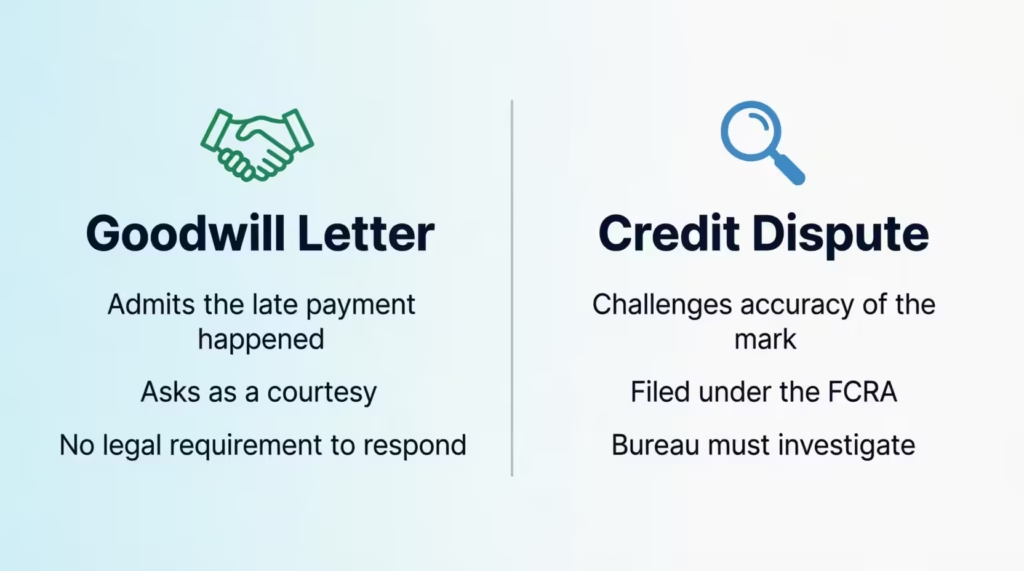
A goodwill letter is a polite request. You are saying, “Yes, this late payment really happened. Yes, it was my fault. I’m asking as a courtesy if you would remove it, given my otherwise clean history.” You are not challenging the accuracy of the mark. You are asking for a favor.
A credit dispute is a legal process under the Fair Credit Reporting Act (FCRA). You file it when the information is wrong, for example, the payment was actually on time, the amount is incorrect, or the account isn’t yours.
Under the FCRA, Citi and the credit bureaus must investigate the disputed item, and if it can’t be verified, it must be removed.
Using a dispute when the late payment is accurate is a bad idea. It wastes time, and if the creditor confirms the mark, it stays. Worse, filing false disputes can be considered fraud.
Simple rule to remember:
- Late payment really happened? Goodwill letter.
- Late payment is wrong, missing, or belongs to someone else? Credit dispute.
Quick Qualifying Checklist Before You Write
Before you spend an hour writing, make sure a goodwill request is even worth sending. You are a strong candidate if you can answer “yes” to most of these:
- Is this your first late payment on this Citi account, or one of very few?
- Is your account currently open and in good standing, or was it closed on good terms?
- Was the late payment 30 days, not 60 or 90 days past due?
- Do you have a specific, honest reason (illness, job loss, natural disaster, autopay glitch, address change, family emergency)?
- Have you brought the account fully current, with no balance owed for that missed cycle?
- Has less than three years passed since the missed payment?
If you can check most of these boxes, you have a real shot. If your account is charged off, in collections, or shows a long pattern of late payments, a goodwill request is unlikely to work. In that case, focus on a broader credit rebuilding plan instead.
What to Include in a Citibank Goodwill Letter
Every effective goodwill letter includes the same core pieces. Miss one, and the reviewer has an easy reason to move on to the next envelope.
Include all of the following:
- Your full legal name as it appears on the account.
- Your Citibank account number (full number, not just the last four digits).
- Your current mailing address, phone number, and email.
- The specific late payment you want removed, including the exact month and year it was reported.
- A brief, honest reason for the missed payment.
- A statement of accountability, showing you understand it was your responsibility.
- Your positive history with Citi (years as a customer, on-time payments, any product loyalty).
- A clear, specific ask: request that Citi update the reporting to the three major credit bureaus (Experian, Equifax, and TransUnion) to show the payment as on time or “never late.”
- A polite closing with your signature and date.
Keep the letter to one page. A human reviewer reads dozens of these a week, and a long, rambling story reads as an excuse. A tight, respectful, well-organized letter reads as credible.
How to Explain the Late Payment Without Over-Explaining
This is where most people accidentally sink their own request. They write three paragraphs justifying the missed payment, and it reads defensive.
Keep the reason to one or two sentences. State what happened, then move on. Reviewers are looking for two things:
- Was this a one-time event or a pattern?
- Are you taking responsibility, or making excuses?
Here are strong, honest reasons that tend to land well:
- A short hospital stay or medical emergency.
- Loss of a job with a documented gap in income.
- A death in the immediate family.
- A move where a paper statement never arrived at the new address.
- A bank change that caused an autopay to fail.
- A natural disaster in your area (FEMA-declared events carry extra weight).
Do not blame Citi’s website, blame the mail, or say “I forgot.” Even if any of these are technically true, they signal carelessness. Own the mistake, explain the context in one line, and pivot to your track record.
Tone and Length That Get Read
Tone matters more than most people realize. The reviewer is a person who can help you or move on. Speak to them like a person, not a corporation.
Follow these tone rules:
- Respectful, not begging. Do not use phrases like “I’m desperate” or “please please please.”
- Confident, not entitled. Do not say “I deserve this to be removed” or “you owe me.”
- Personal, not template-y. Avoid copy-paste openers like “I am writing today to request a goodwill adjustment.” Reviewers see this exact sentence hundreds of times a month, and it triggers a form denial.
- One page maximum. Aim for 200 to 350 words in the body of the letter.
- No legal threats. The moment you mention FCRA, “arbitration,” or “attorney,” the letter gets routed away from the human who can actually help you.
💡 Pro Tip: Handwrite the envelope and print the letter on plain white paper. A typed letter in a hand-addressed envelope stands out from the stack of form letters and gets opened first. Small detail, real impact.
Citibank Goodwill Letter Example
Use this as a starting frame, not a copy-paste. Reviewers spot templates instantly, so rewrite it in your own voice.
[Your Full Name] [Your Street Address] [City, State, ZIP] [Phone] · [Email] [Today’s Date]
Citibank Customer Service P.O. Box 6500 Sioux Falls, SD 57117
RE: Goodwill Adjustment Request Account Number: [Your Full Account Number]
Dear Citibank Customer Care Team,
I’ve been a Citi cardholder since [Year], and I’m writing to ask for a one-time courtesy. In [Month, Year], my account showed a 30-day late payment. I want to be upfront: the late payment was my responsibility, and I’m not disputing that it happened.
At the time, [briefly explain the reason in one sentence, e.g., “I was hospitalized for a week and my autopay did not process before the due date”]. As soon as I realized the issue, I paid the balance in full and set up a stronger backup so it would not happen again.
Aside from this single lapse, my history with Citi has been strong: [X] years as a cardholder, on-time payments before and after, and an account currently in good standing.
I’m working toward [buying a home/refinancing/specific goal], and this single mark is the one thing standing in my way. I would sincerely appreciate it if you could review my account and, as a goodwill gesture, update the reporting to Experian, Equifax, and TransUnion to reflect the payment as on time.
Thank you for taking the time to consider my request. I truly appreciate your help.
Sincerely, [Sign your name in ink] [Print your name]
This sample goodwill letter for a Citi credit card does a few things well. First, it admits the mistake in the opening paragraph.
Then, it provides a clear reason for the request. It also highlights a strong history of positive behaviour. Finally, it ends with a specific and actionable ask. No excuses, no threats, no fluff.
Where to Send Your Goodwill Letter to Citibank
For a standard Citi-branded credit card, the general correspondence address is:
Citibank Customer Service P.O. Box 6500 Sioux Falls, SD 57117
This address is confirmed inside Citi’s own cardmember agreement documents and is the standard destination for written correspondence that isn’t a billing dispute or payment.
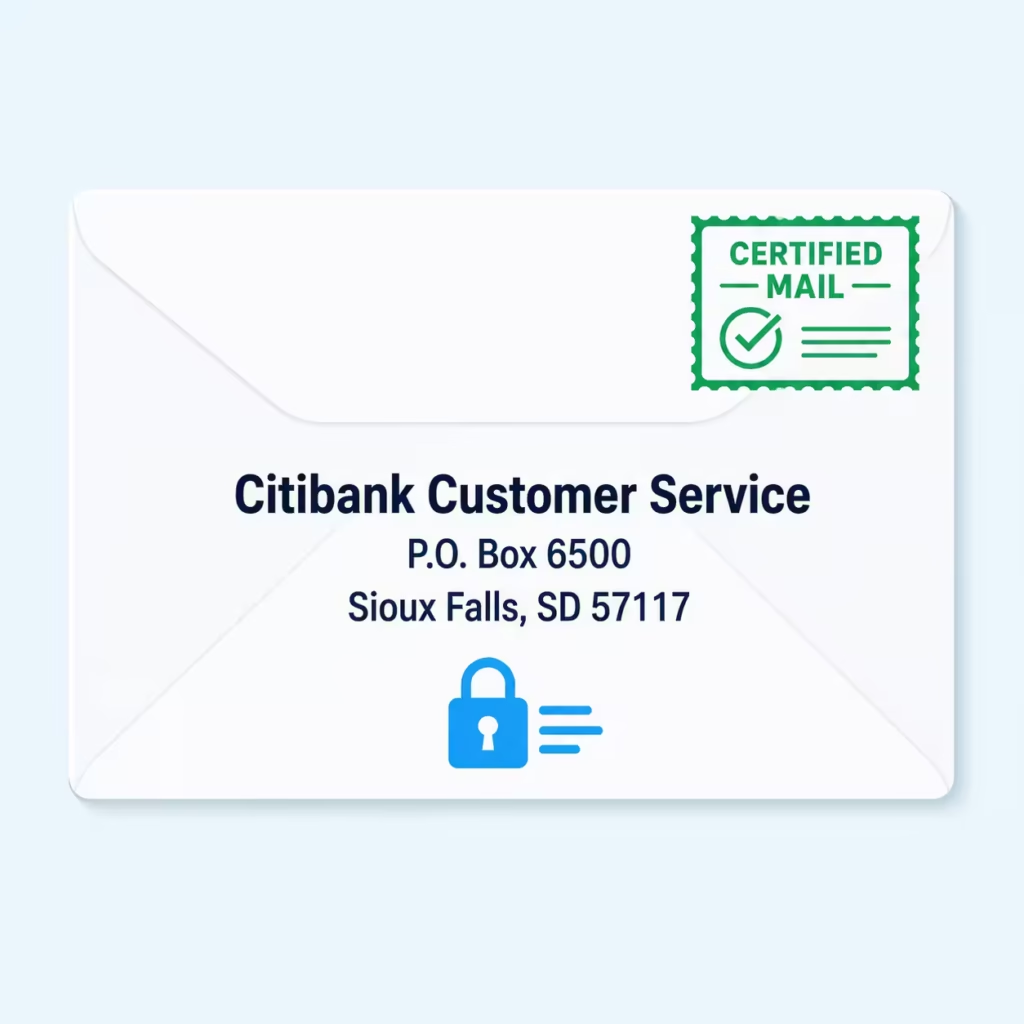
Send the letter by USPS Certified Mail with Return Receipt Requested. This gives you a tracking number, proof of delivery, and a signature on file. It also signals to the mailroom that this is serious correspondence, not junk. The extra few dollars are worth it.
Keep a signed copy of the letter and the certified mail receipt in a folder with the tracking number. If Citi doesn’t respond in 30 days, you’ll want that proof when you escalate.
Can You Email Citibank Instead of Mailing a Letter?
Yes, but not as your first move. Citi accepts written messages through the secure message centre in your online account. You can also reach the Executive Response Team at CitiERU@citi.com, using consumer-reported contact details.
Here is the honest tradeoff: A mailed, physical letter tends to outperform email for goodwill requests, for two reasons. First, physical letters route to a slower, more thoughtful queue where humans read them, while email often triggers a scripted first response. Second, a hand-addressed envelope stands out visually, while emails blend into a queue of hundreds per day.
Best practice: mail the letter first. If you have not heard back in 30 days, follow up by emailing the same letter to the Executive Response Team as an escalation.
Does This Apply to Citi-Branded Store Cards? (Best Buy, Costco, Macy’s)
Yes, but with one small twist. Cards such as the Best Buy Credit Card, the older Costco Anywhere Visa, the Macy’s Credit Card, and legacy Sears cards were issued by Citibank.
This means Citi is the creditor reporting the late payment to the bureaus. The goodwill request goes to Citi, not to Best Buy, Costco, or Macy’s.
A few things to know:
- Use the same Citibank Customer Service, P.O. Box 6500, Sioux Falls, SD 57117 address unless your monthly statement lists a different correspondence address for the specific store card. Always check the back of your statement first.
- Reference the store card name and your full account number in the subject line of the letter (for example, “RE: Goodwill Adjustment Request – Best Buy Credit Card, Account #…”).
- If Costco moved its card away from Citi, and your late payment was during the Citi period, Citi still controls that historical reporting. Send the letter to Citi, not to the new issuer.
The process, tone, and content are the same. Only the account name in the subject line changes.
What Happens After You Send It
Once your letter is in the mail, the waiting begins, and this is where most people spiral. Here is what actually happens on Citi’s side.
Your letter arrives at the Sioux Falls processing center, gets scanned and routed, and lands in a queue. A representative reads it, checks your account history, and decides whether to approve, deny, or escalate to a supervisor. If approved, Citi updates Experian, Equifax, and TransUnion. The late payment is either removed or marked as “paid as agreed.”
Two important things to expect:
- You may receive a form letter denial first. This is common and does not mean the fight is over. Front-line reps often deny by default. Real approvals frequently come from escalation.
- Credit bureau updates take time. Even after Citi approves the change, the bureaus typically need 30 to 45 days to reflect it. Do not panic if your report still shows the late mark two weeks later.
How Long Citibank Takes to Respond
Expect a written response in 15 to 30 days for a mailed letter, and 7 to 14 days for an email to the Executive Response Team. Some people get a phone call within a week, others get a form letter in the fourth week, and a small number never hear back at all.
If 30 days pass with no reply:
- Call Citi customer service at the number on the back of your card and ask if written correspondence was received.
- Send a follow-up email to CitiERU@citi.com with your original letter attached.
- Note the date of both attempts in your records.
Silence is not a “no.” It just means your letter did not reach the right desk. Time to escalate.
What to Do If Citibank Denies Your Goodwill Request
A first denial is not the end. Many successful goodwill removals happen after the second or third try. Each attempt should aim to be more effective than the last.
Here is the standard escalation path:
- First letter to general Citibank customer service (Sioux Falls address).
- Second attempt to the Citi Executive Response Team by mail and email.
- Third attempt by filing a CFPB complaint, which forces Citi to respond in writing within 15 days.
- Final option: filing a complaint with the Office of the Comptroller of the Currency (OCC), which regulates national banks including Citibank.
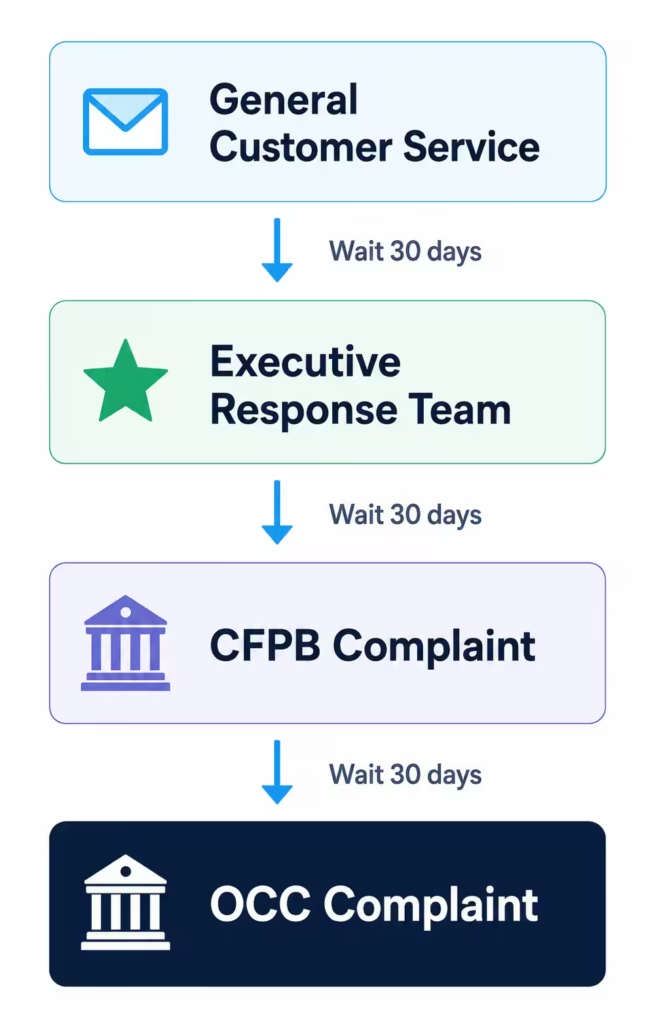
Wait 30 days between each escalation. Sending three letters in one week looks aggressive and can hurt your case.
⚠️ Mistake to Avoid: Do not send multiple goodwill letters to the same department within a few days. Citi’s system flags rapid repeat requests as spam-style contact, and reviewers can lock your file to “no further action.” Wait a full 30 days between each attempt, and only escalate to the next level, never repeat the same level twice.
Escalating to Citi’s Executive Office
The Executive Response Team is the single most useful contact in this entire process. This team manages CFPB complaints, executive office correspondence, and serious customer issues. They have more discretion than regular reps.
Reach them through:
- Email: CitiERU@citi.com
- Phone: 605-331-1698 (based on consumer-reported contact information)
- Mail: Send your escalation letter to the same P.O. Box 6500 address, but write “ATTN: Executive Response Team” clearly on the envelope and at the top of the letter.
When escalating, do not just resend the original letter. Add a short cover paragraph noting:
- The date of your first letter.
- The response (or lack of response).
- A short restatement of your request.
- Your appreciation for a second, more senior review.
Keep the tone respectful. This person has the power to say yes, and they respond to reason, not pressure.
Filing a CFPB Complaint as a Last Resort
If Citi denies your escalated request, or ignores it entirely, the Consumer Financial Protection Bureau is your next move. The CFPB is a federal agency. It takes consumer complaints about banks and sends them to the bank. The bank must reply in writing, usually within 15 days.
A CFPB complaint is not a lawsuit and not a dispute. This is a formal request for the bank to address your concern. It goes directly to Citi’s Executive Response Team, the team you wanted to contact.
To file, follow this process:
- Go to consumerfinance.gov/complaint and click “Submit a Complaint.”
- Choose “Credit reporting or other personal consumer reports” as the product category.
- Select “Incorrect information on your report” or “Problem with a company’s investigation into an existing problem” depending on your situation.
- Enter Citibank, N.A. as the company.
- Write a short, factual summary: what happened, what you asked for, what Citi’s response was, and what you want (removal of the late payment from all three bureaus).
- Attach copies of your original letter, delivery confirmation, and any Citi response.
Keep the complaint under 500 words and completely factual. No emotion, no legal threats, no CAPS. The CFPB reviews complaints in the order they are received, and a clean, professional complaint gets faster, better responses.
Filing a CFPB complaint does not damage your relationship with Citi, does not hurt your credit, and does not cost anything. It is one of the most powerful free tools consumers have.
Frequently Asked Questions
Does Citibank do goodwill adjustments?
Citibank doesn’t have a published goodwill policy. However, they approve goodwill adjustments on a case-by-case basis, mainly through the Executive Response Team. Approvals are more likely for one-time late payments on accounts with an otherwise strong payment record.
Where do I mail a goodwill letter to Citibank?
Send it to Citibank Customer Service, P.O. Box 6500, Sioux Falls, SD 57117, by USPS Certified Mail with Return Receipt Requested. For escalations, address the same envelope to “ATTN: Executive Response Team.”
How long does Citibank take to respond to a goodwill letter?
Expect 15 to 30 days for a mailed letter and 7 to 14 days for an email to the Executive Response Team. If Citi approves the request, the credit bureaus typically update within another 30 to 45 days.
What should I say in a goodwill letter to Citibank?
Include your account details, the specific late payment date, a brief and honest one-sentence reason, an accountability statement, your positive history with Citi, and a clear ask to update the reporting with all three credit bureaus. Keep it to one page and avoid template language.
Can I email Citibank a goodwill request instead of mailing it?
Yes, you can email the Executive Response Team at CitiERU@citi.com, but a mailed letter usually performs better as a first attempt. Use email as your escalation channel if the mailed letter goes unanswered after 30 days.
What if Citibank denies my goodwill letter?
Wait 30 days, then escalate to the Citi Executive Response Team by email and mail. If that also fails, file a CFPB complaint at consumerfinance.gov/complaint. Many successful removals happen only on the second or third try.
Does a goodwill letter work for Citi store cards like Best Buy or Costco?
Yes, because Citibank is (or was) the issuing bank behind these store cards. Keep the Citibank Sioux Falls address unless your statement says otherwise. Also, include the store card name and account number in the letter’s subject line.
Final Thoughts
You can try to remove a late payment from your Citibank account. It’s not guaranteed, but it’s possible with the right tool, tone, and approach.
The best approach, based on years of consumer feedback, is to send a personalized one-page letter via certified mail to Sioux Falls. If necessary, escalate to the Executive Response Team or file a CFPB complaint. Skip templates, own the mistake, and lead with your track record.
If this guide helped you take action, share it with a friend who’s fighting a single late payment before a mortgage application. It could save them thousands over the life of a loan.