
You bought something. The store won’t take it back. Now you’re stuck with it, and you’re wondering if your credit card can help. That’s exactly the situation credit card return protection was built for.
Credit card return protection is a card benefit that may reimburse you when a retailer refuses to accept a return on an eligible purchase. It’s not a legal right, and it’s not on every card.
Below, you’ll learn how the benefit works, which cards still offer it in 2026, what the real dollar limits are, and the exact steps to file a claim before the deadline runs out.
At a Glance
This guide explains what credit card return protection is, how it works, which cards still offer it in 2026, typical dollar limits and claim deadlines, and the exact steps to file a claim successfully.
Core Facts:
- Return protection is a cardmember benefit that may reimburse the purchase price of an eligible item when a retailer refuses to accept a return, but it is not a legal requirement and is not included on every card.
- As of 2026, confirmed cards offering the benefit include American Express (select cards like The Platinum Card and Blue Cash Preferred), Chase Sapphire Reserve, and select other premium Visa or Mastercard products.
- Coverage limits apply per item and per year at the same time, commonly $300 per item on American Express cards and up to $500 per item on Chase Sapphire Reserve, with an annual cap often around $1,000 per account.
- Claim windows commonly run 60 to 90 days, with both American Express and Chase Sapphire Reserve using a 90-day window that starts on the purchase date, not the date the retailer refuses the return.
- The full purchase amount generally must be charged to the one eligible card, since splitting payment with a gift card, cash, or a different card can disqualify the entire claim.
- Excluded categories commonly include motorized vehicles, live plants and animals, perishables, cash equivalents like gift cards, software or digital goods, firearms, medical equipment, and seasonal or one-of-a-kind items.
Best for:
- Cardholders who made a purchase a retailer now refuses to take back and want to know if a claim is possible.
- Frequent shoppers at stores with strict or no-return policies who want an added safety net on discretionary purchases.
- Anyone comparing credit cards who wants to understand realistic dollar limits before assuming return protection justifies an annual fee.
What Is Credit Card Return Protection?
Return protection is a cardmember benefit. It comes from your card issuer or payment network, not from the store. If a retailer won’t accept your return, the benefit may refund the purchase price of an eligible item, up to a set limit.
The benefit shows up in two forms:
- Extended return window. Some programs stretch the store’s return window. For example, if the store allows 30 days, the card benefit may cover you through 60 or 90 days.
- Outright reimbursement. More commonly, the benefit kicks in when the store refuses the return completely. Think of a “final sale” item or an item past its return window.
Two things are worth knowing right away. First, this is a benefit, not a legal requirement. No law forces issuers to offer it. Second, it has become uncommon. Most issuers dropped it years ago, so the card in your wallet may not have it at all.
How It Differs From a Store’s Own Return Policy
The store’s policy and the card benefit are two separate things. They operate independently.
The retailer’s return policy always comes first. Return protection only matters after the retailer says no. If the store accepts your return, you get your refund from the store, and the card benefit never comes into play.
There’s one wrinkle that surprises people. A generous store policy can actually disqualify your claim. If the retailer’s own return or satisfaction policy already matches or beats the card benefit’s terms, many issuers won’t pay. In their view, the store already covers you.
How Credit Card Return Protection Works
The trigger is always the same: the retailer refuses your return. Until that happens, you have no claim.
Depending on the card, the benefit is run either by the issuer directly or by a third-party benefits administrator. That’s an outside company that handles claims on behalf of the issuer or network. American Express and some Mastercard and Visa programs work this way.
At a high level, the flow looks like this:
- You attempt the return with the retailer.
- The retailer refuses.
- You file a claim with the issuer or benefits administrator.
- You submit proof, like your receipt and the retailer’s refusal.
- The claim is approved or denied.
- If approved, you get reimbursed, and you may need to ship the item to the administrator.
Reimbursement typically arrives as a check or a statement credit on your card account. The details, like who you call and what forms you fill out, vary by issuer. The step-by-step section later in this article covers the full process.
Return Protection vs. Purchase Protection, Extended Warranty, and Price Protection
Card benefits pages lump these four together, and it’s easy to file the wrong claim. Each one answers a different question.
| Benefit | The question it answers | What it covers |
|---|---|---|
| Return protection | Did the store refuse my return? | Reimburses an eligible item the retailer won’t take back |
| Purchase protection | Was the item damaged, stolen, or lost soon after I bought it? | Repair, replacement, or reimbursement for covered damage or theft |
| Extended warranty | Did the item break after the manufacturer’s warranty ended? | Extends the original manufacturer’s warranty period |
| Price protection | Did the price drop after I bought it? | Refunds the price difference (largely phased out industry-wide) |
A quick self-check keeps you on track. If the item is fine but the store won’t take it back, that’s return protection. If the item broke or was stolen, that’s purchase protection. If it failed after the warranty expired, that’s extended warranty. If you just found it cheaper, that’s price protection, a benefit most issuers have cut, along with programs like Citi Price Rewind.
Which Credit Cards Currently Offer Return Protection
Here’s the honest answer: most cards don’t. This benefit has become rare, and card lineups shift often.
As of 2026, the confirmed holdouts include:
- American Express. Amex offers return protection on select cards. Its official terms page lists cards such as The Platinum Card, Blue Cash Preferred, and certain Delta SkyMiles cards. American Express publishes its return protection terms on its own site, which is the best place to confirm your specific card.
- Chase Sapphire Reserve. Chase confirms this card includes return protection, with reimbursement of up to $500 per eligible item.
- Select other premium cards. Some Visa and Mastercard products have offered versions of the benefit over the years, but availability is inconsistent.
Coverage can vary even between two cards from the same bank. Don’t trust any third-party list, including this one, as your final word. Your own Guide to Benefits or your issuer’s benefits portal is the governing document. If it’s not in there, you don’t have it.
📌 Did You Know: Old blog posts still claim that cards have return protection long after the benefit was cut. Always check your current Guide to Benefits, not a listicle, before you count on coverage.
Why So Few Cards Still Offer This Benefit
Most major issuers began phasing out return protection around 2018. Industry reporting points to claims-processing costs and a low usage-to-cost ratio as the drivers, though issuers don’t publicly explain each cut.
The same trend killed price protection on most cards. Both benefits cost issuers money on relatively few claims.
The practical takeaway: assume nothing. Verify your specific card before you rely on the benefit or choose a card for it.
Eligibility Requirements for a Return Protection Claim
Before you spend time filing, check that your purchase clears these common requirements. Exact terms vary by issuer, but most programs look for:
- An open account in good standing. Closed or delinquent accounts are typically out.
- The right card was used. The eligible card must be the one that paid for the item.
- The item is in new or like-new condition. Most programs require the item to be unused, working, and in its original purchase condition.
- A real refusal from the retailer. You must actually ask the store and get a no. Assuming they’d refuse doesn’t count.
- A qualifying purchase location. Many programs require the purchase to be made in the U.S. or eligible territories, though this varies.
If any of these fail, the claim likely fails too. It’s better to know that before you gather paperwork.
The “Charge the Full Purchase” Rule and the Split-Payment Pitfall
This rule trips up more people than any other. In most programs, the entire purchase amount must be charged to the one eligible card.
Pay for part of the item with a gift card, cash, or a different card, and you may disqualify the whole claim. Points-plus-cash purchases can raise the same problem, depending on the issuer’s terms.
The habit to build is simple. For any purchase you might return later, put the full amount on one card. If that card has return protection, even better.
⚠️ Mistake to Avoid: Splitting a payment between a gift card and your credit card. A $600 item paid with a $100 gift card and $500 on your card may get zero return protection coverage, because the full amount wasn’t charged to the eligible card.
Coverage Limits: How Much Return Protection Actually Reimburses
The caps are lower than most people expect. Two limits apply at once:
- Per-item limit. Commonly $250 to $500 per item, depending on the card. For example, American Express caps return protection at $300 per item, while Chase Sapphire Reserve covers up to $500 per item.
- Annual limit. Often $1,000 per card account per calendar year. Amex’s published benefit terms confirm this $1,000 calendar-year cap for its eligible cards, based on the date of purchase.
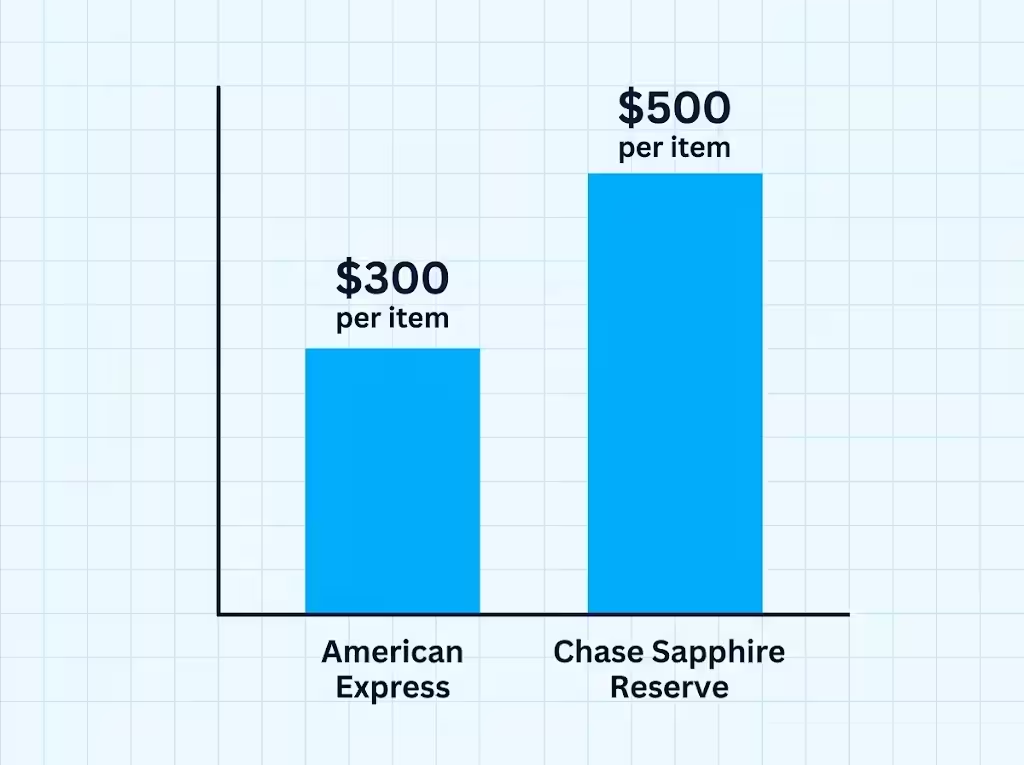
Here’s a real calculation. Say you buy a $900 jacket on a card with a $300 per-item cap. The store won’t take it back. Even with a perfect claim, you get $300, not $900. You absorb the other $600.
One more thing to expect: some issuers subtract shipping, handling, taxes, or rebates you already received from the reimbursed amount. Read your benefit terms so the payout doesn’t surprise you.
How Long You Have to File a Return Protection Claim
The clock is short, and it starts ticking at the wrong moment for most people.
Claim windows commonly run 60 to 90 days. Both the Amex and Chase versions of this benefit use a 90-day window. The key detail: the clock usually starts on the purchase date, not the date the store refused your return.
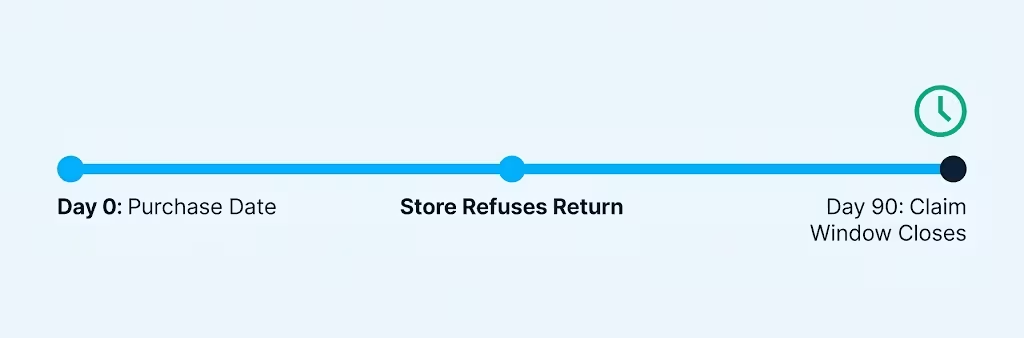
Some programs add a second, shorter deadline. If you file within a certain period after purchase, you may need to submit supplemental proof, like the retailer’s return policy, within a set number of days after starting the claim.
So don’t sit on a decision. Once the store says no, start the claim right away. Deciding “next month” can quietly close your window.
💡 Pro Tip: The day a retailer refuses your return, put a reminder on your phone with your purchase date and the 60 or 90-day deadline. A five-second reminder protects a few hundred dollars.
What Items Are Excluded From Return Protection
Exclusion lists vary by issuer, and your Guide to Benefits is the final word. Still, most programs exclude the same kinds of items:
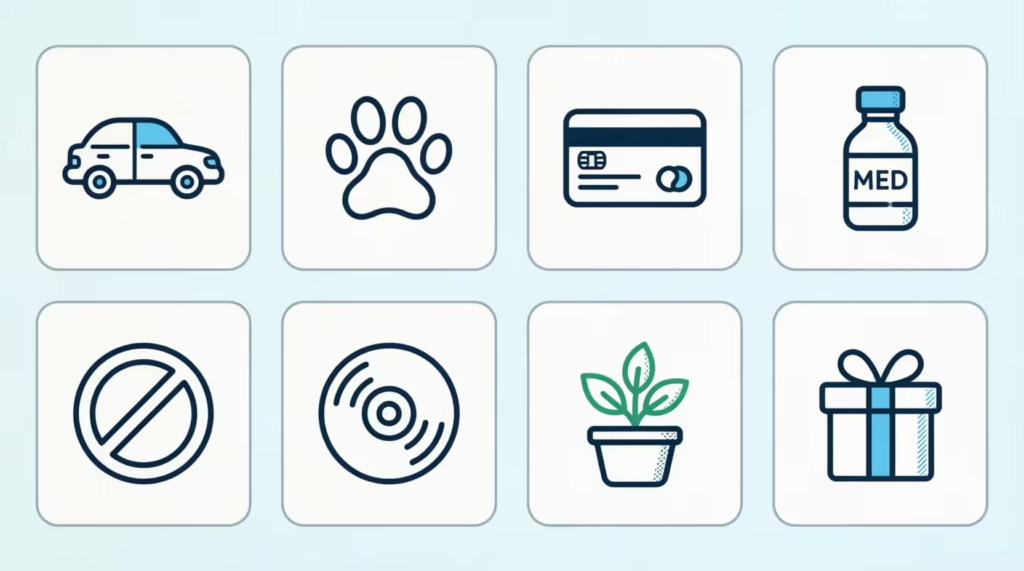
- Motorized vehicles and their parts
- Live plants and animals
- Perishables and consumables, like food, wine, and cosmetics
- Cash equivalents, including gift cards and prepaid cards
- Software and digital goods that have been activated or downloaded
- Firearms and ammunition
- Medical equipment
- One-of-a-kind or limited-edition items
- Rented items or one-time-event attire, like formalwear
- Seasonal items
- Items bought for resale or commercial use
Also remember the store-policy rule from earlier. Items bought from a merchant whose own return or satisfaction policy matches or beats the benefit may be excluded too, since the store already has you covered.
Scan your item against this list before you file. A five-minute check beats a denied claim. You should also check the specific time limits for your claim. Most cards require you to submit an application within 90 days of the purchase. Furthermore, the item must be in good, working condition when you try to return it.
If the store refuses your return, make sure to keep a copy of that denial. You will likely need to provide this proof to your card issuer. Detailed documentation helps speed up the process and prevents unnecessary delays.
How to File a Return Protection Claim, Step by Step
If you’re stuck with a non-returnable item right now, work through these steps in order.
- Attempt the return with the retailer first. The benefit only applies after the store refuses. Go through the normal return process and get a clear no.
- Get written proof of the refusal. Ask for an email, a denial letter, or a written note. If the store simply points to a “final sale” or no-return policy, save a screenshot or copy of that policy with the date.
- Gather your documentation. You’ll typically need the original receipt, your credit card statement showing the charge, the proof of refusal, and sometimes photos of the item showing its condition.
- Contact the issuer or benefits administrator. Check your Guide to Benefits for the claims phone number or online portal. For many Amex, Mastercard, and Visa programs, a third-party administrator handles the claim, not the bank’s regular customer service line.
- Submit the claim form and all proof on time. Fill out the claim form completely and send every requested document. Watch for any shorter sub-deadline for supplemental paperwork.
- Wait for the decision. Keep copies of everything you sent, and note your claim number.
💡 Pro Tip: Start a folder (paper or digital) the day the store refuses your return. Receipt, statement, denial proof, photos, claim number. One folder, everything inside. Claim denials often come down to one missing document.
What Happens After You File: Approval, Shipping the Item, and Getting Paid
Once the claim is in, three things happen.
First, the administrator reviews your documents. Approval timelines commonly run one to two weeks, though complex claims can take longer.
Second, if approved, you may be asked to ship the item to the benefits administrator at your own cost. Some programs reimburse shipping; others don’t. Check your terms before you mail anything, and use tracking.
Third, you get paid. Reimbursement typically comes as a check or a statement credit.
Until the claim fully resolves, keep the item in claim-ready condition. Unused, complete, and stored safely. If the administrator asks for it and you’ve used it or thrown it out, the approval can fall apart.
Common Reasons Return Protection Claims Get Denied
Use this as a pre-filing checklist. Each point below maps to a rule covered earlier in this article.

- No proof of refusal. You never got the retailer’s denial in writing.
- Missed deadline. The claim window, counted from the purchase date, already closed.
- Used or altered item. The item wasn’t in original, unused condition.
- Excluded category. The item falls on the issuer’s exclusion list.
- Split payment. The full purchase wasn’t charged to the eligible card.
- Store policy already covered it. The retailer’s own return or satisfaction policy matched or exceeded the benefit.
- A pattern of claims. Frequent claims can trigger extra review or even benefit revocation on your account.
If your situation fails two or more of these, expect a denial. If it fails none, file promptly and file completely.
Gathering your evidence early helps avoid these common pitfalls. Start by printing your itemised receipt and the store’s official returns policy. Keep these documents together in a folder or scan them into a secure digital file.
When you are ready, log into your card provider’s portal to begin the submission. Double-check your details before clicking send to ensure everything is accurate and clear. Following these simple steps will give your claim the best possible chance of success.
Should Return Protection Influence Which Credit Card You Use?
Honestly? It’s a nice-to-have, not a reason to get or keep a card. The benefit is rare, the payouts are capped, and most cardholders never file a claim in a given year.
That said, it’s genuinely useful for two types of people. One: frequent shoppers at stores with strict or no-return policies. Two: people who often make big discretionary purchases, like clothing, electronics, or home goods, where a $250 to $500 safety net has real value.
When you weigh a card, look at the whole package. Rewards rate, annual fee, purchase protection, and travel perks usually matter far more than return protection alone. A card with a $550 annual fee isn’t justified by a $1,000-per-year return benefit you may never use.
What to Do if Your Card Doesn’t Have Return Protection
No benefit? You’re not out of options.
First, check the other cards already in your wallet. Coverage varies by card, so a second card might have it even if your main one doesn’t.
Second, lean on strong retailer return policies. Stores like Costco and Nordstrom are known for generous returns, and that store policy is doing the same job the card benefit would.
Third, if this benefit matters to you going forward, verify current terms directly with the issuer before you apply for any card. Availability changes, and the only source that counts is the issuer’s own Guide to Benefits.
Frequently Asked Questions (FAQs)
Which credit card has the best return protection?
Chase Sapphire Reserve offers up to $500 per item, higher than American Express’s $300 per item cap. Both cap annual reimbursement around $1,000 per account per calendar year.
Is credit card return protection worth it?
It’s a nice-to-have safety net, not a reason to choose a card. It helps most if you frequently shop at stores with strict return policies or make big discretionary purchases like electronics or clothing.
How much does credit card return protection cost?
Return protection is a complimentary cardmember benefit included with certain cards, not an add-on you pay for separately. You only need to use the eligible card for your purchase to qualify.
What does credit card return protection cover?
It reimburses you for an eligible item when a retailer refuses to accept a return, up to a per-item cap like $300 or $500. It excludes categories like vehicles, gift cards, perishables, and medical equipment.
What should I do if a merchant refuses to refund my purchase?
Get the refusal in writing, such as an email or a photo of the store’s “final sale” policy. Then check if your credit card has return protection and file a claim within 60 to 90 days of your original purchase date.
How long does credit card return protection last?
Most programs give you 60 to 90 days from your purchase date to file a claim, not from the day the store refused the return. Amex and Chase Sapphire Reserve both use a 90-day window.
Do I need to ship the returned item back to get reimbursed?
Some issuers require you to ship the item to their benefits administrator once your claim is approved, sometimes at your own cost. Keep the item unused and in original condition until your claim fully resolves, since some programs reimburse shipping and others don’t.
Can I use return protection if I paid partly with points or a gift card?
Most programs require the entire purchase to be charged to the one eligible card, so splitting payment with a gift card or points can disqualify your claim. For any purchase you might want to return, charge the full amount to a single eligible card.
The Bottom Line
Credit card return protection reimburses eligible purchases when a store refuses a return, but few cards still offer it, and payouts are capped per item and per year. The claim window counts from your purchase date, the full amount must be on one eligible card, and written proof of the store’s refusal is essential.
A practical approach: check your Guide of Benefits today, before you need it. If your card has the benefit, know the caps and the deadline. If it doesn’t, favor retailers with strong return policies.
Know someone fighting a store over a return right now? Share this guide with them. It could save them a few hundred dollars.