
You booked the trip. Your credit card says it comes with travel insurance. Now you are stuck on one question: is that enough, or do you need to buy a separate policy?
Here is the short answer. Credit card travel insurance is enough for some trips, but not for most big international ones. A standalone policy usually wins on medical care, evacuation, and flexibility.
Below, you will learn what each option really covers, where the dangerous gaps hide, and how to decide for your specific trip. You will also see how to combine both, so you pay for protection you actually need.
At a Glance
This guide compares credit card insurance vs travel insurance, covering coverage categories, primary versus secondary payout rules, medical and evacuation gaps, exclusions, cost ranges, and how to combine both types of coverage for one trip.
Core Facts:
- Credit card travel insurance is a fixed benefit bundled into a card with preset limits, while standalone travel insurance is a separate underwritten policy sized to the trip’s actual nonrefundable cost.
- Card benefits typically trigger only when the trip, or a required portion of it, is charged to that specific card, not simply by holding the card.
- Rental car and medical benefits on cards are often secondary coverage, meaning another insurer must be billed first before the card coverage applies.
- Standalone comprehensive travel insurance commonly costs about 4% to 10% of the total nonrefundable trip cost, with Cancel For Any Reason coverage adding further cost.
- Card coverage often caps trip length in a range of 15 to 60 days depending on the card, while standalone policies are built around the traveler’s actual trip dates.
- Cancel For Any Reason coverage is not available as a credit card benefit, typically reimburses 50% to 75% of insured trip cost, and generally must be purchased within 14 to 21 days of the initial trip deposit.
Best for:
- Travelers deciding whether their existing credit card coverage is sufficient for an upcoming trip or whether to buy a standalone policy.
- People planning international, remote, or cruise trips, or trips involving a traveler with a health concern or high-risk activity.
- Travelers looking to combine card benefits with a targeted standalone policy to cover specific gaps like medical and evacuation coverage without paying for a fully duplicate plan.
Credit Card Travel Insurance vs. Standalone Travel Insurance: The Core Difference
Credit card travel insurance is a benefit. It comes bundled with your card. You do not pick it or customize it. You get whatever the card’s terms say, and nothing more.
Standalone travel insurance is different. It is a real, underwritten insurance policy. You buy it from a licensed insurer for one specific trip. You choose the plan. You choose the limits. You can add extras that fit your situation.
The two products also start working in different ways. Card benefits turn on automatically when you pay for travel with that card. For example, if your flight is canceled and you bought the ticket with a qualifying card, a trip cancellation benefit may kick in. A standalone policy works no matter how you paid. You could book with cash, points, or another card, and the policy still applies.
One more difference matters. Card coverage is fixed. If your card’s trip cancellation cap is too low for your trip, you cannot raise it. A standalone policy is sized to your trip. You can insure the full nonrefundable cost, including an expensive honeymoon or a multi-country itinerary.
Both are legitimate forms of travel insurance. They just run on different engines. That is why the rest of this article compares them piece by piece, so you can see where your card ends and a policy needs to begin.
Coverage Categories Compared Side-by-Side
Not every card offers every type of coverage. Benefits vary a lot from card to card, even between cards from the same bank. The only way to know what your card includes is to read its Guide to Benefits. Still, the pattern below holds for most premium travel cards versus a typical comprehensive standalone policy.
| Coverage type | Credit card benefit | Standalone policy |
|---|---|---|
| Trip cancellation | Often included, with fixed caps | Usually included, sized to trip cost |
| Trip interruption | Often included, with fixed caps | Usually included, sized to trip cost |
| Trip delay | Common on travel cards | Common, sometimes more generous |
| Baggage loss or delay | Common on travel cards | Common |
| Rental car damage (CDW) | A standout card benefit | Usually an add-on or not needed |
| Travel accident insurance | Common on premium cards | Sometimes included |
| Emergency medical | Rare or very limited | A core strength |
| Emergency evacuation | Rare or limited | A core strength |
A few takeaways stand out. Cards are often strong on trip delay, baggage, and rental car damage. Many travelers find that the Collision Damage Waiver on a premium card is really helpful. It can often replace the expensive coverage at the rental counter.
Standalone policies pull far ahead on emergency medical care and evacuation. That is where the big money risk lives, and the next few sections explain why.
How the Coverage Actually Pays Out
Having a benefit on paper does not mean a claim gets paid. Three mechanical details decide most outcomes: whether coverage is primary or secondary, how you paid, and how high the limits go. Check your own card against all three before you rely on it.
Primary vs. Secondary Coverage
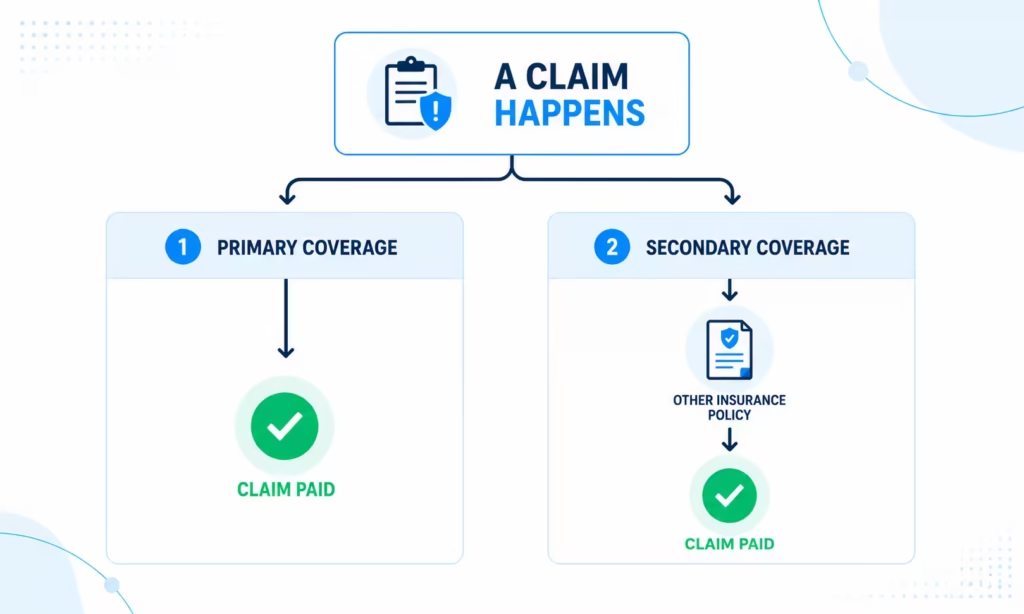
Primary coverage pays first. You file one claim, and that policy handles it.
Secondary coverage pays second. You must file with your other insurance first. That could be your auto insurer, your health plan, or your homeowners policy. Only after that claim is settled does the secondary coverage consider what is left.
This matters most for rental cars. Many cards offer rental car coverage as secondary. If you damage a rental, your personal auto insurance is billed first. That claim can raise your premiums for years. Some premium cards offer primary rental coverage, which avoids that problem. Standalone travel insurance is typically primary, so it does not touch your other policies at all.
Medical benefits on cards, when they exist, are also usually secondary to your health insurance. That adds paperwork and delays right when you are least able to deal with them.
The “Pay With the Right Card” Rule
This is the trap that causes the most denied claims. Card benefits usually trigger only when you charge the trip, or a required portion of it, to that specific card. Holding the card in your wallet is not enough.
Split payments create gaps. Say you book the flight on one card for the points and the hotel on another card for a different perk. Only the flight portion may be protected. The hotel is uninsured.
Bookings made entirely with points or miles can also fail to count as a qualifying payment, depending on the card’s terms. Some cards accept award bookings if you charge the taxes and fees to the card. Others do not. The terms control the answer, not the marketing email.
⚠️ Mistake to Avoid: Do not assume a trip is covered because you “have the card.” Check that every major nonrefundable cost was charged to the card whose benefits you plan to use, and read how that card treats points bookings.
Standalone insurance has no payment rule at all. The policy covers the trip you insured, however you paid for it.
Coverage Limits and Caps
Card coverage comes with fixed dollar caps, per person and per trip. These caps are often modest compared to what an expensive trip actually costs.
Think about a $15,000 honeymoon. If a card’s trip cancellation cap is far below that figure per person, a large share of your money sits unprotected. The card is not “bad.” It was simply never sized for a trip that big.
Standalone policies work the other way. You tell the insurer your total nonrefundable trip cost, and the policy is built around that number.
For a low-cost domestic trip, a card’s caps may easily cover your real exposure. For a big trip, they often will not. Your card’s exact limits live in one place: the Guide to Benefits. It is usually linked in your online account or available from the benefits administrator by phone.
The Medical and Emergency Evacuation Gap
This is the highest-stakes difference between the two options, and the one travelers misjudge most often.
Most credit cards offer little to no emergency medical coverage. When a card does include it, the limits are usually low, and the coverage is typically secondary to your health insurance. That structure made sense to the card issuer, because the card was never designed to be your health plan abroad.
Your regular health insurance may not help much either. Many U.S. health plans offer limited or no coverage outside the country, and foreign hospitals may require payment up front. Medicare generally does not cover health care outside the United States, with only narrow exceptions.
Then there is evacuation. If you are badly hurt or ill in a remote area, getting evacuated to a proper hospital can cost tens of thousands. More complex evacuations can even reach six figures. Very few cards cover evacuation at a level that matches that risk. Many do not cover it at all.
Standalone travel medical insurance is built for exactly this. These policies carry much higher medical and evacuation limits, and they are often primary. They usually have a 24-hour help line. This line can set up evacuations and ensure payment to the provider. That logistics help can matter as much as the money.
This gap matters most when your trip is international, remote, or cruise-based, or when any traveler has a health concern. The U.S. Department of State advises travelers to check their insurance coverage before going abroad and to consider supplemental medical and evacuation coverage. For a quick domestic weekend, the gap may not matter at all.
📌 Did You Know: A medical evacuation is not an ambulance ride. It can involve a private aircraft, medical crew, and coordination across countries. That is why the price tag shocks people.
Exclusions That Apply to Both, and Where They Differ
Neither option is a blanket safety net. Both come with exclusions, and those exclusions cause a large share of denied claims. Three categories deserve your attention before you travel.
Pre-Existing Medical Conditions
Both card benefits and standard standalone policies generally exclude pre-existing conditions. Insurers usually define these with a lookback period. If a condition was treated, diagnosed, or changed within a set window before you booked, claims tied to it can be denied.
Here is the key difference. Many standalone policies offer a pre-existing condition waiver. The catch is timing. You usually need to buy the policy within a certain number of days after your first trip deposit. You also have to meet other conditions, like insuring the full trip cost.
Credit cards generally offer no waiver option at all. If you are traveling with a parent who has a chronic condition, or you have one yourself, this difference alone can justify buying a policy. Buy it early, because the waiver window closes fast.
High-Risk Activities
Standard coverage, from cards and from many standalone policies, excludes risky activities. Common examples include skiing, scuba diving below certain depths, riding a motorbike or scooter, and other adventure sports.
The difference is flexibility. The standalone market sells riders and adventure-sports add-ons that bring these activities back into coverage. Card benefits generally do not offer that option. If your trip involves a scooter in Southeast Asia or a dive trip, a standard card benefit will very likely not respond to an injury from that activity.
Trip Length and Destination Limits
Card coverage often caps how long a covered trip can be. Limits in the range of 15 to 60 days are common, depending on the card. Past that cap, coverage simply stops.
That is a real problem for backpackers, sabbaticals, long cruises, and slow multi-country travel. Standalone policies avoid it because they are built around your actual trip dates. If you will be gone for six weeks, you buy a six-week policy.
Who Is Actually Covered
Many travelers assume everyone in their group is protected because the trip went on one card. That assumption is often wrong.

Card benefits typically cover the cardholder. Some benefits extend to a spouse or dependent children, but the definition of “covered person” varies by card and by benefit. Friends, in-laws, unmarried partners, and adult children often aren’t covered. This is true even if they travel with you and their costs are on your card.
Standalone policies solve this cleanly. You name each traveler on the policy. Anyone named is covered, no matter their relationship to you.
This matters most for group trips, multi-generational family travel, and any trip with companions outside your immediate household. If a friend breaks an ankle on day two of your group trip, your card’s benefit may do nothing for them. Before you travel, check your card’s definition of who is covered. Alternatively, put each traveler on a separate policy to avoid any guesswork.
What Actually Qualifies as a Covered Reason to Cancel or Interrupt a Trip
“Trip cancellation coverage” does not mean you can cancel for any reason. It means you can cancel for a listed reason.
Typical covered reasons under both cards and standard policies include things like:
- A serious illness or injury affecting you or a travel companion
- A death in the family
- Severe weather that disrupts travel
- Jury duty or a similar legal obligation
The list of reasons that are not covered surprises people more. Change of heart, fear of flying, a work conflict, and financial hardship are all commonly excluded under both options.
Card cancellation benefits tend to run on a narrower list than comprehensive standalone policies. So the same cancellation might be covered by a good policy and denied by your card.
Before you rely on either, read the actual covered-reasons list. For a card, it is in the Guide to Benefits. For a policy, it is in the plan documents, and a good insurer will let you read them before you buy.
Cancel For Any Reason (CFAR) Coverage
Cancel For Any Reason coverage exists for one purpose: to fill the gap left by those narrow covered-reasons lists.
With CFAR, you can cancel for a reason outside the standard list and still recover part of your money. Reimbursement is typically 50% to 75% of the insured trip cost, not the full amount. It is flexibility, not a full refund.
Three things to know. First, CFAR is not a credit card benefit. It exists only in the standalone market. Second, it has a purchase window. You commonly must add it within 14 to 21 days of your initial trip deposit, and you usually must insure the full trip cost. Third, it costs extra, often a meaningful percentage on top of the base premium.
One misconception deserves correction. CFAR does not mean you can cancel at the last minute on a whim and get everything back. Policies usually require you to cancel at least 48 to 72 hours before departure, and you still absorb 25% to 50% of the cost. It is a pressure release valve, not an escape hatch.
Comparing the Real Cost of Each Option
Card travel insurance is not literally free. You pay for it inside your annual fee. Premium cards with the strongest travel benefits carry annual fees of several hundred dollars. If you hold the card anyway for points and perks, the insurance is a nice extra. If you would get the card mostly for insurance, do the math carefully.
Standalone travel insurance is typically priced as a percentage of your total nonrefundable trip cost. Industry guidance commonly puts a comprehensive policy in the range of roughly 4% to 10% of trip cost, depending on your age, trip length, destination, and coverage level. Adding CFAR pushes the price higher.
Now frame cost against trip value. For a $600 domestic trip, paying for a policy may not make sense when your card already covers cancellation and delay. For a $15,000 international trip, a policy costing a few hundred dollars protects a sum that dwarfs your card’s caps. The more nonrefundable money you have on the table, the more the “paid” option starts to look cheap.
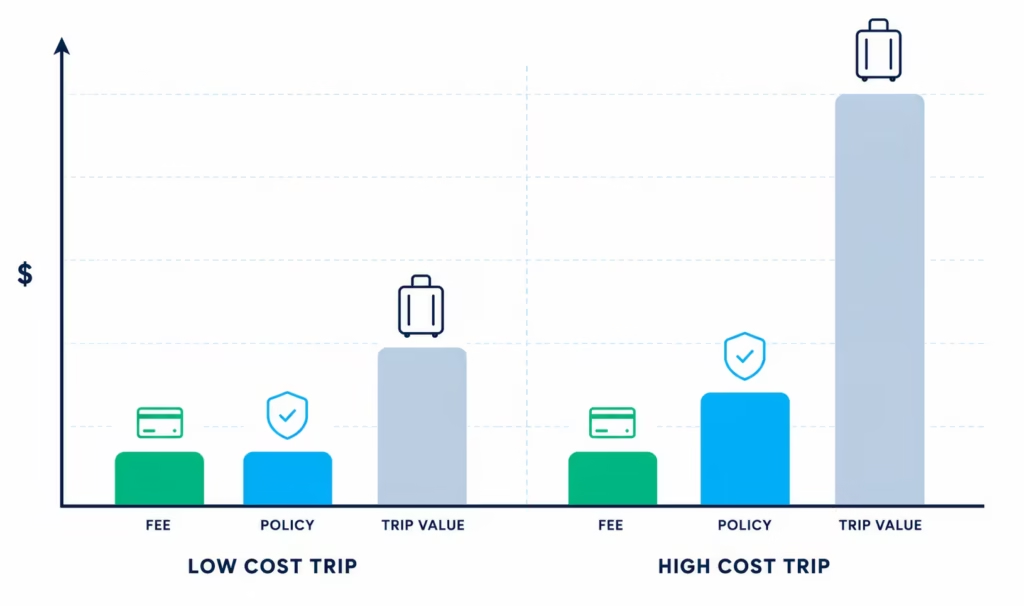
There is no universal right answer here. Your age, health, destination, and trip cost all shift the equation, so treat any percentage range as a starting point, not a quote.
How Filing a Claim Actually Compares
Benefit lists look similar on paper. The claims experience is where the two options feel most different.
With card coverage, the process usually works like this. You first cancel or resolve the issue directly with the airline, hotel, or tour company. Then you contact the card’s benefits administrator, which is a third-party company, not the bank itself. You submit documents. Then you wait for review.
With standalone insurance, the process is often more direct. Many insurers run app- or portal-based claims with status tracking. For medical emergencies abroad, some insurers can arrange direct billing with the hospital, so you are not paying a five-figure bill on your own card and waiting for reimbursement.
Both paths demand paperwork. Expect to provide:
- Proof that the trip was paid correctly (for a card, with that card)
- Receipts and booking confirmations
- Cancellation or delay confirmations from the travel provider
- Medical records, if the claim involves illness or injury
Deadlines apply on both sides. Claims generally must be filed within a set window after the incident, and missing that window can kill an otherwise valid claim. The most common denial reasons are also similar: missing documents, a reason that is not covered, the wrong payment card, or costs above the coverage limit.
💡 Pro Tip: Save every receipt, email, and cancellation notice from the moment something goes wrong. Most denied claims fail on documentation, not on the merits.
Deciding Whether You Need Standalone Travel Insurance for This Trip
Everything above condenses into a practical test. Run your trip through both lists.
Card coverage alone is likely enough when most of these are true:
- The trip is domestic
- Bookings are refundable or low cost
- Your health coverage works at your destination
- No high-risk activities are planned
- The whole trip was paid on one qualifying card
- Everyone traveling fits your card’s definition of a covered person
Standalone insurance is worth serious consideration when any of these are true:
- The trip is international, remote, or a cruise
- Nonrefundable costs are high relative to your card’s caps
- Any traveler has a health concern or a pre-existing condition
- Adventure activities are on the itinerary
- The trip runs longer than your card’s duration limit
- Companions fall outside your card’s covered-person rules
- You want CFAR flexibility
Final Checks Before You Travel
A few concrete steps close the loop:
- Find your card’s Guide to Benefits and read the sections for your trip type. It is usually linked in your online card account.
- Confirm that every major nonrefundable cost was charged to the qualifying card.
- Write down the claim filing deadline and the documents you would need before anything goes wrong.
- If you buy a standalone policy, check the CFAR purchase window right after your first deposit, because it closes within weeks.
- Save your card’s benefits administrator number and your insurer’s 24-hour assistance line in your phone.
Using Both Together: A Layered Coverage Strategy
The choice is not strictly either/or. For many trips, the smartest move is to use both.
Layering works like this. Your card provides the base layer: trip delay, baggage, rental car coverage, and cancellation up to its caps. You already paid for these inside the annual fee, so let them work. Then you buy a standalone policy aimed only at the gaps that could actually hurt you.
For most travelers, those gaps are medical care and evacuation. A medical-focused travel policy, without full cancellation coverage, often costs far less than a comprehensive plan. If cancellation flexibility is your worry, a policy with CFAR targets that gap instead. You are buying surgery, not a sledgehammer.
To pick your gaps, look at your trip’s risk profile. An international trip with a healthy traveler on a tight budget might need only medical and evacuation coverage. An expensive honeymoon with elderly parents joining might call for a fuller policy with the pre-existing condition waiver.
One coordination note: when both coverages exist, primary and secondary order still matters. A primary standalone medical policy pays out directly, without using your health insurance. This is just what you need if you’re at a foreign hospital at 2 a.m.
This layered approach avoids the false choice between relying entirely on your card and paying twice for a duplicate policy. You keep what is already yours and buy only what is missing.
Frequently Asked Questions (FAQs)
Do you need travel insurance if you have a credit card?
It depends on your trip. A card is often enough for a domestic, low-cost, refundable trip, but international travel, high nonrefundable costs, health concerns, or adventure activities usually call for a standalone policy too.
What is the difference between credit card travel insurance and travel insurance?
Credit card travel insurance is a fixed benefit bundled into your card with preset limits you can’t change. Standalone travel insurance is a separate underwritten policy you buy and size to your specific trip cost.
How do I know if my credit card covers travel insurance?
Check your card’s Guide to Benefits, usually linked in your online account or available by calling the number on the back of your card. It lists exactly which coverage types, limits, and exclusions apply.
Do you have to activate credit card travel insurance?
Yes, in effect. Coverage is generally triggered only when you charge the trip, or a required portion of it, to that specific card, not just by holding the card.
How much does travel insurance typically cost?
A standalone comprehensive policy commonly runs about 4% to 10% of your total nonrefundable trip cost. Adding Cancel For Any Reason coverage increases the price further.
How much is travel insurance for a $10,000 trip?
Using the typical 4% to 10% range, a comprehensive policy on a $10,000 trip would cost roughly $400 to $1,000. Your age, destination, trip length, and coverage level shift the exact price.
What will travel insurance not cover?
Both card and standalone coverage generally exclude pre-existing medical conditions, high-risk activities like scuba diving or motorbike riding, and reasons like changing your mind or a work conflict. Trip length limits and payment-card rules can also void a claim.
Are credit card travel insurance policies good enough?
For small, simple, domestic trips, yes, in most cases. For international trips, expensive nonrefundable bookings, or anyone with a health concern, the medical and evacuation gap usually makes a standalone policy the safer choice.
Does credit card travel insurance cover all passengers on the trip?
No. Coverage typically applies to the cardholder, and sometimes a spouse or dependent children, but friends, in-laws, and adult children are often excluded even if their costs are on your card.
Can you combine credit card insurance with a standalone policy?
Yes, this layering approach is common. Let your card handle its base benefits like baggage and rental car coverage, then buy a targeted standalone policy just for gaps like medical and evacuation coverage.
Wrapping Up
Credit card travel insurance is a solid base layer for small, simple, domestic trips. It falls short on medical care, evacuation, high-cost trips, and anyone outside the card’s narrow definition of covered travelers. Standalone policies fill those gaps, and add-ons like CFAR and waivers solve problems cards simply cannot.
A practical approach for many readers: check your card’s Guide of Benefits first, then price a targeted policy for whatever is missing.
If this guide helped you, share it with a friend or family member who is planning a trip right now. It might save them from a very expensive surprise.