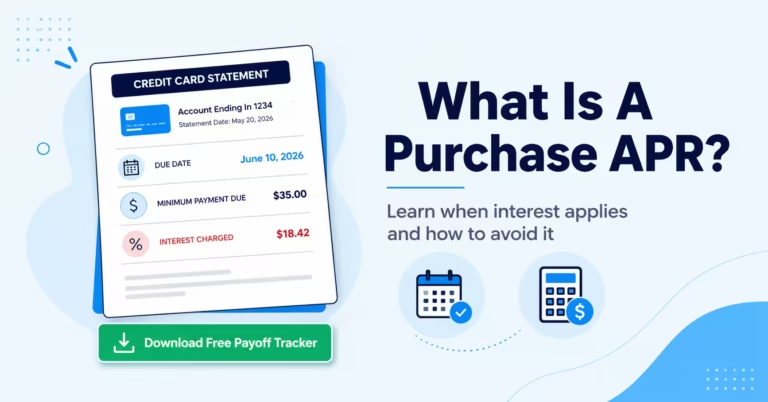

I’ve talked with plenty of people who spot a mystery charge on their credit card statement and feel that small jolt of panic. Sometimes it’s a $95 line, sometimes $550, and it shows up out of nowhere. If you’re staring at that charge or eyeing a shiny new card and wondering what a credit card annual fee really means, you’re not alone. Many first-time cardholders mix it up with interest or think it’s monthly.
Here’s the short answer: an annual fee is a yearly charge some issuers add to your account just for keeping the card open.
Below, we’ll walk through when it hits, what you get for it, how to judge if it’s worth paying, and how to get it waived or refunded.
Key Takeaways
This guide explains what a credit card annual fee is, including when it posts to your statement, what benefits it funds, how to get it waived or refunded, and how to decide if paying one is worth it.
Core Facts:
- A credit card annual fee is a yearly charge for keeping a specific card open, separate from interest, and applies even if you pay your statement in full each month.
- The fee is charged once per year, typically on or near your account anniversary date, not spread across monthly charges.
- Many issuers refund the annual fee in full if you close or downgrade the card within a 30 to 37-day window after the fee posts.
- Unpaid annual fees become part of your balance and start earning interest at your card’s purchase APR, which averaged 25.2% in the most recent CFPB report.
- The five-step worth-it framework is: list benefits used, assign a dollar value to each, add up rewards earned, subtract the fee, then compare to a no-fee alternative.
- Downgrading to a no-fee version of the same card keeps the account open and preserves credit history, while full cancellation can lower available credit and raise utilization.
Best for:
- Cardholders deciding whether to keep, downgrade, or cancel a card before its annual fee posts again.
- New applicants comparing a card’s rewards and perks against its yearly cost before opening an account.
- Anyone who recently saw an unfamiliar annual fee charge and wants to understand what it is and how to address it.
What a Credit Card Annual Fee Is
A credit card annual fee is a yearly charge some card issuers add to your account for the privilege of having that specific card. Think of it like a gym membership. You pay once a year to keep access to the perks tied to that card, whether or not you use them.
This fee is separate from interest. It has nothing to do with how much you spend or carry as a balance. Even if you pay your bill in full every month, the annual membership fee still applies if your card has one.
Not every card charges this fee. A no-annual-fee card costs $0 to keep open. These are common with starter cards, secured cards, and many basic cash back cards. On the other side, premium travel or luxury cards can charge hundreds of dollars each year in exchange for richer rewards.
So what is a credit card annual fee doing on your account? It’s the price of admission for that card’s benefits package. Issuers use it to fund richer rewards, sign-up bonuses, and premium perks like airport lounge access or travel credits.
📌 Did You Know: According to the CFPB’s most recent Consumer Credit Card Market Report, the average annual fee on general purpose cards has been rising as issuers push more rewards-heavy products.
How and When the Annual Fee Is Charged
The timing trips up a lot of new cardholders. The annual fee is charged once per year, not monthly. Most issuers post it to your account on or near your account anniversary date, which is the month you opened the card.
For example, if you opened your card on March 12, expect the fee to appear on your March statement each year after that. Some issuers charge it on the first statement after account opening, then again every 12 months.
You don’t pay it separately. It shows up as a line item on your billing statement and gets added to your balance. If you normally pay in full, just pay the full new balance and the fee is settled. If you carry a balance, the fee becomes part of that balance and can start earning interest, which we’ll cover later.
So no, the fee is not spread across 12 monthly charges. If you see a monthly charge that looks like a “membership fee,” that’s likely a different product, not a standard credit card annual fee.
The Truth in Lending Act, which the CFPB enforces, requires issuers to clearly disclose the annual fee in your card agreement before you open the account. You can also find it in the Schumer Box on any card application.
Where the Annual Fee Appears on Your Statement
On your monthly statement, the fee usually shows up in the transactions or fees section. It’s often labeled something like “Annual Membership Fee,” “Annual Fee,” or the card’s brand name followed by “Fee.”
You’ll also see it listed in the “Fees Charged” summary box that federal rules require on every credit card statement. That box separates fees from interest, so it’s easy to spot.
If you’re not sure whether a charge is your yearly fee, log in to your issuer’s app or website. Look at the transaction details. It will say plainly if it’s the annual fee. You can also call the number on the back of your card.
💡 Pro Tip: Set a calendar reminder for one month before your card anniversary. That gives you time to decide if you want to keep the card, downgrade it, or ask for a retention offer before the fee posts.
What You Get in Exchange for an Annual Fee
Paying a fee only makes sense if the card gives back more value than it takes. Cards with annual fees usually offer a stronger rewards program, richer sign-up offers, and premium benefits you won’t find on free cards.
Here’s what fee-based cards commonly include:
- Higher earn rates, like 3x to 5x points on travel, dining, or groceries
- A big welcome bonus worth $200 to $1,000+ after meeting a spending requirement
- Annual statement credit offers for travel, dining, streaming, or rideshare
- Airport lounge access through networks like Priority Pass or Centurion
- Travel insurance, rental car coverage, and purchase protection
- Free checked bags, priority boarding, or hotel elite status
- Cell phone protection and extended warranty coverage
For example, David, a marketing director who flies six times a year, pays a $250 annual fee on his travel card. He uses the $200 airline credit, gets two lounge visits worth about $60 each, and earns roughly $400 in travel points. His net gain is around $430 after subtracting the fee.
The math works when the credits and rewards you actually use are worth more than the fee. If you’d need to change your spending just to break even, the card probably isn’t the right fit.
First-Year Fee Waivers
Some issuers waive the annual fee for the first year to attract new customers. You’ll see this offer written as “$0 intro annual fee, then $95.” That means you get 12 months to test the card before paying anything.
This can be a smart way to try a premium card. You keep the welcome bonus and perks, and you have a full year to decide if the benefits are worth the fee going forward.
Just mark your calendar. When year two approaches, review your rewards, check the credits you actually used, and decide whether to keep the card, downgrade to a no-fee version, or close it. First-year waivers are less common on ultra-premium cards, which usually charge the full fee from day one.
How Much Annual Fees Typically Cost
Fees vary widely. On the low end, many cards charge $0. In the middle, most rewards cards fall between $95 and $250. Premium travel cards climb to $395, $550, or even $695 or higher. Ultra-luxury cards, like the American Express Platinum Card, now carry fees near $895 per year.
Here’s a simple breakdown of what to expect at each tier:
| Card Type | Typical Annual Fee | Common Benefits |
|---|---|---|
| Starter / Secured | $0 to $39 | Basic credit building, low limits |
| No-annual-fee rewards | $0 | 1% to 2% cash back, simple perks |
| Mid-tier rewards | $95 to $150 | 2x to 3x categories, welcome bonus |
| Premium travel | $250 to $550 | Lounge access, travel credits, insurance |
| Ultra-premium | $595 to $895+ | Elite status, concierge, luxury credits |
Business cards, co-branded airline cards, and hotel cards fit into these same tiers. A basic airline card might charge $95, while its top-tier version can hit $650.
The average credit card annual fee across all cards is much lower than the premium tier suggests, because most Americans hold no-fee or low-fee cards. CFPB market data shows that annual fee revenue keeps rising, driven largely by growth in premium and rewards-heavy products.
Why Fees Vary So Much Between Cards
The size of the fee reflects the value of the card’s benefits and the customer the issuer wants to attract.
- No-fee cards target broad audiences. Issuers earn revenue from interest and merchant swipe fees, so they don’t need a yearly charge.
- Mid-tier cards target regular spenders who want better rewards. A $95 fee helps fund higher earn rates and welcome bonuses.
- Premium cards target frequent travelers and high-income spenders. Fees cover lounge networks, travel insurance, and rich statement credits.
- Ultra-premium cards target luxury customers. Fees are high because the perks, like hotel elite status and thousands in credits, cost the issuer more to provide.
Issuers like Chase, Amex, Capital One, Discover, and Citi price each card based on the reward math they expect from typical users. If most cardholders redeem enough value, the issuer earns from swipe fees and interest. If not, the fee itself covers the gap.
Annual Fee vs. Other Credit Card Fees
The annual fee is just one line in a longer list of possible credit card charges. Mixing them up is common, so here’s how they differ.
- Interest (APR): What you pay when you carry a balance past the due date. It’s charged as a percentage, not a flat fee. The annual fee is not interest.
- Late payment fee: Charged when you miss the payment due date. Federal rules under the CARD Act set limits on how high this can go.
- Foreign transaction fee: A charge, usually 1% to 3%, on purchases made in a foreign currency or through a foreign merchant.
- Balance transfer fee: A one-time charge, often 3% to 5%, when you move debt from one card to another.
- Cash advance fee: A charge for withdrawing cash from your credit card, plus a higher APR that starts right away.
- Over-limit fee: Only applies if you opted in. Many cards no longer charge this.
- Returned payment fee: Charged if your payment bounces.
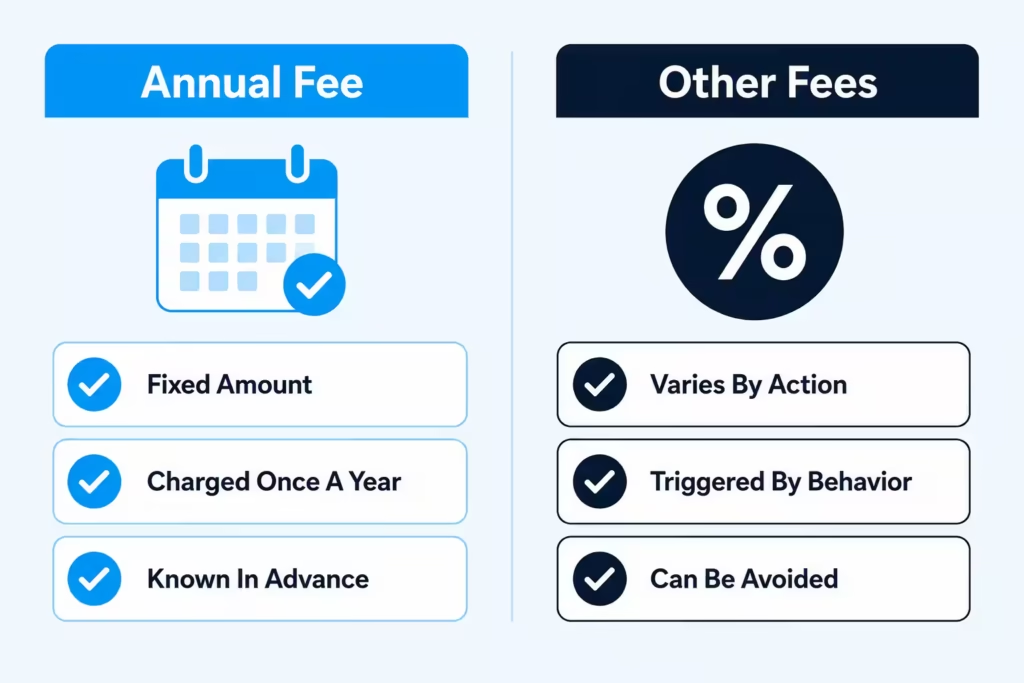
The annual fee is fixed. You know it in advance, and it doesn’t change based on how you use the card. The other fees are triggered by specific actions, like paying late or spending abroad. Understanding the difference helps you avoid surprise charges and pick the right card for your habits.
⚠️ Mistake to Avoid: Don’t assume a no-annual-fee card is free to carry. If you pay late, spend abroad, or carry a balance, other fees and interest can cost far more than a modest annual fee.
Does the Annual Fee Affect Your Credit Limit
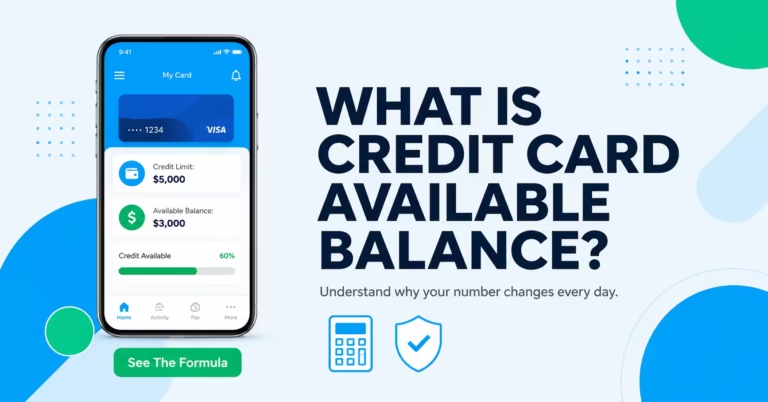
Yes, in a small way. When the fee posts to your account, it counts against your available credit just like any other purchase. If your credit limit is $5,000 and the annual fee is $95, your available credit drops by $95 until you pay it off.
This matters for your credit utilization ratio, which is the percentage of your credit limit you’re using. Utilization is one of the biggest factors in your credit score. A $95 fee on a $500 limit uses 19% of your limit right away. On a $10,000 limit, the same fee barely moves the needle.
The fee does not shrink your total credit limit. You still have the same overall line of credit. It just uses a small slice of it until paid.
If your card has a low limit, pay the fee off quickly to keep utilization low. On higher-limit cards, the impact is usually too small to notice.
Does the Annual Fee Affect Your Credit Score
The fee itself does not directly hurt your credit score. Credit bureaus don’t track annual fees as a separate item. What they do track is your balance, payment history, and utilization.
So the fee only affects your score in two indirect ways:
- It temporarily raises your balance and utilization until paid.
- If you refuse to pay it and let the account go delinquent, that damages your score badly.
As long as you pay the fee on time along with your regular balance, your credit score stays safe. Paying an annual fee is not a red flag to lenders. In fact, having a long-standing card with an annual fee can help your score by adding to your average account age.
What Happens If You Don’t Pay the Annual Fee
Ignoring the fee is a bad idea. Once it posts to your account, it’s part of your balance. You must pay at least the minimum by the due date, just like any other charge.
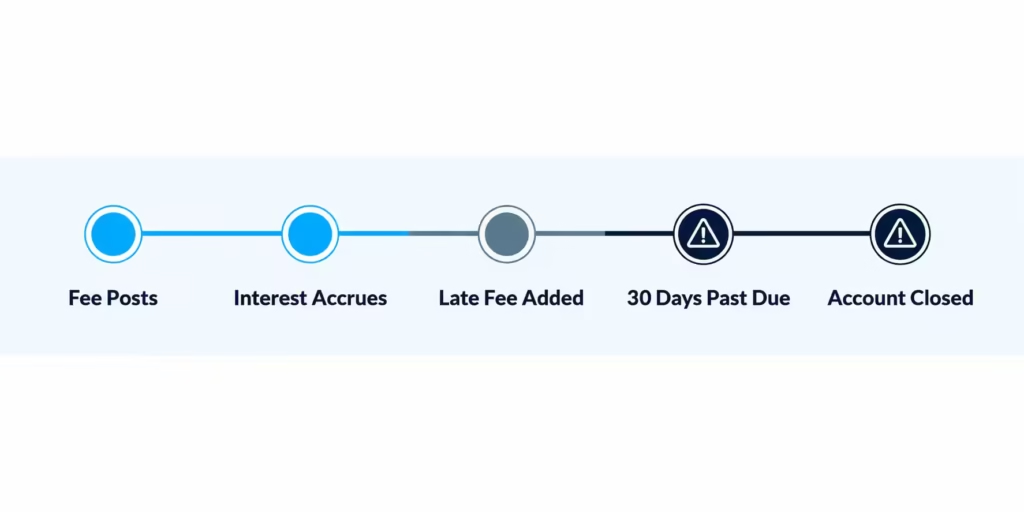
Here’s what happens if you skip it:
- Interest starts accruing. If you don’t pay the full balance, the fee earns interest at your card’s purchase APR, which averaged 25.2% for general-purpose cards in the most recent CFPB market report.
- Late fees pile on. Miss the minimum payment, and you’ll owe a late payment fee on top of the annual fee.
- Your account goes delinquent. After 30 days past due, the issuer reports the late payment to credit bureaus. Your credit score can drop by 60 to 100 points or more.
- The interest rate can rise. Serious delinquency may trigger a penalty APR of up to 29.99%.
- The account can be closed. After 60 to 180 days of nonpayment, the issuer may close the card and send the debt to collections.
The bottom line: even if you don’t want the card anymore, don’t just stop paying. Pay the fee, then call to close or downgrade the account. That protects your credit and your record with the issuer.
Can You Get an Annual Fee Refunded or Waived
Yes, and this is one of the most useful things to know as a cardholder. Issuers often refund or waive the fee if you ask the right way at the right time.
The 30 to 60 day refund window. Most issuers will refund the fee in full if you close or downgrade the card within 30 days of the fee posting. Some, like American Express and Chase, honor this window up to 30 to 37 days. Call customer service, ask politely, and mention you’d like the fee refunded.
Pro-rated refunds. If you cancel later in the year, some issuers offer a pro-rated refund based on the months remaining. For example, canceling six months after the fee posts might get you half back. Not every issuer does this, so ask before you close.
Retention offers. If you’re on the fence about the fee, call and say you’re thinking about closing the card. Retention specialists can offer a statement credit, bonus points, or a fee waiver for one year. Common offers include $50 to $200 in statement credit or 10,000 to 30,000 bonus points after meeting a spend target.
Military waiver. Under the Servicemembers Civil Relief Act (SCRA) and the Military Lending Act, active-duty service members can get annual fees waived on many cards. Ask your issuer about SCRA benefits.
Not every request works. But calling costs nothing, and the yes rate is higher than most people expect, especially if you’ve been a customer for years and pay on time.
Canceling a Card to Avoid Paying the Fee Again
If you decide the card isn’t worth it, you have three main options.
- Downgrade to a no-fee version. Many issuers offer a free version of the same card family. This is often the smartest move. You keep the account open, so your credit history and average account age stay intact. You just lose the premium perks.
- Product change. Similar to a downgrade, but you switch to a different card entirely. Ask what options are available on your account. This usually keeps your account number and history.
- Close the card. If neither option works, you can close it. Just know that closing a card can lower your total available credit, which may bump up your utilization ratio. On newer accounts, it can also shorten your credit history.
Whichever path you pick, do it before the next fee posts, or within the refund window if it just posted. Get any agreement in writing, either through the app’s secure message center or a confirmation email.
How to Decide If an Annual Fee Is Worth Paying
The simple test: add up the value you actually use from the card, then subtract the fee. If the number is positive, keep it. If it’s negative, drop it or downgrade.
Here’s a step-by-step framework.
Step 1: List the benefits you use. Not the ones on the marketing page, but the ones you actually redeem. Include statement credits, lounge visits, free checked bags, cell phone insurance you’d otherwise buy, and any perks you rely on.
Step 2: Assign a dollar value to each. A $200 airline credit is worth $200 only if you use it. A lounge visit might be worth $40 to $60. Cell phone protection might save $100 a year in insurance premiums.
Step 3: Add up your rewards. Multiply your typical spending in each bonus category by the earn rate. For example, $6,000 a year in dining at 3x points, redeemed at 1.5 cents per point, is worth $270.
Step 4: Subtract the fee. If your card charges $250 and you use $600 in benefits and rewards, your net value is $350. Keep the card.
Step 5: Compare to a no-fee alternative. Would a no-annual-fee card earning 2% cash back on everything net you more? If so, switch. A 2% flat card on $30,000 in spend earns $600 with zero fee.
This break-even rewards math changes as your life changes. A travel card is worth it during heavy travel years and a burden in stay-at-home years. Review once a year, near your anniversary.
Is an annual fee worth it? For frequent travelers, big spenders in bonus categories, or people who use the perks, yes. For light users, no-fee cards almost always win. There is no shame in downgrading. The best card is the one that pays you more than it costs.
Frequently Asked Questions (FAQs)
Do I need to pay an annual fee for a credit card?
No, not every card charges one. No-annual-fee cards are common with starter cards, secured cards, and many basic cash back cards, while premium travel cards often charge $250 or more.
Is it dumb to pay an annual fee on a credit card?
Not if the card’s rewards and credits are worth more than the fee. Add up the benefits you actually use each year and subtract the fee; a positive number means the card is paying for itself.
Can you avoid paying a credit card annual fee?
Yes, by choosing a no-annual-fee card or by downgrading an existing card to a no-fee version before the next fee posts. Many issuers also waive the fee for the first year on new accounts.
How do I get my annual fee waived?
Call your issuer and ask for a retention offer, which can include a statement credit, bonus points, or a one-year fee waiver. Active-duty service members can also request a waiver under the Servicemembers Civil Relief Act.
Can I cancel a credit card and not pay the annual fee?
Yes, if you close or downgrade the card within the refund window, usually 30 to 37 days after the fee posts, most issuers will refund it in full. Wait longer and you may only get a pro-rated refund, if any.
Do I have to pay back the annual fee on my credit card?
Once the fee posts to your statement, it becomes part of your balance and must be paid at least at the minimum by the due date. Unpaid fees start earning interest at your card’s purchase APR, which averaged 25.2% in the most recent CFPB report.
Can I remove the annual fee from my credit card?
You can remove it going forward by downgrading to a no-fee version of the same card, which keeps your account open and credit history intact. You typically cannot remove a fee that has already posted unless you’re within the issuer’s refund window.
What happens if you cancel a credit card with an annual fee?
Canceling stops future fees, but it can lower your total available credit and raise your utilization ratio. On newer accounts, it can also shorten your credit history.
Is it better to cancel a credit card or keep it and not use it?
Downgrading to a no-fee version is often smarter than canceling, since it keeps the account open and preserves your average account age. Full cancellation makes sense only if no fee-free version exists and the card isn’t worth keeping.
When is a credit card annual fee charged?
It’s charged once a year, typically on or near your account anniversary date, not spread across monthly charges. For example, a card opened in March will usually show the fee on the March statement each year after.
Wrapping Up
Understanding what a credit card annual fee means makes the decision much simpler. The fee is a yearly charge that pays for the card’s rewards and perks, and it’s easy to spot on your statement near your anniversary date. Some cards charge nothing; others charge hundreds.
The most effective approach is to add up the credits and rewards you truly use each year, subtract the fee, and see if the number is positive.
If this guide was helpful, share it with a friend. They might be thinking about their first rewards card or if their premium card is still worth it. It could save them hundreds a year.