
I know how unsettling it feels to see the name Equifax pop up on a loan denial, a breach notice, or a credit alert and have no clue what this company actually does with your life. You’re not alone; most people confuse the Equifax credit bureau with the lender that said “no,” or think it’s just another credit score app. The truth is simpler and more useful than that.
Equifax is a data company that collects your credit history and sells it to lenders, but it never decides if you get approved.
Below, we’ll explain Equifax’s services, how to get your free report, freeze your file, correct errors, and address issues from the 2017 breach.
Key Takeaways
This guide explains what the Equifax credit bureau does, including how it collects and shares credit data, how to freeze or dispute your file, and how the 2017 breach settlement still affects you through 2026.
Core Facts:
- Equifax is one of three nationwide credit reporting agencies, along with Experian and TransUnion, and has operated since 1899.
- Equifax collects and sells credit data to lenders but never approves or denies credit applications itself.
- Credit freezes are free by federal law and can be placed online, by phone at 1-800-685-1111, or by mail.
- Equifax must investigate most disputes within 30 days, extending to 45 days if new evidence is submitted.
- The 2017 breach exposed data on about 147 million Americans, and the cash claim window closed on January 22, 2024.
- The settlement still provides six free Equifax credit reports per year through December 31, 2026, plus weekly free reports via annualcreditreport.com.
Best for:
- Readers confused about why a lender denied credit and unsure whether Equifax made that decision.
- Anyone wanting to freeze, dispute, or review their Equifax file using official channels.
- Readers trying to understand what benefits from the 2017 breach settlement are still active in 2026.
What Is Equifax
Equifax is one of the three nationwide credit reporting agencies (NCRAs) in the United States, along with Experian and TransUnion. Think of it as a giant filing cabinet. It collects your borrowing history from banks, card issuers, and lenders. Then, it sells that information to companies. They use it to check your credit before offering you a loan, a card, an apartment, or sometimes a job.
The company has been around since 1899, which makes it one of the oldest data firms in the country. That long history is one reason lenders trust its files. Equifax doesn’t loan you money. It doesn’t run your bank account. It just keeps and shares the record of how you handle credit.
Under the Fair Credit Reporting Act (FCRA), Equifax has legal duties. It must keep your data safe, let you see your file, and fix mistakes. The Consumer Financial Protection Bureau (CFPB) and the Federal Trade Commission (FTC) monitor the company to ensure it complies with these rules.
📌 Did You Know: Equifax has credit files for over 200 million U.S. adults. However, it only shares these files with businesses that have a “permissible purpose” under the FCRA, such as lenders checking loan applications.
Where Equifax Gets Its Data
Equifax doesn’t spy on you. Its data comes from “data furnishers.” These are the banks, credit card companies, auto lenders, mortgage servicers, and collection agencies you already do business with. Each month, they send Equifax updates on your accounts. That’s how new balances, missed payments, and paid-off loans show up on your file.
Here’s the part that trips people up: reporting is voluntary. Not every lender reports to all three bureaus. Some report only to Equifax. Some skip it. That’s why your file at Equifax may look a bit different from your Experian or TransUnion file.
Public records also feed in. Bankruptcies, for example, can show up on your Equifax report. Rent and utility payments usually don’t, unless you use a special service that reports them.
Equifax Does Not Approve or Deny Credit
This is the biggest myth to clear up. When a lender turns you down, it feels like Equifax said “no.” It didn’t. Equifax just handed the lender your file. The lender read that file, ran it through its own rules, and made the call.
Every lender uses its own approval formula. One bank might reject a score of 680. Another might approve it with a smile. Equifax has zero say in that choice. So if you get denied, don’t call Equifax to argue. Call the lender and ask for the reason. By law, they must send you an “adverse action” notice that explains which bureau’s report they used and the main reasons for the denial.
Equifax Score vs. FICO vs. VantageScore
The word “score” causes a lot of confusion, so let’s untangle it.
When you log into myEquifax or Equifax Core Credit and see a free “Equifax score,” you’re usually looking at a VantageScore 3.0. That’s a score built by the three bureaus together. It’s a fine snapshot, but most lenders don’t use it.
Most banks and card issuers use a FICO Score, which is built by a separate company called Fair Isaac. FICO has many versions, like FICO Score 8, FICO Score 9, and even auto or mortgage-specific FICO models. Each one weighs your data a little differently.
Here’s a quick side-by-side:
| Score Type | Who Makes It | Range | Where You See It |
|---|---|---|---|
| VantageScore 3.0/4.0 | The 3 bureaus | 300–850 | Free apps, Equifax Core Credit |
| FICO Score 8 | Fair Isaac | 300–850 | Most credit cards, some banks |
| FICO Auto/Mortgage | Fair Isaac | 250–900 (auto) | Car loans, mortgages |
So if your Equifax dashboard shows 720 but your car dealer sees 685, nothing is broken. They’re just looking at two different scoring models built from the same underlying data. Different formulas mean different numbers.
Why Your Equifax Report May Differ From Experian or TransUnion
You pull your three reports on the same day, and the numbers don’t match. That’s normal, not a glitch.
Each bureau runs its own database. They don’t share files. When a lender reports your account, it picks which bureaus to send data to. Some send to all three. Some send to just one or two. So an old store card might sit on your Equifax file but not your Experian file.
Timing matters too. Bureaus update on different schedules. Your credit card balance may hit Equifax on the 5th and Experian on the 12th. If you check both mid-month, the numbers look off.
Errors also creep in one place and not another. A collection account might show up correctly on TransUnion, get misspelled on Equifax, and never reach Experian at all. That’s why checking all three matters, especially before a big loan.
How to Get Your Free Equifax Credit Report
You have three legit ways to see your Equifax file. All are free. Skip any site that asks for a credit card just to view your report.
1. Annualcreditreport.com is the official source set up by federal law. As of 2026, you can pull your Equifax report here once a week for free, along with your Experian and TransUnion reports. The FTC has confirmed this weekly access is now permanent, per the FTC consumer alert on free weekly reports. Go to annualcreditreport.com, pick Equifax, and answer the ID questions.
2. myEquifax is Equifax’s own free portal. Create a login at my.equifax.com, and you’ll get six free Equifax credit reports per year, on top of the weekly ones from annualcreditreport.com. This bonus access runs through December 31, 2026, as part of the 2017 breach settlement terms.
3. Equifax Core Credit is a free tool inside myEquifax. It shows your Equifax report plus a VantageScore. Good for a quick monthly check, not for lending prep.
💡 Pro Tip: Stagger your free pulls. Check Equifax in January, Experian in May, and TransUnion in September. That way you keep an eye on all three across the year without paying a cent.
What’s In an Equifax Credit Report
Your Equifax report has four main parts. Once you see how it’s built, reading it gets much easier.
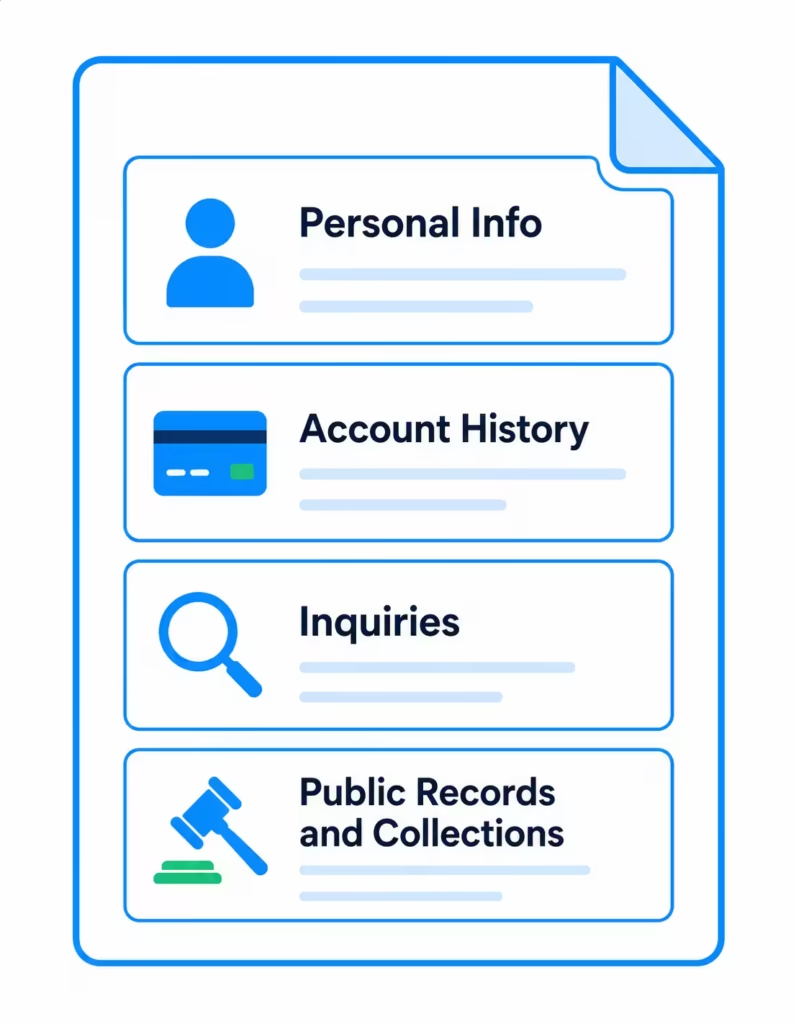
Personal info. Your name, current and past addresses, Social Security number, date of birth, and sometimes employers. This section doesn’t affect your score, but errors here can be a red flag for identity theft.
Account history. Every open and closed credit account: cards, car loans, student loans, mortgages, personal loans. Each entry shows the balance, credit limit, payment status, and a month-by-month record of on-time or late payments. This is the heart of your file.
Inquiries. A list of anyone who has pulled your report in the past two years. “Hard” inquiries (from actual loan or card applications) can nudge your score down for about a year. “Soft” inquiries (from you checking your own report, or from prescreened offers) don’t affect your score.
Public records and collections. Bankruptcies show up here for 7 to 10 years. Unpaid debts sold to collections agencies can also land here. Old tax liens and civil judgments were removed from credit reports back in 2017 and no longer show.
Read every account line carefully. A single misreported late payment can drop your score by 60 to 100 points.
How to Freeze Your Equifax Credit Report
A credit freeze (also called a security freeze) locks your Equifax file so new lenders can’t see it. If a thief tries to open a card in your name, the lender pulls a blank file and denies the application. It’s the single strongest free defense against new-account fraud.
Freezing is free by federal law. You have three ways to do it:
Online: Go to Equifax’s freeze page, create or sign into your myEquifax account, and click “Place a freeze.” Takes about 5 minutes.
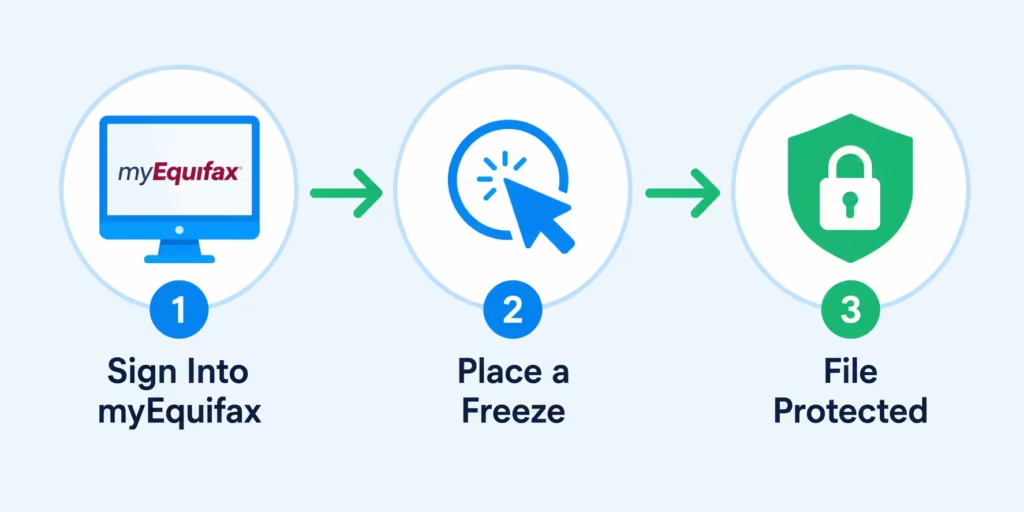
Phone: Call Equifax at 1-800-685-1111. You’ll need your Social Security number and address.
Mail: Send a written request with a copy of your ID, Social Security card, and a utility bill to Equifax Information Services LLC, P.O. Box 105788, Atlanta, GA 30348-5788.
Once frozen, your existing lenders can still see your file. Your score is untouched. You can still apply for jobs and rent apartments (those typically use different data). What stops is new credit checks from lenders you haven’t dealt with before.
Freezing Equifax alone isn’t enough. Do all three bureaus. A thief only needs one open file to do damage.
⚠️ Mistake to Avoid: Don’t confuse a credit freeze with a credit lock. A freeze is a free federal right under the FCRA. A “lock” is often a paid product that sounds similar but comes with fine-print terms. Choose the freeze.
How to Unfreeze or Lift an Equifax Freeze
When you’re ready to apply for a card, car loan, or mortgage, you’ll need to lift the freeze first. Otherwise, the lender’s credit check will bounce.
You can do a temporary lift (for a set number of days, or for one specific lender) or a permanent removal. Both are free. Both are fast when done online through your myEquifax account, usually active in about an hour.
Ask the lender which bureau they’ll pull. If they say Equifax, lift only Equifax and keep the other two frozen. That keeps your protection strong.
Equifax Fraud Alerts
A fraud alert is a middle-ground option. It doesn’t block access to your file. Instead, it tells lenders to take extra steps to verify your identity before opening credit.
There are three types:
- Initial fraud alert: Lasts one year. Free. Good if you lost a wallet or suspect something is off.
- Extended fraud alert: Lasts seven years. Free. Requires an identity theft report from the FTC.
- Active duty alert: Lasts one year. Free. For military members deployed away from home.
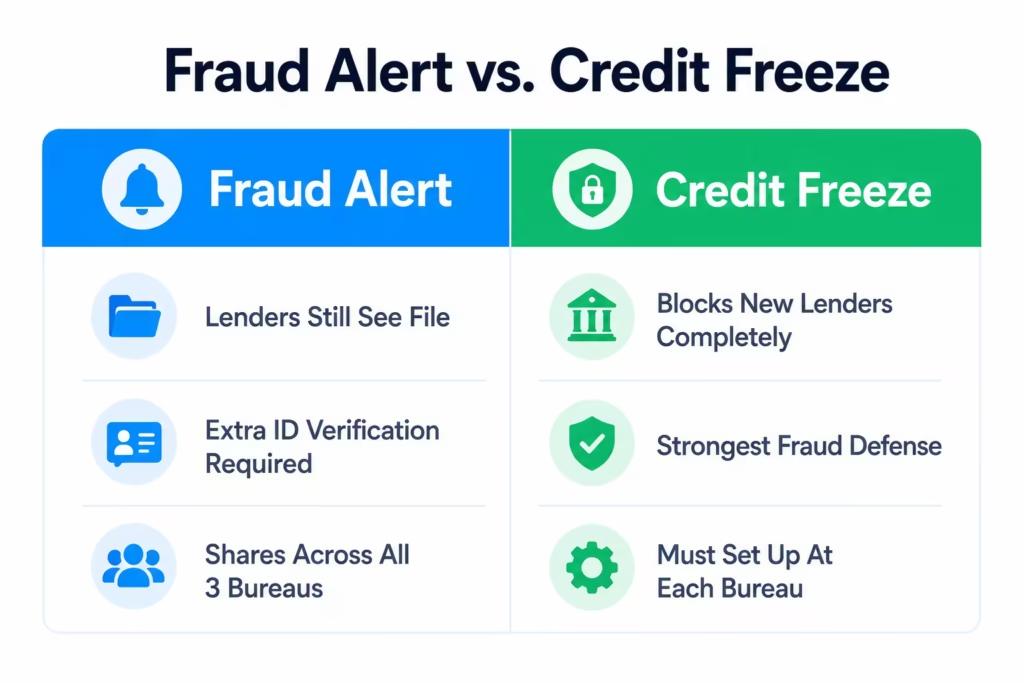
Place a fraud alert at one bureau, and it must, by law, share the alert with the other two. That’s a nice shortcut compared to freezes, which you must set up at each bureau separately.
How to Dispute an Error on Your Equifax Report
Spotting a wrong account, a missed payment that wasn’t missed, or a debt that isn’t yours? You have a clear right to fix it under the FCRA.
You have three ways to file a dispute with Equifax:
Online: The fastest option. Go to the Equifax dispute portal, sign in, pick the wrong item, upload proof (statements, receipts, letters), and submit.
Phone: Call 1-866-349-5191 and walk through the dispute with a rep. Good if you’re not sure how to describe the problem.
Mail: Send a written dispute with copies (not originals) of your proof to Equifax Information Services LLC, P.O. Box 740256, Atlanta, GA 30374. Certified mail with return receipt gives you a paper trail.
In your dispute, spell out which account is wrong, what the error is, and what the file should say. Attach proof: paid-off statements, cancellation letters, court documents, anything that backs your case. The stronger your evidence, the better your odds.
Equifax must then investigate. It contacts the lender (the “data furnisher”) that reported the item, asks them to verify, and updates your file based on what comes back. The FTC’s dispute guidance also recommends disputing directly with the lender at the same time. Two-front pressure works better than one.
If the item is fixed, Equifax must send you a free updated report. If it’s not fixed and you still disagree, you can add a 100-word “statement of dispute” to your file that future lenders will see.
How Long an Equifax Dispute Takes
By federal law, Equifax has 30 days to investigate most disputes and send you the results. If you add new proof during the investigation, that window can stretch to 45 days.
You’ll get the results in writing (or by email if you filed online). If the item was wrong, the fix usually shows on your report within a few days of the decision. If Equifax says the item is right and you disagree, you can dispute again with fresh proof, complain to the CFPB, or, in some cases, sue under the FCRA.
Is Equifax Legit and Safe to Use
Yes, Equifax is a real, federally regulated company. It’s a publicly traded firm on the New York Stock Exchange (ticker EFX).
It falls under the Fair Credit Reporting Act, and both the CFPB and FTC actively police how it handles your data. In 2022, the CFPB fined Equifax $15 million for improper dispute investigations, which shows the oversight is real.
That said, scam sites copy the Equifax name every day. Stick to these official URLs:
- equifax.com — main site
- my.equifax.com — your login and dashboard
- annualcreditreport.com — federally mandated free reports
Anything that says “free Equifax score” but asks for your credit card, sends you a random text, or emails a link you didn’t request is likely a scam. Type the URL by hand. Never click through from an unsolicited email.
Your data is safer than it was in 2017, but no company is bulletproof. Freezing your file is still the smartest move.
The 2017 Equifax Breach: Does It Still Matter Today?
In 2017, hackers stole personal data on about 147 million Americans from Equifax, including Social Security numbers, birth dates, and addresses. It was one of the biggest data breaches in U.S. history.
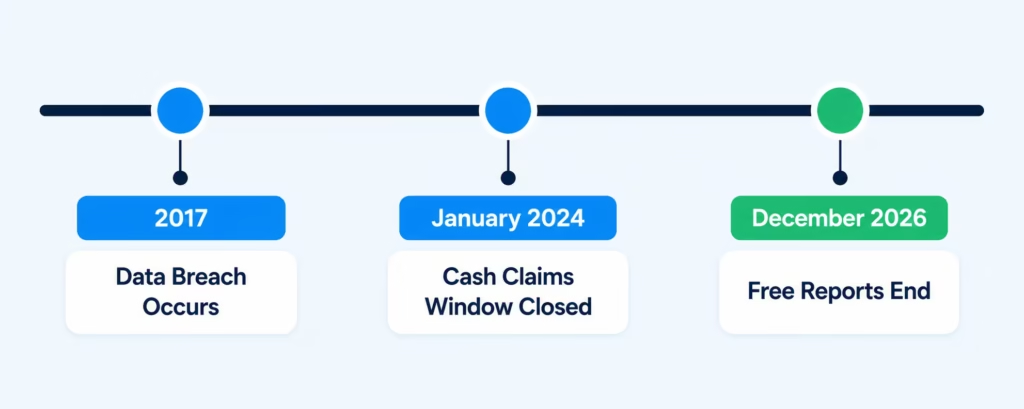
Here’s where it stands in 2026:
What’s expired: The main cash claim window closed years ago. The extended claims period ended on January 22, 2024, per the Equifax Breach Settlement site. You can no longer file for the $125 payout or reimbursement for time spent fixing fraud.
What’s still active: The settlement gave every U.S. adult access to six free Equifax credit reports per year through December 31, 2026, on top of the weekly free reports from annualcreditreport.com. Use them. That’s real value still sitting on the table.
What about your stolen data? Assume it’s still out there. Social Security numbers don’t change. Names and birth dates don’t change. The best long-term defense is a credit freeze at all three bureaus, plus checking your reports regularly. If you signed up for the free credit monitoring the settlement offered, keep it running until it expires.
The breach hurt Equifax’s reputation and drove a lot of the reforms and free-report expansions we now enjoy. Ironically, the event that exposed millions also provided them with better tools to protect themselves.
Frequently Asked Questions (FAQs)
Is Equifax a credit bureau?
Yes, Equifax is one of the three nationwide credit reporting agencies in the United States, alongside Experian and TransUnion. It has operated since 1899 and is regulated under the Fair Credit Reporting Act.
How can I contact Equifax?
Call 1-800-685-1111 to place a freeze, or 1-866-349-5191 to file a dispute. You can also manage your file online through my.equifax.com or by mail at the addresses Equifax provides for freezes and disputes.
How do I contact all three credit bureaus?
Equifax, Experian, and TransUnion each have separate contact channels since they keep separate files. Placing a fraud alert with one bureau is an exception: by law it must be shared with the other two automatically.
Is it safe to give Equifax your SSN?
Equifax is a federally regulated, publicly traded company (NYSE: EFX) that already holds your Social Security number as part of your credit file. It’s required for identity verification when freezing your file or filing a dispute through official channels like equifax.com or my.equifax.com.
What is the Equifax scandal?
In 2017, hackers stole personal data on about 147 million Americans from Equifax, including Social Security numbers, birth dates, and addresses. The cash claim window closed in January 2024, but free credit report access from the settlement runs through December 31, 2026.
Which 3 credit bureaus to freeze?
Freeze your file at Equifax, Experian, and TransUnion, since a thief only needs one open file to cause damage. Freezing is free by federal law and can be done online, by phone, or by mail at each bureau separately.
Can I unfreeze all three credit bureaus at once?
No, freezes must be lifted at each bureau individually since they don’t share files. If you know which bureau a lender will pull, lift only that one and keep the other two frozen for continued protection.
How do I unfreeze my credit instantly?
Log in to your myEquifax account and request a temporary lift for a set number of days or for one specific lender. Online lifts are usually active within about an hour, and both temporary and permanent removals are free.
Can someone use my SSN if my credit is frozen?
A freeze blocks new lenders from viewing your file, so most fraudsters can’t open new credit accounts in your name. It doesn’t protect existing accounts you already have open, which is a gap a freeze alone doesn’t cover.
How long does an Equifax dispute take?
Equifax has 30 days by law to investigate most disputes and report the results. That window extends to 45 days if you submit new evidence while the investigation is already underway.
The Bottom Line
Equifax is a data company, not a decision-maker. It gathers your credit history from lenders, sells that file to companies that need to check you, and hands you tools to see, freeze, and fix your own record.
To protect your FCRA rights, follow this simple plan:
- Freeze your file at all three bureaus.
- Check your Equifax report for free every few months.
- Dispute any errors immediately.
- Use the six bonus reports available until December 2026.
Doing this costs nothing and builds a strong shield around your credit.
If you know someone who just got a loan denial, a breach notice, or their first credit card, share this guide. It could save them hours of confusion and possibly hundreds of dollars in fraud damage.