
I know how stressful it feels to see a late payment from Affirm show up on your credit report. Maybe your autopay failed, you forgot a due date, or money got tight for a few weeks. Now that mark is dragging down your score, and you’re wondering if a well-written goodwill letter to Affirm can make it disappear.
Here’s the honest answer: Affirm has publicly said it will not remove accurate late payment information, even with a goodwill request, but you still have real options that can protect your credit.
We’ll guide you through Affirm’s actual policy, when to send a goodwill letter or a dispute, a useful template, and what to do if Affirm denies your request.
Key Takeaways
This guide explains how to write a goodwill letter to Affirm, covering Affirm’s actual removal policy, when to use a dispute instead, a full letter template, and the escalation steps to take if your request is denied.
Core Facts:
- Affirm states it cannot honor goodwill requests to delete accurate late payment or charge-off information, even if the loan has been paid off in full.
- Affirm began reporting payment data to Experian for loans opened on or after April 1, 2025, and to TransUnion for loans opened on or after May 1, 2025.
- A goodwill letter asks for removal of accurate information as a courtesy, while a dispute claims the reported information is inaccurate and is protected under the Fair Credit Reporting Act.
- Credit bureaus and lenders must investigate FCRA disputes, typically within 30 days, and must remove information that cannot be verified as accurate.
- Under the FCRA, a late payment can remain on a credit report for up to seven years from the date of first delinquency, and this clock does not restart when the loan is paid off.
- If Affirm denies a goodwill request, readers can file a complaint with the Consumer Financial Protection Bureau, which requires a written response, usually within 15 days.
Best for:
- Affirm borrowers who received a late payment mark on Experian or TransUnion and want to know their actual options.
- Readers who are unsure whether their situation calls for a goodwill request or a formal credit dispute.
- Anyone preparing to contact Affirm about a reporting issue and wanting a ready-to-use letter template.
Does Affirm Approve Goodwill Letters?
The short answer is no. Affirm’s own help center clearly states the company “cannot honor goodwill requests to delete accurate late payment or charge-off information, even if the loan has been paid off.” Affirm states that financial institutions must share complete and accurate credit history with the bureaus. So, removing true information as a goodwill gesture would violate that rule.
That’s a hard truth many readers don’t expect. Most goodwill letter guides online treat every lender the same. They tell you to write a nice letter, share your hardship story, and hope for a one-time courtesy removal. That advice can work with some credit card issuers. It does not work the same way with Affirm.
Still, there are three good reasons to keep reading. First, sending a written request creates a paper trail that can help later. Second, if any part of the reporting is wrong, you have a much stronger legal path called a dispute. Third, knowing the policy up front helps you spend your energy on steps that actually move your score.
How Affirm’s Credit Reporting Works
Affirm did not always report to the major credit bureaus. That changed in 2025. Affirm now shares payment plan details with Experian for loans from April 1, 2025, and with TransUnion for loans from May 1, 2025. This includes both positive and negative information. This includes Pay in 4 and longer monthly installment plans.
That means a missed Affirm payment can now show up on your credit file just like a missed credit card payment. Affirm reports things like your loan amount, your payment history, and whether you paid late. Because the reporting is new, some people are seeing their first-ever BNPL-related credit dings and are trying to figure out how to fix them.
The bureau Affirm reports to matters. If you check only one credit report and don’t see the late mark, check the other. Your Affirm loan may only appear on Experian, only on TransUnion, or on both, depending on when your plan started.
Goodwill Letter vs. Dispute: Which One Fits Your Situation
These two tools are not the same, and picking the wrong one wastes weeks of your time.
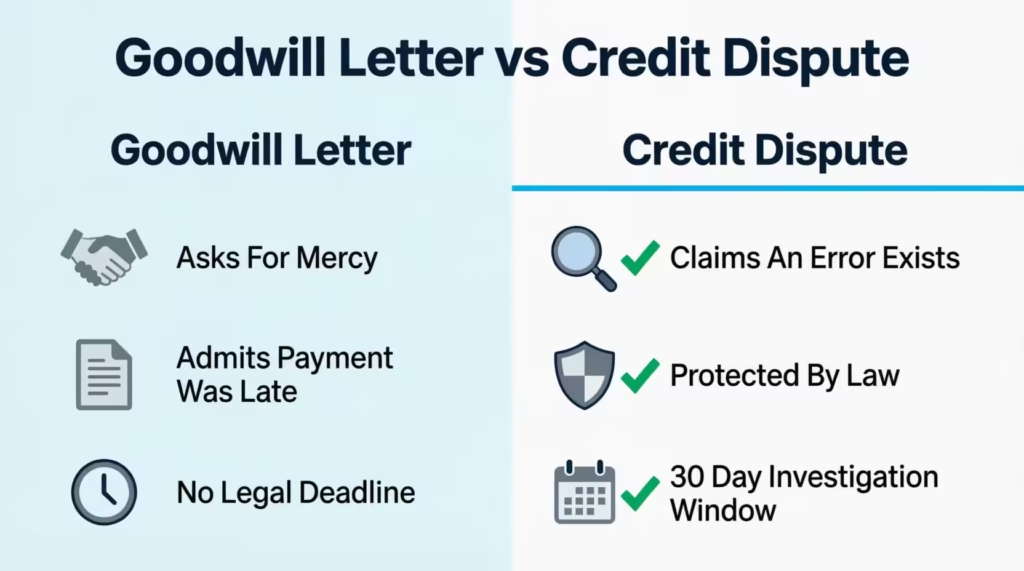
A goodwill letter is a polite request that asks a lender to remove accurate negative information as a one-time courtesy. You are not saying the late payment is wrong. You are saying, “Yes, it happened, here’s why, please consider removing it.” This is the type of letter Affirm does not honor.
A credit dispute is different. A dispute says, “This information on my credit report is not accurate, and I want it corrected or removed.” Disputes are protected by the Fair Credit Reporting Act (FCRA), a federal law. Lenders and credit bureaus must investigate disputes, usually within 30 days. If the lender cannot prove the item is accurate, it must be removed.
So the rule is simple. If the late payment is real and you just want mercy, that’s a goodwill case, and Affirm will likely say no. If any detail on the report is wrong (the date, the amount, the account status, or the account itself), that’s a dispute case, and you have real legal power.
💡 Pro Tip: Before you send anything, pull all three of your credit reports for free at AnnualCreditReport.com. Compare what Affirm reported against your own payment records. Small errors are common with new BNPL reporting, and finding one flips your case from a weak goodwill ask to a strong FCRA dispute.
Quick Checklist: Is This Actually a Reporting Error?
Run through this list before you decide. If you can say “yes” to any item, treat this as a dispute, not a goodwill request.
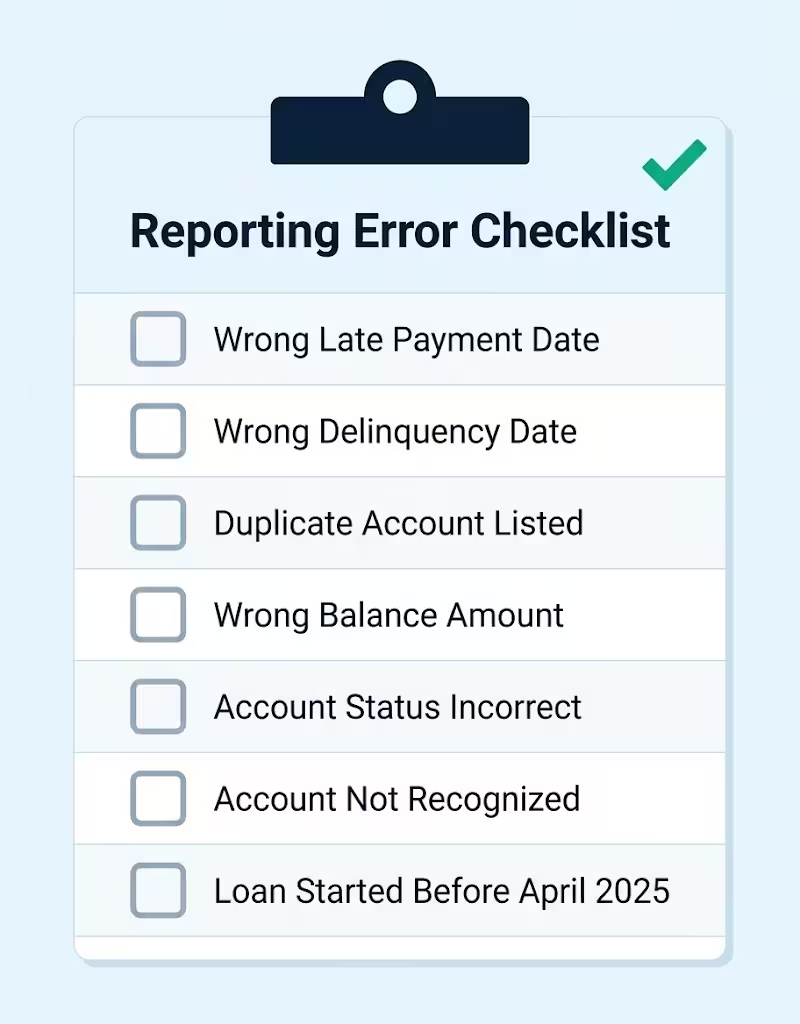
- The late payment date on your report does not match your actual missed payment date.
- The date of first delinquency is wrong or missing. This date sets the 7-year clock and matters a lot.
- Your Affirm loan shows up twice (a duplicate account).
- The balance or original loan amount is wrong.
- The account shows as open when it’s actually closed and paid off.
- You never had an Affirm loan, or the account was opened without your permission (possible fraud).
- The late payment is listed for a loan that started before April 1, 2025, which Affirm may not have been reporting.
If none of these apply, the late payment is likely accurate, and you’re in true goodwill territory.
How to Contact Affirm About Your Credit Report
Affirm does not publish a mailing address just for credit disputes or goodwill letters. Instead, they route all credit reporting questions through their Help Center. That’s the official path, and using it makes sure your request reaches the right team.
To start, log in at affirm.com or open the Affirm app. Go to the Help Center and search for “credit reporting.” You’ll see articles on disputes, goodwill requests, and reporting policy. At the bottom of those articles, there’s a “Contact us” option that lets you send a written message tied to your account.
You can also reach Affirm by phone at 1-855-423-3729. Phone calls are useful for quick questions, but for credit issues, always follow up in writing. A written record protects you if the case goes to a dispute later.
When you contact Affirm, have this ready:
- Your full name and the email tied to your Affirm account
- The last four digits of the loan or your Affirm order ID
- The date the loan was opened
- A short, clear summary of what you’re asking for
- Any supporting documents, like a bank statement showing an autopay failure or a doctor’s note for a medical hardship
Sending everything in one clean package speeds up their reply and shows you’re serious.
What to Include in an Affirm Goodwill Letter
Even though Affirm’s policy is strict, a well-built letter still matters. It creates a paper trail. It forces a human review. It gives you clear evidence if you escalate to the Consumer Financial Protection Bureau (CFPB) or file a formal dispute under the Fair Credit Reporting Act (FCRA).
A strong Affirm goodwill letter should be short, honest, and specific. Try to keep it under one page. Include these seven parts:
- Your account details. Your full name, address, phone number, email, last four digits of the loan or Affirm order ID, and the loan opening date.
- A clear statement of what you want. For example, “I’m asking Affirm to remove the late payment reported on [date] as a one-time courtesy.”
- A short, honest hardship reason. Skip long stories. One or two sentences work best. Common valid reasons include a job loss, a medical emergency, a bank account error, or a failed autopay.
- Proof of the hardship, if you have it. A hospital bill, a layoff notice, or a bank statement showing the failed transfer all help.
- Evidence of your on-time history. If this was your only late payment across all your Affirm loans, say so. Lenders react better to first-time slips.
- Confirmation that the loan is now current or paid off. Affirm is much less likely to help while a balance is still past due.
- A polite, professional close. Thank the reviewer for their time and ask for a written reply.
Avoid three big mistakes. Don’t blame Affirm for something that was your fault. Don’t threaten legal action in a goodwill letter (save that language for a real FCRA dispute). And don’t send a form letter you copied from Reddit. Reviewers spot those in seconds.
⚠️ Mistake to Avoid: Never admit to a late payment in a goodwill letter if you’re not 100% sure the report is accurate. If it turns out the reporting had an error, that written admission can weaken your future FCRA dispute.
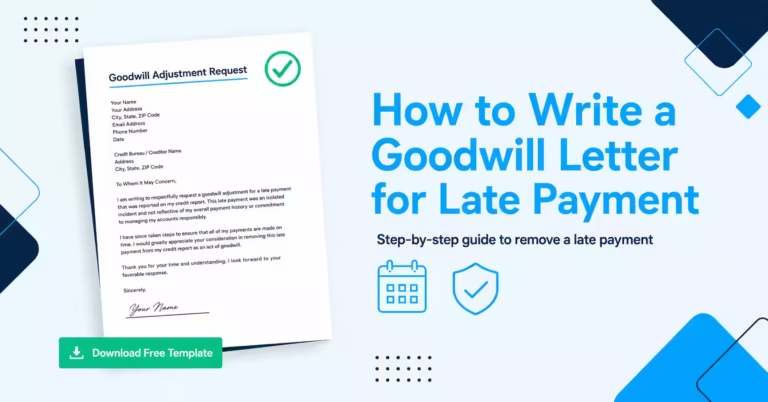
Affirm Goodwill Letter Template
Copy the template below and fill in the brackets. Keep the tone calm and respectful. This version is written for a Pay in 4 or monthly installment plan reported after April 1, 2025.
[Your Full Name] [Your Street Address] [City, State, ZIP] [Email Address] [Phone Number]
Date: [Today’s date]
To: Affirm Credit Reporting Team Submitted via: Affirm Help Center
Re: Goodwill Request for Account ending in [last 4 digits of loan ID]
Dear Affirm Credit Reporting Team,
I’m writing to ask for a goodwill review of a late payment reported on my Affirm account ending in [last 4 digits]. The loan was opened on [loan open date] for a purchase of [$ amount].
I understand Affirm’s policy on accurate reporting, and I’m not disputing that the payment was late. On [date of missed payment], I missed the due date because [brief, honest reason, for example: “my linked bank account was closed and my autopay failed before I could update the new account”]. I fixed the issue as soon as I saw it and brought the account current on [date paid].
Aside from this one time, my payment history with Affirm has been on time. The loan is now [paid in full/current and on autopay]. I’ve attached [bank statement / medical bill / other proof] to support the reason above.
I’m asking, as a one-time courtesy, that Affirm consider removing the late payment mark from my Experian and TransUnion credit reports. This mark is affecting my ability to [buy a car / rent an apartment / refinance a loan], and a clean history would help me move forward.
I understand Affirm may not be able to honor this request. If that’s the case, I’d appreciate a written reply explaining the decision, so I have a full record for my files.
Thank you for taking the time to review my account.
Sincerely,
[Your Full Name] [Signature if mailing a printed copy]
Feel free to shorten this if your situation is simple. The template is a starting point, not a script. The more your letter sounds like you, the better.
How to Send Your Letter
Affirm’s Help Center is the main channel. Log in to your account, open the credit reporting article, and use the “Contact us” form at the bottom. Paste your letter into the message field and attach any proof as an image or PDF files.
Save a copy of everything you send. Take a screenshot of the confirmation page. Save the reference number Affirm gives you. Set a calendar reminder for 30 days out to check for a reply. If you don’t hear back in 30 days, follow up once through the same channel. After that, it’s time to move to the next step in this guide.
If you prefer a mailed paper trail, you can send a printed copy to Affirm’s address: Affirm, Inc., 650 California Street, San Francisco, CA 94108. Use certified mail with a return receipt. This costs a few dollars but gives you legal proof of delivery.
What Happens After You Send the Letter
Set your expectations low so you’re not crushed by the reply. Based on Affirm’s stated policy, most goodwill requests for accurate late payments come back as a denial.
Here’s the typical timeline. Within a few days, you’ll get an auto-reply confirming Affirm received your message. Within 15 to 30 days, a human reviewer will send a written response. The response usually restates the policy, thanks you for reaching out, and confirms the late payment will stay on your report.
Once in a while, Affirm’s team may agree to review the accuracy of the reporting, especially if your letter clearly points to something that could be wrong. If they find an error, they’ll correct it with the bureaus. That correction can take another 30 to 45 days to show up on your Experian or TransUnion report.
If your response is a full denial, don’t panic. A denial isn’t the end. It’s the trigger for the next set of steps below.
If Affirm Denies Your Goodwill Request
A “no” from Affirm doesn’t mean you’re stuck. You still have three strong plays.
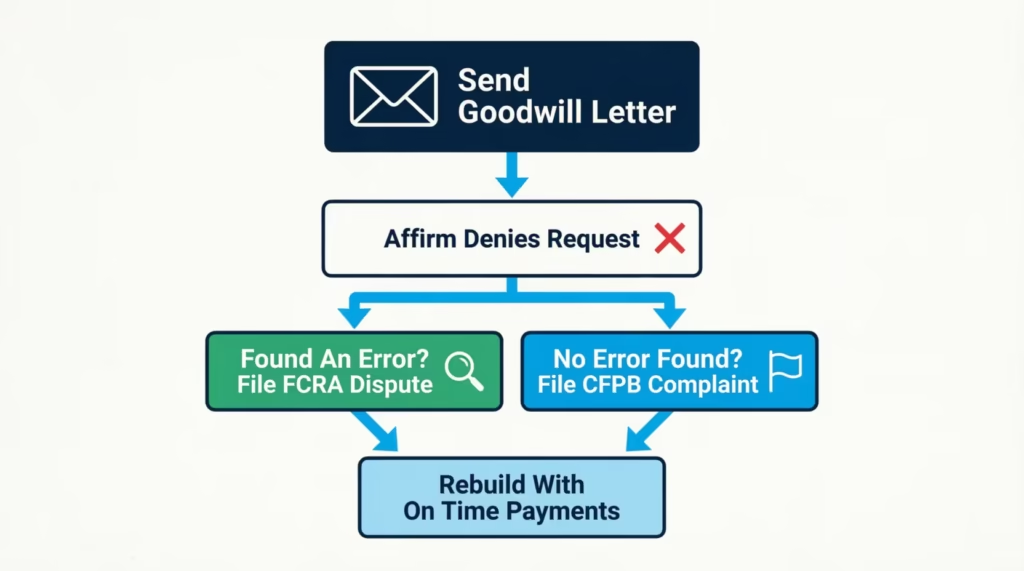
First, escalate through official channels
File a complaint with the Consumer Financial Protection Bureau. The CFPB forwards your complaint to Affirm and requires a written reply, usually within 15 days. Companies take CFPB complaints seriously because the agency tracks patterns and can open investigations. This works best when you have a clear, fact-based concern (not just “please be nice to me”).
Second, shift to an FCRA dispute if you spot any error
Even a small one. Wrong date, wrong balance, duplicate entry, wrong status. File the dispute directly with Experian and TransUnion online. The bureaus are required by federal law to investigate within 30 days, and if Affirm can’t fully verify every detail, the mark comes off. This is the single most effective way to remove BNPL late payments.
Third, focus on rebuilding
A single late payment hurts less over time. Pay every bill on time from now on. Keep your credit card balances below 30% of your limits (below 10% is even better). Don’t apply for new credit unless you need it. Within 6 to 12 months of clean behavior, your score will start climbing back even with the late mark still on your report.
📌 Did You Know: The impact of a late payment fades over time. FICO’s scoring model weighs negative items less as they age. So, a late payment from 18 months ago impacts your score less than one from last month, even if both are on the report.
Checking for Legitimate Reporting Errors and Filing a Dispute
This is often the highest value step in the whole process, and most guides skip it.
Start by pulling your Experian and TransUnion reports at AnnualCreditReport.com. Federal law lets you pull each report for free every week. Look at the Affirm tradeline line by line.
Check these seven items carefully:
- Is your name and address correct on the Affirm account?
- Does the loan open date match the day you actually signed up?
- Does the original loan amount match your purchase?
- Is the payment history grid correct month by month?
- Is the date of first delinquency listed and accurate? This date starts the 7-year reporting clock under the FCRA Federal Trade Commission.
- Is the current balance correct?
- Is the account status right (open, closed, paid, charged off)?
If anything is off, file a dispute. You have two paths, and it’s smart to use both.
Path 1: Dispute with the credit bureau. Go to Experian’s dispute center or TransUnion’s dispute center. Upload your evidence. The bureau contacts Affirm on your behalf and must complete the investigation within 30 days.
Path 2: Dispute directly with Affirm. Use the Help Center’s credit reporting dispute form. Affirm’s own policy says that if you have new evidence, they can review and update the reporting. This creates a direct paper trail with the furnisher.
Doing both at once increases your odds. If Affirm can’t fully prove every reported detail during the bureau investigation, the tradeline must be corrected or removed under FCRA rules.
How Long an Affirm Late Payment Affects Your Credit
Under the FCRA, a late payment can stay on your credit report for up to seven years from the date of first delinquency. The 7-year clock does not restart when you pay off the loan. It only counts from the first missed payment that was never brought current.
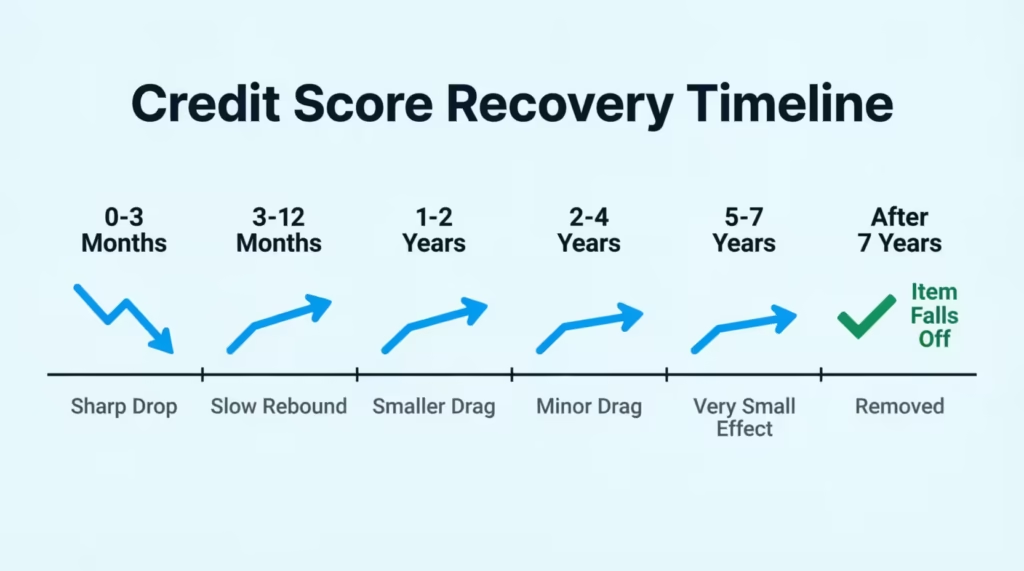
The good news is the score damage does not last seven full years. Most people see the biggest drop in the first 3 to 6 months. After that, the impact fades. Here’s a rough sense of how it plays out for a single Affirm late payment:
| Time since late payment | Typical score impact | What helps most |
|---|---|---|
| 0 to 3 months | Sharp drop, often 60 to 110 points | Bring the account current fast, keep other bills on time |
| 3 to 12 months | Slow rebound as the item ages | On time payments, low credit card use |
| 1 to 2 years | Much smaller drag | Add positive tradelines, keep utilization low |
| 2 to 4 years | Minor drag on most scores | Age of accounts and mix start helping again |
| 5 to 7 years | Very small effect | Item is close to falling off |
| After 7 years | Removed under FCRA | The tradeline drops off automatically |
Two things speed up the recovery. Keep your credit card utilization under 10% of your total limits. Utilization updates monthly, so it’s the fastest lever you have. And add positive on-time payments. Every clean month builds a new layer of trust over the old late mark.
If you’re 4 or 5 years past the late payment and it’s still showing, check the reporting date closely. Some furnishers get the dates wrong, and an incorrect date can keep an item on your report longer than it should be. That’s another spot where a targeted FCRA dispute can win fast.
Frequently Asked Questions (FAQs)
Does Affirm approve goodwill letters for late payments?
No. Affirm’s help center states it cannot delete accurate late payment or charge-off information, even after the loan is paid off, since lenders must report complete and accurate credit history.
How do I send a goodwill letter to Affirm?
Log into affirm.com or the app, open the Help Center’s credit reporting article, and use the “Contact us” form to submit your letter. You can also mail a printed copy to Affirm, Inc., 650 California Street, San Francisco, CA 94108.
What is a good reason to give in a late payment goodwill letter?
Keep it short and honest, one or two sentences. Common valid reasons include a job loss, a medical emergency, a bank error, or a failed autopay after switching accounts.
How long does a goodwill letter take to process?
You’ll typically get an auto-reply within a few days, then a written decision from a human reviewer within 15 to 30 days. If Affirm agrees to correct anything, it can take another 30 to 45 days to show up on your report.
How can I legally remove late payments if a goodwill letter doesn’t work?
File a dispute under the Fair Credit Reporting Act if any detail is inaccurate, such as the wrong date, balance, or a duplicate entry. Bureaus must investigate within 30 days, and unverified items get removed.
How do I ask for late fee removal from Affirm?
Affirm doesn’t offer late fee waivers through goodwill requests since it only reports accurate information as required by law. Your best options are disputing genuine reporting errors or filing a CFPB complaint if evidence is overlooked.
What should I do if Affirm denies my goodwill request?
File a complaint with the Consumer Financial Protection Bureau, which requires Affirm to respond in writing within 15 days. You can also shift to an FCRA dispute with Experian or TransUnion if you spot any inaccurate detail.
How long does an Affirm late payment stay on my credit report?
Up to seven years from the date of first delinquency, per the FCRA. The clock doesn’t restart when you pay off the loan, and score damage typically fades most within the first 3 to 6 months.
Does Affirm report to both Experian and TransUnion?
Affirm reports to Experian for loans starting April 1, 2025, and to TransUnion for loans starting May 1, 2025. Your loan may appear on one bureau, both, or neither depending on when it started.
What’s the difference between a goodwill letter and a credit dispute?
A goodwill letter asks a lender to remove accurate negative information as a courtesy, which Affirm won’t do. A dispute claims the information itself is wrong and is protected by the FCRA, requiring the lender to prove accuracy or remove it within 30 days.
Wrapping Up
Affirm’s official position makes clear that a goodwill letter to Affirm is unlikely to remove an accurate late payment, but that doesn’t leave you without options.
The best way to start is with a clear and honest goodwill request. If you find any mistakes on your credit file, quickly shift to an FCRA dispute. If Affirm overlooks solid evidence, file a CFPB complaint.
Meanwhile, on-time payments and low card balances will steadily lift your score.
If you know someone who’s been hit with a surprise BNPL late payment, share this guide; it could save them months of guessing.