
You see the word “miles” everywhere in credit card ads. It sits right next to “points” and “cash back,” and nobody explains the difference. If you have ever asked what credit card miles are and how they work, you are asking the right question before you apply.
Here is the short answer. Credit card miles are a reward currency. You earn them by spending on a card, and you redeem them later, usually for travel. They have nothing to do with how far you fly.
Below, you will learn how miles work and what they are worth. You will also see how to earn and redeem them well, and which mistakes quietly cost you value.
At a Glance
This guide explains what credit card miles are and how they work, including how they differ from points and cash back, how to calculate their real dollar value, and why devaluation makes hoarding them risky.
Core Facts:
- Credit card miles are a reward currency earned through spending and redeemed for value such as flights, gift cards, or statement credit, with no direct tie to distance flown.
- A mile’s value is calculated by dividing the cash price of a booking by the number of miles required, and most programs land around 1 to 2 cents per mile on standard travel redemptions.
- Co-branded cards earn miles into a single airline program, while flexible currencies from issuers like American Express, Chase, and Capital One can transfer to multiple airline or hotel partners, often at a 1:1 ratio.
- Transfer ratios can weaken over time, as shown when Capital One’s transfer rate to Emirates Skywards changed from 1:1 to 4:3 as of January 2026.
- Most major U.S. airline programs now use dynamic pricing, meaning the miles needed for the same seat can shift daily, such as ranging from 18,000 to 55,000 miles around a holiday.
- Miles expiration policies vary by program: Capital One miles do not expire for the life of the account, United MileagePlus miles never expire, and American AAdvantage miles can expire after 24 months without qualifying activity.
Best for:
- Readers deciding whether a travel rewards card fits their spending and travel habits before applying.
- Cardholders who already hold miles and want to calculate whether a specific redemption is a good use of their balance.
- Anyone choosing between an airline-specific card and a flexible transferable rewards card.
What Are Credit Card Miles?
Credit card miles are a type of reward. You earn them each time you pay with the card. They are not cash, and they are not tied to distance flown. A “mile” here is just a name for one unit of a rewards program.
The name comes from airline frequent flyer programs. Airlines created those programs in the early 1980s to reward repeat travelers. Back then, you earned miles based on how far you flew. Card issuers later borrowed the word because it made their rewards sound travel-friendly.
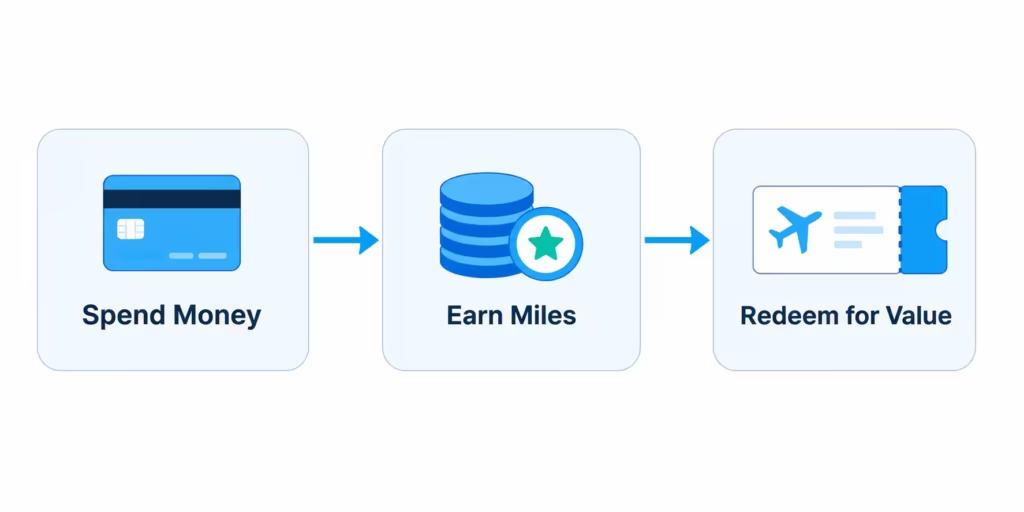
The basic system has three steps:
- You spend money on the card.
- The issuer adds miles to your rewards balance.
- You trade those miles for value, such as a flight or a statement credit.
Think of miles as store credit with a travel theme. The issuer sets the rules for earning and redeeming. That is why two cards that both promise “miles” can work very differently.
Miles vs. Points vs. Cash Back: What’s the Real Difference
These three reward types look similar on the surface. The differences matter when you compare offers.
Cash back is the simplest type. Each reward has a fixed dollar value. Earn 2% cash back on a $100 purchase, and you get $2. No math required.
Points are a flexible currency, usually run by the card issuer. Programs like Chase Ultimate Rewards and American Express Membership Rewards let you redeem points for travel, gift cards, cash back, or transfers to airline partners.
Miles are a travel-weighted currency. The name comes from airlines, and the redemption options usually favor flights. On many general travel cards, though, “miles” and “points” now mean the same thing. Capital One calls its rewards “miles,” but you can redeem them much like bank points.
| Reward type | Typical value | Flexibility | Best fit |
|---|---|---|---|
| Cash back | Fixed dollar value | Use it for anything | Simplicity |
| Points | Varies by redemption | Many redemption options | Flexible travel |
| Miles | Varies by redemption | Travel focused | Frequent flyers |
The practical takeaway: ignore the label. Before you apply, check what the rewards can actually buy and what each unit is worth. A card offering “60,000 miles” and one offering “60,000 points” may be worth very different amounts.
Co-Branded Airline Miles vs. Flexible Transferable Miles
This is the split that decides how locked in your rewards are.
Co-branded cards earn miles straight into one airline’s program. A Delta-branded card earns Delta SkyMiles. A United-branded card earns MileagePlus miles. An American Airlines card earns AAdvantage miles. You can only use them inside that program and its partners.
Flexible currencies work differently. Cards from American Express, Chase, and Capital One earn rewards into the bank’s own program. Later, you can move those rewards to several airline or hotel partners. Capital One, for example, lists more than a dozen transfer partners for its miles.

The trade-off is simple. Co-branded cards often add airline-specific perks, like free checked bags or priority boarding. Flexible currencies give you more ways to redeem, but they take more research to use well. Know which type you are holding before you build a strategy around it.
How You Actually Earn Credit Card Miles
Most people know that spending earns rewards. Fewer people know the three levers that matter most.
Everyday Spending and Bonus Categories
Every miles card has a base earn rate. A common base is 1 mile per dollar spent. Many cards then pay more in bonus categories like travel, dining, or groceries. A card might pay 3 miles per dollar on dining and 1 mile per dollar on everything else.
Two details trip people up. First, issuers define which purchases count as “eligible.” A restaurant counter inside a grocery store may code as groceries, not dining. Second, some cards rotate bonus categories each quarter, while others keep fixed categories all year. Check a card’s structure before you assume it fits your spending.
Sign-Up and Welcome Bonuses
A welcome offer is usually the biggest single source of miles. The typical structure is simple. Spend a set amount in the first few months, then earn a large bonus. A card might offer 60,000 bonus miles after you spend $3,000 in three months.
That one bonus can equal years of regular earning. Spend $15,000 a year at 2 miles per dollar, and you earn 30,000 miles. One welcome offer can beat that by double.
The catch is the minimum spend. Never buy things you don’t need just to hit a bonus. Interest on extra spending can cost more than the miles are worth. Time a new card around spending you already planned, like insurance bills or holiday shopping.
⚠️ Mistake to Avoid: Applying for a card with a minimum spend you can’t reach through normal purchases. A bonus you can’t earn safely is worth nothing.
Transfer Partners
Transfer partners let you move flexible bank rewards into an airline program. Many transfers happen at a 1:1 ratio, so 1,000 bank points become 1,000 airline miles. Not every partner works that way. Some ratios are weaker, and they can change over time.
Capital One’s move with Emirates is a real example. Transfers to Emirates Skywards used to be 1:1. As of January 2026, Capital One miles transfer to Emirates at a 4:3 ratio, so 400 miles become 300 Skywards miles. Your balance did not change, but its buying power on that route dropped.
Protect yourself with one rule: only transfer when you have a specific award seat confirmed. Transfers are one way. Once your points become airline miles, you cannot move them back.
How Much Is a Mile Actually Worth?
A mile has no fixed price. Its value depends on how you redeem it. The formula is easy:
Cash price of the booking ÷ miles required = value per mile, in cents
Most programs land around 1 to 2 cents per mile on standard travel redemptions. Premium cabin flights booked through transfer partners can go higher. Treat published “average” valuations as estimates, not promises. Under dynamic pricing, the same seat can cost a different number of miles each day, so your actual rate changes with every booking.
Worked Example: Calculating Your Redemption Value
Say a round-trip flight costs $420 in cash, or 30,000 miles plus $11.20 in taxes and fees.
Subtract the fees first, since miles don’t cover them: $420 minus $11.20 leaves $408.80. Then divide: $408.80 ÷ 30,000 = about 1.36 cents per mile.
Now compare a gift card. Imagine the same program offers a $150 gift card for 30,000 miles. The math: $150 ÷ 30,000 = 0.5 cents per mile.
Same balance, very different outcome. The flight redemption returns close to triple the value of the gift card. Run this quick check before any redemption. If a flight redemption returns under 1 cent per mile, paying cash and saving the miles is often the better move.
💡 Pro Tip: When a program shows both the cash price and the miles price, do this ten second calculation. It turns a vague “deal” into a number you can judge.
Why Mile Values Keep Changing: Dynamic Pricing and Devaluation
Older advice treated miles like a stable currency, worth about a penny each. That picture is out of date.
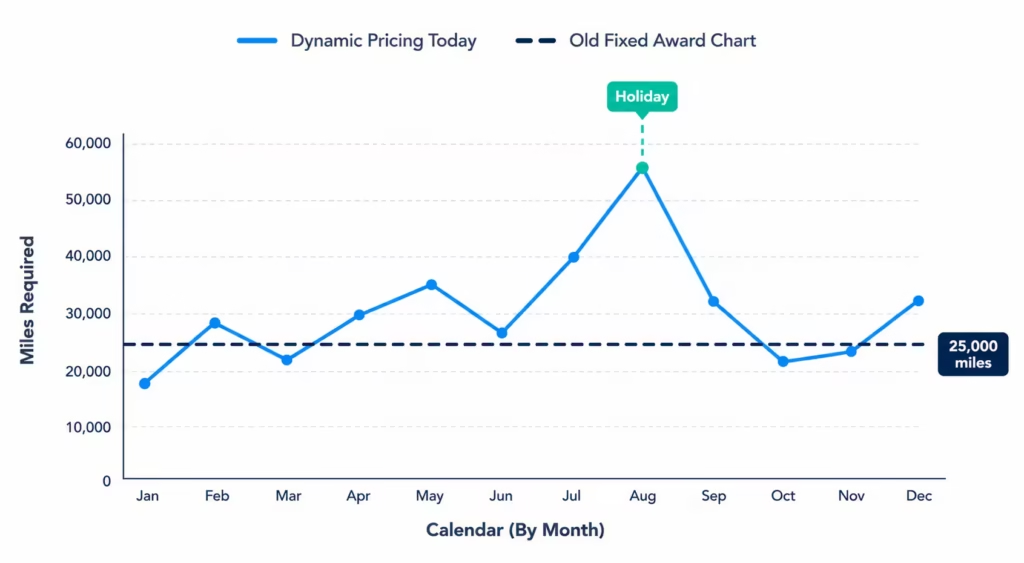
Most major US airline programs now use dynamic pricing. The miles needed for a seat rise and fall with demand and the cash fare, instead of following a fixed award chart. Delta, for instance, stopped publishing an award chart years ago, and its award prices shift with route, demand, and timing.
Under a fixed award chart, a domestic economy seat might have cost 25,000 miles on any date. Under dynamic pricing, that same seat might cost 18,000 miles on a quiet Tuesday and 55,000 around a holiday.
Why the shift? Airlines sell huge volumes of miles to card issuers, and loyalty programs have become major profit centers. More miles in circulation means programs face pressure to control redemption costs.
Pricing awards like cash tickets gives them that control. Consumer complaints about losing value to devaluation led the Consumer Financial Protection Bureau to review these practices. A later CFPB circular warned that devaluing earned rewards can violate the law. That applies when the change conflicts with how the program was marketed.
What Triggers a Devaluation
A devaluation is any change that makes your miles buy less. Three forms are common:
- Award price increases: the program raises the miles needed for seats, sometimes with notice, sometimes without.
- Transfer ratio changes: a bank program weakens the rate to a partner, like the Capital One to Emirates shift described above.
- Silent dynamic creep: prices drift up day by day under dynamic pricing, with no announcement at all. You only notice when the trip you saved for costs more miles than it did last year.
Why Holding Miles Too Long Can Cost You
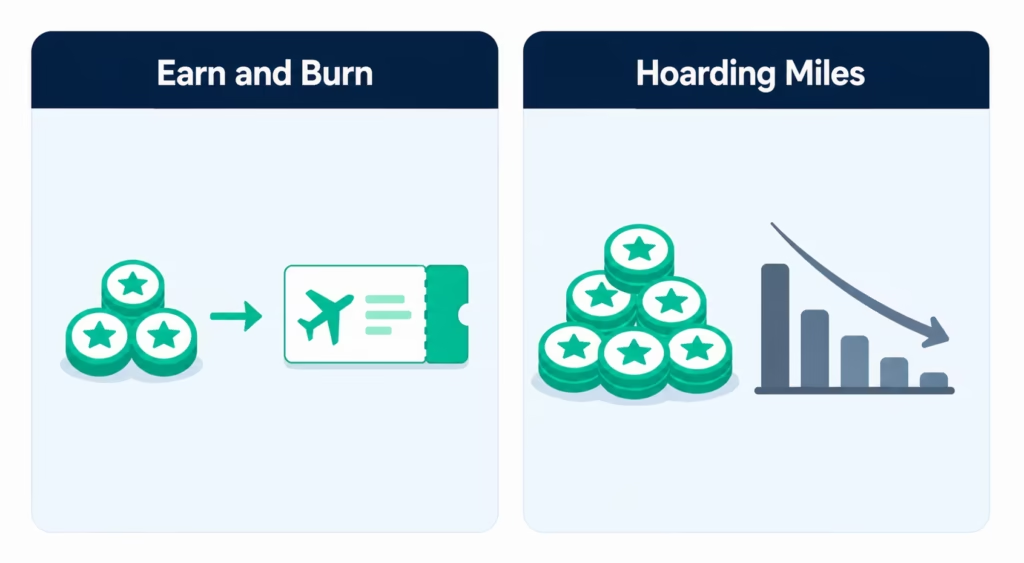
Miles behave like a depreciating asset, not a savings account. A balance you sit on for years tends to buy less over time. A flight that cost 50,000 miles a few years ago may cost far more today.
The practical approach is often called “earn and burn.” Earn miles toward a real, planned trip. Book it. Then earn again. This does not mean spending miles carelessly. It means matching earning to plans you would make anyway.
Flexible currencies soften this risk. If one airline devalues its program, transferable points let you pivot to another partner. Miles locked in a single airline program give you no exit.
Diversification acts as your primary defence against these hidden losses. Keep your points in bank programmes rather than transferring them to a specific airline too early.
This keeps your options open until the moment you are ready to book. Once you have a firm travel date in mind, move only the amount required to secure that seat. By staying flexible, you prevent your hard-earned rewards from being tied to a single, declining programme.
How to Redeem Miles for the Best Value
Redemption options vary by program, but typical value runs in this order:
| Redemption type | Typical value per mile | Notes |
|---|---|---|
| Transfer to a partner for a specific award | Highest potential, often 1.5 cents or more | Takes research; confirm seats first |
| Book award travel through the airline | Often 1 to 2 cents | Best for planned trips |
| Issuer travel portal | Usually a fixed rate, around 1 to 1.5 cents | Simple; rates vary by issuer and card |
| Cash back or statement credit | Often 0.5 to 1 cent | Simple and safe, lower return |
| Gift cards or merchandise | Often under 1 cent | Usually the weakest option |
These are typical ranges, not guarantees. Each program sets its own rates, and they can change.
Keep in mind that “highest value” is not always “best.” Want zero hassle? A statement credit at a lower rate may fit your life better than hunting for award space. The right choice is the one you will actually use.
Redemption Mistakes That Quietly Waste Value
- Redeeming for merchandise or gift cards. These options often return under 1 cent per mile, a fraction of what travel can deliver.
- Skipping the comparison. Always check the cash price before you book with miles. A “cheap” award can still be a poor rate if the cash fare is low.
- Transferring too early. Points moved to an airline are stuck there. Confirm award availability first, then transfer.
- Ignoring minimum increments. Some programs redeem in set blocks, like steps of 2,500 miles. A small balance can get stranded below the threshold.
Do Credit Card Miles Expire?
It depends on where the miles live.
Bank-run programs are usually generous. Capital One says its miles don’t expire for the life of the account. Chase points behave similarly while your card account stays open. Close the account, though, and you can lose the balance. Some issuers let you redeem or transfer first, but policies vary. Redeem or move your rewards before closing any card.
Airline programs set their own rules, and card activity may not count. United announced in 2019 that MileagePlus miles never expire. American takes a different approach: AAdvantage miles can expire after 24 months without qualifying activity, though earning or redeeming any miles resets the clock.
One more wrinkle: miles already earned into an airline program from a co-branded card live in your airline account, not your card account. Closing the card usually does not delete them. The airline’s own expiration policy then applies.
To check your situation, log in to your rewards account and look for expiration language in the program terms. A two-minute check can protect a balance worth hundreds of dollars.
Do the Annual Fee and Interest Cancel Out the Value?
Rewards only have value when the costs stay below them. Two costs matter most.
The annual fee. Do the math in dollars. Say your card charges $95 a year, and you spend $15,000 a year at 2 miles per dollar. You earn 30,000 miles. At roughly 1.3 cents each, that is about $390 in value. Subtract the fee, and you are ahead by around $295. If you spend far less, the fee can eat most of the benefit, and a no annual fee card may serve you better.
Interest. This one is not close. The average interest rate on credit card accounts at commercial banks was 20.94% in May 2026, based on Federal Reserve data. Carry a $5,000 balance at a rate like that, and you pay roughly $1,000 or more in interest over a year. No earning rate comes close to offsetting that.
The framework is simple. Rewards cards make sense only if you pay the statement in full each month. If you often carry a balance, a lower interest card beats a miles card almost every time.
Who a Miles Credit Card Actually Makes Sense For
A miles card tends to fit you if:
- You travel at least a couple of times a year.
- You can pay your balance in full each month.
- You are willing to learn one program’s redemption rules.
It is usually a poor fit if:
- You rarely travel, so cash back would serve you better.
- You want set it and forget it simplicity.
- You sometimes carry a balance, since interest wipes out rewards.
Choosing Between an Airline-Specific Card and a Flexible-Currency Card
Once you decide miles fit your life, one question remains: locked or flexible?
Pick an airline-specific card if you fly one carrier often and value perks like free checked bags or priority boarding. The miles stack onto loyalty you already have.
Pick a flexible currency card if your plans change, you fly multiple airlines, or you just want options. Your rewards stay portable across partners. Many seasoned cardholders carry two types of cards: a co-branded card for their main airline’s benefits and a flexible card for other purchases.
Common Misconceptions About Credit Card Miles
- Myth 1: An empty seat means award space. Reality: airlines set aside a limited pool of seats bookable with miles. A flight can have many empty seats for cash and none for miles.
- Myth 2: booking early always gets the best mileage price. Reality: under dynamic pricing, award prices fluctuate like cash fares. Booking early can help, but there is no guaranteed cheap tier to secure.
- Myth 3: a high cash fare always means a high mileage price. Reality: the two are loosely connected, and the correlation varies by programme. Sometimes an expensive cash ticket costs surprisingly low in miles. That is where outsized value is found.
- Myth 4: all miles are worth about the same. Reality: value differs by programme and redemption. One programme’s mile might yield half a cent on a gift card and 2 cents on the right flight.
The best strategy is to focus on your specific travel goals. Do not hoard miles for too long because airline programmes change their rules often. Instead, earn enough to reach a target reward and book it quickly.
Keep your points account active to prevent them from expiring. Smart travellers check redemption rates before they commit to an airline programme. By doing this research, you ensure your miles provide the most value for your next trip.
Frequently Asked Questions (FAQs)
What is 1 credit card mile worth?
Most miles are worth 1 to 2 cents each on standard travel redemptions, though the exact rate depends on the program and how you redeem. A $420 flight booked for 30,000 miles plus $11.20 in fees works out to about 1.36 cents per mile.
How much is 20,000 credit card miles worth?
At a typical range of 1 to 2 cents per mile, 20,000 miles is worth roughly $200 to $400 in travel value. The actual amount depends on the program and whether you redeem for flights, gift cards, or statement credit.
How much is 50,000 miles worth?
At 1 to 2 cents per mile, 50,000 miles typically converts to $500 to $1,000 in travel redemptions. Gift card or merchandise redemptions usually fall under 1 cent per mile, so the same balance would be worth less.
How much is 100,000 miles worth in dollars?
Valued at 1 to 2 cents per mile, 100,000 miles generally works out to $1,000 to $2,000 in travel value. Premium cabin redemptions through transfer partners can sometimes push this higher.
Is it better to have points or miles?
Neither is universally better since the difference comes down to flexibility, not the label. Points, like Chase Ultimate Rewards, typically offer more redemption options, including cash back and gift cards, while miles are travel-weighted and often best for frequent flyers.
How do I use my credit card miles?
You can redeem miles for award flights through the airline, book travel via the issuer’s portal, transfer them to airline or hotel partners, or use them for cash back, statement credit, or gift cards. Transferring to a partner for a confirmed award seat typically returns the highest value, often 1.5 cents or more per mile.
Do credit card miles expire?
It depends on where the miles are held. Capital One miles don’t expire for the life of the account, and United MileagePlus miles never expire, but American Airlines AAdvantage miles can expire after 24 months of inactivity.
Do I lose my miles if I cancel my credit card?
Closing a bank-issued card, like Chase or Capital One, can forfeit your miles balance unless you redeem or transfer first. Miles already transferred into an airline program, such as from a co-branded card, stay in your airline account and follow that airline’s own rules.
Are credit card miles actually worth it?
They’re worth it mainly if you pay your statement in full each month and travel at least a couple of times a year. Carrying a balance erases the value fast: a $5,000 balance at a 20.94% interest rate costs roughly $1,000 a year, far more than any earning rate offsets.
How does dynamic pricing affect what my miles are worth?
Most major U.S. airline programs now price award seats like cash fares, so the miles needed for the same seat can change daily based on demand. A domestic economy seat might cost 18,000 miles on a quiet Tuesday and 55,000 around a holiday, instead of a fixed rate under an older award chart.
The Bottom Line
Credit card miles are a travel-themed reward currency. You earn them from spending, welcome bonuses, and transfers. You then redeem them at rates that vary widely. Value sits highest in travel redemptions. It fades if you hoard a balance through devaluations or let a program’s rules catch you off guard.
A practical approach is simple. Match the card type to your travel habits, pay in full each month, and redeem for trips you actually plan to take.
Know someone staring at a big sign-up bonus and wondering what it’s really worth? Share this guide so they can judge the real value before they apply.