
A “0% intro APR” offer sounds almost too good to trust, and sometimes it is. You might be wondering what a promotional APR actually means, whether the offer you saw is safe to use, or why your statement shows two different rates on the same card. That confusion is normal, because card offers don’t always explain themselves clearly.
Here’s the short answer: a promotional APR is a temporary interest rate, often 0%, that applies for a set period, after which your card’s regular rate kicks in.
Below, you’ll find how these offers work, what can end them early, and the key difference between 0% APR and deferred interest. You’ll also find a simple payoff plan to use before your promo period ends.
Key Takeaways
This guide explains how a promotional APR works, including the difference between true 0% APR and deferred interest, what ends a promo rate early, and how to build a payoff plan before it expires.
Core Facts:
- A promotional APR is a temporary reduced rate, often 0%, that applies for a set period before the card’s standard purchase APR takes over.
- Under the CARD Act of 2009, a promotional rate must last at least six months unless the cardholder is more than 60 days late on a payment.
- Common promotional periods run 12 months, 15 months, or 18 to 21 months, and length can vary by transaction type on the same card.
- Balance transfers typically carry a separate fee of 3% to 5% of the transferred amount, which is not waived by a 0% promotional rate.
- True 0% APR waives interest entirely during the promo period, while deferred interest accrues in the background and is charged retroactively if any balance remains at the deadline.
- A payment more than 60 days late can end a promotional rate early and trigger a penalty APR that can apply to the entire remaining balance immediately.
Best for:
- Readers deciding whether to use a 0% intro APR offer or a store’s deferred interest financing plan.
- Cardholders who already have a promotional balance and want to confirm their end date and avoid losing the rate early.
- Anyone confused by seeing two different APRs listed on the same credit card statement.
What a Promotional APR Is
A promotional APR is a reduced interest rate that a credit card issuer offers for a limited time. In many cases, that rate is 0%. It applies for a defined window, and once that window closes, the card’s standard rate takes over.
Card issuers use these offers for two main reasons. The first is attracting new customers. A bank may offer 0% intro APR for 15 months to win you over from a competitor. The second is keeping existing customers active. An issuer might send a current cardholder a special rate on balance transfers to encourage more card use.
The term is temporary. This rate is not your card’s real, ongoing rate. Think of it as a trial price with a clear expiration date, even when that date is 18 months away.
It’s also worth knowing that a promotional interest rate on a credit card isn’t charity. Issuers profit when people carry a balance past the end date, miss a payment, or move money around without reading the terms. The offer is fair, but only if you understand the rules before you rely on it.
Promotional APR vs. Standard/Purchase APR
Your card can show two rates at the same time, and that confuses a lot of people. Here’s the difference:
- The promotional APR is the temporary rate. It applies only to the qualifying balance during the promotional period.
- The standard APR (also called the purchase APR) is the card’s normal, ongoing rate. It applies before the promo starts and returns after the promo ends.
Only the balance covered by the promotion gets the reduced rate. Everything else, and everything after the end date, is charged at the standard APR. Seeing “Promotional APR: 0%” and “Purchase APR: 24.99%” on the same statement isn’t a mistake. It just means both rates exist on one account, and each applies to different balances or different points in time.
Where a Promotional APR Applies
One of the most expensive assumptions people make is that a promotional rate covers everything on the card. It usually doesn’t.
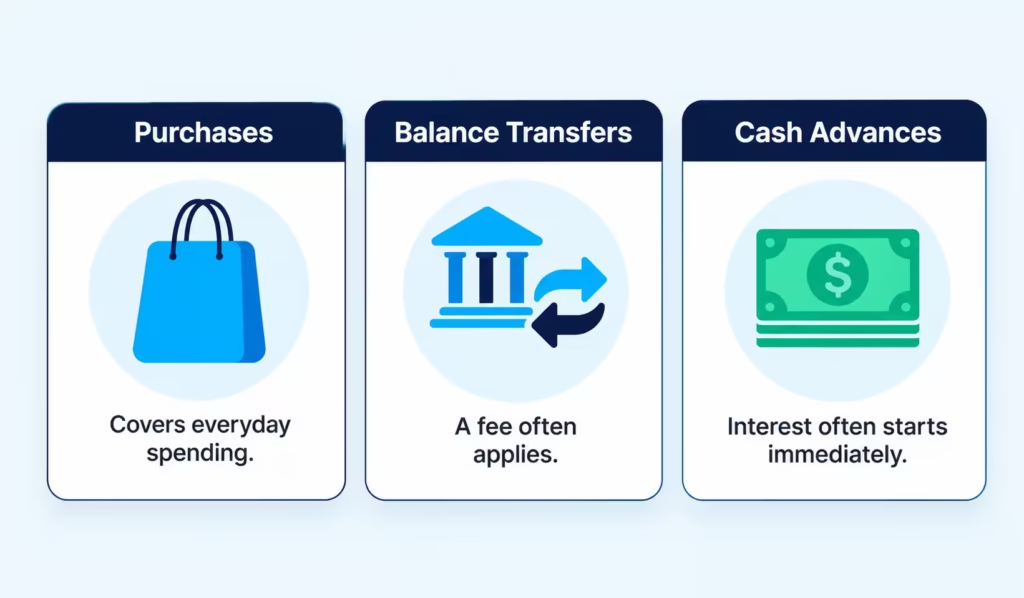
A single card can treat these as completely separate categories:
- Purchases — everyday spending on the card.
- Balance transfers — debt you move from another card or loan.
- Cash advances — cash you pull from the card, which rarely gets a promotional rate and often starts accruing interest immediately.
For example, a card might offer 0% on purchases for 15 months but charge 3% plus a fee on balance transfers. Another card might do the opposite: 0% on transfers for 18 months, while new purchases are charged at the standard rate right away. The same card can even have different promo lengths for different transaction types.
Before you swipe or transfer, check which transactions actually qualify. The offer’s marketing page will say one thing. The terms and conditions will say what it really covers.
How Promotional Balances Are Tracked on Your Statement
Your monthly statement separates each balance type, and this is where you confirm what’s actually getting the promo rate.
Look for a section that breaks your account into categories like purchases, balance transfers, and cash advances. Each category shows its own balance, its own APR, and how much of your payment went where. If your promotional balance isn’t what you expected, call your issuer. Don’t wait, as the promo window may close soon.
Checking this once per statement takes two minutes and catches problems early, while there’s still time to fix them.
Balance Transfer Fees During a Promotional Period
A 0% rate on a balance transfer does not mean the transfer is free.
Almost every balance transfer comes with an upfront balance transfer fee, typically 3% to 5% of the amount moved. Transfer $5,000, and a 3% fee adds $150 to your balance on day one. That fee is separate from interest. The promotion waives the interest, not the fee.
This matters when you’re comparing offers. A 0% transfer with a 3% fee can still beat a card charging 22% interest, but only if you actually pay the balance down during the promo period. Run the numbers before you move the money.
How Long a Promotional APR Lasts
Federal law sets a floor here. Under the CARD Act of 2009, a promotional rate must last at least six months, unless you’re more than 60 days late on a payment. The CFPB confirms this minimum applies to introductory and balance transfer rates.
In practice, most offers run longer. Common promotional period lengths include:
- 12 months — typical for basic offers
- 15 months — common on mid-tier rewards cards
- 18 to 21 months — usually reserved for cards marketed specifically for balance transfers
Remember that length can vary by transaction type on the same card. Your purchases might get 15 months while your transfers get 18. The end date that matters is the one tied to the balance you’re carrying, so find it in writing rather than assuming one date covers everything.
Promotional APR vs. Deferred Interest
This is the single most costly confusion in credit card offers, and it’s worth slowing down for.
A true 0% APR means no interest accrues during the promotional period. At all. If the promo ends and you still owe money, interest starts building only from that day forward, and only on what’s left.
Deferred interest is a completely different animal. With these offers, interest quietly accrues in the background from the day you bought the item. If you pay the full balance before the deadline, that interest vanishes.
But if even one dollar remains when the clock runs out, you owe all of the back interest on the original full amount, charged retroactively to your account. The CFPB explains this difference in detail and warns consumers to read deferred interest terms carefully.
The language on the offer tells you which one you’re looking at:
- “0% APR for 15 months“: true promotional APR. Interest is waived, not delayed.
- “No interest if paid in full within 12 months“: deferred interest. The word “if” is doing enormous work in that sentence.
Deferred interest shows up most often with store credit cards, furniture financing, and medical financing plans. These offers are legal. However, a retroactive charge can turn a small leftover balance into a surprise bill for hundreds of dollars in interest.
Worked Dollar Example: 0% APR vs. Deferred Interest Outcome
Say Jennifer, a marketing manager, buys $3,000 of furniture. She has two choices: a 0% APR credit card for 12 months, or the store’s “no interest if paid in full in 12 months” plan at a 26.99% standard rate.
She pays $250 a month for 11 months, then life gets busy. In month 12, she pays only $200, leaving a $50 balance when the deadline hits.
| Outcome | True 0% APR Card | Deferred Interest Plan |
|---|---|---|
| Starting balance | $3,000 | $3,000 |
| Balance left at deadline | $50 | $50 |
| Interest charged at deadline | $0 | ~$395 (12 months of retroactive interest on the full $3,000) |
| Interest after deadline | Accrues only on the $50 going forward | Accrues on the $50 plus the ~$395 just added |
Same spending. Same payments. A difference of roughly $395, all because of the word “if.”
⚠️ Mistake to Avoid: Never assume “no interest” and “0% APR” mean the same thing. If the offer contains the phrase “if paid in full,” it’s deferred interest, and one small leftover balance can trigger a year of back interest.
What Can End a Promotional APR Early
A promotional rate isn’t guaranteed until the end date. Certain actions can cancel it ahead of schedule, and the triggers are more specific than most people realize:
- A late or missed payment. This is the big one. If your payment is more than 60 days late, the issuer can revoke the promotional rate entirely. Even one slip can do it.
- Going over your credit limit. Some cardmember agreements treat this as a default event that ends the promo.
- Other default conditions spelled out in your agreement, like a returned payment.
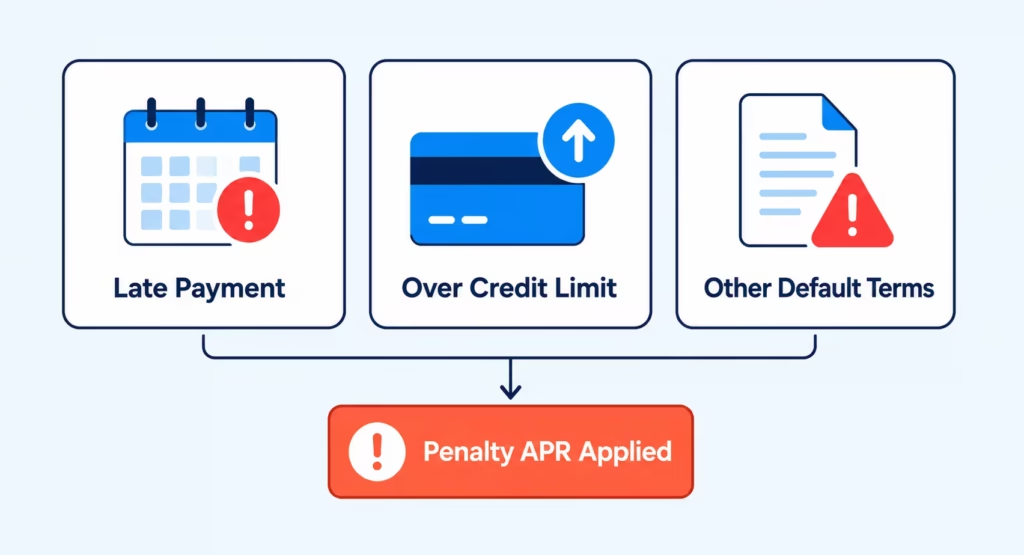
When a trigger fires, the rate that replaces your promo may not be the standard APR. It can be a penalty APR, which often runs close to 29.99%, higher than the card’s normal rate.
💡 Pro Tip: Set up autopay for at least the minimum payment the day you activate the card. Autopay is the single cheapest insurance policy against losing your promotional rate to a forgotten due date.
What Happens Immediately After Early Termination
Losing the rate early isn’t something you get a grace period to fix. The consequences are immediate:
- The penalty APR can apply to your entire remaining promotional balance right away, not just to new spending.
- Interest starts accruing at the higher rate from that billing cycle forward.
- Your minimum payment jumps, because more of each payment now goes to interest instead of principal.
There’s usually no warning call and no second chance built in. The new rate simply appears on your next statement. That’s why prevention, not recovery, is the strategy that works here.
What Happens When the Promotional Period Naturally Expires
If you keep the rate in good standing until the end date, the transition is gentler, but it still changes your math overnight.
For a true 0% APR offer, the moment the promotional period ends, the standard APR applies to whatever balance remains, from that day forward. Interest does not get backdated. A card with $1,200 left at a 24.99% standard APR starts accruing roughly $25 per month in interest on that balance, beginning with the next billing cycle.
New purchases after the end date get charged at the standard rate right away. If you have a balance, you usually lose the grace period on those purchases as well. That means interest starts the day you buy, not after the statement closes.
This is the point where “no interest for 15 months” quietly becomes “interest every month until it’s gone.” The card didn’t change. The clock just ran out.
How to Build a Payoff Plan Before the Promo Ends
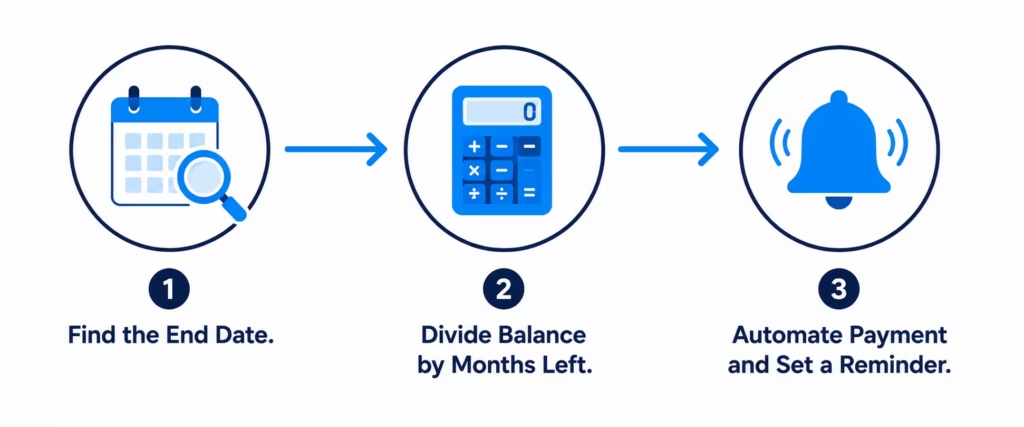
Knowing your end date is only half the job. The other half is a plan to hit zero before it arrives. Three steps get you there:
- Find the exact end date. Check your cardmember agreement or the rate section of your statement. Don’t guess from the month you applied.
- Divide the balance by the months remaining. If you owe $4,800 with 12 months left, your target payment is $400 per month. Add a small buffer, say $420, to cover any new purchases or rounding.
- Automate that payment and set a reminder 60 days before the deadline. If the final months look tight, that reminder gives you time to adjust while there’s still room to act.
One more thing: don’t confuse the minimum payment with your payoff payment. The minimum is designed to keep the account in good standing, not to clear the balance. On a 0% offer, minimum payments leave you with most of the balance still sitting there when the standard rate kicks in.
How to Verify the Exact Terms of a Specific Offer
General knowledge tells you how these offers usually work. Your agreement tells you how yours actually works. Before relying on any promotion, confirm four things in the official documents:
- The exact APR for each transaction type (purchases, transfers, cash advances).
- The exact start and end dates of the promotional period.
- Which transactions qualify, and whether any fee applies to transfers.
- Whether it’s a true 0% APR or deferred interest. Look for the phrase “if paid in full.”
You can find this in the cardmember agreement and pricing disclosure that came with your card. Both documents are in your issuer’s online portal or app. If anything is unclear, call the number on the back of the card and ask the representative to point you to the exact clause. Getting it in writing beats getting it wrong.
Common Mistakes That Cost Money on Promotional APR Offers
Most expensive promo APR stories trace back to one of these four errors:
- Treating deferred interest like 0% APR. A leftover $100 balance under a deferred interest plan can trigger retroactive interest on the entire original purchase.
- Missing a payment. One payment more than 60 days late can swap your 0% rate for a penalty APR near 30% on the whole remaining balance.
- Assuming one promo covers everything. Purchases, balance transfers, and cash advances each carry their own terms, and transfers usually carry a fee on top.
- Paying only the minimum. “No interest” doesn’t mean “no rush.” Without a payoff plan, the balance meets the standard APR at the finish line.
📌 Did You Know: Federal rules require your issuer to apply any payment above the minimum to your highest-rate balance first. That means extra payments automatically attack the most expensive part of your debt.
Frequently Asked Questions (FAQs)
Is 0% APR a trap?
Not if you understand the terms, but it can become costly if you miss a payment or confuse it with deferred interest. A payment more than 60 days late can trigger a penalty APR near 29.99% on your entire remaining balance.
Are promo APRs worth it?
Yes, if you can pay off the balance before the promo ends and you read the fine print. A 0% transfer with a 3% fee still beats paying 22% interest, but only if you actually clear the balance in time.
How do promotional APRs work?
An issuer offers a reduced rate, often 0%, for a set period like 12 to 21 months, then the standard APR applies to whatever balance is left. By law, under the CARD Act of 2009, these offers must last at least six months.
Is 24.9% APR high for a credit card?
It’s close to average for many rewards cards, though it’s still expensive if you carry a balance. On $3,000 carried for a year, that rate would add several hundred dollars in interest.
How much is 26.99% APR on $3,000?
Carrying $3,000 at 26.99% for 12 months adds roughly $395 in interest if unpaid, as shown in the example of deferred interest financing. That’s why paying down the balance before any promo deadline matters so much.
Does promotional APR mean the same thing as 0% APR?
Not always. A promotional APR is any temporary reduced rate an issuer offers, and it’s often 0%, but the term itself just means “temporary rate.” Always check the specific percentage listed on your offer.
What happens when my promotional APR ends?
Your card’s standard purchase APR takes over on any remaining balance starting that day. For example, a $1,200 balance at 24.99% starts accruing roughly $25 a month, and new purchases get charged the standard rate immediately.
Is 0% APR the same as “no interest if paid in full”?
No, and confusing them is one of the costliest mistakes people make. True 0% APR waives interest entirely, while “no interest if paid in full” is deferred interest that charges back all the interest retroactively if even $1 remains at the deadline.
Do credit card APRs apply if I pay on time?
If you pay your full statement balance by the due date, you typically avoid interest charges entirely during that billing cycle. Interest only accrues on balances carried past the due date or during periods when a grace period is lost, like immediately after a promo ends.
What can cause my promotional APR to end early?
A payment more than 60 days late, going over your credit limit, or another default listed in your agreement can all cancel your promo rate immediately. When that happens, the penalty APR can apply to your entire remaining balance starting that billing cycle, not just new charges.
The Bottom Line
A promotional APR is a helpful tool. It’s usually a temporary rate, often 0%. This gives you a set time to pay off a purchase or transfer without paying interest. The risks are in the details. You might lose the rate if you pay late. It’s easy to confuse 0% APR with deferred interest. Also, you could reach the end date without a payoff plan.
Based on how these offers are structured, the most effective approach is simple: confirm your exact end date, divide your balance by the months left, and automate that payment.
Know someone eyeing a 0% offer or a store’s “same as cash” deal? Share this with them. It could save them from a year of retroactive interest they never saw coming.