
Handing a team member a corporate credit card is a big act of trust. But trust, on its own, doesn’t protect your business when something goes wrong — a missing receipt, an unauthorized charge, or a dispute over a personal purchase. Many companies find this out too late.
According to the ACFE’s 2024 Report to the Nations, organizations lose an estimated 5% of their annual revenues to occupational fraud, and expense reimbursement fraud is one of the most frequently reported schemes.
A signed, written company card policy agreement is the clearest way to set expectations, assign responsibility, and protect both sides.
Keep reading to find everything you need: a plain-English breakdown of every section, step-by-step filling instructions, legal tips, and common pitfalls — all in one place.
Download Your Free Employee Credit Card Agreement Templates
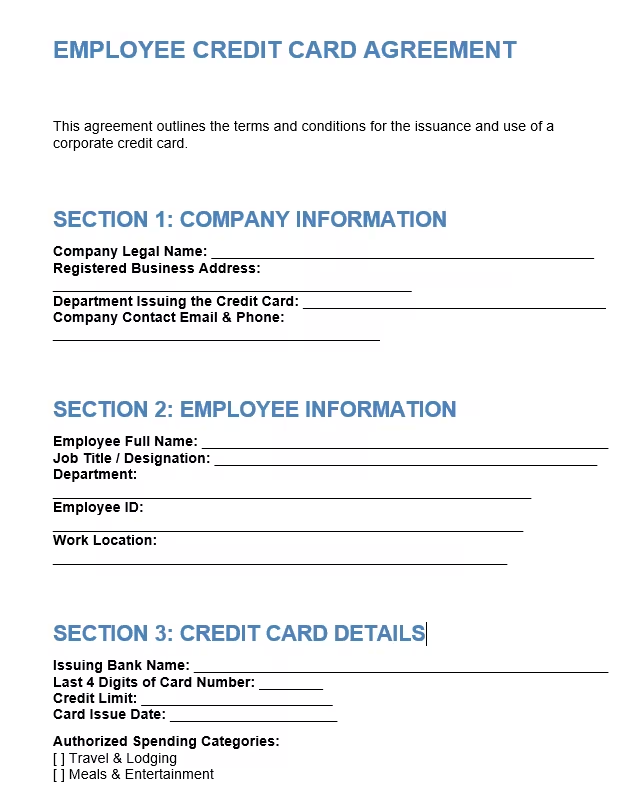
Two ready-to-use templates are available so you can get started right away. Each one includes all the parts your agreement needs. This ranges from approved spending categories to final signatures.
Pick the format that works best for your team:
Disclaimer: The Templates & Printables on this site are provided for informational and personal tracking purposes only. This is not financial, legal, tax, or credit advice. While reasonable efforts are made to ensure accuracy, Credit Card Wind makes no warranties as to the completeness, reliability, or accuracy of the calculations generated by these Templates & Printables. Users are responsible for independently verifying all data and calculations. Terms, conditions, rates, regulations, and legal requirements vary by institution, jurisdiction, and individual circumstances.
Always refer to your official statements, account agreements, and applicable laws, and consult a qualified professional before making any financial, legal, or other important decisions. By using these Templates & Printables, you acknowledge that Credit Card Wind and its owner shall not be liable for any damages, losses, or financial consequences arising from the use or misuse of these Templates & Printables.
This universal disclaimer applies to all templates and printables provided by Credit Card Wind (https://creditcardwind.com), created by Robert Williams (Owner at Credit Card Wind).
© Credit Card Wind. All rights reserved.
These templates and printables may be downloaded and used for personal, non-commercial purposes only. Redistribution, resale, or modification for commercial use without permission is strictly prohibited.
What Is an Employee Credit Card Agreement?
A corporate cardholder agreement is a written document between a company and an employee. It spells out the rules for how a business-issued credit card can and cannot be used.
Think of it as a clear understanding between both sides. The company agrees to provide the card for approved business expenses. The employee agrees to use it only for those purposes, keep records, and follow all reporting requirements.
The ACFE’s 2024 Report to the Nations found that organizations lose an estimated 5% of their annual revenues to occupational fraud, and expense reimbursement fraud ranks among the most common categories. A signed agreement gives your business a documented line of defense before any card is activated.
This document has several names:
- Corporate card authorization form
- Company credit card policy agreement
- Employee cardholder agreement
- Business card use policy
The name doesn’t matter as much as the content. What matters is that both parties sign it and understand what it says.
Tip: → Before setting the employee’s spending cap in this agreement, run the numbers with the business credit card limit calculator.
Why Your Business Needs This Agreement
Some business owners skip this step because they trust their team. That’s understandable. But a written company card policy isn’t about distrust — it’s about clarity. Without one, disputes become much harder to resolve.
Consider what happens without a signed agreement:
- An employee makes a personal purchase and genuinely believes it qualifies as a business expense.
- A card gets lost and the employee doesn’t report it right away because no procedure was ever explained.
- An employee leaves the company and continues using the card for several days.
- A receipt goes missing and the company has no written rule requiring documentation.
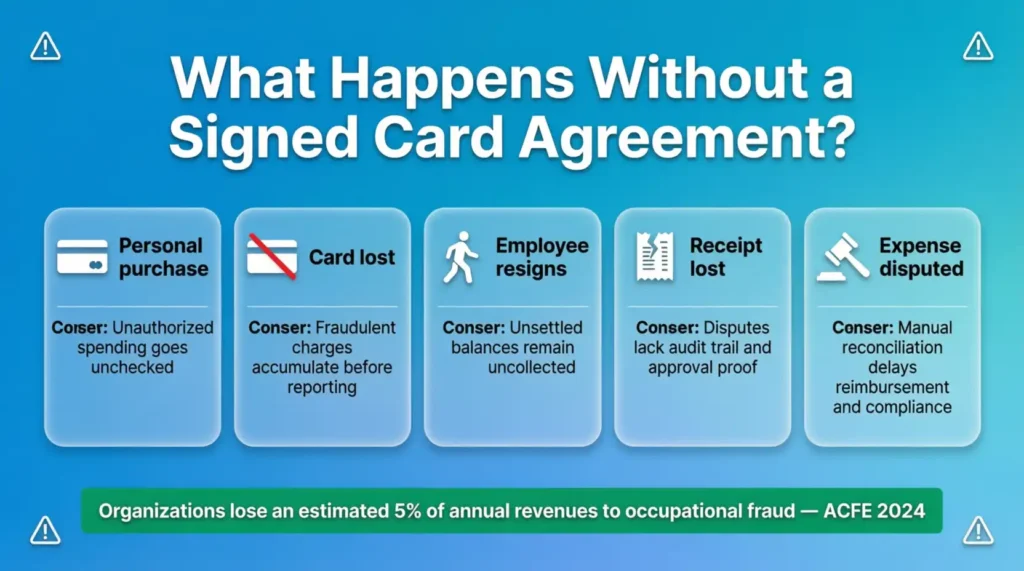
A written agreement would have made expectations clear in each case. It clearly explains what employees can and cannot do. It also outlines how to report expenses and the consequences of breaking the rules.
Beyond conflict prevention, a corporate card usage policy also supports your company in other ways:
Financial controls. The agreement defines spending categories, credit limits, and documentation requirements. This makes it easier to track and audit expenses.
Legal protection. If an employee misuses the card, a signed agreement strengthens your position in any disciplinary or legal process that follows.
Tax compliance. Documented business expenses are easier to substantiate during an IRS audit. Without clear rules and receipts, deductions become harder to defend.
Audit readiness. Finance teams can reconcile expenses faster when employees follow a documented process from the start.
📌 Did You Know: The median loss per occupational fraud case is $145,000, according to the ACFE 2024 Report to the Nations. A one-page agreement costs nothing — and it could save your business far more than that.
Who Should Sign This Agreement?
Any employee getting a company credit card must sign a corporate card authorization form before activation. This includes full-time employees, part-time employees, contractors (when applicable), and temporary staff with card access.
It’s not just about the cardholder, either. Most agreements require two signatures:
- The Employee — the person who will use the card
- A Company Representative — typically from Finance, HR, or senior management
Both signatures matter. The employee’s signature confirms they’ve read and understood the terms. The company representative’s signature makes the agreement official and enforceable.
Some businesses also ask the employee’s direct manager to review the agreement before it’s signed. This adds another layer of accountability, especially in departments with higher spending volumes.
When to re-sign?
Employees must sign a new agreement when:
- The card policy changes significantly.
- They move to a new role with a higher credit limit.
- A new card is issued after the old one expires or is replaced.
Key Sections Included in Our Templates
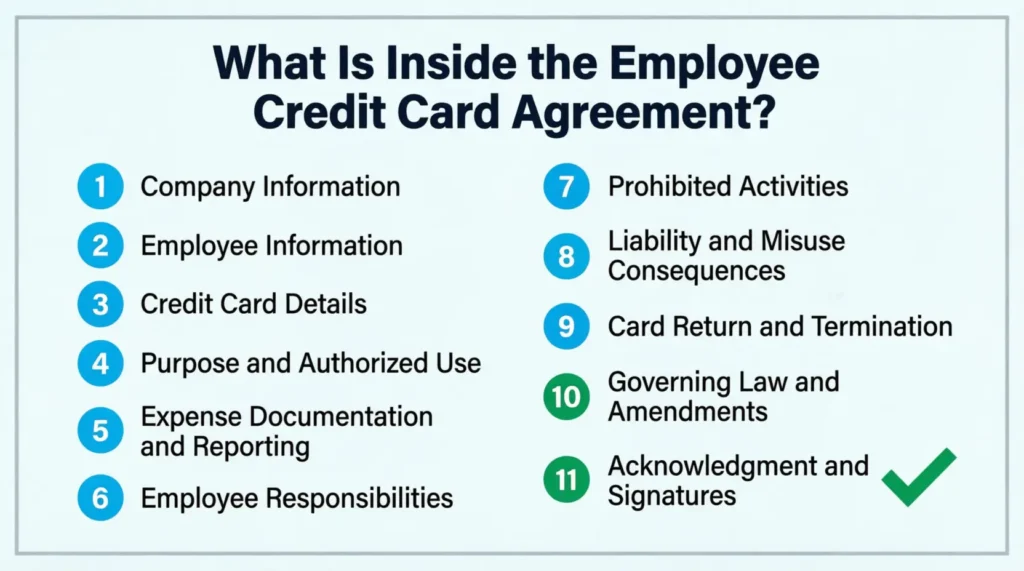
Both templates include 11 structured sections. Each one serves a specific purpose. Here’s what each section covers and why it matters:
Section 1: Company Information
This section records the company’s legal name, registered address, the department issuing the card, and company’s contact details. It establishes the identity of the issuing party and creates a clear paper trail.
Section 2: Employee Information
This captures the cardholder’s full name, job title, department, employee ID, and work location. Accurate employee details connect the agreement to the person and simplify record-keeping.
Section 3: Credit Card Details
This section includes:
- The issuing bank name
- The last four digits of the card number
- The credit limit
- The card’s issue date
- A checklist of approved spending categories
The spending category checklist is especially useful. It allows both parties to see the exact categories approved for the employee. These include Travel and Lodging, Meals and Entertainment, Office Supplies, and Client-Related Expenses. Categories not checked are off-limits by default.
Section 4: Purpose and Authorized Use
This section explains what a valid business expense is. It also makes clear that personal purchases are not allowed. It references the company’s broader Expense Policy for detailed definitions.
Section 5: Expense Documentation and Reporting
This is one of the most important sections. The employee must submit original itemized receipts for each transaction. They need to use the specified expense system and meet the submission deadline. For example, receipts might need to be submitted within five business days of the transaction. The section also states the consequences for late or missing documentation.
Section 6: Employee Responsibilities
This section outlines the employee’s ongoing duties:
- Safeguarding the card
- Ensuring charges are accurate
- Reporting loss or theft right away
- Keeping card details confidential
Section 7: Prohibited Activities
The agreement specifies the activities that are not allowed. These include:
- Cash advances
- Personal purchases
- Sharing the card with unauthorized people
- Using the card after employment ends or when suspension is announced
Section 8: Liability and Misuse Consequences
This section makes it clear that the employee is financially responsible for unauthorized charges. The company can deduct these amounts from the employee’s wages if local law allows it. Misuse may result in disciplinary action, like termination or legal proceedings.
Section 9: Card Return and Termination
When an employee resigns, is terminated, or when the company asks, they must return the card right away. They also need to settle any outstanding expenses before their last day.
Section 10: Governing Law and Amendments
This section states which state or jurisdiction governs the agreement. It also allows the company to update the policy anytime, as long as employees are informed in a specified way.
Section 11: Acknowledgment and Signatures
The final section captures signatures from both the employee and the company representative. It confirms that the employee has read, understood, and agreed to all terms.
How to Use the Employee Credit Card Agreement Template
Follow these steps to fill out and finalize the agreement in the correct manner:
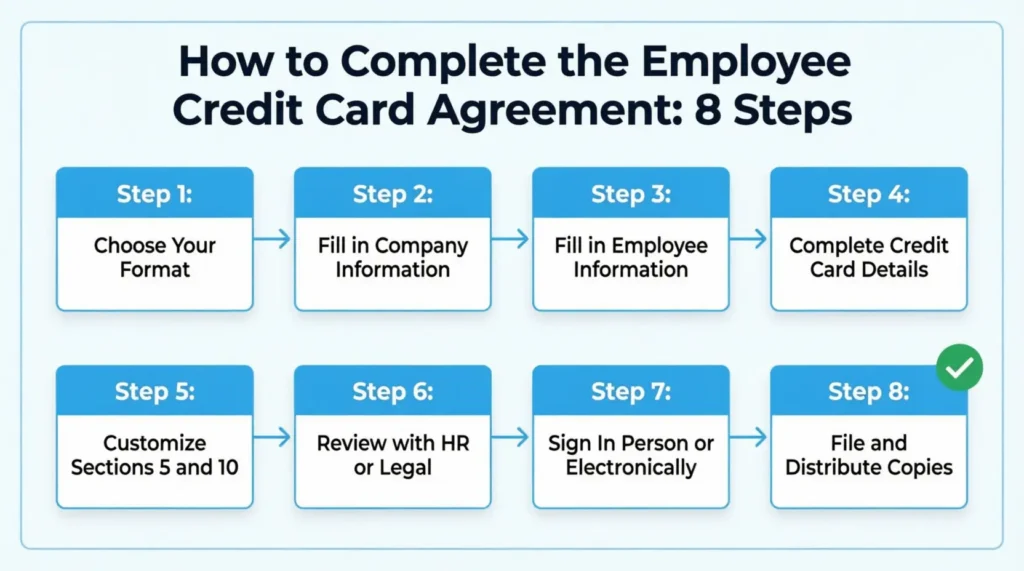
Step 1: Choose your format.
Download either the US Letter or A4 Word template, depending on your printing setup. Both files are fully editable in Microsoft Word.
Step 2: Fill in Section 1. Company Information.
Enter your company’s legal name, registered address, the issuing department (usually Finance or HR), and the company contact email and phone number.
Step 3: Fill in Section 2. Employee Information.
Enter the employee’s full name, job title, department, employee ID, and work location. Double-check the employee ID against your HR records to avoid errors.
Step 4: Complete Section 3. Credit Card Details.
Enter the issuing bank name, last four digits of the card, the approved credit limit, and the card issue date. Then check the appropriate boxes in the spending categories list. Only check categories that apply to this specific employee’s role.
Step 5: Customize Sections 5 and 10.
In Section 5, replace the placeholder text for your expense system name and your submission deadline. In Section 10, fill in your governing state or jurisdiction. Also, choose how you want to notify employees about policy changes.
Step 6: Review with HR or Legal.
Before signing, ask someone from HR or legal to check the agreement. They should ensure it meets your state’s employment laws and your internal expense policy.
Step 7: Sign in person or electronically.
Collect signatures from the employee and an authorized company representative. If using electronic signatures, tools like DocuSign or Adobe Sign are widely accepted.
Step 8: File and distribute copies.
Save a signed copy in the employee’s personnel file and email a copy to the employee for their own records. Keep the original in a secure, accessible location.
💡 Pro Tip: Don’t hand the card over until the agreement is signed. Once a card is active and in someone’s hands, it becomes much harder to enforce documentation requirements retroactively.
Customizing the Template for Your Business
The template is designed to work across many industries and company sizes. But a little customization makes it significantly more effective.
Adjust the spending categories.
The template includes five common categories as checkboxes. Add unique expense types to your list. These can include field equipment, research materials, or specific software tools.
Set a realistic credit limit.
The credit limit field is intentionally left blank. Fill it in based on the employee’s role and expected spending needs. A traveling sales rep will likely need a higher limit than an office administrator.
Specify your expense system by name.
Instead of leaving the placeholder “[Enter Expense System Name],” enter the actual name of the platform your team uses, whether that’s Expensify, SAP Concur, QuickBooks, or a custom internal system. This removes any ambiguity.
Name your notification method.
In Section 10, put in your real notification channel. This could be your company email, an internal memo, or your HR portal.
Add a spending limit per transaction.
Some companies add a per-transaction cap in addition to a total credit limit. For example, single purchases over $500 might require prior manager approval. If this applies to your business, add a line to Section 4 or Section 6.
Match the tone to your culture.
The template uses professional language. However, you can adjust the wording in Section 4 and Section 6 to better reflect your company’s voice. Just make sure the legal terms stay accurate.
Common Mistakes to Avoid
Many businesses use a corporate card policy agreement in good faith but still run into problems. These are the most common pitfalls:
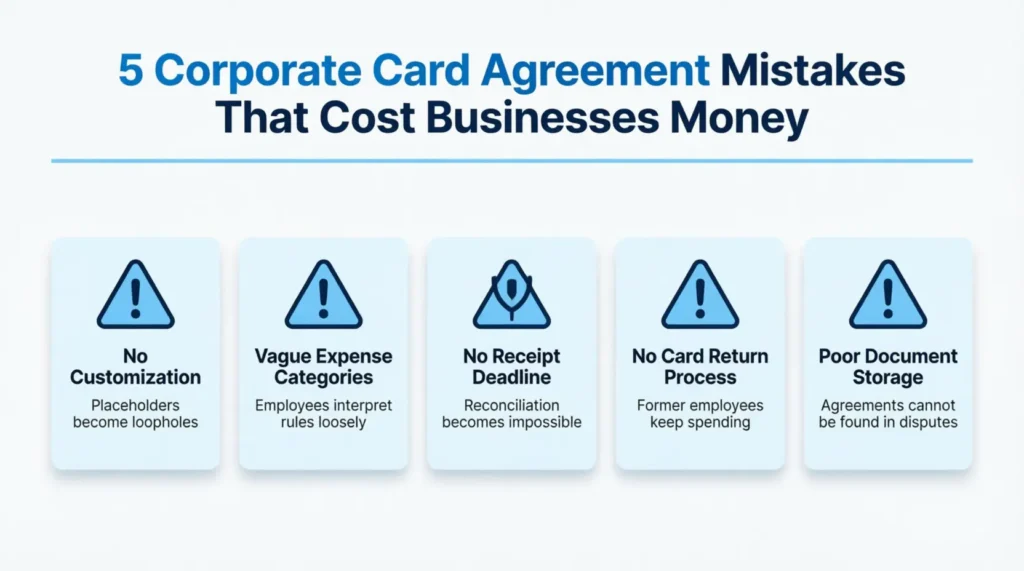
Using a generic agreement without customization.
A blank template with placeholder text still in place is not a finalized agreement. Employees may use undefined placeholders as loopholes. Always complete every field before anyone signs.
Not specifying which expenses are approved.
Vague language like “business expenses” leaves too much room for interpretation. The spending category checkboxes in Section 3 exist for this reason. Use them.
Setting no reporting deadline.
Jessica was the office manager at a mid-sized marketing firm. She had employees submit receipts three to six weeks after their transactions. This happened because there was no deadline set. That made monthly reconciliation nearly impossible. A firm deadline, such as within five business days, prevents this entirely.
Skipping the card return process.
A logistics company discovered that a former employee charged $1,200 in personal expenses. This happened during the two weeks after their resignation. The company didn’t collect the card on the employee’s last day. Section 9 of the agreement addresses this directly, but it only works if someone actually follows through.
Storing agreements poorly.
A signed agreement that no one can find is useless in a dispute. Store signed copies both digitally and in the employee’s physical personnel file.
⚠️ Mistake to Avoid: Never circulate the agreement as an informal email attachment without a formal signing process. Agreements exchanged via email without a clear signature confirmation may not hold up in a workplace dispute or legal proceeding.
Legal Considerations and Compliance
A corporate card authorization form carries real legal weight. Before finalizing yours, consider these key legal areas:
Wage deduction laws.
The Fair Labor Standards Act (FLSA) and state wage laws govern whether and how an employer can deduct unauthorized charges from an employee’s paycheck. Federal FLSA wage deduction rules from the U.S. Department of Labor are the starting point, but state laws often add extra protections for employees. Always confirm that your deduction language in Section 8 is compliant with your state.
At-will employment.
In most US states, employment is at-will. This means the agreement doesn’t override an employee’s right to resign at any time. However, the financial liability clause in Section 8 typically remains enforceable even after employment ends, provided it was agreed to in writing.
Electronic signatures.
Under the Electronic Signatures in Global and National Commerce Act (E-SIGN Act), electronic signatures are legally valid for most employment agreements in the United States. If you want to collect digital signatures, use a platform that timestamps and logs the signing event.
Business expense documentation.
IRS Publication 463 outlines the federal rules for documenting travel, meals, and entertainment expenses. The receipt and reporting rules in Section 5 of the template meet federal standards, which is key for tax deductibility.
State-specific rules.
Some states, like California and New York, have rules about when expenses get reimbursed. They also require notifying employees about changes to these policies. If your company works in different states, you might need separate agreements or state-specific addenda.
📌 Did You Know: California Labor Code Section 2802 requires employers to reimburse employees for all necessary business expenses. A clear expense policy also protects employees by ensuring their reimbursements occur without delay.
Best Practices for Implementation
Drafting the agreement is just the first step. How you roll it out determines how effective it actually is.
Introduce the agreement during onboarding.
The best time for a new employee to sign the corporate card policy is before they get the card. It should be part of their onboarding paperwork. This sets expectations from the start.
Walk employees through the agreement.
Don’t just hand someone a document and ask them to sign it. Review the key sections with them, especially the prohibited activities list and the reporting deadline. Employees who understand the rules are far more likely to follow them.
Update the agreement when policy changes.
Update the agreement and get new signatures if your expense system changes, your credit limits shift, or your spending categories expand. An outdated document creates gaps in coverage.
Conduct periodic expense audits.
Schedule quarterly or annual reviews of corporate card activity. Compare charges against approved categories and submitted receipts. Regular audits signal to employees that the policy is actively enforced, not just a formality.
Pair the agreement with a full expense policy.
The cardholder agreement works best as a companion document to a broader company expense policy. The expense policy defines the details. The agreement confirms that the employee has read and accepted those details.
💡 Pro Tip: Mark a recurring calendar reminder to review all active corporate card agreements annually. Role changes, credit limit adjustments, and policy updates all require a fresh review — and sometimes a new signature.
Comparing A4 vs US Letter Formats
Both templates contain identical content. The only difference is page size. Here’s how to decide which one to use:
US Letter (8.5″ x 11″) is the standard paper size in the United States and Canada. If your office printers are loaded with US Letter paper and you primarily operate within the US, this is the format to use. It’s also the format most commonly expected by US legal and HR departments.
A4 (210mm x 297mm) is the international standard used across Europe, Asia, Australia, and most of the rest of the world. If your company works internationally, has offices outside the US, or shares documents with partners abroad, A4 is the better option.
What if you’re unsure? Choose the format that matches the paper your printer is loaded with. Both files are Word documents. This means the text will adjust automatically if you change the paper size in your printer settings.
Can you print US Letter content on A4 paper? You can, but the margins may look slightly off. It’s always cleaner to use the format that matches your printer’s paper size from the start.
Integration with Your Expense Management System
The agreement talks about your expense system in Section 5. But consider how they interact beyond just the document.
Many modern expense management platforms, like Expensify, SAP Concur, Ramp, and Brex, let companies:
- Set spending rules
- Upload receipts from mobile devices
- Flag transactions outside approved categories
When your corporate card policy document aligns with these system settings, you create a consistent enforcement loop.
Map your agreement to your system settings.
If your agreement says receipts are due within five business days, set that same deadline as a reminder in your expense platform. If your agreement limits travel spending to a specific category, make sure that category exists in your system.
Keep a digital copy of every signed agreement.
Many expense platforms allow you to store documents alongside employee profiles. Linking the signed agreement to the employee’s profile in your system makes it easy for Finance and HR to reference it during audits or disputes.
Automate receipt reminders.
Several platforms can automatically email employees when a transaction is posted without an attached receipt. This reduces the burden on Finance teams and keeps employees compliant without constant manual follow-up.
David, the finance director at a 60-person consulting firm, noticed that 30% of monthly receipts were late. So, he set up automated receipt reminders in the company’s expense platform. Within two billing cycles, that number dropped to under 5%.
Handling Violations and Disputes
Even with a signed agreement in place, violations can still happen. Knowing how to respond consistently is just as important as having the agreement itself.
Start with documentation.
Before taking any action, gather the evidence. Check the transaction record. Compare it to the approved spending categories in the signed agreement. Also, note if a receipt was submitted.
Follow your disciplinary process.
Most companies have a formal disciplinary procedure. A first-time minor violation, such as a late receipt submission, might warrant a verbal reminder. A serious violation, like a personal purchase or cash advance, usually needs a written warning and a formal review.
Consult HR and Legal before deducting wages.
Section 8 of the agreement states that the company may deduct unauthorized charges from the employee’s wages where permitted by law. However, this is one area where state law varies significantly. Confirm with your HR or legal team before processing any payroll deduction.
Keep records of every step.
Document each incident, the evidence found, the response taken, and the outcome. If a dispute escalates to a formal proceeding, this record becomes critical.
Update the agreement if needed.
If a violation shows a gap or an unclear part in the agreement, update the document. Then, collect new signatures from all active cardholders. A policy that doesn’t address a specific situation can create enforcement problems.
Additional Resources and Support
If you’re building or updating your corporate card program for the first time, the agreement is a strong foundation. These additional resources can help you build on it:
Company Expense Policy.
The cardholder agreement is most effective with a clear expense policy. This policy should outline acceptable spending limits, approval processes, and category definitions. If you don’t have one, drafting a simple one-page policy is a worthwhile next step.
Employee Financial Wellness Programs.
Some employees misuse corporate cards not out of dishonesty but out of confusion about what qualifies as a business expense. Short onboarding sessions or written FAQs can reduce this kind of unintentional misuse.
HR and Payroll Integration.
Your HR team should keep a copy of every signed cardholder agreement in the employee’s personnel file. When an employee leaves, HR can use the agreement. It helps confirm the card return and final expense steps in Section 9.
Periodic Policy Reviews.
IRS rules around business expense documentation, as outlined in IRS Publication 463, can change. Review your expense policy and agreement language at least once a year to make sure they reflect current requirements.
Legal Counsel for Multi-State Operations.
If your business operates in more than one state, have a local employment attorney review the agreement for each jurisdiction. Wage deduction rules and expense reimbursement laws vary considerably from state to state.
Frequently Asked Questions
Is an employee credit card agreement legally binding?
Yes, if both the employee and an authorized company representative complete and sign it, it becomes a legally binding contract. It can be used as evidence in disputes, disciplinary proceedings, or legal actions.
Can a company deduct unauthorized charges from an employee’s paycheck?
In many US states, yes, if the agreement explicitly authorizes it and state wage laws permit it. However, rules vary by state, so you should confirm with HR or legal counsel before making any deduction.
Do part-time or contract workers need to sign a corporate card agreement?
Any worker who is issued a company credit card should sign an agreement, regardless of employment status. The card use is the trigger, not the employment classification.
What happens to the corporate card when an employee resigns?
The employee must return the card to Finance or HR on their last day and submit all outstanding receipts. Section 9 of the agreement covers this process, and the company should also contact the card issuer to cancel or reassign the card.
Can an employee use a corporate card for personal emergencies?
No. The agreement prohibits personal, family, and household purchases. If an employee faces an emergency and needs financial help, it should go through a specific company policy. This could be an employee assistance program or a salary advance process.
How often should the agreement be renewed or updated?
Review the agreement at least once a year. Collect a new signature if the card policy changes a lot, a new card is issued, or the employee changes roles.
What should an employee do if the corporate card is lost or stolen?
The employee must report the loss immediately to both the issuing bank and the company’s Finance Department. Section 6 of the agreement requires this. Most card issuers have 24-hour fraud reporting lines for this purpose.
Is the A4 template different in content from the US Letter version?
No. Both templates contain the same 11 sections and identical language. The only difference is the page size, which affects how the document prints and fits on standard paper in different regions.
Can electronic signatures be used on this agreement?
Yes. Under the federal E-SIGN Act, electronic signatures are legally valid for most employment documents in the United States. Use a platform that logs timestamps and creates an audit trail for each signing event.
Does this agreement replace a full company expense policy?
No. The cardholder agreement confirms that the employee has agreed to the rules. A full expense policy is a separate document that defines those rules in detail. Use both documents together for maximum clarity and legal protection.
Bottom Line
A well-drafted corporate card agreement is one of the simplest and most effective internal controls a business can put in place. It defines what employees can and can’t do. This creates a clear documentation trail and gives both sides a fair reference point if a dispute comes up.
Based on the legal and financial risks outlined throughout this guide, the most effective approach is to pair the signed agreement with an active expense management system and conduct at least one annual policy review. This combination catches problems early and keeps your corporate card program clean.
Both templates on this page are free, completely editable, and ready for use. Download the format that fits your setup, customize the key fields, and have employees sign before any card is handed over.
If you know a business owner or operations manager who issues corporate cards without a written agreement, share this page with them. A well-prepared document can prevent major headaches later on.